


⏲️ Estimated reading time: 7 min
Table of Contents
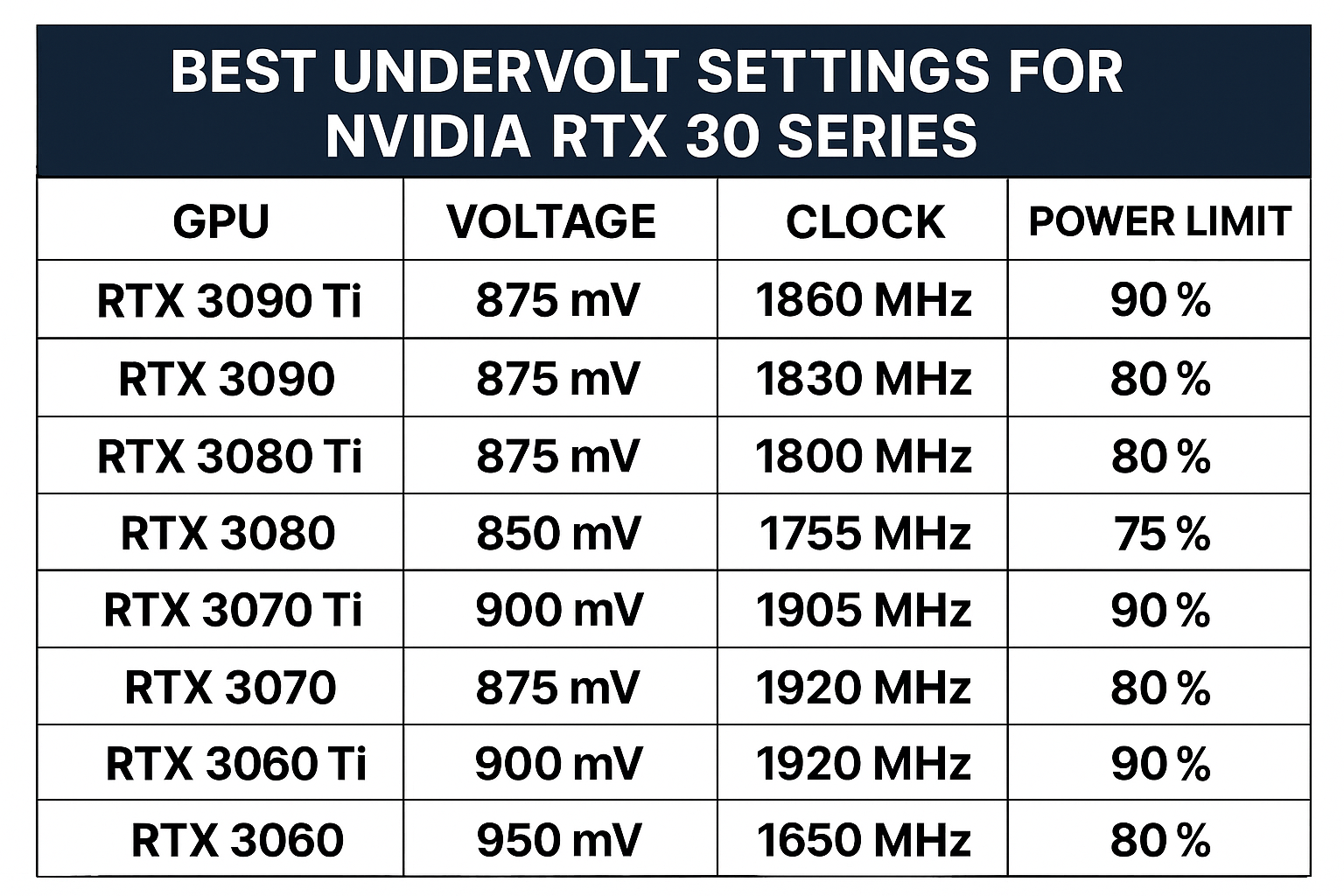
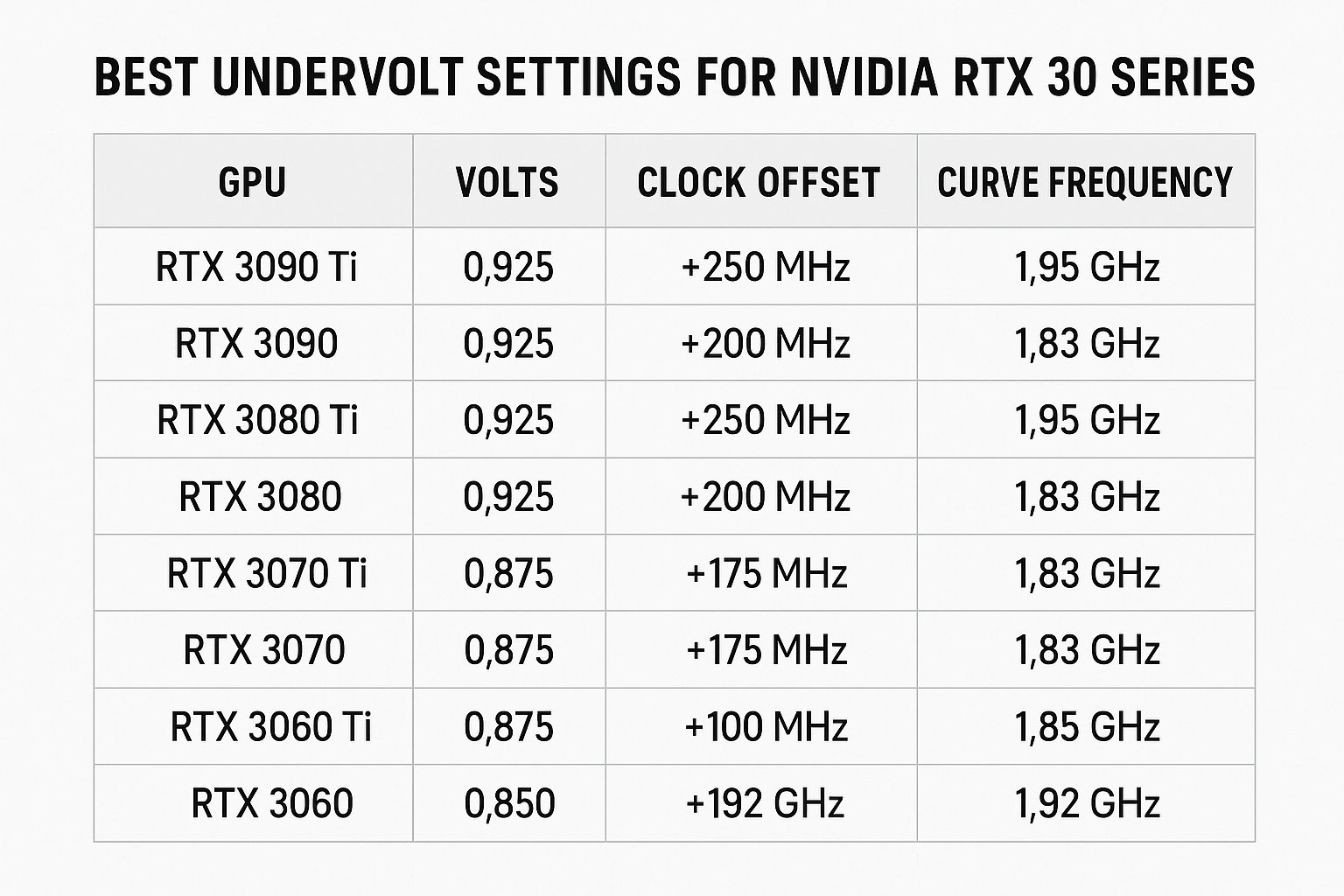
🔌 Best Undervolt Settings for NVIDIA RTX 30 Series (3060 → 3090 Ti). Discover the best undervolt settings for NVIDIA RTX 30 series GPUs, from RTX 3060 to RTX 3090 Ti. Tested values ensure lower power consumption, cooler temperatures, and quieter performance without losing FPS. Perfect for gamers and creators seeking efficiency.
🔧 Recommended Undervolt Values for NVIDIA RTX 30 Series
Undervolting your GPU is one of the most effective ways to improve efficiency while keeping performance nearly identical. Below are the tested undervolt values for every RTX 30 series card (except RTX 3050), organized by Founders Edition, High-End Customs, and Standard Models.
1️⃣ RTX 3060
You may also be interested in: International Coffee Day History, Rituals, Ways to Celebrate
Founders Edition
- Core Clock: ~1905 MHz
- Voltage: 0.850 V
- Memory OC: +500 MHz
- Power Limit: 85–90%
- Temperature Load: 60–65 °C
- Power Draw: 150–160 W
High-End Customs (ASUS Strix, MSI Gaming X Trio, EVGA XC)
- Core Clock: ~1920 MHz
- Voltage: 0.850–0.875 V
- Memory OC: +600 MHz
- Power Limit: 100%
- Temperature Load: 55–60 °C
- Power Draw: 160–170 W
Standard Models (Gigabyte Eagle, Zotac Twin Edge, Palit)
- Core Clock: 1875–1900 MHz
- Voltage: 0.850 V
- Memory OC: +400–500 MHz
- Power Limit: 85–90%
- Temperature Load: 65–70 °C
- Power Draw: 150–165 W
2️⃣ RTX 3060 Ti
Founders Edition
- Core Clock: ~1890 MHz
- Voltage: 0.850 V
- Memory OC: +500 MHz
- Power Limit: 90%
- Temperature Load: 65–70 °C
- Power Draw: 190–200 W
High-End Customs
- Core Clock: ~1905–1920 MHz
- Voltage: 0.850–0.875 V
- Memory OC: +600–700 MHz
- Power Limit: 100%
- Temperature Load: 60–65 °C
- Power Draw: 200–210 W
Standard Models
- Core Clock: 1860–1890 MHz
- Voltage: 0.850 V
- Memory OC: +400–500 MHz
- Power Limit: 90–95%
- Temperature Load: 70–75 °C
- Power Draw: 190–205 W
3️⃣ RTX 3070
Founders Edition
- Core Clock: ~1875 MHz
- Voltage: 0.850 V
- Memory OC: +500 MHz
- Power Limit: 90%
- Temperature Load: 65–70 °C
- Power Draw: 210–220 W
High-End Customs
- Core Clock: 1890–1910 MHz
- Voltage: 0.850–0.875 V
- Memory OC: +600–800 MHz
- Power Limit: 100%
- Temperature Load: 58–65 °C
- Power Draw: 220–230 W
Standard Models
- Core Clock: 1860–1875 MHz
- Voltage: 0.850 V
- Memory OC: +400–500 MHz
- Power Limit: 90–95%
- Temperature Load: 70–75 °C
- Power Draw: 210–225 W
4️⃣ RTX 3070 Ti
Founders Edition
- Core Clock: ~1860 MHz
- Voltage: 0.875 V
- Memory OC: +400–500 MHz
- Power Limit: 90%
- Temperature Load: 70–75 °C
- Power Draw: 250–260 W
High-End Customs
- Core Clock: 1875–1900 MHz
- Voltage: 0.875–0.900 V
- Memory OC: +600–700 MHz
- Power Limit: 100%
- Temperature Load: 64–70 °C
- Power Draw: 260–275 W
Standard Models
- Core Clock: ~1850–1875 MHz
- Voltage: 0.875 V
- Memory OC: +400 MHz
- Power Limit: 90–95%
- Temperature Load: 72–76 °C
- Power Draw: 250–270 W
5️⃣ RTX 3080
Founders Edition
- Core Clock: ~1845 MHz
- Voltage: 0.850–0.875 V
- Memory OC: +500 MHz
- Power Limit: 90%
- Temperature Load: 68–72 °C
- Power Draw: 260–280 W
High-End Customs
- Core Clock: ~1860–1890 MHz
- Voltage: 0.875 V
- Memory OC: +600–800 MHz
- Power Limit: 100%
- Temperature Load: 60–66 °C
- Power Draw: 270–290 W
Standard Models
- Core Clock: 1830–1860 MHz
- Voltage: 0.850–0.875 V
- Memory OC: +400–500 MHz
- Power Limit: 90–95%
- Temperature Load: 70–75 °C
- Power Draw: 270–300 W
6️⃣ RTX 3080 Ti
Founders Edition
- Core Clock: ~1830 MHz
- Voltage: 0.875 V
- Memory OC: +400–500 MHz
- Power Limit: 90%
- Temperature Load: 72–76 °C
- Power Draw: 290–310 W
High-End Customs
- Core Clock: 1845–1860 MHz
- Voltage: 0.875–0.900 V
- Memory OC: +600–700 MHz
- Power Limit: 100%
- Temperature Load: 66–70 °C
- Power Draw: 310–330 W
Standard Models
- Core Clock: ~1820–1840 MHz
- Voltage: 0.875–0.900 V
- Memory OC: +400 MHz
- Power Limit: 90–95%
- Temperature Load: 72–78 °C
- Power Draw: 300–320 W
7️⃣ RTX 3090
Founders Edition
- Core Clock: ~1875 MHz
- Voltage: 0.875 V
- Memory OC: +500 MHz
- Power Limit: 90%
- Temperature Load: 65–70 °C
- Power Draw: 285–300 W
High-End Customs
- Core Clock: ~1905 MHz
- Voltage: 0.875–0.900 V
- Memory OC: +600–1000 MHz
- Power Limit: 100%
- Temperature Load: 60–66 °C
- Power Draw: 300–320 W
Standard Models
- Core Clock: 1860–1875 MHz
- Voltage: 0.875–0.900 V
- Memory OC: +400–500 MHz
- Power Limit: 90–95%
- Temperature Load: 70–75 °C
- Power Draw: 290–310 W
8️⃣ RTX 3090 Ti
Founders Edition
- Core Clock: ~1860 MHz
- Voltage: 0.900 V
- Memory OC: +400–500 MHz
- Power Limit: 90%
- Temperature Load: 70–75 °C
- Power Draw: 350–370 W
High-End Customs
- Core Clock: ~1875–1890 MHz
- Voltage: 0.900–0.925 V
- Memory OC: +600–800 MHz
- Power Limit: 100%
- Temperature Load: 65–70 °C
- Power Draw: 360–380 W
Standard Models
- Core Clock: ~1850–1870 MHz
- Voltage: 0.900 V
- Memory OC: +400 MHz
- Power Limit: 90–95%
- Temperature Load: 72–78 °C
- Power Draw: 350–380 W
📊 Overall Summary
- 🎯 Sweet Spot for most RTX 30 GPUs: ~1850–1900 MHz @ 0.850–0.900 V
- 📉 Average power savings: 70–120 W compared to stock
- 🔇 Much lower temperatures & noise
- ⚡ Performance loss: 1–3 FPS at most
Undervolting
Undervolting the NVIDIA RTX 30 series brings the best of both worlds: near-identical performance with drastically lower heat, power consumption, and noise. Whether you own a Founders Edition or a high-end custom model, you can achieve a stable sweet spot undervolt without sacrificing gaming or creative performance.
📋 Quick Reference Table – RTX 30 Series Undervolt Values
| GPU | Founders Edition (Clock @ V) | High-End Customs (Clock @ V) | Standard Models (Clock @ V) | Avg. Power Draw | Temp Range |
|---|---|---|---|---|---|
| RTX 3060 | 1905 MHz @ 0.850 V | 1920 MHz @ 0.850–0.875 V | 1875–1900 MHz @ 0.850 V | 150–170 W | 55–70 °C |
| RTX 3060 Ti | 1890 MHz @ 0.850 V | 1905–1920 MHz @ 0.850–0.875 V | 1860–1890 MHz @ 0.850 V | 190–210 W | 60–75 °C |
| RTX 3070 | 1875 MHz @ 0.850 V | 1890–1910 MHz @ 0.850–0.875 V | 1860–1875 MHz @ 0.850 V | 210–230 W | 58–75 °C |
| RTX 3070 Ti | 1860 MHz @ 0.875 V | 1875–1900 MHz @ 0.875–0.900 V | 1850–1875 MHz @ 0.875 V | 250–275 W | 64–76 °C |
| RTX 3080 | 1845 MHz @ 0.850–0.875 V | 1860–1890 MHz @ 0.875 V | 1830–1860 MHz @ 0.850–0.875 V | 260–300 W | 60–75 °C |
| RTX 3080 Ti | 1830 MHz @ 0.875 V | 1845–1860 MHz @ 0.875–0.900 V | 1820–1840 MHz @ 0.875–0.900 V | 300–330 W | 66–78 °C |
| RTX 3090 | 1875 MHz @ 0.875 V | 1905 MHz @ 0.875–0.900 V | 1860–1875 MHz @ 0.875–0.900 V | 290–320 W | 60–75 °C |
| RTX 3090 Ti | 1860 MHz @ 0.900 V | 1875–1890 MHz @ 0.900–0.925 V | 1850–1870 MHz @ 0.900 V | 350–380 W | 65–78 °C |
🔔 For more tutorials like this, consider subscribing to our blog.
📩 Do you have questions or suggestions? Leave a comment or contact us!
🏷️ Tags: RTX 3060 undervolt, RTX 3060 Ti undervolt, RTX 3070 undervolt, RTX 3070 Ti undervolt, RTX 3080 undervolt, RTX 3080 Ti undervolt, RTX 3090 undervolt, RTX 3090 Ti undervolt, undervolting guide, GPU efficiency
📢 Hashtags: #RTX30Series, #Undervolt, #RTX3080, #RTX3090, #RTX3070, #RTX3060, #NVIDIA, #GamingPC, #PCPerformance, #GPU
