


⏲️ Estimated reading time: 24 min
Table of Contents
Some mothers discover that the hardest part of parenting is not doing difficult tasks, but carrying the responsibility for almost everything while a partner remains emotionally or practically absent. This article explores invisible labor, unequal parenting, exhaustion, communication, boundaries, and what genuine shared parenthood can look like.
Motherhood can be exhausting even inside a loving and supportive relationship. Children need attention, meals need planning, appointments must be remembered, clothes somehow become too small overnight, and bedtime does not always arrive peacefully. Parenting was never supposed to feel effortless.
Yet there is a different kind of exhaustion that can appear when one parent carries most of the family responsibility while the other remains physically present but only partially involved.
That experience sits at the heart of the original message that inspired this article. It describes a mother who remembers appointments, notices when her child needs new shoes, wakes during the night, plans meals, manages emotional moments, and still finds herself explaining why she is exhausted.
This is not simply a story about washing dishes or changing diapers. It is about responsibility.
It is also important to avoid turning the issue into a simplistic argument about women versus men. Many fathers carry enormous parenting responsibilities. Some fathers raise children alone. Families differ because of work schedules, health, finances, culture, personality, and countless other circumstances.
The important question is therefore not, “Who does more because they are a mother or father?”
A healthier question is: Do both adults genuinely feel responsible for the family they created?
When You Realize You Were Already Parenting Alone
There is a painful difference between physically being alone and feeling alone while someone is sitting beside you.
A mother can live with her partner, share the same bedroom, eat at the same table, and technically raise a child “together,” yet still feel that nearly every important responsibility eventually lands on her shoulders. The original text captures this distinction powerfully. It suggests that becoming physically separated does not always create the experience of single parenthood. Sometimes it simply makes visible an imbalance that existed long before the relationship ended.
That realization rarely comes from one forgotten chore. Instead, it develops through hundreds of ordinary moments.
Imagine that a child needs a dentist appointment. One parent notices the problem, finds a dentist, checks available dates, remembers the appointment, reorganizes work, prepares the child, takes them there, remembers the dentist’s advice, buys whatever is required afterward, and schedules the next visit.
The other parent may sincerely believe that parenting is being shared because they drove the car that afternoon.
Driving certainly helped. However, it represented only one visible part of a much larger responsibility.
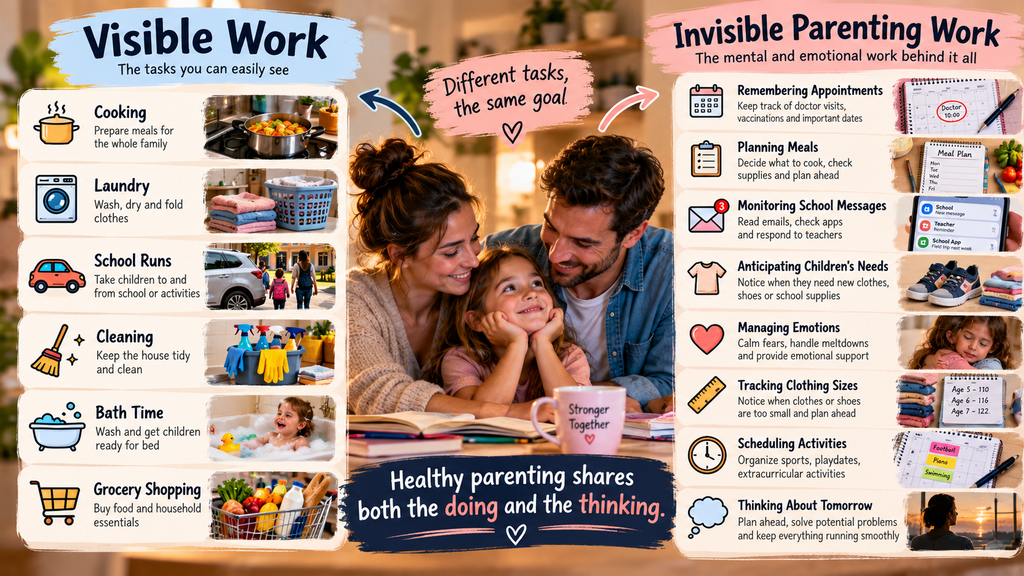
Researchers increasingly describe this hidden planning and monitoring as cognitive or mental household labor. It includes anticipating needs, organizing routines, remembering information, monitoring what still needs attention, and managing family logistics.
That invisible work matters because someone has to carry it.
When the same person carries it every day, exhaustion can accumulate even when individual tasks appear small.
The Invisible Work Behind an Ordinary Family Day
A family morning might look simple from the outside.
Everyone wakes up. The child eats breakfast. Someone gets them dressed. They leave for school or daycare.
However, look underneath that routine.
Someone noticed yesterday that the cereal was nearly finished. Someone bought milk. Someone remembered that Tuesday was sports day. Someone washed the sports clothes. Someone checked the weather. Someone noticed the child’s shoes were getting tight. Someone remembered the permission slip. Someone knew that school ended earlier that afternoon.
This is where visible labor and invisible labor separate.
Putting a sandwich into a lunchbox is visible.
Remembering that there is no bread for tomorrow is invisible.
Taking a child to an appointment is visible.
Remembering that the appointment needs to be scheduled is invisible.
Buying birthday presents is visible.
Remembering every birthday, choosing an appropriate gift, checking sizes, ordering it early enough, wrapping it, and remembering where you hid it are mostly invisible.
A 2026 study involving 2,309 Italian mothers examined cognitive, managerial, and emotional dimensions of mental labor. Researchers described this work as planning, anticipating, organizing, and emotionally monitoring family life.
The important word here is anticipating.
Family management is frequently about solving tomorrow’s problems today.
Why remembering everything is exhausting
A task disappears from your attention once it is completed.
Responsibility does not.
Suppose a mother washes her child’s school clothes. The physical job eventually ends. Yet the larger mental process continues: Are there enough clean clothes for tomorrow? Is tomorrow swimming day? Does the child need a costume Friday? Have the shoes become too small? Is the winter jacket still suitable?
The brain effectively keeps dozens of small background processes running.
Recent research into mental load among women and mothers found that constantly thinking about tasks and feeling that tasks never truly finish were common reasons participants experienced mental load as burdensome.
This helps explain why someone can look physically inactive while still feeling mentally exhausted.
Rest becomes difficult when your body stops working but your mind continues managing the household.

Helping Is Not the Same as Taking Responsibility
Language can reveal more than we realize.
People often say that a father “helps” with his children.
- He helps change diapers.
- He helps prepare dinner.
- He helps with bedtime.
- He helps take the children to school.
At first glance, that sounds positive. Yet there is an important question hidden inside the word help: Whose responsibility are we assuming it was in the first place?
UNICEF Parenting makes a similar distinction when discussing father involvement. Its guidance notes that describing fathers as merely “helping” can unintentionally imply that caring for the child fundamentally belongs to the mother.
Parenthood works differently.
A father caring for his child is not doing the mother a favor. A mother caring for her child is not doing the father a favor.
They are parenting.
This distinction becomes especially important when one parent must continually issue instructions.
“Can you give her a bath?”
“Can you prepare his lunch?”
“Can you pick up the medicine?”
“Can you change the diaper?”
“Can you put them to bed?”
The requested tasks may get completed, but the requesting parent remains the family manager.
From assistant to co-owner
Consider two versions of the same situation.
In the first family, a mother says:
“Can you please prepare the children for school tomorrow? Their clothes are upstairs. Emma needs her sports bag. Daniel needs his permission form. Lunch is in the fridge. Please leave by 7:45.”
The father completes everything correctly.
That is useful cooperation.
Now imagine another version.
The father already knows tomorrow is sports day. He checks the school messages himself. He prepares the bags that evening, notices Daniel’s permission form has not been signed, prepares breakfast, wakes the children, and gets everyone to school.
Nobody had to manage him.
That is ownership.
The physical workload may not differ dramatically. The mental workload does.
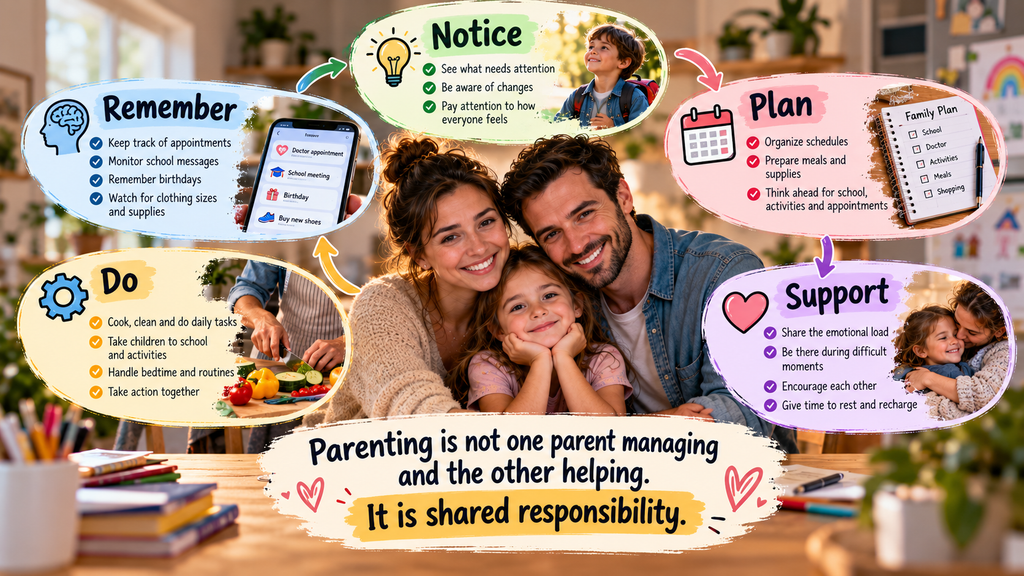
Shared parenting becomes stronger when both adults notice, remember, plan, execute, and follow through rather than leaving one parent permanently responsible for management.
Why “Just Ask Me” Can Become Another Burden
“Just tell me what you need.”
This sentence can be sincere. Sometimes it is exactly what healthy communication requires. Nobody can read another person’s mind, and partners should communicate their needs clearly.
However, there is a point where “just ask” stops solving the problem.
Imagine having to manage an employee who never independently notices anything.
You must identify every task, explain it, assign it, remind the person, check whether it happened, and solve whatever was forgotten.
Even if the employee performs each assigned task perfectly, you remain responsible for the entire operation.
Something similar can happen at home.
If one parent must constantly notice what needs doing before requesting participation from the other, the responsibility has not really been divided. Only the execution has.
The original text expresses this idea clearly: when the mother asks for “help,” what she actually wants is participation in the life both parents created together.
That difference deserves attention.
Replace requests with responsibility areas
Couples trying to rebalance parenting can start by assigning complete areas of responsibility rather than individual chores.
For example, instead of saying:
“Please take Sophie to swimming lessons Saturday.”
One parent can become responsible for swimming.
That means checking the schedule, keeping track of lesson changes, preparing equipment, washing the swimsuit, arranging transportation, paying fees when necessary, and noticing when new equipment is required.
The same method can work for school communication, medical appointments, groceries, bedtime, extracurricular activities, laundry, family finances, or meal planning.
Ownership reduces the number of instructions required.
More importantly, it distributes the thinking.
Equal Parenting Does Not Always Mean 50/50
Fairness should not become a mathematical obsession.
Real families change constantly.
One parent may work nights. Another may temporarily stay home with a newborn. Someone might become ill. A partner may have an unusually demanding month at work. One person may naturally be better at cooking while another handles finances efficiently.
Therefore, healthy shared parenting does not necessarily mean dividing every task exactly in half.
It means both people understand that the family’s needs belong to both of them.
A 2026 Pew Research Center survey of U.S. working parents illustrates why perceptions of fairness matter. Among different-sex couples in the study, mothers were more likely than fathers to report doing more day-to-day parenting and household chores. Satisfaction was also considerably higher among mothers who said responsibilities were shared about equally.
The goal should therefore be sustainable fairness rather than perfect arithmetic.
A 70/30 week can still be healthy
Imagine that one parent has an important work project lasting two weeks.
During that period, the other parent might handle 70% of family responsibilities.
That does not automatically represent an unhealthy relationship.
The important part comes afterward.
Does the overloaded partner receive support when circumstances change? Does the other person recognize what happened? Can responsibilities shift naturally?
Healthy relationships often operate more like:
“I have more capacity this week, so I have you.”
Next month it might become:
“You’re exhausted. I’ve got this.”
The danger begins when 70/30 quietly becomes 90/10 for years and everyone starts treating it as normal.
Emotional Labor Is Part of Parenting Too
Children do not only need food, clean clothes, and transportation.
They need emotional regulation, reassurance, patience, conversation, affection, boundaries, and security.
That work can be difficult to measure.
Consider a child who comes home crying after a difficult day at school.
One parent may spend forty minutes listening, asking gentle questions, helping the child understand what happened, communicating with the teacher, monitoring the child’s mood over the following days, and deciding whether further intervention is necessary.
Nothing tangible was produced.
No floor was cleaned.
No meal was cooked.
Yet meaningful parenting occurred.
Research increasingly includes emotional management within discussions of invisible family labor. A 2026 study of mothers in Croatia found that higher maternal load was associated with greater perceived stress and lower occupational balance, with emotional load particularly associated with stress.
This does not mean every difficult parenting day represents a psychological problem. Parenting naturally includes stressful periods.
It means emotional caregiving deserves recognition as real work.
When a Partner’s Presence Actually Creates More Work
A difficult point in the source material appears when the narrator realizes that her partner’s presence does not reduce her burden but increases it.
This feeling can develop for several reasons.
Perhaps one parent must repeatedly remind the other what needs doing. Maybe unfinished tasks have to be corrected. Sometimes there are constant arguments about responsibilities. In other situations, one partner needs emotional reassurance every time the subject is discussed, shifting attention away from the original problem.
None of these situations automatically proves that a relationship is beyond repair.
People can learn.
Habits can change.
Parenting roles can be renegotiated.
Someone who grew up in a household where fathers rarely participated in childcare may initially repeat what they observed without consciously choosing it. Likewise, a person who has always taken control of household management may struggle to relinquish that control.
What matters is what happens once the imbalance becomes visible.
Mistakes are different from patterns
Everyone forgets things.
A father forgetting one school event does not make him an absent father.
A mother losing patience one evening does not make her a bad mother.
Healthy relationships leave room for imperfection.
Patterns are different.
If one person consistently ignores responsibilities, requires repeated reminders, dismisses the other parent’s exhaustion, and refuses meaningful conversations about change, the problem extends beyond ordinary forgetfulness.
A useful question becomes:
When the problem is clearly communicated, does anything actually change?
Words matter.
Repeated behavior matters more.
What Genuine Partnership Looks Like in Everyday Life
Shared parenting rarely looks dramatic.
Usually, it looks wonderfully ordinary.
Someone notices there is no milk and buys it.
Someone hears the baby crying and gets out of bed without pretending to be asleep.
A parent receives the school email and handles it without forwarding it to the other parent with “What should we do?”
Someone notices their partner is overwhelmed and takes over bedtime.
One parent cooks while the other cleans.
One knows the children’s clothing sizes. Both know the pediatrician’s name.
Both can pack the school bag.
Both understand the bedtime routine.
Both know where important documents are kept.
Most importantly, neither adult behaves as though the household will collapse if the other stops giving instructions.
UNICEF resources on gender-responsive parenting encourage fathers to participate in childcare and household responsibilities and frame family care as a shared responsibility rather than something belonging exclusively to mothers.
Presence is more than living in the same house
A person can be physically present but emotionally unavailable.
Conversely, a parent with demanding working hours can still be deeply engaged.
Presence is not measured only by hours.
It is demonstrated through attention.
Do you know what your child is worried about?
Do you know who their friends are?
Do you know what happens at school?
Can your child approach you when frightened?
Do you know their routines without asking your partner?
Can you comfort them?
Can you care for them independently?
These questions reveal much more about involvement than simply asking who spends the most hours at home.
How Couples Can Rebalance an Unequal Parenting Load
Recognizing an imbalance is useful only when it leads toward constructive action.
The first goal should not be winning an argument. It should be understanding how the household actually operates.
Step 1: Map the entire workload
Write down everything required to keep the household and children functioning for one week.
Do not list only physical chores.
Include remembering, planning, researching, scheduling, communicating, buying, monitoring, transporting, comforting, and following up.
For example, “doctor appointment” should not be one item.
Break it down:
Notice the health concern. Find the doctor. Make the appointment. Remember the date. Arrange transportation. Adjust work schedules. Prepare documents. Attend the appointment. Buy medication if required. Follow the treatment instructions. Schedule follow-up care.
Suddenly, the true workload becomes easier to see.
Step 2: Identify ownership
Next to each responsibility, write who currently owns it.
Not who occasionally performs it.
Who thinks about it without being asked?
That distinction often reveals hidden inequality immediately.
One person might appear responsible for 12 physical chores while another has only eight. Yet the second person may manage nearly every appointment, school message, shopping decision, family calendar, emotional issue, and future plan.
Counting chores alone can therefore be misleading.
Step 3: Transfer complete responsibilities
Choose areas that one partner can fully own.
Suppose the father takes responsibility for school mornings.
He should then learn everything required for school mornings rather than waiting for instructions.
He checks schedules.
He prepares necessary items.
He understands breakfast preferences.
He knows departure time.
He monitors school notices relevant to that routine.
This removes both execution and management from the other parent’s mental list.
Step 4: Establish minimum standards together
Conflict often appears because partners define “finished” differently.
One person thinks cleaning the kitchen means loading the dishwasher.
Another expects counters cleaned, leftovers stored, the floor checked, and everything prepared for breakfast.
Neither partner should silently assume the other knows their definition.
Agree on reasonable standards.
The goal is not perfection.
The goal is predictability.
Step 5: Review the arrangement
Family needs change.
A responsibility system that worked with a six-month-old baby may become useless when the child starts school.
Have a short conversation every week or two.
Ask:
“What is overwhelming you right now?”
“What can I take?”
“Is anything falling through the cracks?”
“Does our current arrangement still feel fair?”
Ten calm minutes can prevent months of resentment.
Communication Without Turning Everything Into a Fight
An exhausted parent may understandably reach a point where frustration explodes.
“You never do anything!”
The feeling behind that sentence may be completely genuine.
However, absolute statements often trigger defensiveness.
The conversation then shifts from the workload to whether “never” is technically accurate.
A more productive approach focuses on observable patterns.
For example:
“I’ve noticed that I’m currently handling the school calendar, medical appointments, clothes, groceries, bedtime planning, and most nighttime wake-ups. I’m exhausted. I need us to redistribute complete responsibilities rather than me asking for individual tasks.”
That statement identifies the problem and proposes a direction.
Be specific about what change means
“Be more involved” can mean different things to different people.
Try defining involvement.
Instead of:
“I need more help with the children.”
Try:
“I’d like you to take full responsibility for Tuesday and Thursday school routines, including checking school messages and preparing everything the night before.”
Now success is measurable.
Communication cannot guarantee cooperation, but clarity makes it much harder for both partners to misunderstand the expectation.
Why Children Benefit From Seeing Shared Responsibility
Children learn relationships by watching relationships.
They notice who cooks.
They notice who comforts them.
They notice who cleans.
They notice who makes decisions.
They notice whose work receives appreciation.
They also absorb assumptions about what mothers and fathers are “supposed” to do.
UNICEF encourages parents to challenge rigid gender stereotypes by modeling shared nurturing and caregiving roles.
A boy who watches his father cook dinner, change diapers, comfort a crying child, clean the bathroom, and openly express affection receives an important lesson.
Care is not feminine.
Responsibility is not feminine.
Likewise, a girl who watches adults share domestic responsibilities learns that love does not require one person to carry everything.
These lessons may influence how children understand partnership years later.
When Exhaustion Turns Into Resentment
Resentment rarely arrives suddenly.
It accumulates.
One forgotten appointment.
Another interrupted night.
Another meal planned.
Another weekend where one parent rests while the other catches up.
Another request for help.
Another argument about why help was needed.
Eventually, the exhausted parent may stop asking.
That silence can be mistaken for peace.
It may actually mean hope is disappearing.
Research on cognitive household labor has found associations between disproportionate cognitive work and maternal stress, burnout, mental health, and relationship functioning.
These findings should not be interpreted as proof that unequal chores directly cause every mental health difficulty. Relationships and mental health are complex, and much of this research is observational.
Still, the pattern deserves attention.
Chronic overload can matter.
Do not wait until you stop caring
Couples often address household inequality only after resentment has become severe.
Earlier conversations are usually easier.
If you notice yourself constantly thinking, “Why do I have to remember everything?” that feeling deserves investigation.
Likewise, if your partner repeatedly says they feel alone in parenting, resist the temptation to immediately produce a list of everything you already do.
Listen first.
Their complaint may not mean you literally do nothing.
They may be saying:
“I don’t feel that we carry responsibility together.”
That is a very different message.
When Separation Makes an Existing Reality Visible
Sometimes relationships improve.
People listen.
Responsibilities change.
Partners become more present.
Other relationships do not.
The original text ends with a particularly difficult idea: leaving does not always suddenly transform someone into a single mother; sometimes separation simply makes the external situation match a reality she already felt she was living.
That sentiment can resonate deeply, but it should not be treated as universal advice to end a relationship.
Separation is a major personal, emotional, financial, practical, and sometimes legal decision.
Children’s needs, housing, finances, safety, custody arrangements, support networks, and individual circumstances all matter.
No internet article can determine whether someone should stay or leave.
What the idea can do is encourage an important question:
Am I experiencing partnership, or am I simply experiencing another person’s presence?
For some couples, asking that question starts a difficult but productive conversation.
For others, it confirms something they have understood for a long time.
Shared Parenthood Starts With Shared Ownership
There is a powerful difference between saying:
“Tell me what to do.”
and:
“I see what needs doing.”
There is another difference between:
“I helped you today.”
and:
“I took care of our family today.”
Healthy parenting does not require two perfect people.
It requires participation, communication, flexibility, respect, and accountability.
Both parents will make mistakes.
Both will occasionally forget something.
Both deserve rest.
Both can become overwhelmed.
The goal is not to create a household scoreboard where every diaper, dish, school run, and sleepless hour earns a point.
The goal is to create a family where neither person feels permanently abandoned inside a partnership.
That is what shared responsibility ultimately means.
Frequently Asked Questions
What is the mental load in parenting?
Mental load describes the ongoing thinking required to manage family life. It can include remembering appointments, anticipating children’s needs, planning meals, tracking school information, organizing schedules, monitoring supplies, and thinking about what must happen next. Unlike washing dishes or driving to school, much of this work is invisible.
Is mental load the same as household chores?
No. Household chores are often physical and observable. Mental load includes the planning, remembering, anticipating, coordinating, and monitoring surrounding those chores. Someone may physically complete a task while another person remains responsible for noticing that the task exists.
Does unequal parenting always mean the father is responsible?
No. Family situations vary enormously. Fathers can also carry disproportionate parenting and household responsibilities, and single fathers may carry everything themselves. The central issue is not gender alone but whether responsibilities are distributed sustainably and respectfully.
Should parenting always be divided 50/50?
Not necessarily. Exact equality is unrealistic during many periods of family life. Work schedules, illness, pregnancy, newborn care, disability, and other circumstances can temporarily change the balance. A healthy arrangement should remain flexible while ensuring one person does not permanently carry nearly everything.
Why can asking for help still feel exhausting?
Because identifying a task, assigning it, explaining it, remembering it, and checking whether it happened are themselves forms of work. Sharing complete ownership of responsibilities can reduce this management burden.
How can partners divide the mental load?
Start by documenting both visible and invisible responsibilities. Then assign complete areas of ownership instead of isolated chores. Review the arrangement regularly because children’s needs and family schedules change over time.
Can an unequal relationship improve?
Yes, some relationships can improve significantly when both people recognize the imbalance and consistently change their behavior. Communication, practical redistribution of responsibilities, couples counseling, parenting education, or other professional support may help depending on the circumstances.
Is feeling alone in a relationship a reason to separate?
That decision cannot be made from a single feeling or an online article. Relationship history, safety, children, finances, communication, support, and many other circumstances matter. A qualified relationship counselor, family professional, or legal professional can provide appropriate guidance when needed.
What does an involved father look like?
Involvement means more than occasional activities. An involved father can participate in everyday care, understand routines, notice needs, provide emotional support, manage responsibilities independently, and build his own relationship with his child.
What is the biggest difference between helping and shared parenting?
Helping usually means completing something another person still owns. Shared parenting means both adults take responsibility for noticing, planning, completing, remembering, and following through on family needs.
A Family Should Feel Like a Team
Perhaps the most important lesson is surprisingly simple: nobody should have to become invisible to keep a family functioning.
Meals matter. Clean clothes matter. Appointments matter. School schedules matter. Yet the person remembering all of those things matters too.
Good relationships do not require perfect equality every day. They require awareness. When one partner is drowning, the other should not wait for a detailed instruction manual before noticing the water.
Parenting becomes more sustainable when responsibility belongs to both adults. That means sharing visible chores, invisible planning, emotional care, difficult nights, ordinary mornings, mistakes, decisions, and moments of joy.
The strongest version of partnership is not one person carrying the family while another occasionally lends a hand.
It is two people able to say:
This is our child. This is our home. This is our responsibility. We are doing this together.
⚠️ Disclaimer and Source Hygiene
This article provides general educational and informational content about parenting, relationships, household labor, and mental load. It does not provide psychological, medical, legal, or relationship advice for an individual situation. Anyone experiencing severe relationship conflict, emotional distress, domestic abuse, safety concerns, or complicated separation and custody issues should seek appropriate professional support.
The article was inspired by the user-provided source text and expanded using research and educational material from sources including peer-reviewed studies indexed through PubMed/PMC, Pew Research Center, and UNICEF. Research findings describe populations and associations and should not be used to diagnose an individual person or relationship.
🔔 For more tutorials like this, consider subscribing to our blog.
📩 Do you have questions or suggestions? Leave a comment or contact us!
🏷️ Tags: mental load, motherhood, shared parenting, invisible labor, parenting responsibilities, relationship advice, parental burnout, emotional labor, involved fathers, family relationships
📢 Hashtags: #Motherhood, #MentalLoad, #SharedParenting, #Parenting, #InvisibleLabor, #Relationships, #Mothers, #Fathers, #FamilyLife, #ParentingTogether
📚 Sources and References
Pew Research Center – How Working Parents Divide Family Responsibilities (2026). A survey of working parents examining parenting tasks, household chores, paid work, and satisfaction with how responsibilities are distributed.
Vettoretto, Minello, Ortensi & Tosi – Understanding the Dimensions of Mental Labor: The Invisible Load of Italian Mothers. Research involving 2,309 mothers examining cognitive, managerial, and emotional dimensions of family mental labor.
Cognitive Household Labor: Gender Disparities and Consequences for Maternal Mental Health and Wellbeing. Research examining cognitive and physical household labor among mothers of young children and associations with well-being and relationship functioning.
Mental Load in Women and Mothers: Causes of Distress, Personality Traits, and Psychopathology. Research examining invisible household and caregiving work, perceived burden, and psychological correlates.
UNICEF Parenting – The Relationship Between Father and Baby. Educational material emphasizing active father involvement and challenging the idea that fathers merely “help” mothers with childcare.
UNICEF – Gender-Responsive Parenting. Guidance addressing father involvement, shared household responsibility, and gender-equitable parenting.
🕊️ Secondary Sources and Testimonials
The original source supplied for this article presents a personal, emotionally framed description of a mother realizing that she had effectively carried parenting and household responsibility alone even before becoming physically separated. It emphasizes appointments, children’s clothing needs, nighttime waking, meal planning, emotional care, exhaustion, and repeated requests for participation.
Its closing message is particularly important to interpret carefully. It presents separation not necessarily as the moment single motherhood begins, but as the moment an existing experience of carrying responsibility alone becomes externally visible. This article treats that statement as a perspective for reflection rather than universal relationship advice.
