


⏲️ Estimated reading time: 35 min
Table of Contents
Celebrate Evander Holyfield’s birthday with a closer look at the life, achievements, and lasting influence of “The Real Deal.” Discover how the American boxing legend rose from his early amateur years to become an undisputed champion in two divisions and a four-time world heavyweight champion.
Happy Birthday, Evander Holyfield: Celebrating The Real Deal
Some athletes become famous because they win. Others remain part of sporting culture because their careers give people something to remember, discuss, and pass along. Evander Holyfield belongs in that second group. His name brings together championship ambition, demanding rivalries, difficult defeats, and remarkable returns. For longtime boxing followers, he represents an era when the heavyweight division regularly produced evenings that felt larger than sport. For younger readers, his story offers an opportunity to discover a champion whose achievements reach far beyond a familiar nickname or one widely replayed incident.
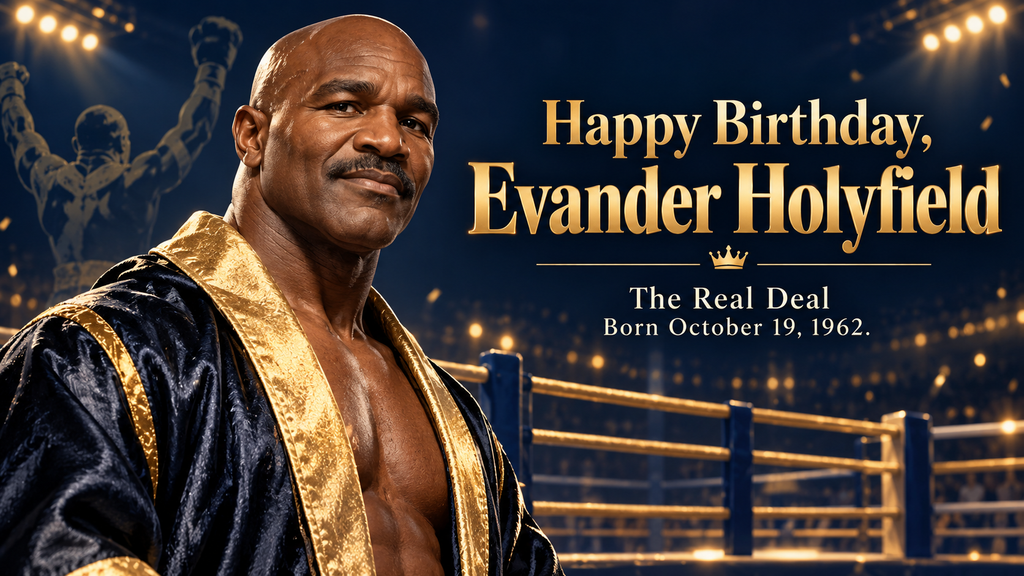
On October 19, 2026, Holyfield celebrates his 64th birthday. Born in Atmore, Alabama, in 1962, he became an American professional boxer whose main competitive career stretched from 1984 to 2011. Along the way, he reached the top of both the cruiserweight and heavyweight divisions. Those accomplishments provide the foundation for this birthday tribute, but they do not explain everything about his appeal. The deeper interest lies in how a career develops: through preparation, changing circumstances, talented opponents, and the willingness to start rebuilding when success slips away. Evander Holyfield
A thoughtful celebration should make room for that entire journey. It should recognize the victories without pretending that every performance ended happily. It should explain the titles without burying readers under boxing terminology. Above all, it should remember that a sporting legacy grows through competition. Holyfield’s achievements matter partly because other excellent fighters challenged him, defeated him, and forced him to respond. His birthday offers a good reason to revisit that history with appreciation, perspective, and curiosity about what made “The Real Deal” such an enduring figure.
From Atmore to Atlanta: Where His Boxing Story Began
Holyfield’s story begins in Alabama, although Atlanta became central to his development. His official biography records his birth in Atmore and his family’s later move to Atlanta. It also describes his introduction to boxing through a Boys Club during childhood. That setting matters because it places the beginning of his career somewhere accessible and ordinary: a community environment where a young person could discover a demanding activity, receive guidance, and begin learning through repetition. The future champion did not start with a championship belt. He started with the experience of being a beginner. Evander Holyfield
It is easy to tell an athlete’s childhood backward, as though every early experience clearly pointed toward greatness. Real development rarely feels so obvious at the time. A child entering a boxing gym must learn unfamiliar movements, listen to instructions, and accept correction. Even simple tasks require attention. Standing in balance, moving without crossing the feet, and returning the hands to a protective position can feel awkward before practice makes them familiar. Looking at Holyfield’s beginnings through that lens makes his later success more understandable. Before there was a public reputation, there was a long process of learning.
For readers outside sport, this is one of the most relatable parts of his biography. The starting point does not need to resemble the eventual destination. Someone learning a language, building a website, or preparing for a professional qualification faces a similar gap between present ability and future ambition. The useful response is to identify the next manageable step. That might mean attending a lesson, completing a small project, or practicing one skill carefully. Holyfield’s early development provides a sporting example of a broader idea: large achievements become possible through smaller experiences that initially attract very little attention.
Amateur Boxing Built the Foundation for Bigger Challenges
Before professional championships entered the picture, Holyfield established himself in amateur competition. He represented the United States at the 1983 Pan American Games, winning a silver medal. The following year brought an even larger international stage at the Los Angeles Olympics. These experiences belong near the beginning of any serious account of his career because they show that his development included competition beyond a local or regional setting. He encountered different opponents, different expectations, and the pressure of representing his country before beginning his professional journey. Evander Holyfield
For a new boxing fan, the word “amateur” can create the wrong impression. It does not mean casual participation or an absence of advanced skill. In this context, it identifies a competitive structure distinct from professional boxing. International amateur athletes may spend years preparing for short, highly demanding contests. Their opportunities can depend on a limited number of performances, which makes concentration especially important. A tournament also creates a different rhythm from a professional career. An athlete must focus on the immediate contest while remaining prepared for the possibility of another opponent soon afterward.
Those conditions help explain why amateur experience deserves attention rather than a quick mention before the famous fights. It gives a developing boxer opportunities to solve problems under pressure. An opponent may move differently, control distance more effectively, or disrupt an expected rhythm. The athlete must respond within the rules and within the time available. Readers can appreciate that process without understanding every scoring detail. Watch the decisions between exchanges, the effort to establish position, and the response after a difficult moment. These smaller observations reveal how competitive experience can shape a boxer long before a world title becomes possible.
The 1984 Olympics: A Bronze Medal and an Unfinished Opportunity
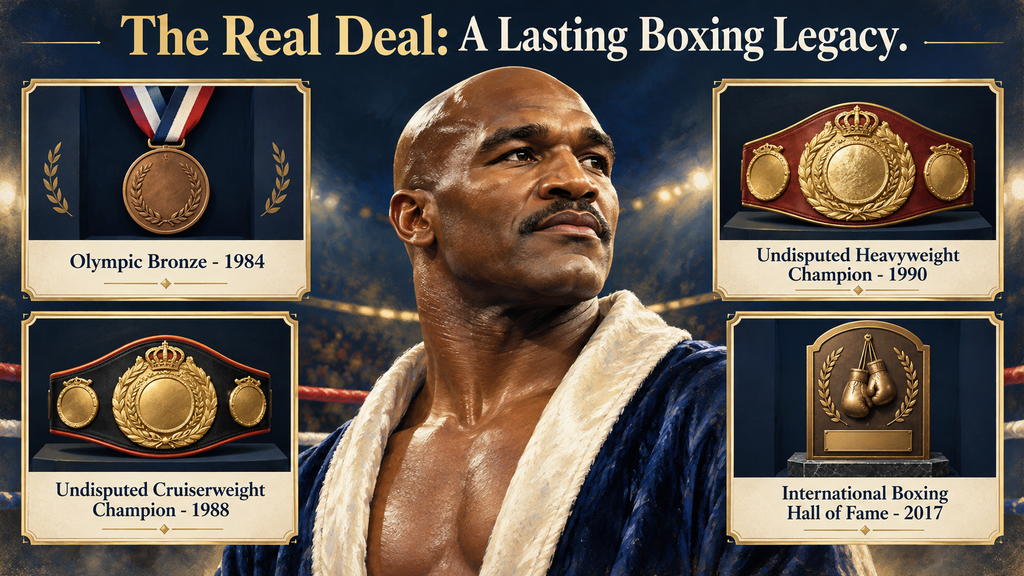
Holyfield won a light-heavyweight bronze medal at the 1984 Los Angeles Olympics. His tournament ended with a controversial disqualification in the semifinal against New Zealand’s Kevin Barry. Olympic records retain the official outcome, while historical accounts explain why the decision became such a memorable part of his amateur career. Both elements deserve recognition. The medal is an established achievement, and the controversy helps explain the emotional weight attached to it. A responsible account can acknowledge the dispute without rewriting the official result or claiming a gold medal he did not receive. Evander Holyfield
For an athlete, a tournament exit can feel much larger than a single result. Years of preparation may lead toward one brief opportunity. Spectators see the contest, but they usually do not see the ordinary training days that made participation possible. That contrast helps explain why Olympic disappointment can remain important even after later professional success. A new achievement does not erase the experience that came before it. Instead, both become part of the same career. Holyfield’s bronze medal belongs in his story as an international accomplishment and as a reminder that promising journeys can include unresolved frustration.
There is also a useful distinction between accepting a recorded outcome and deciding what to do next. Acceptance does not require enthusiasm about a decision. It means recognizing the circumstances well enough to make a practical choice. Outside sport, someone might encounter an unsuccessful application, a disputed assessment, or an opportunity that ends earlier than expected. The next step could involve an appeal, additional preparation, or a different route. Holyfield’s later career gives this chapter perspective: the Olympic result mattered, but it did not establish the final limit of what he could achieve.
Turning Professional Meant Beginning Another Learning Process
Holyfield entered professional boxing in 1984. On November 15, he defeated Lionel Byarm by decision at Madison Square Garden in New York. The World Boxing Council’s historical account identifies that contest as his professional debut. For readers familiar only with the heavyweight champion, the date provides an important starting point. The professional career began with a scheduled contest against a specific opponent, rather than with immediate access to the sport’s biggest titles. His reputation would develop through the results and experiences that followed. World Boxing Council
Moving into professional sport changes the questions surrounding an athlete. Potential remains interesting, but people increasingly expect evidence of progress. Can the competitor handle a different pace? Can earlier strengths remain effective as opposition improves? What needs adjustment between appearances? Those questions do not disappear after a successful debut. They become more demanding. A developing professional must keep learning while public attention gradually attaches itself to the record. Each victory can create opportunity, but it can also encourage expectations that are difficult to manage if improvement stops.
A useful way to understand this stage is to compare it with starting a skilled profession. Completing training does not mean someone has encountered every practical problem. A new driver, designer, or technician still needs experience applying knowledge in changing circumstances. Good habits must survive pressure, fatigue, and unfamiliar situations. The comparison is limited, because professional boxing carries its own particular demands and risks, but the learning principle remains recognizable. Early success is a foundation to build upon. It becomes more valuable when the person involved continues accepting feedback and treating the next challenge as a fresh problem.
Dwight Muhammad Qawi and the First World Championship
Holyfield won his first professional world title against Dwight Muhammad Qawi on July 12, 1986. The contest took place in Atlanta and ended with Holyfield receiving a split decision after fifteen rounds. The International Boxing Hall of Fame’s profile of Qawi records the result and describes a closely contested championship encounter. For Holyfield, it marked the move from promising professional to world titleholder. For readers exploring his career, it offers an essential starting point because the significance of his achievements began well before the heavyweight division. Int’l Boxing HOF
A split decision means the judges did not all select the same winner. That distinction helps a newcomer understand why a championship victory can involve uncertainty until the scorecards are announced. It also reminds us that the phrase “won a world title” can conceal very different experiences. Some title fights end quickly. Others demand sustained work across a long contest. Holyfield’s first championship belongs to the latter category. The result matters, but so does the setting: an ambitious challenger meeting an established champion and remaining competitive through the full scheduled distance.
When watching an older contest like this, avoid judging its importance only through isolated highlights. Short clips naturally favor dramatic exchanges, while longer viewing reveals the work that connects them. Notice how the boxers approach each other, how they reset, and how their decisions change as the contest develops. Those observations help explain why experienced followers remember certain fights so strongly. The attraction is not simply that punches landed. It is that two skilled competitors created a difficult, changing problem for each other, and the final result emerged from many decisions rather than one memorable image.
Becoming Undisputed at Cruiserweight
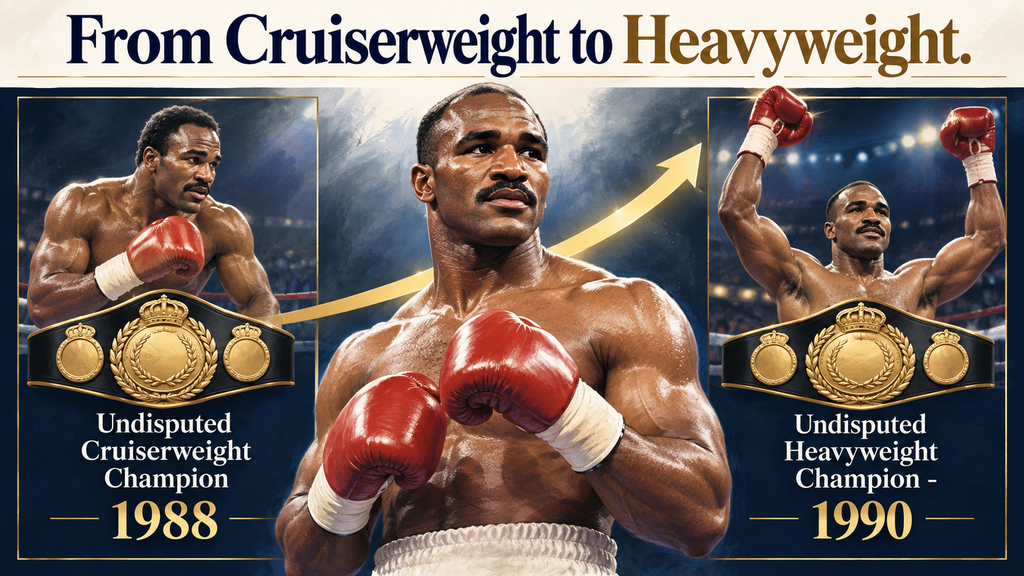
Holyfield’s cruiserweight achievements continued after the Qawi victory. He added the IBF championship by defeating Ricky Parkey in 1987, then defeated WBC champion Carlos de León in 1988. With the WBA, IBF, and WBC titles together, he became the division’s undisputed champion in that era. His official career history documents that progression. These victories deserve their own place in a birthday tribute because they establish the strength of his record before the heavyweight accomplishments that later brought even wider recognition. Evander Holyfield
The terms “unified” and “undisputed” can confuse readers who follow sports with one principal championship. In boxing, several organizations may recognize world champions within the same division. A unified champion holds multiple major titles together. An undisputed champion holds the full set required for that status in the relevant era. Historical context matters because championship structures have changed. When describing Holyfield’s cruiserweight reign, the clearest approach is to identify the belts he held and the period involved. That gives readers useful information without forcing them to memorize every organization’s history.
There is a broader sporting idea here: adding achievements can mean reducing uncertainty about who stands at the top. One victory may establish a claim, while further victories against other champions strengthen it. Of course, titles alone cannot answer every question about sporting greatness. Opponent quality, performance, and historical circumstances still matter. Nevertheless, Holyfield’s cruiserweight run gives his legacy an unusually strong first chapter. Anyone discovering him only through heavyweight footage misses a substantial part of the story. His later ambition followed an earlier period in which he had already reached the summit of another division.
Moving to Heavyweight Raised the Level of Uncertainty
After establishing himself at cruiserweight, Holyfield moved into heavyweight competition in 1988. His route toward a championship opportunity included victories over opponents such as James Tillis, Pinklon Thomas, Michael Dokes, and Alex Stewart. The International Boxing Hall of Fame identifies those contests as part of the progression that led to his meeting with James “Buster” Douglas. This was a transition between competitive environments, not simply a change in the wording beside his name. Success in one division provided credibility, but it did not automatically settle his standing in another. Int’l Boxing HOF
Moving upward invites a practical question: which strengths will continue to work when the circumstances change? An athlete cannot assume that familiar habits will produce identical results against a different range of opponents. Distance, timing, and physical demands may require adjustment. The interesting part for spectators is watching that adjustment happen. A boxer might encounter opponents who offer greater reach, different movement, or a different kind of pressure. Understanding those variables makes the progression more engaging than treating each contest as another line on a record.
Readers can apply the same question to a new responsibility in ordinary life. A person promoted at work may have skills that earned the opportunity but still need new methods for a larger role. Someone expanding a small business may discover that an informal process no longer works at a different scale. The lesson is not that ambition guarantees success. It is that successful movement often requires adaptation alongside confidence. Holyfield’s heavyweight transition is compelling because he pursued a larger goal while still having to establish that his existing abilities could meet its demands.
Buster Douglas and the Night Holyfield Reached the Summit
On October 25, 1990, Holyfield defeated James “Buster” Douglas by a third-round knockout to become undisputed heavyweight champion. The WBA, WBC, and IBF titles were at stake. Douglas had previously defeated Mike Tyson, so Holyfield’s championship opportunity arrived against the man who had changed the division’s immediate direction. The result gave Holyfield undisputed status at heavyweight after his earlier success at cruiserweight. It remains one of the central achievements in his career and an essential reason his name holds such a prominent place in boxing history. worldboxingfederation.org
The significance of a short championship contest can be easy to misunderstand. A bout that ends early may look straightforward in a highlight package, yet the opportunity itself usually stands at the end of a much longer process. Preparation, earlier victories, and the ability to perform at the right moment all contribute. That does not mean every result was inevitable. Sport remains uncertain precisely because preparation cannot remove the opponent’s influence or guarantee what happens under pressure. The attraction lies in seeing whether years of work become effective when the stakes are highest.
For a birthday retrospective, this victory provides a natural turning point. Before it, Holyfield was pursuing the heavyweight championship. Afterward, he had to defend it. Those are related but different tasks. A challenger can concentrate attention on reaching the top, while a champion becomes a target for others doing the same. Expectations change, and earlier success creates a new standard against which future performances will be judged. Winning the title therefore completed one ambition while beginning another chapter. The achievement was enormous, but the competitive story still had many difficult pages ahead.
Facing George Foreman and Larry Holmes Connected Two Eras
Holyfield’s first heavyweight championship reign included successful defenses against George Foreman and Larry Holmes. Both men already occupied important places in heavyweight history, which gave the contests significance beyond the immediate title stakes. Holyfield defeated each by decision. These meetings connect his career with earlier generations and help explain why heavyweight history often feels like a conversation across decades. A champion’s record includes opponents at different stages of their careers, and each meeting needs that context to be understood fairly. worldboxingfederation.org
For newer fans, a famous name can create two opposite mistakes. One is assuming that a former champion’s reputation guarantees the same abilities at every age. The other is dismissing an experienced competitor because the most celebrated years came earlier. A careful viewer avoids both shortcuts. Experience, timing, physical condition, and current form all matter. The better question is what each boxer brought into that particular contest. That approach respects the opponent while keeping the analysis grounded in the event that actually happened.
These cross-generational meetings also offer an enjoyable way to explore sporting history. Start with one contest, then learn why the older champion was already famous. Return afterward and watch with that background in mind. The experience becomes richer because recognizable techniques and reputations now have a history attached to them. Holyfield’s career works particularly well as a starting point for this kind of exploration. Following his opponents leads readers toward several major chapters of heavyweight boxing, while returning to his own performances shows how he established his place among those different generations.
Riddick Bowe Turned Defeat Into a Defining Rivalry
Holyfield lost his heavyweight titles to Riddick Bowe in 1992, regained the WBA and IBF belts in their 1993 rematch, and lost their third meeting in 1995. The sequence gives their rivalry a clear shape: defeat, a successful response, and another defeat. It is a more interesting story than a simple description of uninterrupted dominance. Their meetings show why an athlete’s standing cannot always be understood through one result. A rivalry develops as competitors return with experience of each other, new expectations, and the knowledge that an earlier outcome can be challenged. Int’l Boxing HOF
The second meeting took place on November 6, 1993, with Holyfield winning a majority decision. That date is confirmed in The Ring’s record of his career. A majority decision means two judges favored the winner while the third scored the contest even. For a reader unfamiliar with boxing results, that small explanation makes the record easier to follow. It also highlights an important point about rematches: the response to defeat does not need to look effortless to be meaningful. A closely earned victory can carry particular significance when it reverses an earlier championship loss. The Ring Record
There is a practical lesson in examining a setback without allowing it to become a permanent identity. Someone can acknowledge that an approach failed and still believe improvement is possible. The useful work involves asking specific questions rather than repeating motivational slogans. What created the difficulty? Which choices can change? What remains outside personal control? Sporting rivals force those questions into public view. Holyfield’s meetings with Bowe remain compelling because neither man existed simply to confirm the other’s greatness. Each had the ability to disrupt the other’s plans, which made the outcomes meaningful.
Mike Tyson: A Major Victory Before the Famous Rematch
Holyfield defeated Mike Tyson on November 9, 1996, stopping him in the eleventh round to win the WBA heavyweight title. The victory deserves attention on its own terms. Later discussion often moves quickly toward their second meeting, but the first contest supplied a major championship result. The HistoryMakers’ biographical account identifies the win as Holyfield’s return to a heavyweight world title and notes its recognition by The Ring. Any account that starts and ends with the rematch leaves out the sporting achievement that made another meeting so significant. thehistorymakers.org
For someone discovering the rivalry now, begin with the competitive question rather than the later controversy. What were the two boxers trying to establish? How did the contest change as it continued? What made the eventual result important within Holyfield’s career? These questions guide attention toward performance. They also make the viewing experience more rewarding than approaching an old fight only to confirm something already heard. Famous athletes can become simplified into reputations, while an actual contest reveals the choices, adjustments, and limitations that a reputation alone cannot explain.
Their June 28, 1997, rematch ended with Tyson’s disqualification after he bit Holyfield’s ears. The incident is part of the historical record, but a birthday tribute can address it briefly and without graphic detail. Its lasting visibility should not reduce Holyfield’s career to one opponent’s actions. He had already become an undisputed champion in two divisions, and his first victory over Tyson remained a separate accomplishment. Keeping those distinctions clear gives readers a fuller understanding of the rivalry and preserves the focus on the wider career being celebrated. New Georgia Encyclopedia
Michael Moorer, Lennox Lewis, and the Value of Context
Michael Moorer defeated Holyfield in 1994, while Holyfield won their rematch in 1997 to add the IBF heavyweight title to his WBA championship. The two results form another important example of how his career developed through returns rather than a straight line. A rematch gives both competitors information they did not possess before the first meeting, but information alone does not determine the result. They still have to prepare and perform. For the audience, that combination of familiarity and uncertainty helps make repeat contests especially engaging. Int’l Boxing HOF
Holyfield also met Lennox Lewis twice in 1999. Their first contest ended in a disputed draw, and Lewis won the rematch by decision. The distinction between those outcomes matters. Describing a decision as controversial does not change the official record, just as recording the official result does not require pretending that public disagreement never existed. A clear account can do both jobs: state what happened officially and explain why the event generated debate. This approach respects readers by giving them the information needed to understand the history without directing them toward a predetermined emotional response. New Georgia Encyclopedia
These chapters also demonstrate why celebrating one athlete need not diminish another. Moorer and Lewis brought achievements and abilities of their own. Their success against Holyfield belongs in an honest tribute because strong opposition gives a career its substance. Without that resistance, a list of victories offers less insight into competitive quality. Birthday articles can remain warm while acknowledging difficult results. In fact, the recognition often becomes more meaningful when it survives a complete picture. Admiration based on the whole record has more depth than praise that depends on leaving inconvenient moments outside the frame.
Four Heavyweight Championship Reigns: What the Achievement Means
Holyfield’s victory over John Ruiz in August 2000 began his fourth reign as a major world heavyweight champion. The distinction concerns separate championship reigns, rather than the number of individual belts he held at one time. The Atlanta Sports Hall of Fame recognizes him as boxing’s four-time world heavyweight champion. That description is central to his public legacy, but it becomes more useful when readers understand the counting behind it. Championship history can sound confusing when several organizations, multiple belts, and repeated title victories appear in the same sentence. atlantasportshalloffame.org
A straightforward way to follow the record is to separate two questions. First, when did a boxer begin a new title reign? Second, which championships did that reign include? Those questions describe different things. Holding several belts simultaneously can establish unified or undisputed status, while returning to championship status after losing it creates another reign. Holyfield’s career includes both kinds of achievement. Understanding the distinction helps explain why “undisputed champion” and “four-time champion” can both describe him without meaning the same thing.
The human interest lies in the repeated return to contention. Once an athlete has already reached the top, another attempt carries its own difficulties. There may be public doubts, memories of earlier defeats, and questions about whether previous success can be repeated. None of those pressures guarantees a dramatic comeback, and a responsible biography should avoid suggesting otherwise. What the record shows is that Holyfield repeatedly returned to championship status. Readers do not need to treat every comeback as a formula for their own lives to appreciate the sustained competitive ambition involved.
Understanding His Record Without Reducing the Career to Numbers
Holyfield’s standard professional record is commonly presented as 44 wins, 10 losses, and 2 draws, with 29 wins by knockout. Boxing records also list one no contest separately. The distinction helps explain why some summaries show different bout totals even when they agree on wins, losses, and draws. A no contest is not the same result as a draw, and neither belongs in the loss column. The safest approach is to state each category clearly rather than assume that every source uses an identical display format. Int’l Boxing HOF
Numbers provide structure, but they cannot carry the entire interpretation of a sporting career. A record does not automatically reveal the quality of opposition, the stage of each competitor’s development, or the circumstances surrounding a contest. An unbeaten record and a long career against major rivals raise different historical questions. Neither should be assessed through a single shortcut. For readers exploring boxing, the most useful habit is to connect the result with the opponent and the period. That turns a statistical entry into an event with understandable significance.
The same care applies to knockout totals. They describe how victories were recorded, but they do not measure every aspect of skill. A decision victory may reflect excellent judgment and control across the full distance. A stoppage can emerge from sustained work or a sudden opportunity. Rather than using one column to settle every debate, treat the record as an index for further exploration. Choose a contest, learn its context, and then watch what the athletes actually did. Holyfield’s career offers plenty of material for that approach because its interest extends across divisions, rivalries, and different phases of competition.
Why “The Real Deal” Remains Such an Effective Nickname
Holyfield’s nickname, “The Real Deal,” has become inseparable from his boxing identity. It is short, memorable, and easy to understand even for someone who rarely watches the sport. As an expression, it suggests authenticity and the ability to deliver when tested. That makes it particularly suitable for retrospective writing, although the phrase should not replace actual explanation. A nickname gives readers an entry point. The career record, the opponents, and the championship achievements provide the reasons to keep reading.
Part of its appeal is that it invites a practical question: what does performance look like when reputation meets a difficult test? Fans often debate that question without using those exact words. They want to know whether an athlete can adapt, recover, and remain effective when the situation becomes uncomfortable. Holyfield’s career provides many occasions for that discussion. His record contains victories and defeats, which gives the nickname a more interesting setting than a carefully protected image. Readers can examine the evidence and form an opinion rather than simply accept a promotional description.
Outside boxing, the expression can also carry a useful standard for everyday work. Reliability becomes visible through repeated actions: finishing a task carefully, acknowledging a mistake, or improving a weak process. Grand promises matter less if they are never supported by conduct. This is an interpretation of what the nickname can suggest, rather than a claim about Holyfield’s private thoughts or a quotation from him. Keeping that distinction clear allows a birthday tribute to draw thoughtful connections without inventing personal beliefs, conversations, or motivational advice that the athlete never gave.
A Beginner’s Guide to Appreciating His Boxing
A newcomer does not need to understand every technical term to enjoy a historical contest. Begin by watching position. Notice where each boxer stands and how much space separates them. Then look at what happens before and after an exchange. Does a competitor step away, change direction, or remain close? These observations make the action easier to follow because they reveal that boxing involves decisions about space and timing as well as individual punches. Watching with a simple question in mind is often more useful than trying to notice everything at once.
On a second viewing, pay attention to combinations and responses. A combination means several punches linked together, but the interesting detail is what creates the opportunity and what follows it. One boxer may draw a response, change the rhythm, or use movement to regain a favorable position. Avoid assuming that a dramatic exchange tells the whole story. The quieter intervals can reveal planning, hesitation, or adjustment. If commentary uses an unfamiliar term, pause afterward and look it up rather than allowing vocabulary to interrupt the entire experience.
Finally, compare a short highlight package with a longer authorized recording. Highlights are useful introductions, but they remove the time between memorable moments. That missing time can change how a performance feels. A longer view reveals stretches of control, difficulty, and recovery that a montage cannot preserve. These suggestions are for appreciating sporting history, not for practicing contact techniques without instruction. Someone interested in participating should learn through a qualified coach and an appropriate training environment. As a spectator, the immediate goal is simpler: understand the contest well enough to appreciate the decisions that shaped it.
What His Career Can Teach Without Turning Into a Slogan
The most useful lessons from a sporting career are usually specific. “Never give up” sounds encouraging, but it does not tell a person how to respond to a real problem. A more practical idea is to review a setback before deciding on the next attempt. For example, someone struggling with an examination could identify the weakest topic, change the study method, and schedule another assessment when prepared. That resembles the structure of competitive improvement without pretending that ordinary life and professional boxing carry identical demands.
Another useful lesson concerns the relationship between confidence and evidence. Believing improvement is possible can help someone begin, but progress still needs something concrete behind it. That might involve instruction, better preparation, or a clearer understanding of the task. Holyfield’s career invites discussion of persistence because he returned to championship success after defeats. The appropriate takeaway is that another attempt can matter when circumstances and preparation support it. There is no need to promise that determination alone will produce the same outcome for everyone.
A third lesson is to appreciate achievement without demanding perfection. People often judge themselves through a recent mistake while evaluating successful public figures through selected highlights. That comparison is incomplete from the beginning. An honest sporting biography includes uncertainty, losses, and limitations alongside its celebrated moments. Reading Holyfield’s story in that way can make the admiration more grounded. The value lies in seeing a substantial career as a whole. It gives readers room to respect excellence while recognizing that excellence does not require every chapter to be equally successful.
Hall of Fame Recognition and a Legacy Worth Exploring
Holyfield entered the International Boxing Hall of Fame in 2017. The institution’s profile records his induction alongside the major results that shaped his career. Hall of Fame recognition provides a useful historical marker because it places an athlete within a broader collection of boxing’s notable figures. It does not require every fan to rank him in exactly the same position. Instead, it offers an invitation to examine the achievements and decide which aspects of the career carry the greatest significance. Int’l Boxing HOF
For some readers, the cruiserweight championship run may be the most impressive chapter. Others may focus on becoming undisputed at heavyweight, defeating Tyson, or regaining titles after earlier losses. Those preferences need not conflict. A long career can contain several different reasons for admiration. The more interesting conversation begins when people explain their choices. What makes a victory meaningful? How should opposition affect an assessment? Does sustained success matter more than a particular peak? Holyfield’s record provides enough variety to keep those questions open and worthwhile.
That is also why a birthday tribute can do more than repeat familiar praise. It can help an experienced fan revisit an overlooked chapter or give a first-time reader a clear route into the history. Start with the verified milestones, learn the meaning of the titles, and then explore the contests that seem most interesting. There is no requirement to watch everything or settle every historical argument. Curiosity is enough. A sporting legacy remains alive when people continue engaging with the actual career, rather than passing along only a nickname and a handful of disconnected images.
Frequently Asked Questions
When is Evander Holyfield’s birthday?
Evander Holyfield’s birthday is October 19. He was born in 1962. His official biography and the International Boxing Hall of Fame agree on that date. October 18, 1963, should therefore not be used in a birthday headline or graphic. Checking both the day and the year is important because an incorrect birth year also produces an incorrect age. For an evergreen article, the full birth date is more useful than a reference to his age alone. Evander Holyfield
How old does Evander Holyfield turn in 2026?
Holyfield turns 64 on October 19, 2026. On October 18, he is still 63. This distinction matters when preparing a birthday post in advance. An article published before the anniversary can say that he “turns 64 on October 19.” A post published on the birthday can say that he “celebrates his 64th birthday.” Stating the full date prevents confusion when readers discover the article later.
Where was Evander Holyfield born?
Holyfield was born in Atmore, Alabama, United States. Atlanta later became important to his upbringing and boxing development. These details describe different parts of his story, so there is no need to choose one location and ignore the other. His birthplace belongs in a factual introduction, while Atlanta helps explain the setting in which he began developing as a boxer. His official biography provides that distinction. Evander Holyfield
What does “The Real Deal” refer to?
“The Real Deal” is Holyfield’s famous boxing nickname. It forms part of his sporting identity rather than describing a separate championship. Readers may interpret the phrase as suggesting authenticity, reliability, and proven ability under pressure. Those associations help explain its appeal, but an interpretation should not be presented as a quotation from Holyfield. A useful article connects the nickname with documented career achievements instead of relying on the phrase as evidence by itself.
Did Evander Holyfield win an Olympic medal?
Yes. Holyfield won a bronze medal in the light-heavyweight competition at the 1984 Los Angeles Olympics. His semifinal ended in a controversial disqualification against Kevin Barry. The official medal remains bronze, regardless of later debate about the decision. Keeping the result and the controversy separate makes the explanation clear. Readers can recognize the disappointment surrounding the tournament while still appreciating an established Olympic achievement. Evander Holyfield
Was he a champion before moving to heavyweight?
Yes. Holyfield became an undisputed cruiserweight champion before establishing himself at heavyweight. His cruiserweight title progression included victories over Dwight Muhammad Qawi, Ricky Parkey, and Carlos de León. That earlier success is essential to understanding his legacy. A biography focused only on heavyweight boxing leaves out a major championship chapter. For readers exploring his career for the first time, cruiserweight provides a valuable starting point rather than an optional footnote. Evander Holyfield
Who did Holyfield beat to become undisputed heavyweight champion?
Holyfield defeated James “Buster” Douglas on October 25, 1990. He won by a third-round knockout and took the WBA, WBC, and IBF heavyweight titles. The result established him as undisputed heavyweight champion after his earlier undisputed success at cruiserweight. Understanding that sequence explains why the Douglas victory occupies such a prominent place in career retrospectives. It completed a major transition between divisions and began his first heavyweight championship reign. worldboxingfederation.org
How many times did Evander Holyfield beat Mike Tyson?
Holyfield won both of their professional meetings. The first ended with an eleventh-round stoppage in 1996. The second ended with Tyson’s disqualification in 1997. The different outcomes should be stated clearly because they describe very different contests. The first meeting remains an important championship victory in its own right. Giving it proper attention helps readers understand the rivalry beyond the incident that later received so much public attention. New Georgia Encyclopedia
Why is he described as a four-time heavyweight champion?
The description refers to four separate reigns as a major world heavyweight champion. It does not mean that he held four different belts simultaneously. Boxing’s terminology becomes easier to follow when title reigns and individual championships are counted separately. Holyfield’s championship history includes periods when he held several belts together and later returns to titleholding status. His victory over John Ruiz in 2000 began the fourth reign associated with this distinction. atlantasportshalloffame.org
When was Holyfield inducted into the International Boxing Hall of Fame?
Holyfield was inducted in 2017. The Hall of Fame’s profile recognizes a career that included Olympic participation, cruiserweight championships, heavyweight titles, and major rivalries. The induction offers a useful place to begin further reading because it brings the main competitive milestones together. From there, readers can explore individual opponents and contests in more detail. Historical recognition becomes more interesting when it encourages curiosity about the achievements behind the honor. Int’l Boxing HOF
Another Birthday, Another Reason to Remember the Journey
Happy birthday to Evander Holyfield, a champion whose career offers far more than a list of famous results. The titles establish his place in boxing history, while the changing path between them gives the story its human interest. There were beginnings that required patience, opportunities that demanded preparation, and defeats that created difficult choices. Looking at those chapters together produces a more meaningful tribute than describing a career as though every success arrived naturally. The achievement becomes easier to appreciate when the uncertainty remains visible.
As October 19 marks another birthday, the invitation is simple: remember the victories, respect the opponents, and explore the journey with fresh attention. Longtime supporters may rediscover a contest they have not watched in years. New readers may find that the cruiserweight champion interests them as much as the famous heavyweight. Either way, the celebration gains something from curiosity. Holyfield’s legacy remains worth discussing because it contains ambition, adaptation, and sustained competition at the highest level. Happy 64th birthday, “The Real Deal,” on October 19, 2026.
⚠️ Disclaimer and Source Hygiene
This article is an educational birthday tribute based on publicly available biographical information and historical boxing records. Sporting interpretations are editorial observations, while dates and results are supported by the sources identified below. It does not report a private birthday celebration, imply endorsement by Evander Holyfield, or provide personalized training or medical advice. Readers considering boxing participation should consult a qualified coach and an appropriate healthcare professional about their individual circumstances. Any accompanying image should be properly licensed or clearly presented as an illustration.
Historical sources sometimes contain typographical errors, outdated summaries, or different approaches to displaying records. Important details should therefore be checked across sources rather than copied automatically from one page. In this article, the birthday follows Holyfield’s official biography and the International Boxing Hall of Fame. Championship descriptions identify the relevant belts and era where necessary. No private conversations, birthday plans, or personal testimonials have been invented. These practices help preserve a warm, readable tribute while keeping the factual foundation clear.
Sources and References
- Evander Holyfield – Official Career History: Birth date, early background, and career milestones.
- International Boxing Hall of Fame – Evander Holyfield: Championship results, professional career summary, and 2017 induction.
- International Boxing Hall of Fame – Dwight Muhammad Qawi: Date and outcome of Holyfield’s first world championship victory.
- World Boxing Council – Professional Debut Retrospective: Historical account of his professional debut.
- World Boxing Federation – Champions of the Past: Evander Holyfield: Heavyweight progression and championship history.
- The Ring Record – Evander Holyfield: Individual fight dates and results.
- Atlanta Sports Hall of Fame – Evander Holyfield: Background and recognition of his heavyweight championship distinction.
Secondary Sources and Biographical Research
- Olympedia – Evander Holyfield: Olympic participation and medal record.
- The HistoryMakers – Evander Holyfield: Biographical background associated with its oral-history collection.
- New Georgia Encyclopedia – Evander Holyfield: Regional background and career context, checked against specialist records where details differ.
- Encyclopedia of Alabama – Evander Holyfield: Birthplace and broader biographical context.
Testimonials
No personal testimonials or attributed quotations have been added. The birthday wishes and reflective passages are original editorial writing.
