


⏲️ Estimated reading time: 28 min
Table of Contents
The first organic follower on a Facebook Page may look like a tiny milestone, but it represents something important: a real person discovered your content and chose to stay. Here is why that first follower matters, what it teaches you, and how to turn one genuine connection into sustainable growth.
Facebook Pages often begin in silence. You create the Page, upload a profile picture, write the description, publish the first posts, and wait. At first, the numbers barely move. There may be a few impressions, an occasional reaction, or a visit from someone who already knows you. Then, one day, something different happens.
A person you did not personally invite discovers the Page and presses Follow.
For my Facebook Page, that person was Sam Williams.
It is only one follower when viewed through an analytics dashboard. Yet the first genuinely organic follower feels different because the number represents something much more valuable than a statistic. Someone encountered the content naturally, found enough value or curiosity in it, and voluntarily decided that they wanted to see more.
This article is not a story about becoming famous on Facebook overnight. It is about the opposite: appreciating the small signals that appear when you build something from zero. It is also about understanding what organic growth really means, why authentic followers matter, and how creators can grow without turning every post into a desperate request for likes.
Why the First Organic Facebook Follower Feels Different
Anyone can create a Facebook Page. The difficult part begins after pressing the Publish button. A new Page has little history, limited engagement data, few followers, and almost no established community. You may spend hours preparing articles, graphics, descriptions, and social posts while receiving very little visible feedback.
You may also be interested in: Adults Fight Over a Child
That is why the first organic follower can become surprisingly memorable. This person is not simply another number added to a counter. Their decision provides the first small piece of evidence that your content can reach someone outside your immediate circle.
The word organic is important here. Facebook provides Page owners with legitimate tools to invite friends to like or follow a Page. Facebook There is nothing wrong with using those tools. However, discovering that somebody found the Page independently can feel more meaningful because it shows that discovery is beginning to happen without a direct personal invitation.
What I Mean by an Organic Follower
In this context, an organic follower means someone who discovered the Page naturally rather than following because I personally asked them to do so. They might have encountered a public post, seen content shared somewhere else, clicked through from another source, or discovered the Page through Facebook itself.
That distinction does not make invited followers less valuable. Friends, existing readers, customers, and acquaintances can become excellent community members. The point is simply that an independent follower gives you a different type of feedback.
Someone who does not know you has fewer personal reasons to support the project. The content itself has to create the interest. When that happens for the first time, the Page has crossed a small but psychologically important line: it has reached beyond its creator.
One Follower Is Still a Real Person
Social media dashboards can make people forget that every number represents somebody. We become accustomed to seeing accounts with thousands, hundreds of thousands, or millions of followers. Against those figures, a single follower looks insignificant.
That comparison can distort how we think about growth.
Imagine publishing a new website and discovering that one complete stranger returned several times because they genuinely enjoyed reading it. Most new bloggers would consider that encouraging. A Facebook follow represents a similar decision. The person is effectively saying, “I may want to see something from this Page again.”
That is worth appreciating.
The Screenshot That Became a Memory
When I noticed that first organic follower, I took a screenshot. Not because one follower is a spectacular social media achievement, but because first moments cannot be recreated later.
If a Page eventually reaches 100, 1,000, or 10,000 followers, the dashboard will show the current total. It will not reproduce the feeling of watching that first genuine connection happen.
Saving the screenshot therefore became a small digital time capsule. Years from now, it may look amusingly modest. That is exactly what makes it valuable. Every larger number has to begin somewhere.
What Actually Attracts an Organic Facebook Follower?
There is no magic formula that guarantees organic followers. Social platforms change continuously, audiences behave differently, and the same post can perform very differently depending on timing, subject, presentation, and who encounters it.
However, creators can control several important things. They can decide whether their content is original, useful, readable, honest, visually clear, and worth somebody’s time. Those fundamentals matter more than chasing every temporary social media trick.
Facebook also gives users substantial control over what appears in their Feed. People can hide stories, adjust Feed preferences, unfollow Pages, and indicate whether they are interested in content. Facebook additionally says it works to reduce clickbait and spam in Feed. Facebook That makes a simple principle especially important: attracting attention is useful only when the content behind that attention deserves it.
Useful Content Gives People a Reason to Return
Before asking how to gain followers, ask a simpler question: Why should somebody follow this Page?
A technology Page might provide troubleshooting guides. A cooking Page could publish practical recipes. A travel Page might offer firsthand destination advice. A WordPress Page can solve technical problems, explain plugins, discuss security issues, or help beginners understand features that initially seem complicated.
The subject is less important than the value delivered.
A useful post solves a problem, teaches something, answers a question, entertains responsibly, or gives the reader a perspective worth remembering. When visitors repeatedly encounter useful material, following becomes a logical next step rather than a favor to the creator.
Consistency Builds Recognition
Publishing ten posts in one afternoon and then disappearing for three months rarely creates a coherent identity. A healthier approach is to establish a schedule you can realistically maintain.
Consistency does not necessarily mean publishing every day. For one creator, three thoughtful posts each week may work well. Another may publish one detailed article weekly. A news-focused Page might require more frequent updates.
The important part is sustainability.
Regular publishing gives you opportunities to learn which topics resonate with readers. It also develops your own skills. Headlines improve. Graphics become clearer. Writing becomes more natural. You begin recognizing which subjects deserve a detailed article and which work better as short social posts.
Over time, those improvements accumulate.
Authenticity Is More Sustainable Than Tricks
New Page owners can become obsessed with shortcuts. Search online for Facebook growth strategies and you will encounter endless promises involving viral formulas, secret posting times, engagement tricks, automated comments, and follower packages.
Those tactics can distract from the actual goal.
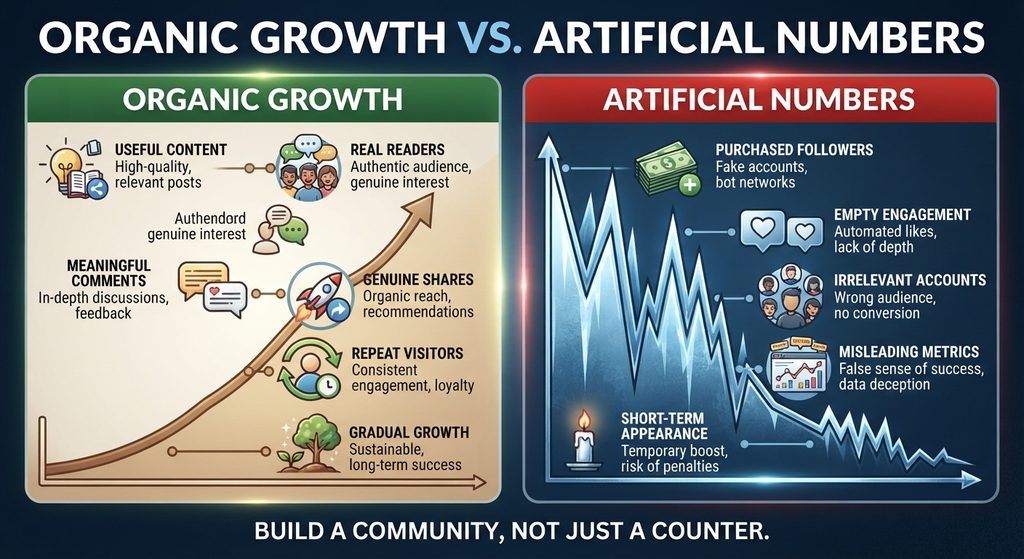
A Page does not simply need a larger number displayed beside “followers.” It needs people who intentionally chose to follow because they are interested in what the Page publishes.
Meta’s published guidance across its platforms also emphasizes authentic behavior and warns against artificially collecting engagement or spamming users. Facebook Even without thinking about platform rules, fake engagement provides weak business value. Ten thousand uninterested accounts cannot replace a smaller audience that reads, comments, shares, and returns.
Why Buying Followers Is Usually the Wrong Milestone
A follower counter can be manipulated. A community is much harder to fake.
Services that promise hundreds or thousands of followers may make a Page look larger temporarily, but a large follower count does not automatically create meaningful readership. If those accounts have no genuine interest in your subject, they are unlikely to read articles, participate in discussions, recommend your work, or visit your website.
This creates a strange situation. A Page may display impressive numbers while feeling completely empty whenever something is published. The appearance of popularity becomes disconnected from actual audience interest.
Engagement Matters More Than Vanity Numbers
Suppose Page A has 20,000 followers but receives almost no meaningful interaction. Page B has 800 followers, yet its posts regularly generate genuine discussions, website visits, repeat readers, and shares.
Which community would you rather build?
For most independent publishers, Page B is far more interesting.
Follower totals are useful as one measurement, but they should not become the only measurement. Website clicks, returning visitors, meaningful comments, shares, reading time, newsletter subscriptions, and conversions can reveal much more about whether the audience actually values the content.
A follower count tells you how many people pressed a button. It does not tell the entire story of the relationship that follows.
Do Not Turn Every Post Into an Engagement Request
There is nothing inherently wrong with asking readers to follow a Page occasionally. A clear call to action can help someone understand how to keep receiving updates.
Problems begin when every piece of content becomes an engagement demand.
“Like this.”
“Share this.”
“Tag five friends.”
“Comment immediately.”
“Follow now.”
When those instructions dominate the content, the audience can start feeling like a metric rather than a group of people. A better approach is to make the content itself valuable and then offer a natural invitation to follow when appropriate.
The distinction is subtle but important. Good content gives first and asks second.
How One Follower Can Improve Your Content Strategy
The first organic follower is worth celebrating, but the most productive response is not simply to stare at the follower counter. Use the milestone as motivation to improve the Page.
Look at what you published before the follow occurred. Consider which posts generated impressions, reactions, clicks, or comments. Think about where visitors might have discovered your content. You may not always be able to identify exactly why a particular person followed, but patterns become clearer as more data accumulates.
The goal is not to obsess over every metric. Instead, use available information to make better editorial decisions.
Study What Happened Before the Follow
Review your recent content. Did you publish a useful tutorial? Was one image noticeably stronger than your previous graphics? Did a particular topic receive more reactions? Did somebody share an article?
These observations can provide clues.
However, avoid drawing major conclusions from a single follower. One event is not enough data to prove that a particular posting time, headline style, image format, or topic guarantees growth.
Think of the first follower as the beginning of your dataset, not the final answer.
As more people interact with the Page, patterns become more meaningful. You can then compare topics, formats, posting frequency, click-through behavior, and engagement quality over longer periods.
Repeat the Value, Not Necessarily the Exact Post
When something works, creators often attempt to duplicate it immediately. Sometimes that makes sense, but repetition can quickly become monotonous.
Instead of copying a successful post, identify why it may have worked.
Perhaps the subject answered a common question. Maybe the headline clearly described the benefit. The graphic might have made a complicated idea easier to understand. Perhaps the post arrived when a topic was receiving unusual attention.
Once you understand the underlying value, you can reproduce the principle while creating something new.
That approach builds a recognizable editorial identity without turning the Page into a collection of nearly identical posts.
Test Different Content Formats
Not everyone consumes information in the same way. Some readers prefer detailed articles. Others respond to concise explanations, photographs, infographics, short videos, questions, or practical checklists.
Experimenting can reveal what your particular audience appreciates.
For example, a WordPress-focused Page could publish a detailed troubleshooting guide on Monday, a short security tip on Wednesday, and a simple infographic on Friday. After several weeks, the creator can compare the results.
Testing does not require abandoning your identity. It simply helps you discover the most effective ways to communicate the same underlying expertise.
The Journey From One Organic Follower to a Real Community
After the first follower arrives, it is tempting to immediately focus on follower number two. Then 10. Then 100. Eventually, the process can become an endless chase in which no milestone feels satisfying for more than a few minutes.
A better approach is to view growth as community building.
The question changes from “How do I get more followers?” to “How do I make this Page worth following?”
That second question produces better decisions. It encourages creators to improve articles, respond respectfully to comments, publish reliable information, correct mistakes, design clearer visuals, and think about what readers actually need.
Treat Early Followers Like Early Supporters
Early followers occupy an unusual position. They discovered the project before it became established. They saw the rough edges, smaller audience, experimental posts, and evolving design.
That can make them particularly valuable.
If somebody leaves a thoughtful comment, respond when appropriate. If they identify an error, investigate it. When readers repeatedly ask similar questions, consider turning those questions into future content.
This does not mean allowing followers to dictate everything you publish. Editorial independence still matters. However, listening to real readers can reveal problems and opportunities that analytics alone cannot show.
Give People Something Worth Sharing
Shares are especially interesting because they can extend content beyond the Page’s existing audience. Yet people generally need a reason to associate their name with something they redistribute.
That reason might be usefulness.
It might be humor.
It might be an interesting discovery.
It could be an emotional story, an important warning, a clear tutorial, or an unusually helpful explanation.
Instead of writing “Please share” beneath ordinary content, invest that effort in making the content genuinely share-worthy. The second strategy requires more work, but it creates a stronger foundation.
Respect the Reader’s Attention
Attention is one of the most limited resources online. Every reader has endless alternatives competing for the next minute of their time.
Respecting attention means getting to the point, using accurate titles, formatting articles for readability, avoiding unnecessary repetition, and delivering what the headline promises.
It also means resisting misleading clickbait.
A sensational headline may produce a click, but disappointment can destroy trust quickly. If the article does not deliver what the title promised, the visitor has little reason to return.
Sustainable organic growth depends heavily on that return visit.
Facebook Is Only One Part of the Audience
A Facebook Page can become a useful distribution channel, but independent publishers should avoid treating any social platform as the entire business.
Platforms can modify interfaces, recommendation systems, features, policies, and distribution behavior. Users can also change their habits. A source of traffic that works well today may become less important later.
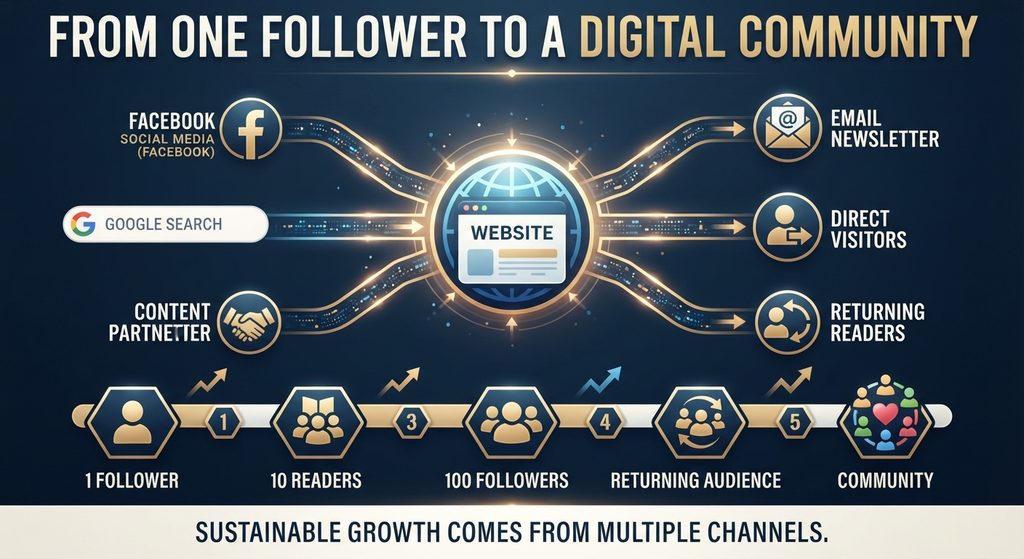
For a website owner, Facebook works best as one component of a broader audience strategy rather than the only way readers can discover the site.
Build the Website at the Same Time
If your Facebook Page supports a blog, continue improving the blog while building the social audience.
Publish useful evergreen articles. Improve navigation. Fix broken links. Optimize mobile performance. Create sensible internal links. Keep important pages current. Make it easy for visitors to discover related content.
A visitor arriving from Facebook should encounter a website that encourages exploration.
That journey matters. A social post may generate the first click, but the website experience influences whether the person becomes a returning reader.
Search Traffic and Social Traffic Serve Different Purposes
Search visitors often arrive with a specific question. They may search for instructions, troubleshooting information, definitions, comparisons, or news.
Social visitors frequently discover content more passively.
Both can be valuable.
A practical article may attract search traffic for years while also generating occasional social engagement. Meanwhile, an interesting Facebook post can introduce people to a website they would never have discovered through a search engine.
Combining these channels creates a more resilient publishing strategy.
Consider Direct Audience Relationships
Email newsletters, browser bookmarks, RSS feeds, and direct website visits can provide another layer of stability. These channels allow readers who already appreciate the content to return intentionally.
The objective is not to pull people away from Facebook. It is to give interested readers options.
Someone might discover an article through Facebook today, bookmark the website tomorrow, and subscribe later. That journey is more meaningful than simply maximizing a follower number.
Mistakes New Facebook Page Owners Should Avoid
Growth becomes frustrating when expectations are unrealistic. A creator may spend several hours designing a Page and then wonder why thousands of people have not discovered it within a week.
The internet rarely works that way.
Established Pages often have years of accumulated content, links, shares, brand recognition, advertising, collaborations, or existing audiences behind them. Comparing a new Page with a mature publisher ignores all of that history.
Your most useful comparison is usually with your own previous performance.
Publishing Only When You Want Something
Some Pages remain silent until the owner wants visitors to buy something, click something, subscribe, donate, or perform another action.
That relationship quickly becomes one-sided.
Try to provide useful content even when you are not asking readers for anything. Educational posts, helpful resources, interesting observations, practical tutorials, and genuine updates build familiarity.
Then, when you occasionally publish an important call to action, the request exists within a larger relationship rather than appearing as the Page’s entire purpose.
Copying Content Without Adding Value
Originality matters both ethically and strategically.
Republishing other people’s material without appropriate rights can create copyright problems. Meta’s own copyright guidance emphasizes that finding something online or giving the original creator credit does not automatically provide permission to repost copyrighted material. Facebook
Original work also gives people a reason to follow your Page.
You can discuss news, research, trends, or public information, but contribute something useful. Explain the context. Verify facts. Add analysis. Provide practical instructions. Link readers to appropriate sources.
A Page becomes memorable when it develops its own voice and purpose.
Ignoring Comments and Feedback
Small Pages have one advantage that huge Pages often lose: the ability to interact personally.
If five people comment, you can actually read every comment. You can understand their questions and respond thoughtfully when a response makes sense.
Use that advantage.
Those conversations can also inspire future articles. A single reader question may reveal that hundreds of other people have the same confusion.
Community feedback can therefore become part of the editorial process.
What Organic Growth Really Looks Like
Organic growth is rarely a smooth upward line. Some posts may reach considerably more people than others. A week can pass with little visible activity, followed by a post that unexpectedly attracts new readers.
That unevenness is normal.
Creators often see polished success stories after the difficult early stages have disappeared from view. They see the Page with 100,000 followers, not the months when its creator was publishing to 37 people.
Remembering that can make the early phase easier to appreciate.
Zero to One Can Be Harder Than It Looks
Going from zero to one proves that discovery is possible.
Going from one to ten provides additional evidence.
Reaching 100 begins to resemble a small audience.
Eventually, the numbers become larger, but the basic mechanism remains surprisingly similar. A person encounters something. They evaluate it. They decide whether it deserves another moment of their attention.
Creators cannot control that final decision. They can only increase the probability by consistently publishing work that deserves consideration.
Growth Does Not Need to Be Fast to Be Valuable
Fast growth can be exciting, but slow growth is not automatically failure.
For an independent website, 500 highly relevant followers may provide considerably more value than 50,000 people who have little interest in the subject.
The quality of the relationship matters.
Ask whether followers return. Do they read? Do they ask questions? Do they recognize the Page? Are some visitors becoming regular website readers?
Those signals describe a community more accurately than a single large counter.
How I Would Grow a New Facebook Page From the First Follower
If I were starting from this exact milestone again, I would keep the strategy simple. I would publish consistently, focus on topics I genuinely understand, create original visuals, and connect social posts to useful website content when appropriate.
I would also avoid changing direction every time one post performed poorly. Individual posts are noisy data. A content strategy needs enough time and enough published material before patterns become trustworthy.
Most importantly, I would keep the Page recognizable. Readers should gradually understand what they can expect when they see its name.
Create Several Clear Content Pillars
A Page becomes easier to understand when it has a few recognizable subjects.
For a technology and lifestyle publication, those pillars might include WordPress tutorials, cybersecurity warnings, practical technology guides, internet trends, and selected lifestyle topics.
The exact categories depend on the site’s purpose.
Content pillars do not prevent experimentation. They simply provide structure. A visitor can look at several posts and quickly understand why following might be worthwhile.
Create Better Images Instead of More Images
Visual content can make posts easier to notice, but quality matters more than quantity.
A useful graphic should support the information rather than simply decorate the post. Infographics can summarize processes. Screenshots can demonstrate technical steps. Original illustrations can explain abstract concepts.
Keep text readable on mobile screens and avoid overcrowding images with tiny information.
Whenever possible, create or properly license visual assets rather than downloading random pictures from the internet. That protects both the publication and the people whose work appears online.
Make Headlines Accurate and Interesting
A strong headline creates curiosity without deceiving the reader.
“The WordPress Setting That Can Cause This Error” can work when the article genuinely identifies and explains that setting. A headline promising an unbelievable secret when the article contains ordinary advice damages credibility.
Readers remember disappointment.
Accurate titles may sometimes attract fewer impulsive clicks, but they help build a stronger long-term relationship with the audience.
Measure Trends Over Time
Do not refresh statistics every few minutes.
Instead, review performance at useful intervals. Compare several weeks or months. Look at which topics consistently attract readers rather than focusing entirely on isolated spikes.
Consider metrics such as reach, meaningful interactions, link clicks, returning website visitors, and follower growth.
Numbers should guide editorial decisions, not control your mood.
The Human Meaning Behind Social Media Statistics
Digital publishing can become strangely mechanical. We discuss impressions, sessions, click-through rates, conversions, followers, rankings, and engagement percentages.
Those measurements are useful, especially when operating a website professionally. Yet every meaningful metric eventually traces back to human behavior.
- Someone opened the article.
- Someone stayed long enough to read it.
- Someone found the answer useful.
- Someone shared it.
- Someone decided to follow.
That human layer is easy to overlook once the numbers grow.
Remember the People Behind the Dashboard
If a Page reaches 10,000 followers someday, it becomes impossible to know every person individually. Nevertheless, the principle established by the first follower should remain.
Readers deserve accurate information and reasonable respect.
They should not be treated merely as traffic sources for advertisements or numbers that improve a social profile’s appearance.
Ironically, remembering this often supports better publishing decisions. When you write for actual people instead of algorithms, you naturally begin asking more useful questions: Is this clear? Is it accurate? Does it answer what the title promises? Would I find this useful?
Those questions create better content.
Small Milestones Deserve Recognition
Creators sometimes refuse to celebrate anything until they reach a huge target.
That can make a long project unnecessarily exhausting.
The first follower matters. So does the tenth. The first genuine comment matters. The first article that receives meaningful search traffic matters. The first returning reader matters.
Celebrating does not require pretending that a tiny milestone is enormous. It simply means acknowledging progress.
The screenshot of Sam Williams as the first organic follower captures one of those moments for this Page. Whatever happens later, that particular first cannot happen twice.
A Practical 30-Day Organic Growth Approach
The first month after noticing genuine organic growth is a good time to establish habits rather than chase dramatic results. Start by reviewing the Page itself. Make sure the profile image, description, website link, categories, and public information clearly represent the publication.
Then concentrate on content.
During those 30 days, publish at a pace you can sustain beyond the experiment. Track broad patterns without changing strategy after every post. Use a mixture of evergreen material and timely content when the subject naturally supports both.
At the end of the month, compare the results with the beginning.
Week One: Improve the Foundation
Review the Page from the perspective of somebody who has never seen it.
Can a visitor immediately understand what the Page publishes? Does the profile image look recognizable? Does the description explain the purpose? Is the website destination correct?
Facebook provides settings that allow Page owners to control various aspects of Page visibility and presentation. Facebook Review these periodically because platform interfaces and available options can evolve.
Next, examine your recent posts. Identify which ones best represent the quality you want future visitors to encounter.
Week Two: Publish With a Clear Purpose
Instead of publishing simply because the calendar says you should, assign a purpose to each post.
One post might teach.
Another might answer a common question.
A third could highlight a detailed website guide.
Another might invite genuine discussion around a relevant subject.
This creates variety while keeping the Page focused. It also makes later analysis more useful because you can compare different types of content.
Week Three: Listen to the Audience
Look beyond raw reach.
Which posts generated meaningful comments? Which links produced website visits? Did readers ask questions? Were certain subjects shared more often?
Write those observations down.
If the audience is still very small, avoid making sweeping conclusions. Instead, treat these signals as hypotheses to test again.
Organic growth is partly a process of discovering where your expertise overlaps with audience interest.
Week Four: Refine Instead of Reinventing
After several weeks, resist the temptation to rebuild everything.
Keep what appears to be working. Improve weaker areas. Test one or two changes rather than ten changes simultaneously.
For example, you might improve headline clarity while keeping the posting schedule stable. Alternatively, test a different image format while maintaining the same content categories.
Controlled changes make it easier to understand what actually affected performance.
Frequently Asked Question
What is an organic follower on Facebook?
An organic follower is generally understood as someone who chooses to follow a Page through natural discovery rather than through purchased follower services or paid acquisition. They may discover content through Facebook, shares, search, another website, or recommendations. In this article, I use the term specifically for a person who followed without receiving a personal invitation from me.
Is one organic follower important?
Numerically, one follower is obviously small. Symbolically, however, the first organic follower can be important because it demonstrates that someone outside your immediate network discovered the Page and chose to receive future content.
Should I invite friends to follow my Facebook Page?
You can. Facebook officially provides functionality for inviting friends to like or follow Pages. Facebook However, invitations should complement rather than replace a strategy based on useful content and genuine audience discovery.
Should I buy followers for a new Facebook Page?
Buying followers is generally a poor foundation for a real community. A large number of irrelevant or inactive accounts may make the follower counter look impressive without producing meaningful readership, engagement, website traffic, or customer relationships.
How often should a new Facebook Page post?
There is no universal frequency that suits every Page. Choose a schedule that allows you to maintain quality consistently. Three strong posts per week can be more useful than several rushed posts every day. Test your schedule over time and adjust it using actual audience behavior.
How long does organic Facebook growth take?
There is no guaranteed timeline. Results depend on the niche, content quality, existing audience, competition, distribution, consistency, timing, and many other factors. Some Pages grow quickly after a successful post, while others develop gradually over months or years.
Are Facebook followers more important than website visitors?
They measure different things. Followers can help create recurring social exposure, while website visitors interact directly with your publication. For bloggers and independent publishers, a diversified audience across social, search, email, and direct traffic can reduce dependence on one platform.
What should I publish to attract genuine followers?
Publish material that gives the intended audience a clear reason to return. Tutorials, useful explanations, original reporting, practical tips, thoughtful commentary, educational graphics, and relevant updates can all work when they match the Page’s purpose.
Should every Facebook post contain a link?
Not necessarily. A Page can combine website links with standalone social posts, images, short explanations, discussions, and other appropriate formats. The best mix depends on the publication and its audience.
What should I do after gaining my first organic follower?
Keep publishing. Study what readers respond to, improve your weakest content, maintain consistent standards, and resist shortcuts. The goal after gaining one follower should not simply be getting another number. It should be becoming more worthy of the next person’s attention.
Every Community Has a First Person
Today it is one organic follower. Tomorrow it might be two, ten, one hundred, or considerably more. Nobody can guarantee how quickly those numbers will change.
What can be controlled is the work behind them.
Create useful content. Be consistent. Write accurate headlines. Make original visuals. Respect readers. Learn from analytics without becoming obsessed with them. Avoid artificial shortcuts that produce impressive-looking numbers without a meaningful audience.
Most importantly, remember where the community began.
For this Page, Sam Williams became the first organic follower. That small milestone deserves its screenshot because it represents the moment the Page stopped being something published only by its creator and became something another person voluntarily chose to follow.
If the community becomes much larger someday, the first follower will still be the first.
And that is a number no future milestone can replace.
⚠️ Disclaimer and Source Hygiene
This article is based on personal publishing experience, general digital-content practices, and research using official Meta/Facebook resources where platform-specific information is discussed. Facebook features, interfaces, recommendation systems, policies, and Page settings may change over time, so Page administrators should verify current options before making technical or business decisions.
The article does not promise specific follower, reach, traffic, or revenue results. Organic social-media performance varies considerably between Pages and audiences. References to individual followers describe the author’s own milestone and should not be interpreted as an endorsement by that person.
🔔 For more tutorials like this, consider subscribing to our blog.
📩 Do you have questions or suggestions? Leave a comment or contact us!
🏷️ Tags: Facebook organic followers, Facebook Page growth, first Facebook follower, organic Facebook growth, social media growth, Facebook marketing, Facebook Page tips, organic social media, audience building, content strategy
📢 Hashtags: #Facebook, #FacebookPage, #OrganicGrowth, #FirstFollower, #SocialMedia, #ContentCreator, #AudienceGrowth, #DigitalMarketing, #Blogging, #ContentStrategy
📚 Sources and References
For Facebook-specific functionality and current platform guidance, the article uses official Meta/Facebook documentation. Facebook explains that Page administrators can invite friends to like or follow their Page, which helps distinguish that method from the independently discovered follower described in this article. Facebook
Facebook also documents the ways users can influence what appears in Feed, including Feed preferences, hiding content, unfollowing, and signals such as “Interested” and “Not interested.” Its documentation additionally notes efforts to reduce clickbait and spam. Facebook
For creators using third-party material, Meta’s copyright guidance is especially relevant. It explains that simply finding material online, giving credit, or modifying it does not automatically eliminate potential copyright issues. Creators should publish original work or ensure they have appropriate rights to material they use. Facebook
Useful official references:
- Facebook Help Center – Invite friends to like or follow a Page
- Facebook Help Center – Control what you see in Feed
- Facebook Help Center – Manage Page settings
- Meta copyright guidance
🕊️ Secondary Sources and Testimonials
The central testimonial in this article comes from the real experience documented in the accompanying screenshot: Sam Williams appeared as the first organic follower of the Facebook Page. The screenshot serves as a personal record of the milestone rather than evidence of a broader claim about Facebook’s algorithm.
The wider lesson is intentionally simple. Large communities do not begin as large communities. They begin when individual people discover something worth returning to. For an independent publisher, recognizing those early readers can help preserve the human perspective that becomes increasingly easy to lose as analytics grow larger.
