


⏲️ Estimated reading time: 7 min
Table of Contents
Nvidia and Intel’s $5 Billion Partnership: A Seismic Shift in AI and PC Hardware. Nvidia and Intel have announced a landmark $5 billion collaboration that fuses Nvidia’s RTX GPU power with Intel’s x86 CPUs. From custom AI data center processors to integrated PC SoCs, this partnership could reshape the semiconductor landscape for years to come.
Nvidia and Intel
On September 18, 2025, the technology industry witnessed one of the most surprising and potentially transformative announcements in recent history: Nvidia and Intel are officially partners. What once seemed unthinkable two long-time rivals in the PC and data center space aligning is now reality.
Nvidia committed $5 billion in Intel stock purchases, instantly becoming one of Intel’s largest shareholders. But the financial aspect is only the beginning. The collaboration includes jointly developed hardware platforms that fuse Nvidia’s RTX GPU technology with Intel’s x86 CPUs, designed for both consumer PCs and massive AI data centers.
Industry outlets have described the deal as “seismic” a reshaping of the competitive dynamics between Nvidia, Intel, AMD, Arm, and TSMC. In this article, we’ll dive deep into the announcement, examine the key elements, strategic implications, and potential impact across markets.
Key Elements of the Announcement
1. Intel x86 RTX SoCs for PCs
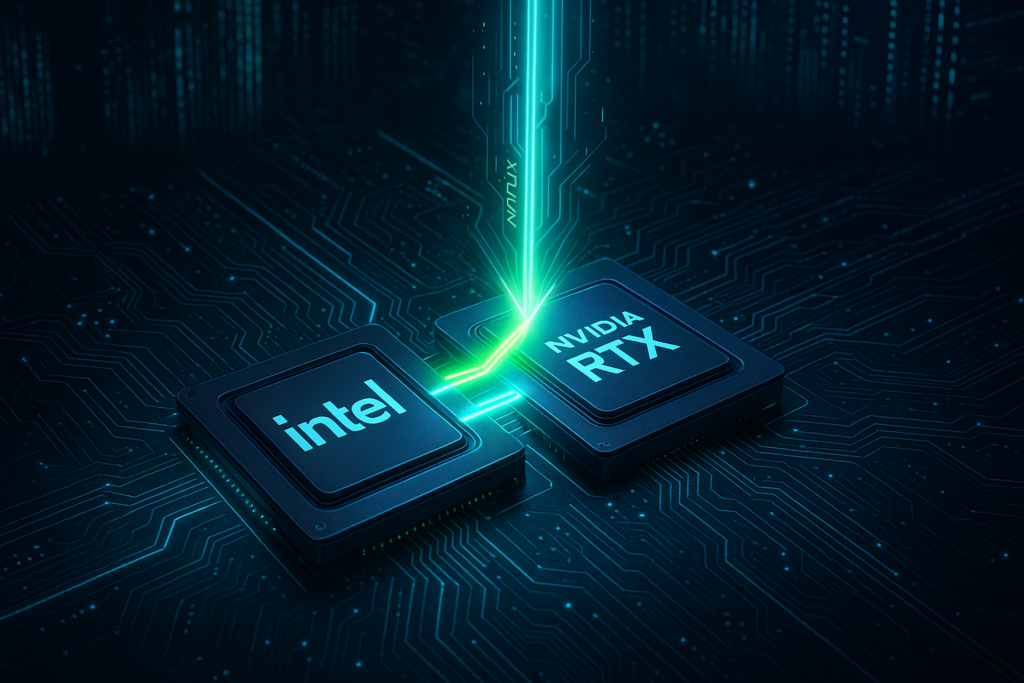
The most headline-grabbing piece of the puzzle is the plan to design system-on-chips (SoCs) that directly integrate Nvidia RTX GPU chiplets with Intel x86 CPU cores.
- High-bandwidth NVLink integration: Instead of traditional PCIe links between CPU and GPU, these chips will use Nvidia’s NVLink to enable ultra-fast communication between components.
- Target devices: Gaming laptops, compact desktops, and thin-and-light machines where heat, size, and efficiency matter as much as raw performance.
- Performance vision: By merging CPU and GPU on the same SoC, latency is reduced, power efficiency improves, and tasks like ray tracing, AI upscaling (DLSS), and real-time rendering can benefit from tighter hardware synergy.
- Competitor comparison: AMD’s APUs have offered CPU+GPU integration for years, but with Nvidia’s RTX graphics architecture, Intel gains access to superior ray tracing, CUDA, and AI cores.
This could mean next-generation laptops that deliver near-desktop GPU performance in a much smaller thermal envelope.
2. Custom Nvidia Data Center x86 Processors
For the data center, Intel will produce bespoke x86 CPUs that Nvidia can tightly integrate with its accelerated computing platforms.
- Optimized for AI training & inference: These CPUs will work hand-in-hand with Nvidia’s CUDA ecosystem, Tensor cores, and AI-centric hardware.
- Enterprise adoption: Hyperscalers and cloud giants (AWS, Microsoft Azure, Google Cloud) could benefit from infrastructure where CPUs and GPUs are co-designed, improving energy efficiency and throughput.
- Strategic positioning: With Intel CPUs inside, Nvidia can expand its dominance in data center AI workloads, while Intel gets relevance in markets where its Xeon processors have lost ground.
This represents a powerful combination of strengths Intel’s mature CPU ecosystem + Nvidia’s leadership in AI.
3. Nvidia’s $5 Billion Investment in Intel
The financial cornerstone of the partnership is Nvidia’s purchase of $5 billion in Intel common stock at $23.28/share.
- Ownership stake: Estimated between 4–5%, placing Nvidia among Intel’s top investors.
- Confidence booster: Intel’s stock price surged more than 30% in pre-market trading after the announcement, reflecting renewed optimism in Intel’s turnaround.
- Timing: This comes after Intel secured $5.7 billion in U.S. government subsidies and a $2 billion investment from SoftBank earlier in 2025. Nvidia’s move signals industry validation of Intel’s direction.
- Focus: Unlike speculation that Intel might manufacture Nvidia GPUs, the agreement clarifies: the foundry side is not the focus. Instead, Intel will design and build CPUs tailored for Nvidia’s needs.
Strategic Implications
For Intel
- Revitalized product portfolio: Having Nvidia as a customer strengthens Intel’s roadmap for x86.
- Arc GPU sidelining? Analysts believe Intel may downplay or even phase out its own Arc discrete GPUs to prioritize Nvidia’s RTX ecosystem.
- Financial stability: The $5 billion cash infusion plus newfound confidence from markets could stabilize Intel’s long-term R&D commitments.
For Nvidia
- Custom x86 options: Nvidia has been pushing Arm-based Grace CPUs, but this move ensures it has x86 solutions that are backward-compatible with legacy software.
- Supply chain hedging: Closer ties to Intel reduce dependency on external fabs like TSMC.
- Expanded dominance: With both Arm (Grace) and x86 (Intel custom CPUs), Nvidia gains flexibility unmatched by rivals.
For the Market
- AMD in the crosshairs: AMD’s unique advantage with combined CPU/GPU designs may be challenged directly.
- Stock surges: Intel shares rocketed upwards, while AMD’s stock dipped slightly in response.
- Geopolitical dimension: With the U.S. government heavily supporting domestic semiconductor collaboration, this deal also strengthens American tech independence.
Industry Reaction
Tech communities across Reddit, X (Twitter), and specialized forums are buzzing with speculation:
- Excitement: Many see this as the long-awaited “dream team” partnership for gaming laptops.
- Skepticism: Some worry Nvidia may overshadow Intel, reducing its autonomy.
- Regulatory concern: Analysts warn regulators may scrutinize the deal, especially if it alters competitive dynamics too drastically.
Timeline and Future Generations
Nvidia and Intel confirmed that this partnership will cover “multiple generations” of products. No launch dates were disclosed, but based on semiconductor development cycles:
See also: FC Companion App Guide: Install & Use Like a Pro
- Earliest consumer SoCs: Likely late 2026 or early 2027.
- First data center deployments: Possibly 2027, given validation and hyperscaler adoption timelines.
The long roadmap signals this is not a short-term experiment but a fundamental realignment of strategies.
Wider Context: The AI Arms Race
This announcement arrives during an unprecedented boom in AI infrastructure spending. Companies like OpenAI, Anthropic, and Google DeepMind are scaling up models that require tens of thousands of GPUs.
- Nvidia dominates GPUs, but CPUs remain essential for orchestration and preprocessing.
- Intel, once the king of CPUs, has lost relevance in AI until now.
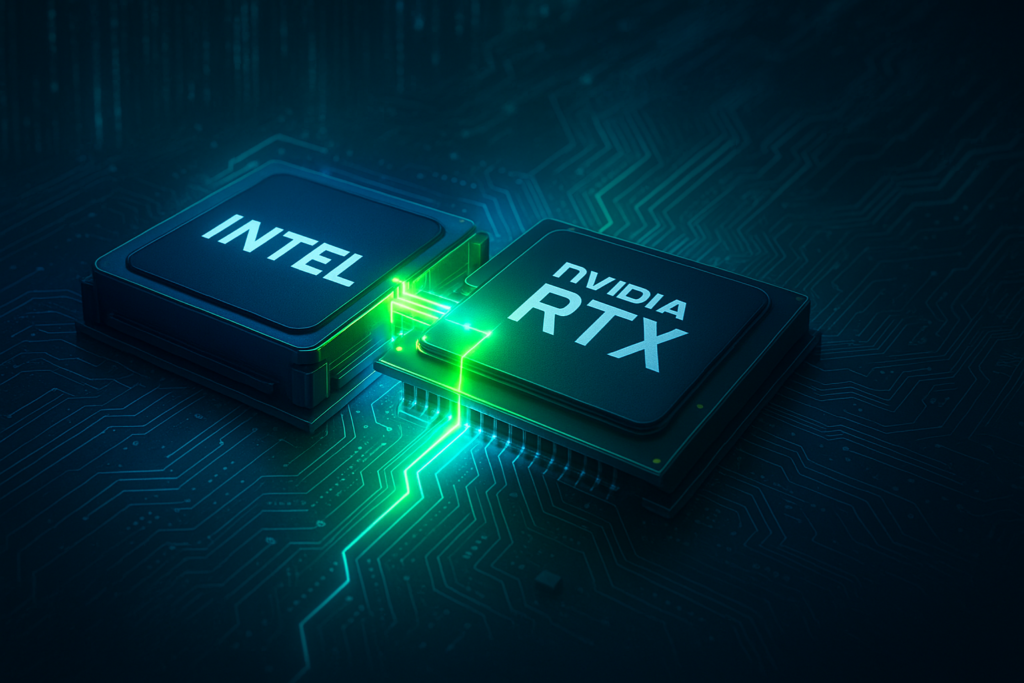
- Together, the companies could offer full-stack solutions where CPU and GPU are optimized in harmony.
This is also part of a larger U.S. strategy to maintain semiconductor leadership against growing competition from China.
Challenges and Open Questions
While the news is groundbreaking, several uncertainties remain:
- Manufacturing clarity: Will Intel’s own fabs handle all chips, or will TSMC still play a role?
- Software ecosystems: How will existing Nvidia CUDA and Intel oneAPI frameworks coexist or merge?
- Product overlap: How does this affect Nvidia’s Grace CPU roadmap or Intel’s Xeon line?
- Regulatory approval: Will U.S. and EU authorities view this as anti-competitive?
These unanswered questions will determine whether the partnership fulfills its potential or stumbles.
Final Thoughts
This partnership isn’t just about two companies it’s about the future of computing. By aligning their strengths, Nvidia and Intel are preparing to dominate both consumer PCs and enterprise AI markets.
If successful, Intel x86 RTX SoCs could become the standard for gaming laptops, while custom data center CPUs cement Nvidia’s AI supremacy. For Intel, this is a lifeline; for Nvidia, it’s an expansion of dominance. For the market, it’s a new era.
Wrap-Up
The Nvidia–Intel alliance represents a historic fusion of platforms once thought irreconcilable. With $5 billion on the line and the promise of integrated CPU–GPU designs across PCs and data centers, the stakes couldn’t be higher. Whether this reshapes the industry for decades or becomes another bold experiment depends on execution but either way, history was made on September 18, 2025.
🔔 For more tutorials like this, consider subscribing to our blog.
📩 Do you have questions or suggestions? Leave a comment or contact us!
🏷️ Tags: Nvidia Intel deal, Intel x86 RTX SoC, Nvidia AI processors, Intel custom CPUs, Nvidia investment, semiconductor partnership, AI infrastructure, PC gaming hardware, NVLink integration, AMD competition
📢 Hashtags: #Nvidia #Intel #AI #Semiconductors #RTX #x86 #DataCenters #GamingPC #TechNews #Partnership
