


⏲️ Estimated reading time: 7 min
Table of Contents
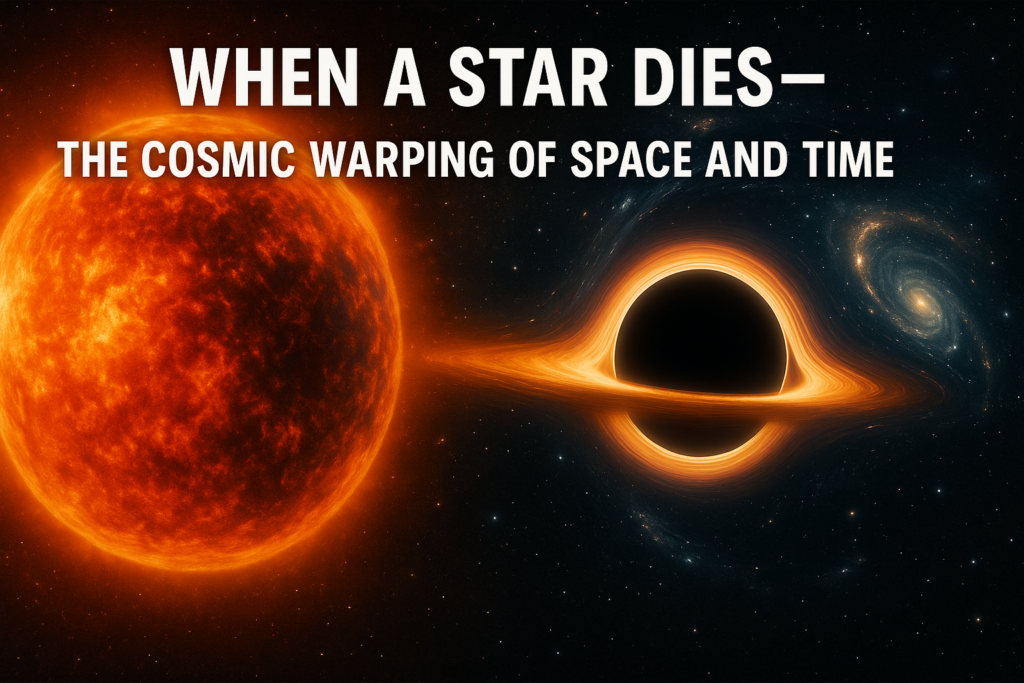
When a massive star dies, its collapse doesn’t just end in an explosion. It bends reality itself, warping space-time so violently that light, matter, and even time behave in extraordinary ways beyond human imagination.
The Cosmic Death of a Star
When a star dies, it doesn’t simply explode. The process is far more dramatic and mind-bending. Its death unleashes a collapse so powerful that the very fabric of the universe space and time begins to distort around it.
Imagine a star twenty times more massive than our Sun. For millions of years, it burns hydrogen into helium, balancing the outward pressure from nuclear fusion against the inward pull of gravity. But when its nuclear fuel finally runs out, the balance ends abruptly.
In a matter of seconds, the star collapses under its own weight.
Gravity Beyond Imagination
During this collapse, gravity grows so overwhelming that space-time curves inward like a bowling ball pressing deep into a cosmic trampoline. The core of the dying star crushes into an incredibly dense sphere, sometimes no larger than a city.
If the remaining mass is small enough, it becomes a neutron star a super-dense ball made almost entirely of neutrons, where a teaspoon would weigh billions of tons. But if the mass exceeds a critical limit, the collapse continues without end, forming a black hole, a region of space where gravity is so strong that not even light can escape.
The Cosmic Lens Effect
Black holes and neutron stars both have an incredible effect on their surroundings. The intense gravitational field around them doesn’t just pull in matter it bends light.
This bending, known as gravitational lensing, can make distant stars and galaxies appear distorted, multiplied, or shifted from their true positions.
If you could observe a black hole safely, you might witness stars behind it appearing in unexpected places sometimes duplicated into multiple images. The dead star’s gravity literally acts like a cosmic magnifying glass, curving the light of the universe around itself.
Time Slows Down Near a Black Hole
Gravity doesn’t only bend space it also bends time. Near the crushing gravity of a neutron star or black hole, time itself slows.
For an observer close to the surface, one second might feel normal, but for someone far away, that same second could last minutes or even hours.
Einstein’s Theory of General Relativity predicted this over a century ago. His equations showed that massive objects curve space-time, affecting both how light travels and how time flows.
This isn’t just theory it’s been proven through countless astronomical observations. The GPS systems we use daily even rely on corrections from Einstein’s relativity to stay accurate.
The Geometry of Space Itself Changes
When we say a star’s death “warps space-time,” we’re not speaking metaphorically. The collapse creates a distortion so intense that it alters the actual geometry of the universe.
The star’s core becomes a point of near-infinite density what physicists call a singularity. Around this singularity lies the event horizon, the point of no return.
Anything crossing that invisible line light, matter, or even information can never escape.
Inside, the known laws of physics break down. Space and time themselves swap roles in a sense; what was once spatial distance becomes time-like, and what was once time behaves like space. It’s the ultimate cosmic paradox an object so dense it erases our current understanding of reality.
A Star’s Death Creates a New Kind of Universe
While it sounds like an end, the death of a massive star is also a beginning.
The explosion that accompanies the collapse a supernova scatters heavy elements like iron, gold, and uranium across space. These elements form new planets, moons, and even life itself.
So, in a poetic way, every human being carries atoms forged in the heart of long-dead stars.
But the black holes and neutron stars left behind continue to shape the cosmos. Their extreme gravity affects nearby stars, gas clouds, and even light itself sometimes forming the centers of entire galaxies.
Physics Beyond Fiction
Standing near such a cosmic monster would defy everything we know about experience.
Space would curve, light would twist, and time would crawl. From your perspective, distant stars might shimmer strangely or appear to stretch into rings. Meanwhile, to an outside observer, you’d appear to move slower and slower frozen in time as you approached the event horizon.
It’s a realm where the line between science and science fiction disappears.
Einstein was right: gravity really does warp time.
The universe is not a static stage it’s a living, flexible fabric that bends, ripples, and stretches under the influence of mass and energy. Every dying star is both a tragedy and a transformation a reminder that even in death, the cosmos keeps creating beauty from destruction.
Why We Can’t Stop Studying Black Holes
Astrophysicists study black holes not only to understand how stars die but also to uncover the secrets of time, space, and creation itself.
Each new observation from gravitational waves detected by LIGO to the shadow image of a black hole captured by the Event Horizon Telescope confirms that Einstein’s universe is stranger and more elegant than we ever imagined.
The more we learn, the clearer it becomes: the end of a star is not the end of the story. It’s a gateway into the deepest mysteries of existence.
The Universe in Motion
Every moment, somewhere in the cosmos, a star is dying, collapsing, and transforming. Each event reshapes the structure of reality bending light, twisting time, and sending ripples across space.
We live in a universe that is constantly in motion, where endings are beginnings and destruction leads to creation.
The death of a star is one of nature’s greatest performances a spectacle of gravity, light, and time that reminds us just how wild and wondrous physics can be.
So the next time you look up at the night sky, remember: the light from those stars is ancient, and some of them may already be gone. What you see is the past, stretched across time and space, whispering stories of death, rebirth, and the ever-bending universe.
FAQ
What happens when a star dies?
A massive star runs out of fuel, causing its core to collapse under gravity. This collapse can result in a neutron star or a black hole.
Why does gravity bend light?
Gravity bends light because mass curves space-time. Light follows that curvature, appearing bent when passing near massive objects like black holes.
Can time really slow down near a black hole?
Yes. The stronger the gravity, the slower time moves relative to areas with weaker gravity, as proven by Einstein’s General Relativity.
What is gravitational lensing?
It’s the bending and magnifying of light caused by a massive object’s gravity. It allows astronomers to see distant galaxies hidden behind others.
Are we made from star dust?
Absolutely. The carbon, oxygen, iron, and other elements in our bodies were forged in the hearts of ancient stars before being scattered into space by supernovae.
The Endless Cycle of Cosmic Creation
Every death in the universe plants the seed for new life. Stars die so that new ones may form. From their ashes, galaxies shine brighter, planets emerge, and life takes shape.
So next time someone says “Physics is boring,” remember this:
When a star dies, it doesn’t fade into silence it becomes a doorway to eternity.
🔔 For more tutorials like this, consider subscribing to our blog.
📩 Do you have questions or suggestions? Leave a comment or contact us!
🏷️ Tags: star death, black hole, neutron star, space-time, Einstein relativity, gravitational lensing, physics, astronomy, supernova, cosmic collapse
📢 Hashtags: #StarDeath, #BlackHole, #SpaceTime, #Einstein, #Physics, #Astronomy, #Cosmos, #Relativity, #NeutronStar, #Supernova
The Universe Never Truly Ends
Even in death, stars give meaning to existence. Their collapse is not destruction it’s transformation. The cosmos doesn’t erase; it evolves. Every photon, atom, and ripple carries forward the story of light, gravity, and endless creation.
Read also: Speeds in the Universe: From Earth to the Cosmic Infinite
