


⏲️ Estimated reading time: 11 min
Table of Contents
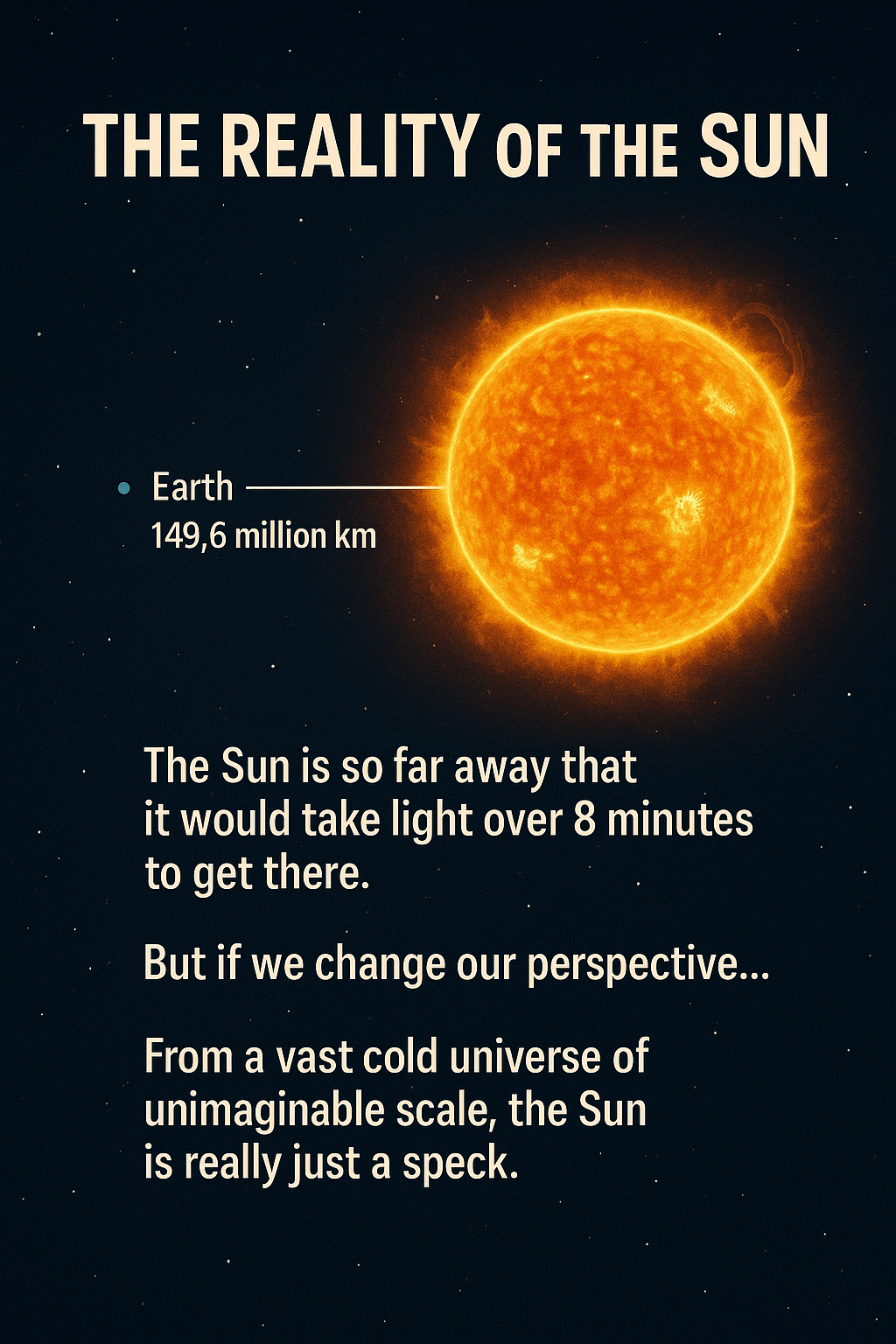
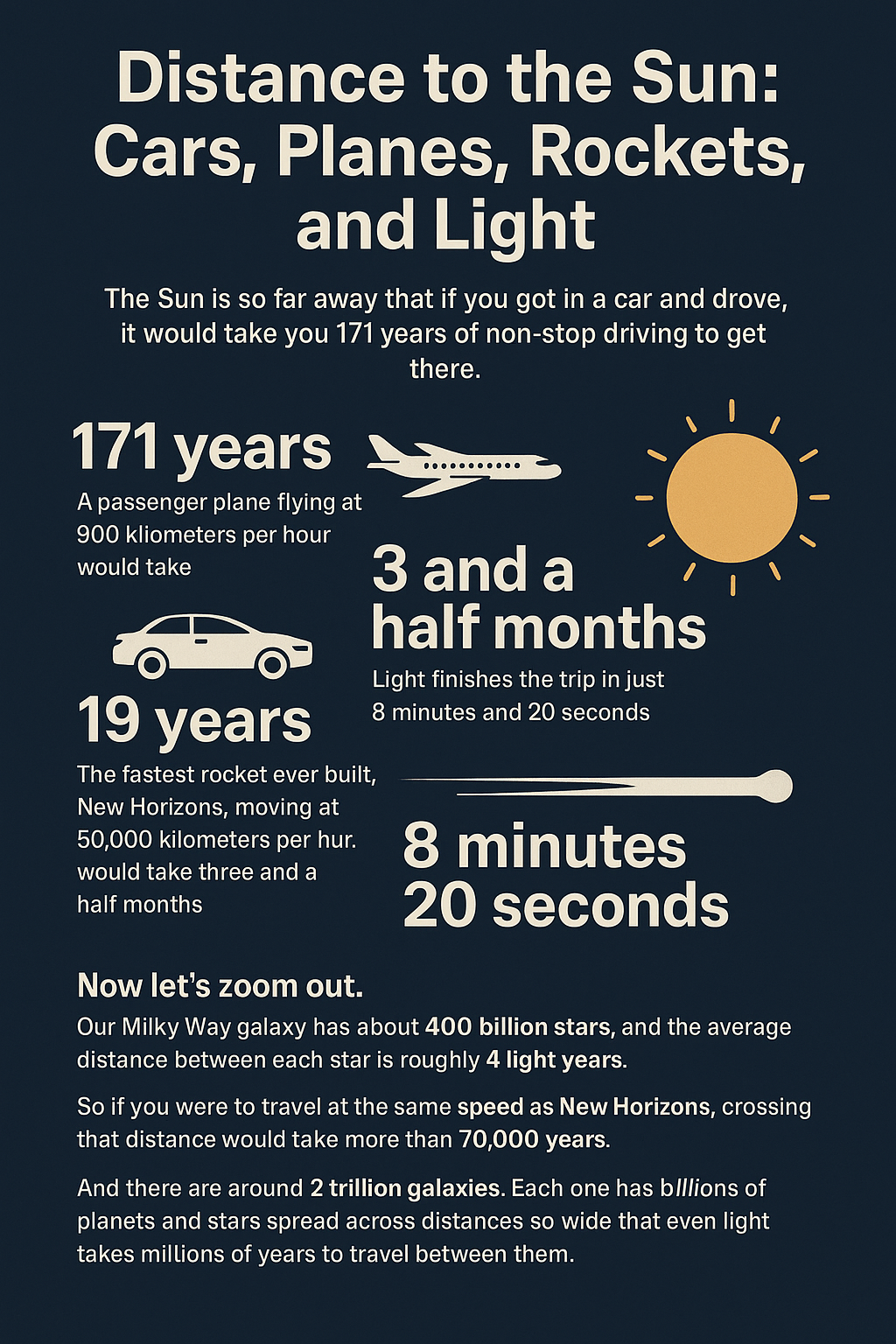
The Sun feels close at dawn, yet it sits 150 million kilometers away. Driving there non-stop would take 171 years. At jet speed, 19 years. Even our fastest probe needs months. Light wins in minutes. Scale changes everything across an immense universe.
Distance to the Sun: Cars, Planes, Rockets, and Light
Ever looked up and thought the Sun seems near?
It looks large. It warms your skin.
But the numbers tell a different story.
We compare cars, planes, rockets, and light.
Then we zoom out to the Milky Way and beyond.
You will leave with a sharp sense of cosmic scale.
Outbound sources: (Wikipedia), (NASA), (ESA), (Britannica).
This post turns awe into clear, human scale facts.
Distance to the Sun in Plain Numbers
Astronomers call the average Earth–Sun distance one astronomical unit.
That equals about 150 million kilometers.
The number shifts a bit across Earth’s orbit (Wikipedia).
But for back-of-the-napkin math, 150 million works well.
To build intuition, let’s compare travel modes.
We hold the distance fixed.
We change the speed.
By Car: 171 Years of Non-Stop Driving
Assume a steady 100 km/h.
Ignore fuel, sleep, and roads.
At that speed, the trip needs about 1.5 million hours.
That equals 171 years.
You would start the journey in one century.
Your great-great-grandchildren would still be driving in the next.
Check the math
- Distance: 150,000,000 km
- Speed: 100 km/h
- Time = distance / speed = 1,500,000 hours
- Hours to years ≈ 1,500,000 / 8,760 ≈ 171 years
By Passenger Plane: 19 Years at 900 km/h
Modern airliners cruise near 900 km/h (Wikipedia).
At that speed, the trip needs about 166,667 hours.
That equals around 19 years.
No crew could manage such a flight.
The fuel math breaks reality.
The thought experiment still helps scale the distance.
Check the math
- Time = 150,000,000 / 900 ≈ 166,667 hours
- Hours to years ≈ 166,667 / 8,760 ≈ 19.0 years
By Record-Fast Probe: Months, Not Years
The New Horizons probe crossed the solar system fast (NASA).
It reached about 58,000 km/h during its journey.
At that speed, the Earth–Sun distance takes roughly 108 days.
That equals about three and a half months.
Deep space needs extreme speeds to feel “near.”
Check the math
- Time = 150,000,000 / 58,000 ≈ 2,586 hours
- Hours to days ≈ 2,586 / 24 ≈ 107.8 days
By Light: Minutes, Not Months
Light moves at 299,792 km/s in vacuum.
It covers the Earth–Sun distance in about 8 minutes 20 seconds.
That delay explains why solar events reach us slightly later (ESA).
When you see the Sun, you see it as it was minutes ago.
Comparative Table: Distance to the Sun
| Mode | Typical Speed | Travel Time to Sun |
|---|---|---|
| Car | 100 km/h | ~171 years |
| Passenger plane | 900 km/h | ~19 years |
| New Horizons probe | 58,000 km/h | ~108 days |
| Light | 299,792 km/s | ~8 min 20 sec |
Speeds are representative for intuition, not mission planning. See (NASA), (ESA), (Wikipedia).
Distance to the Sun: A Human-Scale Story
Let’s add some color with a short story.
Imagine a family road trip that never ends.
You measure progress by decades, then by generations.
Still, the Sun stays out of reach.
The scale defeats ordinary travel.
Now switch to a jet.
The cabin hums for nineteen continuous years.
Flight attendants hand snacks to your grandchildren.
You cross only a single astronomical unit.
The Sun does not care.
Space keeps its vastness.
Zooming Out: The Milky Way’s Scales
The Milky Way may hold about 400 billion stars (Britannica).
The average gap between nearby stars is a few light years.
Our closest neighbor, Proxima Centauri, sits 4.24 light years away (Wikipedia).
At New Horizons speed, that trip would take over 70,000 years.
Back-of-the-envelope check
- 1 light year ≈ 9.461 × 10¹² km
- 4 ly ≈ 3.784 × 10¹³ km
- At 58,000 km/h: time ≈ 6.52 × 10⁸ hours
- Hours to years ≈ 6.52 × 10⁸ / 8,760 ≈ 74,500 years
Cross-galaxy trips take far longer.
Even light needs tens of thousands of years to cross the Milky Way.
Human travel remains far slower than light.
That gap defines our cosmic limits.
Two Trillion Galaxies: A Universe of Distance
Observations suggest roughly two trillion galaxies in the observable universe (Wikipedia).
Each galaxy holds billions of stars and planets.
Gaps between galaxies are vast beyond simple thought.
Light needs millions of years to cross some intergalactic gulfs (ESA).
Human craft crawl by comparison.
When you gaze at a galaxy image, you view deep time.
Some photons began their trip before humans existed.
They crossed voids, dodged dust, and reached your eyes tonight.
Cosmic photos are postcards from the ancient past.
Visuals: Quick Conversion Tables
Astronomical Unit Conversions
| Quantity | Value |
|---|---|
| 1 AU | ~149,597,870 km |
| Light travel | ~8 min 20 sec |
| Car at 100 km/h | ~171 years |
| Plane at 900 km/h | ~19 years |
| 58,000 km/h | ~108 days |
Light-Year Conversions
| Quantity | Value |
|---|---|
| 1 light year | ~9.461 × 10¹² km |
| 4 light years | ~3.784 × 10¹³ km |
| 4 ly at 58,000 km/h | ~74,500 years |
| 4 ly at light speed | ~4 years |
Figures give intuition, not precise mission figures.
See (NASA), (ESA), (Wikipedia), (Britannica).
Case Study: New Horizons and the Meaning of “Fast”
New Horizons launched in 2006 toward Pluto (NASA).
Gravity assists and careful planning raised its speed.
It still needed years to reach Pluto’s realm.
“Fast” in space means relentless, not instant.
The probe snapped historic images of Pluto.
It also proved how flight time dominates deep space.
Even with high speed, vast distances win.
That lesson repeats across the solar system.
Case Study: Voyager and the Outer Frontier
Voyager 1 left Earth in 1977 (NASA).
It rides a different speed profile than New Horizons.
Even so, it took years to cross the giant planets.
Voyager now sails in interstellar space.
Signals still need over 20 hours to reach us (NASA).
Voyager’s journey shows two truths.
First, steady speed accumulates reach.
Second, light-time delay rules deep space communication.
Every command returns feedback hours later.
Navigation becomes patient and predictive.
Why Light Wins Every Race
Light moves at nature’s speed limit.
Massive objects cannot reach light speed (Wikipedia).
They need infinite energy as they approach that limit.
So rockets will always lag behind light.
The physics sets a hard cap.
Warp drives and wormholes appear in fiction.
They need exotic matter or radical geometry (Wikipedia).
No experiment supports practical versions yet.
Until then, light defines the scoreboard.
Distance to the Sun: Pros and Cons of Travel Modes
Pros and Cons Table
| Mode | Pros | Cons |
|---|---|---|
| Car | Simple idea, human scale | 171 years, no road, impossible |
| Plane | Faster intuition | 19 years, fuel limits, no atmosphere |
| New Horizons | Real space speed | Months even for 1 AU |
| Light | Fastest possible | Not for human travel |
The Human Angle: Why These Numbers Matter
Numbers shape expectations.
They prevent hype from blurring truth.
Reveal where technology helps and where physics rules.
They also inspire better questions.
See also: Best Steps for Setting Virtual Memory in Windows
We can push propulsion forward.
We can build lighter craft and smarter trajectories.
But physics still sets boundaries.
Knowing the scale points research in useful directions.
It guides budgets, goals, and patience.
How Astronomers Measure Big Distances
Astronomers use a distance ladder (Britannica).
Nearby space uses parallax.
Mid-range distances use standard candles like Cepheids.
The farthest reaches use Type Ia supernovae and redshift.
Each rung calibrates the next.
This ladder lets scientists map the universe.
It turns faint light into real kilometers.
It also rechecks itself with better instruments.
Space telescopes refine each rung across decades (NASA).
Practical Conversions for Curious Minds
You can build quick estimates at home.
Keep these in mind when reading space news.
- 1 AU ≈ 150 million km
- 1 light minute ≈ 17.99 million km
- Sunlight time ≈ 8 min 20 sec
- Nearest star ≈ 4.24 ly
- Milky Way diameter ≈ ~100,000 ly (Wikipedia)
These anchors help test claims fast.
They also keep clickbait in check.
Use them to frame what “far” means in context.
Distance to the Sun in Everyday Metaphors
If the Earth were a one-cent coin, the Sun would be a large beach ball.
Place them 15 meters apart in a schoolyard model.
Even then, Pluto and the Kuiper Belt drift far away.
The model teaches humility.
Or shrink everything so 1 AU equals 1 meter.
Then the nearest star sits over 250,000 meters away.
That is 250 kilometers on your map.
Space is mostly space.
The Psychology of Scale
The brain prefers close-range scales.
We reason well about rooms, streets, and cities.
Cosmic scales blow past that comfort zone.
We anchor on metaphors to bridge the gap.
That is why cars and planes help.
Metaphors also risk confusion.
We must ground them in math.
That balance keeps wonder and truth together.
Awe thrives when numbers stay honest.
What Limits Space Travel Today?
Energy limits acceleration.
Propellant mass limits payload.
Human biology limits long missions.
Reliability limits complex hardware across decades.
Communication lag limits real-time control.
Engineers fight each limit with design.
Solar electric propulsion raises efficiency (NASA).
Nuclear options promise higher specific impulse (NASA).
Laser sails target ultra-light probes (Wikipedia).
Each path trades complexity for speed.
Future Concepts on the Horizon
Solar sails ride sunlight momentum.
They work best for light craft near the Sun (ESA).
Beamed sails use lasers to push tiny probes fast.
Nuclear thermal engines heat hydrogen to gain thrust.
Nuclear electric engines power ion thrusters long term.
Fusion drives remain a dream.
Antimatter gives huge energy density on paper.
Both need breakthroughs in production and control.
Hope should walk with realism.
Physics sets the lane lines.
Distance to the Sun: A Parent’s Guide
Share these steps with a curious child.
- Time sunlight with a clock.
- Convert those minutes to kilometers.
- Compare that to your city’s width.
- Build a scale model on a field.
- Place planets at their scaled distances.
- Walk the gap to feel the emptiness.
- Talk about why life needs distance and warmth.
- End with a look at the night sky.
Learning grows when feet move.
Let kids walk the scale and ask why.
Outbound Reading and Tools
- Solar system basics (NASA)
- The astronomical unit (Wikipedia)
- Light-year and parallax (Britannica)
- ESA classroom resources (ESA)
These pages extend the core ideas.
They add diagrams and teacher guides.
Key Takeaways
- The Distance to the Sun is about 150 million km.
- A car needs 171 years; a jet needs 19 years.
- New Horizons needs about 3.5 months at 58,000 km/h.
- Light needs ~8 minutes 20 seconds.
- Stars sit light years apart.
- Human craft remain far slower than light.
- Cosmic scale dwarfs daily experience.
- Good metaphors plus math reveal that truth.
- Future drives may cut time, not erase it.
- Wonder grows with accurate numbers.
Pros and Cons
Pros
- Clear intuition through familiar speeds.
- Simple math checks keep trust.
- Scales connect Earth and cosmos.
- Useful for classrooms and parents.
Cons
- Idealized speeds ignore real limits.
- No fuel, life support, or safety considered.
- Not mission design guidance.
- Numbers round for clarity.
🌞 FAQ About the Distance to the Sun
1. How far is the Sun from Earth?
The Sun is about 150 million kilometers away from Earth on average. This distance is called one astronomical unit (AU).
2. How long does sunlight take to reach Earth?
Sunlight travels at the speed of light and reaches us in about 8 minutes and 20 seconds.
3. How long would a passenger plane take to reach the Sun?
A jet flying at 900 km/h would need roughly 19 years to cover the same distance if it could fly in space.
4. How fast was the New Horizons spacecraft?
New Horizons reached speeds near 58,000 km/h, enough to travel the Earth–Sun distance in around 108 days.
5. Why are stars so far apart?
Stars formed from vast clouds of gas and dust. Gravity pulled material into clusters, leaving light-year-wide gaps between them.
6. Can anything travel faster than light?
No. According to current physics, nothing with mass can exceed the speed of light. It’s nature’s ultimate speed limit.
🔔For more tutorials like this, consider subscribing to our blog.
📩 Do you have questions or suggestions? Leave a comment or contact us!
🏷️ Tags: Distance to the Sun, astronomical unit, speed of light, New Horizons, space travel, Milky Way scale, light year, cosmic distances, solar system, astronomy education
📢 Hashtags: #DistanceToTheSun, #Astronomy, #SpeedOfLight, #NewHorizons, #LightYear, #CosmicScale, #SolarSystem, #SpaceTravel, #STEM, #ScienceEducation
Starlight, Shrunk to a Thought
The Sun looks mighty from our small world.
Across the universe, it is a mote in a vast night.
If the Sun is tiny, where do we stand?
We stand at the cusp of understanding.
We hold tools that turn awe into knowledge.
That is enough to begin.
Sources with links:
- NASA – Solar System Exploration: https://solarsystem.nasa.gov/
- ESA – Education and Science: https://www.esa.int/
- Wikipedia – Astronomical Unit: https://en.wikipedia.org/wiki/Astronomical_unit
- Britannica – Light-Year and Distance Ladder: https://www.britannica.com/science/light-year
