


⏲️ Estimated reading time: 6 min
Table of Contents
Speeds in the Universe vary enormously depending on the scale we observe: planetary, stellar, galactic, and cosmic. From Earth’s rotation to the expansion of the Universe itself, this guide explains clearly and simply how fast we are really moving through space.
We Live in a Constantly Moving Universe
Although the Universe often feels calm and motionless, nothing is truly still.
Everything moves continuously and relentlessly.
Planets spin.
Stars orbit.
Galaxies travel.
Space itself expands.
The only thing that changes is the scale at which we observe motion.
At a human scale, these speeds are invisible.
At a cosmic scale, they become almost impossible to imagine.
This article explains the speeds of the Universe, step by step, from the smallest to the largest scale.
Planetary Scale: Earth and the Solar System
Earth’s Rotation Around Its Axis
Earth rotates once every 24 hours around its axis.
This rotation creates day and night.
At the Equator, where Earth’s circumference is greatest, the rotational speed is remarkable.
Earth’s rotational speed at the Equator:
- approximately 1,670 km/h
- about 465 meters per second
As you move closer to the poles, this speed decreases.
At the poles, rotational movement is almost zero.
👉 We do not feel this motion because it is smooth and constant.
Earth’s Revolution Around the Sun
In addition to rotating, Earth orbits the Sun.
This movement defines one year.
Earth’s orbital speed around the Sun:
- approximately 107,000 km/h
- about 29.8 km/s
At this speed, Earth could circle the planet in less than 25 minutes.
👉 Solar gravity keeps Earth in a perfectly balanced orbit.
Orbital Speeds of Other Planets
A planet’s orbital speed depends on its distance from the Sun.
The closer a planet is, the faster it moves.
Examples:
- Mercury: ~170,000 km/h
- Mars: ~86,700 km/h
- Jupiter: ~47,000 km/h
👉 This relationship is described by Kepler’s laws of planetary motion.
Stellar Scale: The Sun in Motion
The Sun Is Not Stationary
The Sun is not fixed in space.
It travels together with the entire Solar System.
The Sun orbits the center of the Milky Way galaxy.
Sun’s orbital speed around the galactic center:
- approximately 828,000 km/h
- about 230 km/s
This speed far exceeds anything humanity has ever built.
What Is a Galactic Year?
A galactic year is the time it takes the Sun to complete one orbit around the Milky Way’s center.
Duration of one galactic year:
- approximately 225–250 million years
👉 Since modern humans appeared, the Sun has not completed a single full galactic orbit.
This perspective reshapes how we think about time.
Galactic Scale: The Milky Way in Motion
Rotation of the Milky Way Galaxy
The Milky Way is a spiral galaxy.
Its stars do not all move at the same speed.
At the outer edges of the galaxy, rotational speeds are extremely high.
Estimated speeds at the galactic edges:
- between 700,000 and 900,000 km/h
These speeds are influenced by:
- the galaxy’s total mass
- gravitational distribution
- dark matter
👉 Dark matter plays a crucial role in holding galaxies together.
The Milky Way Traveling Through Space
Beyond rotation, the Milky Way itself moves through the Universe.
Milky Way’s speed through space:
- approximately 2,100,000 km/h
- about 600 km/s
This motion occurs relative to other galaxies and large-scale cosmic structures.
👉 We are part of an enormous cosmic flow.
Cosmic Scale: The Expanding Universe
Understanding the Expansion of the Universe
The Universe is not static.
The space between galaxies is expanding.
Galaxies are not flying through empty space.
Instead, space itself is stretching.
This phenomenon is described by Hubble’s Law.
👉 The farther a galaxy is, the faster it moves away from us.
Faster Than Light Without Breaking Physics
Very distant galaxies appear to recede faster than the speed of light.
This does not violate relativity because:
- objects are not moving through space faster than light
- space itself is expanding
👉 Relativity limits motion within space, not the expansion of space.
The Ultimate Speed Limit: Light
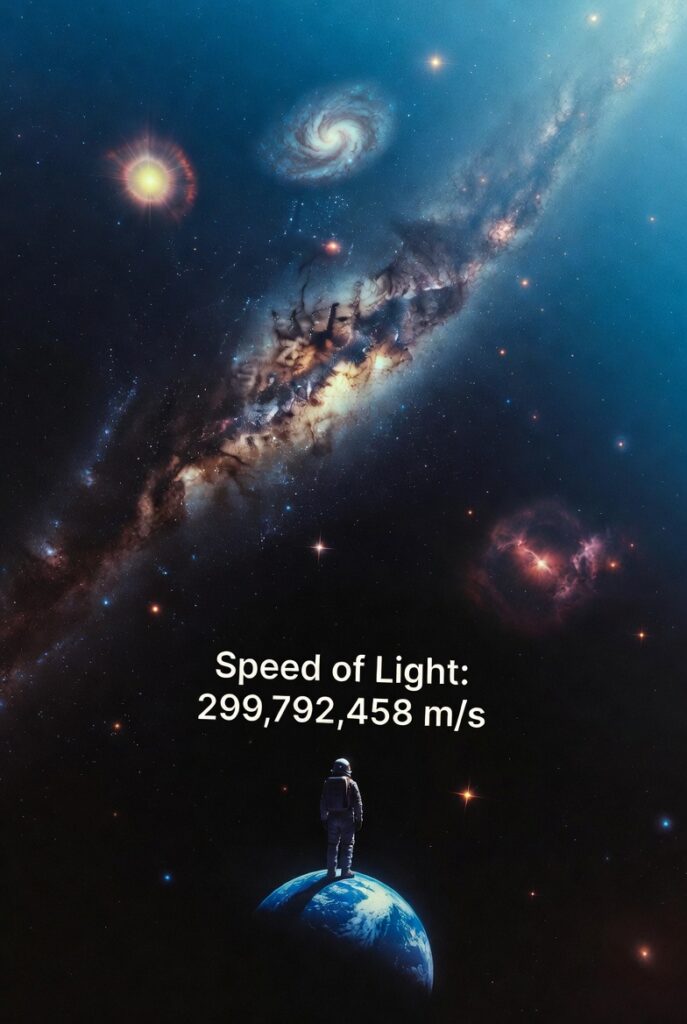
The speed of light is the fundamental limit of the Universe.
Speed of light in a vacuum:
- 299,792 km/s
- approximately 1,080,000,000 km/h
No object with mass can reach or exceed this speed.
👉 Light defines the cosmic speed limit.
Quick Summary of Universal Speeds
Comparison Table
| Scale | Approximate Speed |
|---|---|
| Earth’s rotation | 1,670 km/h |
| Earth orbiting the Sun | 107,000 km/h |
| Sun orbiting galactic center | 828,000 km/h |
| Milky Way through the Universe | 2,100,000 km/h |
| Speed of light | 1,080,000,000 km/h |
Why Don’t We Feel These Speeds?
Because these motions are:
- constant
- smooth
- non-accelerating
Human senses detect changes in motion, not steady movement.
It is the same reason passengers do not feel the speed of a cruising airplane.
👉 We exist inside a perfectly balanced cosmic system.
The Perspective-Changing Idea
We stand on a rotating Earth.
Earth orbits a moving Sun.
The Sun travels inside a rotating galaxy.
The galaxy moves through an expanding Universe.
And yet we feel stillness.
This stillness does not mean immobility.
It means harmony.
Frequently Asked Questions
Are we moving faster than an airplane right now?
Yes vastly faster, even while standing still.
Why don’t we get dizzy?
Because there are no sudden accelerations.
Will the Universe ever stop expanding?
Current models suggest expansion is accelerating.
Can anything exceed the speed of light?
No object with mass can, according to known physics.
Does dark matter affect galactic speeds?
Yes, it is essential for galactic stability.
Is Earth in a special place in the Universe?
No, the Universe is homogeneous on large scales.
Will the Sun leave the Milky Way?
No, it is gravitationally bound to it.
Do these speeds change over time?
Yes, but extremely slowly on cosmic timescales.
A Final Thought: Calm Inside the Speed
The Universe is a constant race.
We are passengers on a perfectly tuned cosmic vehicle.
We do not feel the speed because we belong to it.
🟦 Disclaimer and Source Hygiene
You may also be interested in: The Eternal, Cycle Of Man (AHLMA)
This article is for educational and informational purposes only.
The information is based on widely accepted scientific research and data from astronomy and cosmology (including NASA, ESA, and modern astrophysics).
For academic or professional study, consult peer-reviewed scientific sources.
🔔 For more tutorials like this, consider subscribing to our blog.
📩 Do you have questions or suggestions? Leave a comment or contact us!
🏷️ Tags: universe speeds, astronomy explained, speed of light, milky way galaxy, cosmology, solar system, space science, astrophysics, universe motion, science education
📢 Hashtags: universe speeds, astronomy explained, speed of light, milky way galaxy, cosmology, solar system, space science, astrophysics, universe motion, science education
