


⏲️ Estimated reading time: 5 min
Table of Contents
🎵 Daisy Bell – From 1894 Phonograph to the First Computer Song. “Daisy Bell (Bicycle Built for Two)” started as a Victorian love song in 1892, captured in a rare 1894 phonograph recording. Decades later, it made history again as the first song sung by a computer, shaping AI’s cultural memory.
Daisy Bell – From 1894 Phonograph to the First Computer Song
Few songs can boast a journey from the grooves of a wax cylinder to the circuits of a computer. “Daisy Bell (Bicycle Built for Two)”, written in 1892 by Harry Dacre, is one of them. With a humorous, romantic theme about love on a tandem bicycle, it quickly became a favorite in Victorian music halls.
What makes it truly special is its dual legacy:
- In 1894, it was immortalized in one of the earliest known phonograph recordings, preserving the voice and music for over a century.
- In 1961, it became the first song sung by a computer, when Bell Labs’ IBM 7094 synthesized human-like singing.
This article explores both milestones the original 1894 recording and the technological leap in 1961, as well as the cultural afterlife of this timeless tune.
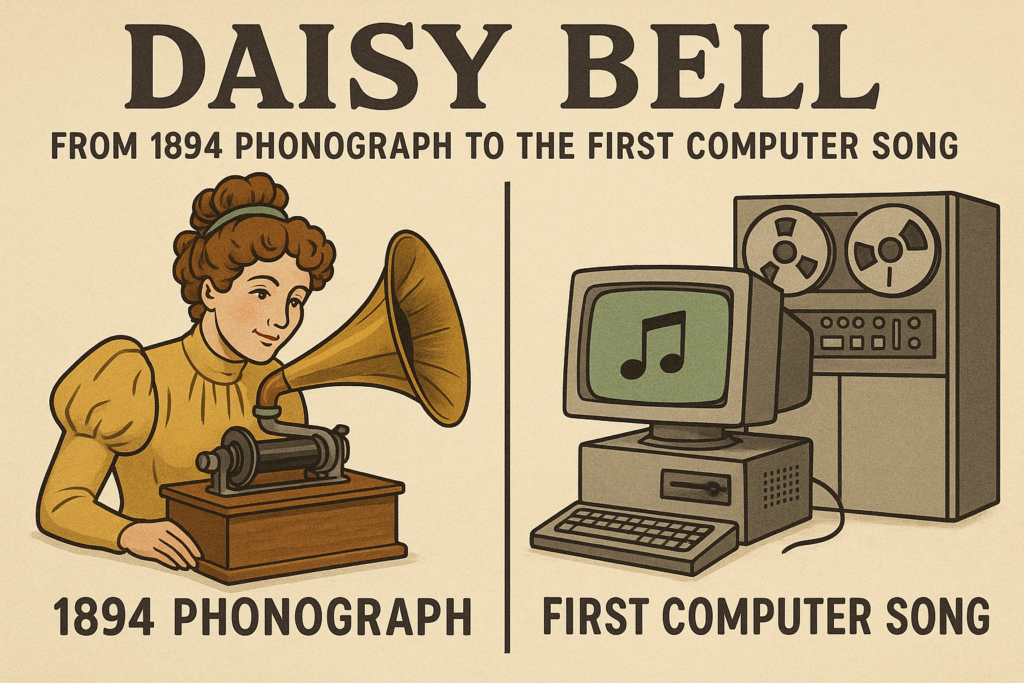
The Original 1894 Phonograph Recording
Shortly after its composition, “Daisy Bell” was recorded on an early wax cylinder phonograph, making it one of the oldest preserved versions of a popular music-hall song.
🎧 Why it matters:
- Offers a rare glimpse into how people heard music in the late 19th century.
- Demonstrates the transition from live-only performances to recorded sound.
- Showcases the authentic Victorian singing style, different from modern renditions.
👉 On YouTube, you can listen to “Daisy Bell – Original 1894 Phonograph Recording with Lyrics.” This version combines antique audio with on-screen lyrics, helping modern listeners appreciate its charm.
Lyrics and Their Significance
The song’s chorus remains iconic:
“Daisy, Daisy, give me your answer do,
I’m half-crazy all for the love of you.
It won’t be a stylish marriage,
I can’t afford a carriage,
But you’ll look sweet upon the seat
Of a bicycle built for two.”
Read also: How Princess Diana Changed Royal History
🔎 Meaning:
- Love is presented as playful and genuine, not materialistic.
- The tandem bicycle symbolizes partnership and equality in a relationship.
- Its humor and relatability made it easy to sing and remember.
The Leap to Technology – Bell Labs 1961
In 1961, engineers John Kelly and Carol Lochbaum programmed the IBM 7094 at Bell Labs to synthesize human-like speech and song. The chosen melody? Daisy Bell.
Why this song?
- Simple melody.
- Clear, repetitive lyrics.
- Already iconic in popular culture.
This experiment became the first song sung by a computer. It astonished audiences and influenced science fiction, showing how music could bridge humans and machines.
HAL 9000 and 2001: A Space Odyssey (1968)
Arthur C. Clarke, who witnessed the IBM demo, later inspired director Stanley Kubrick to include “Daisy Bell” in 2001: A Space Odyssey.
In the film, the HAL 9000 computer sings “Daisy Bell” as it is deactivated one of cinema’s most chilling yet emotional moments.
Pros and Cons of Daisy Bell’s Legacy
| Pros | Cons |
|---|---|
| First phonograph recording preserves Victorian music | Sound quality of 1894 recording is poor by modern standards |
| First computer-sung song, a technological milestone | Often parodied in media, losing some seriousness |
| Catchy and easy-to-sing tune | Considered “childish” compared to more complex songs |
| Culturally immortalized in 2001: A Space Odyssey | Sometimes reduced to a novelty reference |
Timeline of Daisy Bell
| Year | Event |
|---|---|
| 1892 | Harry Dacre composes “Daisy Bell” |
| 1894 | First phonograph recording made |
| 1961 | IBM 7094 sings “Daisy Bell” at Bell Labs |
| 1968 | HAL 9000 sings it in 2001: A Space Odyssey |
| 2000s | Reintroduced through YouTube and internet culture |
| 2025 | Remembered as a bridge between human creativity and machine intelligence |
Case Studies
Study 1: 1894 Phonograph
- Rare early sound recording.
- Captures authentic performance style.
- Used in historical studies of music halls and Victorian entertainment.
Study 2: IBM 7094 Singing Daisy Bell
- Demonstrated first computer vocal synthesis.
- Inspired AI voice assistants today (Siri, Alexa, ChatGPT).
- Changed how society views machines and creativity.
Modern Relevance
- Still a teaching tool in music history and AI research.
- Available in both antique and computer renditions on YouTube.
- Used as a cultural symbol for the intersection of romance, art, and technology.
Key Takeaways
- “Daisy Bell” began as a lighthearted Victorian love song but became a cultural and technological landmark.
- The 1894 phonograph recording ensures we can still hear its original charm.
- The 1961 Bell Labs performance transformed it into a cornerstone of AI history.
- Its presence in 2001: A Space Odyssey immortalized it in pop culture.
🔔 Subscribe to stay updated with our reviews!
📩 Share your experience in the comments.
🏷️ Tags: Daisy Bell, Bicycle Built for Two, Harry Dacre, 1894 Phonograph, IBM 7094, Bell Labs, HAL 9000, 2001 A Space Odyssey, Music History, AI Songs
📢 Hashtags: #DaisyBell #BicycleBuiltForTwo #PhonographRecording #MusicHistory #AIHistory #ComputerMusic #HAL9000 #2001ASpaceOdyssey #VictorianEra #BellLabs
