


⏲️ Estimated reading time: 35 min
Table of Contents
Sarah Everard was walking home through London when a serving police officer abused his authority to abduct and murder her. Her death shocked Britain, exposed serious failures in police vetting and accountability, and sparked a national conversation about women’s safety, public trust, and institutional responsibility.
A Walk Home That Changed Britain
On the evening of March 3, 2021, 33-year-old Sarah Everard left a friend’s home in Clapham, south London. She was making her way back to Brixton, where she lived. It was an ordinary journey through a city she knew, on a route that should never have become the beginning of a national tragedy. Sarah worked in marketing, had friends and family who loved her, and had a future filled with possibilities. She was simply returning home after spending time with someone she knew.
But Sarah never arrived. In the hours and days that followed, concern grew into a major missing-person investigation. Detectives began piecing together her final known movements, reviewing surveillance footage, examining vehicle records, and following evidence that eventually led them to a serving Metropolitan Police officer. The discovery was deeply disturbing. The person responsible for her disappearance was not a stranger merely pretending to be an officer. He was an actual police officer who had used the authority associated with his position to commit a terrible crime.
The murder of Sarah Everard became much more than a criminal case. It raised difficult questions about how police forces identify dangerous behaviour, how complaints against officers are handled, and whether institutions entrusted with protecting the public are sufficiently accountable. It also prompted thousands of women to share their experiences of feeling unsafe in public spaces. Sarah’s story deserves to be told carefully, accurately, and respectfully, without sensationalising the violence or reducing her life to the circumstances of her death.
Who Was Sarah Everard Before Her Disappearance?
Sarah Everard was born in 1987 and grew up in York, England. She attended Fulford School and later studied human geography at Durham University. As an adult, she built a career in marketing and communications, eventually moving to London. Those who knew her described a warm, thoughtful, and compassionate person who valued friendship and family. Her life was not defined by the crime that later made her name known across the United Kingdom. She was a daughter, sister, partner, friend, and professional with her own interests, ambitions, and relationships.
By March 2021, Sarah was living in Brixton, south London. Like many Londoners, she regularly walked between neighbourhoods, visited friends, and used the city’s streets as part of everyday life. Her disappearance occurred during the COVID-19 pandemic, when England was operating under restrictions that affected social gatherings and movement. Those restrictions later became important because her attacker falsely presented her detention as a legitimate police action. However, visiting someone or walking home did not make Sarah responsible for what happened to her.
Understanding Sarah as a person matters. Public discussion of violent crimes sometimes focuses almost entirely on the offender, the investigation, and the sentence. Yet behind every headline is an individual whose life had meaning long before the tragedy. Sarah’s family repeatedly emphasised her kindness, humour, and the happiness she brought to others. Remembering those qualities helps keep the focus where it belongs: on the person whose life was taken, the people who loved her, and the responsibility of the institutions that failed to prevent the crime.
March 3, 2021: The Evening Sarah Everard Disappeared
Leaving a Friend’s Home in Clapham
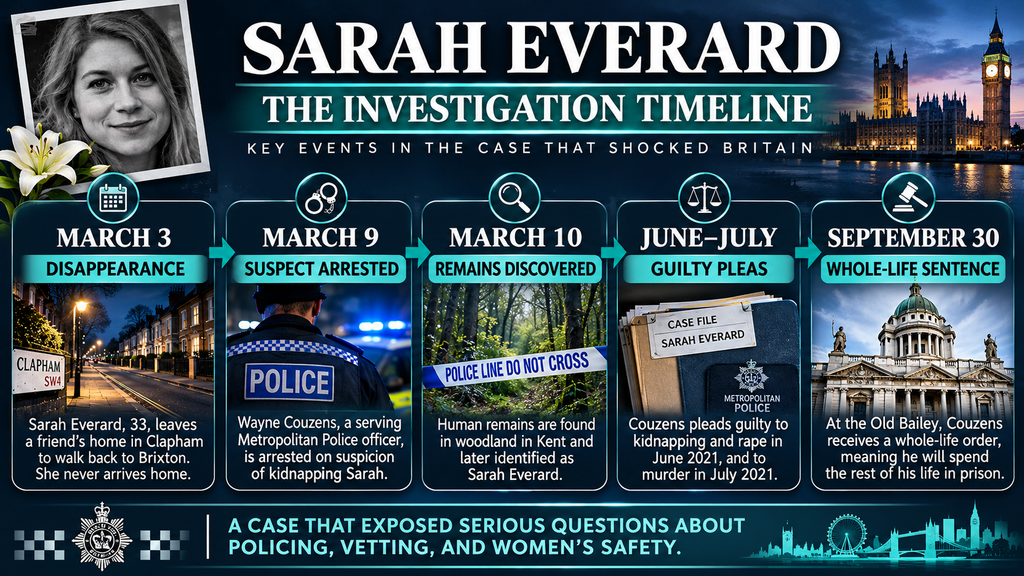
Sarah spent the evening visiting a friend in Clapham. At approximately 9 p.m., she left to walk towards her home in Brixton. The route took her through south London, including streets near Clapham Common. Investigators later used CCTV footage, witness information, and digital records to reconstruct her journey. These details became central to the investigation because they helped establish where she had been and when she was last seen before her disappearance.
Nothing about walking home made Sarah’s behaviour reckless or unusual. She was travelling through a residential area, following a familiar kind of journey taken by countless people every evening. In the public conversation that followed, some commentary focused on what women could do to protect themselves. But this case illustrated a fundamental limitation of personal safety advice: even a person behaving reasonably and cautiously can encounter someone determined to abuse power and commit violence.
The Encounter With Wayne Couzens
Wayne Couzens was a serving officer with the Metropolitan Police, working in the Parliamentary and Diplomatic Protection Command. He was off duty when he encountered Sarah. Using his genuine police status, he falsely claimed authority to detain her under COVID-19 restrictions. This deception was central to the crime. Sarah was confronted by someone who appeared to possess the legal power to stop and arrest members of the public, making the situation particularly difficult to challenge.
Couzens abducted Sarah and transported her out of London to Kent, where he sexually assaulted and murdered her. The established facts were later confirmed through his guilty pleas and court proceedings. There is no need to describe the violence graphically to understand its severity. What makes the case especially alarming is the deliberate misuse of police authority. A position intended to protect the public became the means through which an offender gained control over an innocent person.
Why the Abuse of Authority Was So Significant
Police officers hold powers that ordinary members of the public do not possess. In legitimate circumstances, those powers allow officers to investigate offences, make lawful arrests, and protect communities. However, the same authority creates serious risks when an officer acts dishonestly or criminally. People may comply with instructions because they reasonably believe an officer is exercising lawful powers. That expectation of legitimacy can make an abuse of authority especially dangerous.
In Sarah’s case, Couzens exploited the credibility of his position. The central issue was not simply that an offender happened to work for the police. His police identity helped him carry out the abduction. This distinction later shaped the public debate about professional standards, vetting, supervision, and the need for effective safeguards. It also raised questions about how members of the public can verify an officer’s identity and actions when they feel uncertain or threatened.
Sarah Everard’s Final Journey

How Detectives Investigated Sarah Everard’s Disappearance
The Missing-Person Investigation Begins
When Sarah failed to return home and could not be contacted, those close to her became increasingly concerned. A missing-person investigation began, and officers sought information about her movements. Investigators examined the route she was believed to have taken, gathered surveillance footage, and appealed for information. In a large city such as London, reconstructing a person’s journey can involve reviewing material from numerous cameras, comparing timestamps, and identifying relevant vehicles or individuals.
Missing-person investigations often require detectives to consider several possibilities before they have enough evidence to establish what happened. A person may have experienced an accident, a medical emergency, or a crime. Investigators therefore build timelines rather than relying on assumptions. In Sarah’s case, surveillance footage became particularly important. It helped detectives identify a vehicle connected to her final known movements and provided a starting point for tracing the person who had been driving it.
The White Vauxhall Astra That Became Crucial Evidence
One of the most important developments involved footage showing Sarah beside a white Vauxhall Astra with its hazard warning lights flashing. The vehicle was significant because it placed Sarah near a car that investigators could potentially identify through its registration. Rather than treating the footage as an isolated image, detectives examined the surrounding circumstances and used vehicle records to establish who had access to the car.
Investigators traced the registration to a hire vehicle rented in Dover, Kent. Rental documentation helped connect the car to Wayne Couzens. The phone number associated with the booking also matched information held in his Metropolitan Police personnel records. These links helped investigators identify a serving police officer as a suspect. The case demonstrates how apparently routine business records, when lawfully obtained and combined with surveillance evidence, can become crucial in a serious criminal investigation.
Why Vehicle and Telephone Records Matter
Vehicle registration information, rental agreements, and telephone records can help establish connections between people, places, and events. Each source has limitations when considered alone. A rental agreement identifies who arranged to use a vehicle, but it does not necessarily prove who was driving at a particular moment. Similarly, a telephone number can help establish an association, but investigators must consider the wider evidence before drawing conclusions.
In Sarah’s case, the value came from combining multiple sources. Surveillance footage helped establish a timeline. Rental records connected a specific car to a named individual. Police employment information then helped confirm the suspect’s identity. This evidence-led approach is important because serious criminal cases require more than suspicion. Investigators must gather material that can withstand legal scrutiny and support reliable findings in court.
March 9 and 10: The Arrests and Discovery in Kent
On March 9, 2021, police arrested Wayne Couzens on suspicion of kidnapping Sarah Everard. The investigation continued, and he was subsequently arrested on suspicion of murder on March 10. By this stage, the inquiry had moved from an urgent search for a missing woman to a criminal investigation involving a serving police officer. The development shocked the public and created immediate questions about how someone holding such a trusted position could become the principal suspect.
On March 10, investigators discovered human remains in woodland near Ashford, Kent. The remains were subsequently identified as Sarah’s. This confirmed the devastating outcome that her family and friends had feared. The discovery also provided investigators with further evidence and allowed the criminal proceedings to advance. For those close to Sarah, however, the official confirmation represented an irreversible personal loss, not merely a significant development in a police investigation.
The arrests and discovery marked a turning point in public awareness of the case. News coverage spread rapidly, and attention increasingly focused on the suspect’s police employment, the circumstances of the abduction, and the wider implications for public trust. Questions about Couzens’s earlier conduct also emerged. Those questions would eventually lead to official inquiries examining whether warning signs had been overlooked and whether stronger institutional safeguards might have prevented the tragedy.
The Warning Signs Before Sarah Everard’s Murder
Earlier Indecent Exposure Allegations
One of the most troubling aspects of the case was the evidence of Couzens’s earlier sexually inappropriate and criminal behaviour. He had been linked to reports of indecent exposure before Sarah disappeared, including incidents in Kent and an allegation involving a McDonald’s restaurant in south London shortly before the murder. These matters later became the subject of criminal proceedings and official scrutiny.
In 2023, Couzens was sentenced for three indecent exposure offences committed between November 2020 and February 2021. The existence of these earlier offences raised an important question: whether more effective investigations and information-sharing could have identified his behaviour before he committed murder. It is important to distinguish between facts established by criminal proceedings and broader questions about what institutions should reasonably have known at particular times.
How Missed Opportunities Can Become Institutional Failures
Police organisations handle large amounts of information, including complaints, allegations, intelligence reports, disciplinary matters, and criminal investigations. For those systems to protect the public, relevant information must reach the right people and receive appropriate attention. A report that remains isolated in one department may not reveal a wider pattern. When information is fragmented, warning signs can become harder to identify.
The Sarah Everard case highlighted the consequences of inadequate vetting, ineffective follow-up, and poor handling of concerns about officer behaviour. Not every allegation proves wrongdoing, and fair procedures remain essential. However, fairness does not mean ignoring reports or failing to investigate them thoroughly. Institutions must balance due process with the responsibility to identify credible risks, particularly when employees possess powers that can directly affect public safety.
Why Previous Behaviour Deserves Serious Examination
A previous offence does not establish that someone will commit a more serious crime. Nevertheless, repeated sexual misconduct can provide relevant information about risk and professional suitability, especially in positions of public trust. Investigators and employers should assess such behaviour through lawful, evidence-based processes rather than dismissing it as minor or unrelated.
This principle applies beyond policing. Schools, healthcare organisations, transport providers, and other institutions also have responsibilities when employees interact with potentially vulnerable people. Reliable reporting channels, appropriate background checks, careful recordkeeping, and independent oversight can help identify patterns that might otherwise be missed. The lesson is not that every allegation predicts future violence, but that credible concerns must be taken seriously and assessed properly.
The Criminal Proceedings and Guilty Pleas
June and July 2021: Couzens Admits His Crimes
In June 2021, Wayne Couzens pleaded guilty to kidnapping and sexually assaulting Sarah Everard. In July, he pleaded guilty to her murder. These admissions meant that the central facts of the case did not require a contested murder trial. However, the court still had to determine the appropriate sentence and consider the seriousness of the offences, including the offender’s deliberate misuse of his position as a police officer.
Guilty pleas can shorten criminal proceedings and avoid the need for witnesses and families to endure certain aspects of a trial. They do not diminish the seriousness of the offences or the harm caused. In this case, the admissions confirmed that the man entrusted with police powers had committed the kidnapping, sexual assault, and murder of a woman who was simply walking home.
September 30, 2021: A Whole-Life Sentence
On September 30, 2021, Lord Justice Fulford sentenced Couzens to a whole-life order at the Old Bailey in London. The judge emphasised the exceptional seriousness of the crime and the abuse of police authority involved. A whole-life order is the most severe sentence available under English criminal law. It means that the offender has no ordinary prospect of release through parole, although exceptional legal provisions may apply in very limited circumstances.
The sentence reflected the court’s assessment of the deliberate and calculated nature of the offences. It also recognised the extraordinary damage caused when an officer exploits the public’s trust in policing to commit a crime. Couzens later challenged aspects of his sentence, but the whole-life order was upheld. The punishment established his legal responsibility, yet it could not undo the loss suffered by Sarah’s family or resolve the broader institutional questions raised by the case.
Why the Court Considered Police Authority an Aggravating Factor
An aggravating factor is a circumstance that makes an offence more serious when a court determines punishment. In Sarah’s case, the misuse of police status was central. Couzens did not simply conceal his identity while committing a crime. He used the appearance of lawful authority to deceive Sarah and facilitate her abduction.
This distinction has implications for public confidence. Police officers depend on cooperation from the communities they serve. People are expected to recognise lawful instructions and comply with legitimate police action. When an officer exploits that expectation, the harm extends beyond the immediate victim. It can damage trust in the institution and create fear among people who may later encounter officers acting properly. The court’s reasoning acknowledged that wider dimension of the crime.
The Investigation and Court Timeline
The Angiolini Inquiry: What Went Wrong Before the Murder?
Why an Independent Inquiry Was Established
Following Sarah Everard’s murder, the British government established an independent inquiry chaired by Dame Elish Angiolini. Its purpose was to examine how Wayne Couzens had been able to join and remain within policing despite warning signs about his conduct. The inquiry was not intended to retry the criminal case. Instead, it examined the systems, decisions, and institutional practices that had failed to identify and address the risks he presented.
The first report, published on February 29, 2024, examined Couzens’s career, earlier behaviour, and the opportunities missed by police organisations. It identified serious shortcomings in the investigation of sexual offences, vetting arrangements, and the handling of concerning information. The report made 16 recommendations intended to strengthen safeguards and reduce the likelihood of similar abuses of police authority. GOV.UK+1
The Inquiry’s Findings on Missed Opportunities
The inquiry examined reports made to police about Couzens before Sarah’s murder. It found that none of eight previously reported cases resulted in his arrest and referral for prosecution at the time. Although the strength of the available evidence varied, the inquiry concluded that some of the allegations could have been investigated more effectively. Its findings described repeated failures to handle reports in a reasonable and professional manner.
These findings matter because the criminal investigation after Sarah disappeared demonstrated what coordinated, thorough investigative work could achieve. The inquiry distinguished between the successful investigation that identified Couzens as Sarah’s killer and the earlier opportunities that had been missed. This contrast illustrates why organisations must not judge their effectiveness solely by how they respond after a major tragedy. Prevention depends on the quality of everyday decisions, including how seemingly isolated reports are recorded and investigated. Part 1 Report+1
Recommendations for Police Vetting and Accountability
The Angiolini Inquiry called for stronger vetting, improved handling of sexual misconduct allegations, and greater attention to professional standards. Vetting is not merely a background check completed when someone joins an organisation. In policing, it must also be supported by ongoing assessment, reliable intelligence-sharing, and effective responses to new information about an officer’s conduct.
In March 2024, the government accepted the recommendations directed to it from the inquiry’s first report. These included examining how certain indecent exposure offences are handled, researching possible links between offending patterns, and improving public awareness that such behaviour constitutes criminal conduct. Accepting recommendations is an important step, but meaningful improvement also depends on implementation, independent scrutiny, and measurable results. GOV.UK+1
What Changed in the Inquiry’s Later Work?
The Wider Investigation Into Women’s Safety
The inquiry expanded beyond the individual failures associated with Couzens. Its second phase examined the wider risk of sexually motivated crimes against women in public spaces, alongside the responsibilities of policing and other organisations. This broader approach recognised that protecting women cannot depend solely on catching offenders after serious crimes have already occurred.
A first report from Part 2 was published on December 2, 2025. It included further recommendations focused on prevention, consistency in policing, and cooperation between relevant organisations. The inquiry’s work also continued to address police culture and the risks created by sexism and misogyny. These issues require careful examination because harmful attitudes, weak supervision, and ineffective reporting mechanisms can undermine public safety even when they do not directly establish that a particular crime will occur. GOV.UK+1
Why Institutional Reform Takes Time
Changing an organisation involves more than introducing a new policy document. Recruitment teams must understand revised vetting standards. Supervisors need training to recognise concerning behaviour. Officers must have confidence that reporting misconduct will lead to fair and meaningful action. Senior leaders also need reliable information to determine whether reforms are working.
For example, a police force might introduce a stronger process for reviewing complaints against serving officers. That process would need clear reporting procedures, trained investigators, appropriate access to relevant records, and independent checks. Without these elements, the reform could exist on paper while producing little practical improvement. The Sarah Everard case shows why institutions must be judged by their conduct and outcomes, not simply by the promises they make following public criticism.
How Sarah Everard’s Murder Changed the National Conversation
Why Women Shared Their Experiences
Sarah’s murder prompted an outpouring of grief, anger, and concern across Britain. Many women described the precautions they routinely took while travelling alone, including choosing well-lit routes, sharing their location with trusted people, or contacting friends after arriving home. These accounts revealed how ordinary journeys could involve constant calculations about personal safety.
The discussion was not limited to London. Women in towns and cities across the country recognised aspects of their own experiences in the conversations that followed. Some spoke about harassment in public places. Others described occasions when they felt uncomfortable challenging someone who appeared to hold authority. Although individual experiences differed, a recurring theme emerged: women should not have to accept fear as an unavoidable part of everyday life.
Why Personal Safety Advice Is Not Enough
Advice about staying aware of surroundings or contacting someone when feeling threatened can sometimes be useful. However, it becomes problematic when presented as the primary solution to violence against women. Such advice risks transferring responsibility from offenders and institutions to potential victims.
Sarah’s case makes this distinction particularly important. Her attacker exploited genuine police authority, creating a situation in which the usual assumptions about seeking help or complying with an officer became dangerously complicated. No practical checklist could guarantee protection against such deliberate deception. Effective prevention must therefore include professional accountability, prompt investigation of misconduct, public education, and broader efforts to challenge harassment and violence.
The Difference Between Fear and Responsibility
Fear can influence how people move through public spaces, but fear alone does not explain why violence occurs. Responsibility for a crime belongs to the person who commits it. Institutions may also bear responsibility for failures within their duties, depending on the evidence and applicable standards. Recognising those responsibilities is essential to an informed discussion.
A constructive response asks how risks can be reduced without restricting the freedom of potential victims. Better public transport, safer street design, reliable reporting systems, and accountable policing can contribute to a broader safety strategy. Yet no single measure will eliminate every threat. The objective should be to reduce opportunities for harm while protecting the right of everyone to travel, work, socialise, and return home without intimidation.
The Clapham Common Vigil and Public Response
A Community Gathers to Remember Sarah
Following Sarah’s death, people gathered at Clapham Common to remember her and express solidarity with women concerned about public safety. Flowers, messages, and other tributes appeared near the bandstand. The location became a symbol of grief and reflection, as well as a focal point for discussions about policing and the treatment of women.
The events unfolded during the COVID-19 pandemic, when restrictions on gatherings complicated the organisation of public vigils. A planned event faced legal and practical difficulties, while people continued to arrive independently to pay their respects. The situation required authorities to balance public health regulations, freedom of expression, and the importance of peaceful remembrance.
Why the Police Response Became Controversial
The Metropolitan Police’s handling of the gathering on March 13, 2021, drew significant criticism after images showed officers restraining and arresting attendees. For many observers, the scenes appeared especially troubling because the gathering was connected to the murder of a woman by a serving police officer.
The controversy also demonstrated how different questions can exist within the same event. Police had responsibilities under the pandemic rules, while attendees had legitimate interests in mourning, peaceful assembly, and expressing concern about women’s safety. Subsequent reviews and legal proceedings examined aspects of the policing response. It is important not to reduce those complex findings to a single image or assume that every decision made during the gathering received the same legal assessment.
The Importance of Trust During Public Demonstrations
Public demonstrations can become moments when confidence in institutions is strengthened or weakened. Police officers must enforce the law proportionately, respect lawful expression, and explain their actions where appropriate. Members of the public also benefit from clear information about applicable rules and available avenues for challenging decisions.
In the aftermath of Sarah’s murder, these principles carried particular weight. People were not only grieving; many were questioning whether the police understood their concerns. Effective communication and proportionate decision-making were therefore essential. The controversy surrounding the vigil became another reason for authorities to examine how they engage with communities during emotionally significant public events.
Remembering Sarah and the Call for Safer Streets

How Can Someone Verify a Police Officer’s Authority?
Understanding the Difference Between Identification and Lawful Action
The Sarah Everard case prompted questions about how members of the public can respond when someone claiming to be a police officer approaches them. The first important distinction is that identifying a person as an officer does not automatically establish that every instruction they give is lawful. Police powers depend on the circumstances, the legal authority being exercised, and the applicable procedures.
In England and Wales, officers may exercise different powers depending on whether they are stopping someone, requesting information, conducting a search, or making an arrest. The rules are not identical in every situation. A uniform, warrant card, or police vehicle may help establish identity, but people may still have reasonable questions about what is happening. Official guidance is therefore more reliable than social media claims suggesting that one simple test can establish whether every police encounter is legitimate.
Asking Questions When Circumstances Feel Unusual
When it is safe and practical, a person who is uncertain about an officer’s actions may ask for the officer’s name, identification number, station, and the reason for the interaction. The officer’s legal obligations to provide information vary according to the power being exercised and the circumstances. Someone should not assume that refusing to cooperate is always lawful or safe.
For example, if an unfamiliar person approaches someone in an isolated location and claims to be a plain-clothes officer, the individual may wish to request identification and ask for the situation to be verified through an official police channel. If immediate danger is suspected, contacting emergency services may be appropriate. These are general precautions, not guarantees, and they should never be interpreted as placing responsibility for an officer’s criminal behaviour on the person approached.
Contacting Emergency Services and Reporting Concerns
In the United Kingdom, 999 is the emergency number for situations requiring immediate police, fire, or ambulance assistance. The non-emergency police number in England, Wales, and Scotland is 101. People who suspect impersonation, unlawful conduct, or an immediate threat should use an appropriate official channel according to the circumstances.
A person reporting an incident can provide the location, approximate time, description of the individual, vehicle details if safely available, and an explanation of what occurred. They should avoid putting themselves in danger to gather evidence. If a complaint concerns a police officer, the reporting process may also involve professional standards departments or independent oversight bodies. The most appropriate route depends on the nature and seriousness of the allegation.
What Police Organisations Can Learn From This Case
Better Recruitment and Continuous Vetting
Police recruitment should examine an applicant’s suitability for a role involving significant public powers. Background checks, employment history, criminal intelligence, and relevant conduct information can all contribute to that assessment, subject to legal safeguards. Yet recruitment is only the beginning. An officer’s suitability may change over time as new information emerges.
Continuous vetting helps organisations respond to relevant developments after an employee has joined. For example, if credible allegations of serious misconduct arise, there should be a defined process for assessing the information and determining whether further investigation or temporary restrictions are appropriate. Decisions must remain evidence-based and procedurally fair. The purpose is not to presume guilt, but to ensure that warning signs are neither ignored nor lost between departments.
Effective Investigation of Sexual Misconduct
Reports of indecent exposure, harassment, and other sexual offences require professional attention. Investigators should preserve relevant evidence, interview witnesses appropriately, assess available records, and consider whether reports may be connected. Poorly investigated allegations can leave victims without answers and prevent authorities from identifying patterns of behaviour.
The Angiolini Inquiry placed particular emphasis on improving responses to indecent exposure. Its findings demonstrated that offences sometimes treated as relatively minor may still warrant careful investigation, especially when repeated allegations concern the same person. This does not mean that every offender will escalate to more serious violence. It means that investigators should assess each report on its merits while remaining alert to relevant patterns. GOV.UK+1
Independent Oversight and Organisational Culture
Independent oversight is important because organisations can struggle to investigate allegations against their own members without concerns about conflicts of interest. External scrutiny can strengthen public confidence when it is genuinely independent, properly resourced, and capable of making findings based on evidence.
Organisational culture also matters. Employees need to understand that professional loyalty does not require silence about misconduct. Supervisors should encourage lawful reporting, protect individuals from retaliation where applicable, and respond consistently to credible concerns. A healthy workplace does not assume that every complaint is true, but neither does it dismiss complaints because the subject is respected, experienced, or holds a senior position.
How Communities Can Support Women’s Safety
Creating Safer Public Environments
Women’s safety is influenced by many factors, including the design of public spaces, transport accessibility, the availability of help, and how authorities respond to reported incidents. Well-maintained lighting, visible transport information, clear emergency contact points, and reliable reporting systems can make public spaces easier to navigate and help people obtain assistance.
For example, a transport operator might improve the way passengers report harassment by providing accessible reporting channels and training staff to respond appropriately. A local authority might review poorly maintained pedestrian routes or improve coordination with community safety organisations. These measures cannot prevent every offence, but they can form part of a practical prevention strategy that addresses risks without blaming potential victims.
Encouraging Respectful Behaviour and Intervention
Preventing harassment also requires attention to everyday behaviour. People should understand that intimidation, unwanted sexual attention, and threats are not acceptable. Education in schools, workplaces, and communities can help establish expectations around consent, respect, and personal boundaries.
Bystanders may sometimes be able to help someone experiencing harassment, but intervention should be guided by safety. A person could alert transport staff, contact emergency services, or offer support after an incident rather than confronting a potentially dangerous individual. The aim is to reduce harm, not encourage unnecessary risks. Communities become safer when responsibility is shared and people know how to seek help through appropriate channels.
Listening to Survivors and Families
Policies are more likely to address real problems when decision-makers listen to people affected by harassment, violence, and institutional failures. Survivors may identify barriers that are not obvious from administrative data alone, such as confusing reporting procedures, fear of being dismissed, or a lack of information about what happens after a complaint.
Families affected by serious crime can also contribute important perspectives on accountability and support services. Their experiences should be treated with sensitivity rather than used merely to create publicity. Listening does not mean expecting victims or families to design every solution. It means ensuring that their experiences inform decisions alongside research, professional expertise, and independent evaluation.
Why Responsible Reporting Matters in True Crime Stories
Remembering the Victim Beyond the Headlines
True crime stories often attract public attention because they involve difficult questions about human behaviour, criminal investigations, and justice. However, responsible reporting should never turn a victim’s suffering into entertainment. In Sarah Everard’s case, the central facts are already deeply serious. There is no need to exaggerate events, invent conversations, or recreate the violence in graphic detail. Accurate reporting can explain what happened while preserving dignity and respecting the people affected.
Sarah was a person with relationships, ambitions, and a life that extended far beyond the circumstances of her death. Her family did not choose to become part of a national debate. Their loss remains personal, even though the case has important public implications. Ethical coverage should acknowledge this distinction and avoid treating private grief as material for speculation.
Separating Established Facts From Allegations
A reliable article distinguishes between allegations, evidence presented during proceedings, guilty pleas, court findings, and conclusions reached by official inquiries. These categories are not interchangeable. For example, an earlier complaint against an officer may justify investigation, but it does not automatically establish criminal guilt. Conversely, a guilty plea provides a clear legal basis for describing the admitted offence as fact.
The Sarah Everard case has an extensive official record, including court proceedings and independent inquiry findings. Writers should use these sources wherever possible, check dates carefully, and explain when later investigations revealed information that was not known at the time. This approach helps readers understand both the crime and the institutional failures without creating misleading impressions.
Avoiding Victim-Blaming Language
Words can shape how readers understand responsibility. Phrases suggesting that someone should have taken a different route, stayed indoors, or behaved more cautiously may unintentionally shift attention away from the offender. Sarah’s decision to walk home was not the cause of her murder. The crime occurred because Wayne Couzens chose to abuse his authority and commit serious offences.
Safety discussions can still offer practical information, but that information should be presented without implying that following particular advice guarantees protection. Responsible journalism focuses on what offenders did, how institutions responded, and what evidence supports the proposed reforms. It also respects the fact that victims cannot reasonably be expected to anticipate every possible form of criminal deception.
Frequently Asked Questions
1. Who was Sarah Everard?
Sarah Everard was a 33-year-old British marketing professional who lived in south London. She grew up in York and studied at Durham University. She was kidnapped and murdered in March 2021 while walking home after visiting a friend. Her death became the focus of a major national discussion about women’s safety, police accountability, and the abuse of public authority.
2. When did Sarah Everard disappear?
Sarah disappeared on the evening of March 3, 2021. She had been visiting a friend in Clapham and was walking towards her home in Brixton. Investigators reconstructed her final movements using surveillance footage and other evidence. Her disappearance prompted a major police investigation that led to the arrest of Wayne Couzens on March 9.
3. Who was responsible for Sarah Everard’s murder?
Wayne Couzens, who was serving as a Metropolitan Police officer at the time, was responsible. He used his police status to deceive Sarah into believing she was being lawfully detained. He subsequently kidnapped, sexually assaulted, and murdered her. Couzens pleaded guilty to the offences in 2021 and received a whole-life prison sentence.
4. How did police identify Wayne Couzens as a suspect?
Investigators examined CCTV footage that helped connect Sarah’s disappearance to a white Vauxhall Astra. The vehicle’s registration led to rental records in Dover, Kent. Information associated with the hire agreement helped identify Couzens, while police employment records confirmed his connection to the Metropolitan Police. The wider investigation brought together multiple sources of evidence.
5. Where was Sarah Everard found?
Sarah’s remains were discovered on March 10, 2021, in woodland near Ashford, Kent. They were subsequently identified, confirming her death. The discovery was an important development in the criminal investigation, but it was also devastating news for her family, friends, and everyone hoping she would be found alive.
6. What sentence did Wayne Couzens receive?
On September 30, 2021, Couzens received a whole-life order at the Old Bailey. This is the most severe sentence available under English criminal law. It means he has no ordinary prospect of release through parole. His challenge to the sentence was unsuccessful, and the whole-life order remained in place.
7. Were there warning signs before Sarah’s murder?
Yes. Official investigations identified earlier reports of sexual misconduct and indecent exposure involving Couzens. The Angiolini Inquiry concluded that police organisations had missed opportunities to investigate concerning behaviour effectively. Its findings highlighted shortcomings in vetting, information-sharing, and the handling of allegations against officers. GOV.UK
8. What was the Angiolini Inquiry?
The Angiolini Inquiry was an independent investigation established after Sarah’s murder. Its first report, published in February 2024, examined Couzens’s career, previous behaviour, and the failures that allowed warning signs to be missed. Later work considered broader issues involving women’s safety, policing practices, and institutional culture. The inquiry made recommendations intended to improve prevention and accountability.
9. Why did Sarah Everard’s murder cause nationwide protests?
The murder generated widespread grief and anger because the offender was a serving police officer who had exploited his authority. Many women recognised the broader concerns about harassment, personal safety, and trust in public institutions. Vigils and public demonstrations became opportunities to remember Sarah and call for meaningful improvements in how violence against women is prevented and investigated.
10. What is the most important lesson from Sarah Everard’s case?
The case demonstrates that public trust must be supported by effective accountability. Police organisations need strong vetting procedures, professional investigations, reliable reporting channels, and meaningful independent scrutiny. It also reinforces a basic principle: people should be able to move through public spaces without being blamed for the criminal actions of others.
A Life Remembered, a Responsibility That Remains
Sarah Everard’s murder remains one of the most disturbing criminal cases in modern British history, not because of sensational details, but because of the profound betrayal of trust at its centre. A woman walking home encountered someone who held genuine police powers and used those powers to deceive and harm her. The crime exposed serious vulnerabilities in systems intended to protect the public and raised questions that extended far beyond a single offender.
The investigation brought Wayne Couzens to justice, and the court imposed the most severe available sentence. Independent inquiries subsequently examined the warning signs that had been missed and the institutional improvements needed to reduce future risks. Yet accountability cannot end with a conviction or a published report. The lasting measure of reform is whether institutions investigate concerns properly, identify dangerous conduct, and act before further harm occurs.
Sarah was 33 years old. She had a family, friends, a career, and a future. She should have made it home. Remembering her means recognising the value of the life she lived, respecting the grief of those who loved her, and taking seriously the responsibility to make public spaces and trusted institutions safer for everyone.
⚠️ Disclaimer and Source Hygiene
This article is provided for educational, historical, and public-interest purposes. It discusses a documented criminal case involving kidnapping, sexual violence, and murder. The content has been written in a respectful, non-graphic manner and does not promote violence, harassment, or discrimination.
The factual account is based on publicly available court records, official government publications, policing statements, and independent inquiry findings. Where broader issues of safety, institutional responsibility, or prevention are discussed, they should be understood as general educational information rather than personalised legal or professional advice. Readers seeking guidance about police powers, reporting procedures, or personal safety should consult current official resources or qualified professionals.
If you or someone you know is experiencing immediate danger in the United Kingdom, call 999. For non-emergency police assistance, contact 101 where available.
🔔 For more tutorials like this, consider subscribing to our blog.
📩 Do you have questions or suggestions? Leave a comment or contact us!
🏷️ Tags: Sarah Everard, Sarah Everard Case, Wayne Couzens, UK Crime History, Women’s Safety, Metropolitan Police, Angiolini Inquiry, Police Accountability, London Crime Investigation, Violence Against Women
📢 Hashtags: #SarahEverard, #RememberSarahEverard, #WomensSafety, #JusticeForSarah, #PoliceAccountability, #UKCrimeHistory, #TrueCrimeAwareness, #SaferStreets, #ViolenceAgainstWomen, #PublicSafety
Sources and References
Official Government and Inquiry Sources
1. UK Home Office – Angiolini Inquiry Part 1 Report (2024). The independent report examining Couzens’s career, earlier behaviour, missed warning signs, and 16 recommendations for improving policing safeguards. Read the official inquiry report.
2. UK Home Office – Angiolini Inquiry Collection. Official documentation covering the inquiry’s different phases, including the later investigation into women’s safety and police culture. Explore the Angiolini Inquiry documents.
3. UK Government – Government Accepts Angiolini Inquiry Recommendations (March 25, 2024). Explains the government’s response to the recommendations directed to it. Read the government response.
4. UK Parliament – Angiolini Inquiry Recommendations. Parliamentary discussion of the inquiry’s findings, police vetting, and the handling of sexual offences. Read the parliamentary statement.
5. Court of Appeal – R v Stewart and Others [2022] EWCA Crim 1063. Judicial record addressing several sentencing appeals, including Couzens’s appeal against his whole-life order. Read the Court of Appeal judgment.
Policing and Oversight Sources
6. College of Policing – Sarah Everard Murder Sentencing Statement (September 30, 2021). An official response discussing the sentence and the damage caused to public confidence in policing. Read the College of Policing statement.
7. Independent Office for Police Conduct – Investigation Into Earlier Indecent Exposure Reports. Explains scrutiny of how police handled allegations involving Couzens before Sarah’s murder. Read the IOPC findings.
8. Metropolitan Police – Response to Issues Raised by Couzens’s Crimes. An official statement addressing public concerns and the importance of rebuilding confidence. Read the Metropolitan Police response.
Secondary Sources and Testimonials
9. The Independent – Wayne Couzens: Judge’s Sentencing Remarks in Full (September 30, 2021). Reporting that reproduces the judge’s sentencing explanation and provides context about the abuse of police authority. Read the sentencing coverage.
10. Family Statements and Victim Impact Accounts. Sarah Everard’s family’s experiences were presented during the sentencing proceedings and discussed in official responses. Their accounts provide important personal context, but this article deliberately avoids reproducing extended passages from their statements. College of Policing+1
Editorial note: The subject involves sexual violence and murder. Non-graphic, factual treatment reduces unnecessary sensationalism.
