


⏲️ Estimated reading time: 5 min
Table of Contents
Born in 63 BC, Augustus became the first Roman Emperor and the founder of the Roman Empire. His reign transformed Rome from a fragile republic into a stable empire, ushering in an era of peace and prosperity known as the Pax Romana.
Augustus, the First Roman Emperor
63 BC
The year 63 BC is remembered in history as the birth of one of the most significant figures of the ancient world: Augustus, originally known as Gaius Octavius. He is considered the first Roman Emperor and the founder of the Roman Empire, laying the foundations for the Pax Romana, a period of peace and stability. His life, reforms, and leadership permanently shaped the destiny of Rome and Western civilization.
Origins and Childhood of Augustus
Augustus was born on September 23, 63 BC, in Rome, into an equestrian family. His father, Gaius Octavius, was a respected senator, and his mother, Atia, was the niece of Julius Caesar. This family connection to the great Roman general would profoundly influence his future.
As a child, Octavius was educated in the traditional Roman spirit, learning oratory, Roman law, and military strategy. Intelligent, ambitious, and disciplined, he quickly showed the qualities that would pave the way for his political and military career.
Connection to Julius Caesar
In 45 BC, Julius Caesar, impressed by his nephew’s qualities, officially adopted him and named him heir. This decision changed Octavius’s life forever. When Caesar was assassinated in 44 BC, the 19-year-old Octavius inherited not only his fortune but also the loyalty of part of the Roman army and people.
Caesar’s assassination triggered a bloody civil war, and Octavius, together with Marcus Antonius and Lepidus, formed the Second Triumvirate to avenge Caesar and seize control of Rome.
The Road to Power
Step by step, Octavius eliminated his political rivals and consolidated his authority. The decisive confrontation came at the Battle of Actium (31 BC), where Octavius’s forces defeated Marcus Antonius and Queen Cleopatra of Egypt.
This victory paved the way for a new era: the fragile Roman Republic, weakened by corruption and internal strife, gave way to the Roman Empire, with Octavius at its head.
Augustus – The First Roman Emperor
In 27 BC, the Roman Senate granted Octavius the title of Augustus, meaning “the venerable” or “the sacred.” While he maintained the outward appearance of the republic keeping traditional offices and institutions Augustus concentrated all real power in his hands: supreme command of the army, financial control, and political dominance over the Senate.
Thus, Augustus became the first Roman Emperor, founder of the Julio-Claudian dynasty, and architect of a new political order.
The Reforms of Augustus
One of his greatest achievements was the complete reorganization of Rome and its provinces:
- Administrative Reform: divided the empire into imperial and senatorial provinces for more efficient governance.
- Military Reform: reduced the number of legions and created a professional standing army, loyal directly to the emperor.
- Social and Moral Reform: promoted traditional Roman values, encouraging family, marriage, and population growth.
- Infrastructure Development: built roads, aqueducts, temples, and forums, transforming Rome into a monumental capital.
The famous saying attributed to him goes: “I found Rome built of bricks, and left it clothed in marble.”
Pax Romana – Augustus’s Legacy
Under Augustus, the Roman Empire entered an era of relative peace and prosperity lasting nearly two centuries, known as the Pax Romana. Trade flourished, culture reached new heights, and the empire’s population enjoyed stability and security.
Writers such as Virgil, Ovid, and Horace produced timeless works, supported by Augustus and his close circle of patrons.
The Final Years and Death of Augustus
Augustus ruled for over four decades, until his death in AD 14 at the age of 75. Succession was ensured by Tiberius, the son of his wife Livia, thus continuing the dynasty.
His death marked the end of an era, but the institutions and reforms he created remained the backbone of the Roman Empire for centuries.
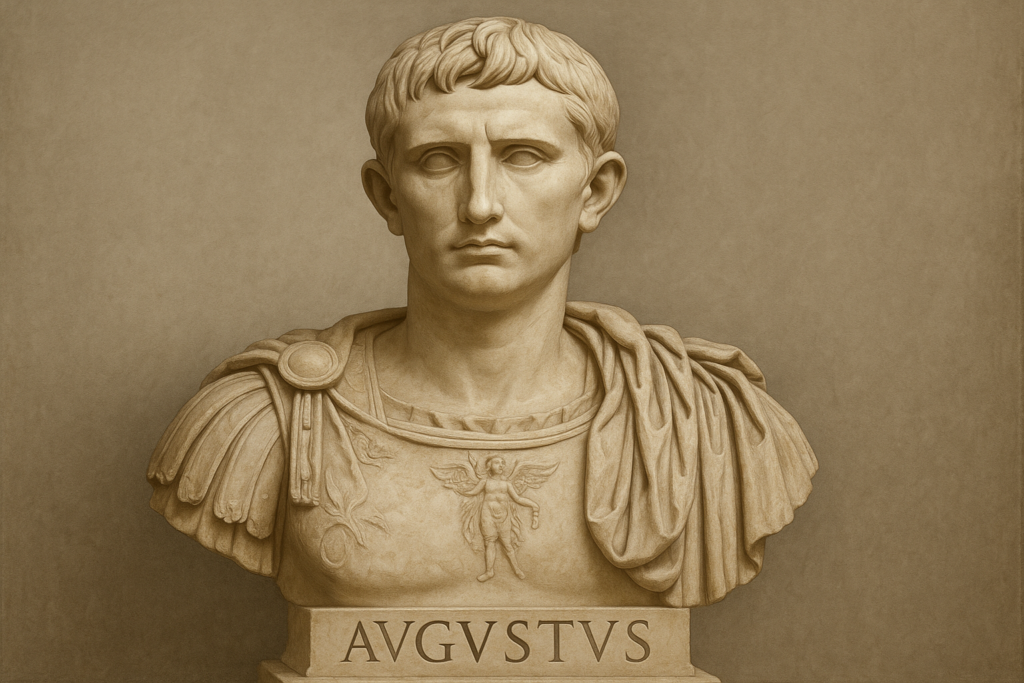
The Importance of Augustus in History
Augustus was not only a victorious military leader but also a brilliant political strategist. By blending absolute power with republican appearances, he managed to gain both popular and senatorial support.
Without Augustus, Rome might not have survived the chaos of civil wars nor become the greatest empire of antiquity.
Closing Thoughts
You may also be interested in: João Ferreira da Silva: The Controversial Case That Ended
Born in 63 BC, Augustus remains one of the most influential figures in world history. His reign established a new political order and inaugurated a period of unmatched prosperity. He was more than an emperor he was the architect of an empire that shaped the destiny of humanity for centuries.
🔔 For more tutorials like this, consider subscribing to our blog.
📩 Do you have questions or suggestions? Leave a comment or contact us!
🏷️ Etichete: Augustus, Ancient Rome, Roman Empire, Julius Caesar, Pax Romana, world history, Roman emperors, Battle of Actium, Roman reforms, Julio-Claudian dynasty
📢 Hashtag-uri: #Augustus #AncientRome #RomanEmpire #History #JuliusCaesar #PaxRomana #RomanReforms #Actium #FirstEmperor #Civilization
