


⏲️ Estimated reading time: 6 min
Table of Contents
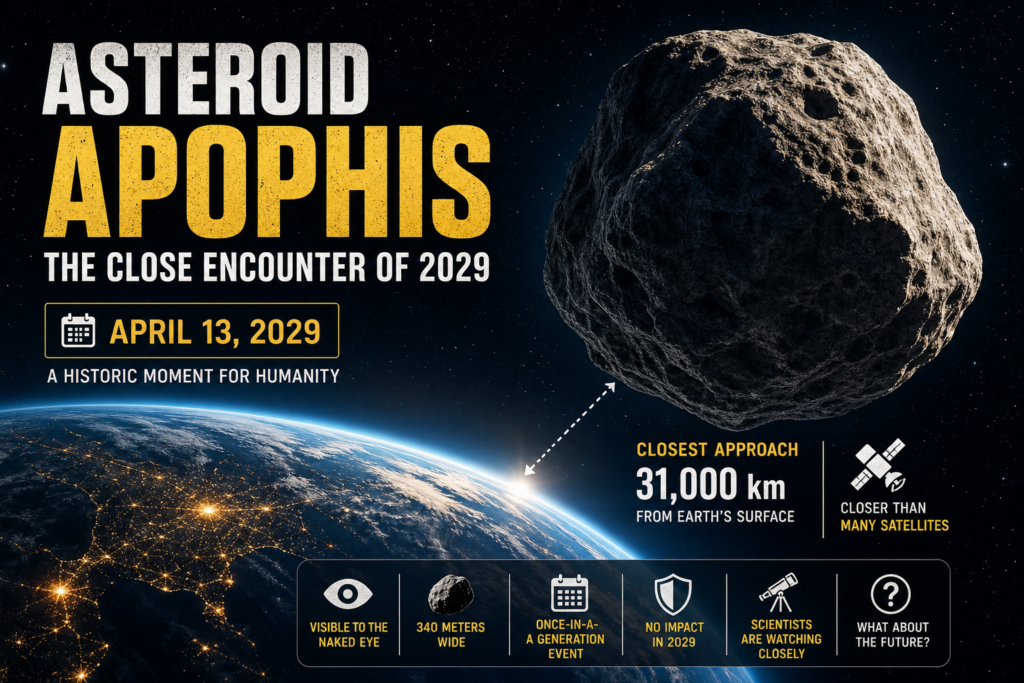
On April 13, 2029, the asteroid Apophis will pass extremely close to Earth. Is this a breathtaking cosmic event or a real cause for concern? Discover everything you need to know about this fascinating and potentially dangerous encounter.
Apophis 2029: A Historic Close Encounter
In modern astronomy, few events have captured global attention like the approach of asteroid Apophis. On April 13, 2029, humanity will witness a rare and extraordinary cosmic event one that is both awe-inspiring and, for some, unsettling.
This massive asteroid, measuring about 340 meters across, will pass just 31,000 kilometers above Earth’s surface. That distance is closer than many satellites orbiting our planet. In simple terms, Apophis will pass right through Earth’s cosmic neighborhood.
What Is the Apophis Asteroid?
Apophis is classified as a Near-Earth Object (NEO), meaning its orbit brings it close to Earth.
The Origin of Its Name
The asteroid is named after Apophis, the Egyptian god of chaos and destruction. This name reflects the initial fear it caused among scientists.
Size and Composition
Apophis has:
- A width of approximately 340 meters
- A rocky composition
- A massive structure capable of causing regional devastation
While it is not large enough to cause global extinction, its impact could destroy an entire city or region.
Why Is the 2029 Event So Important?
The 2029 flyby is one of the closest known encounters with a large asteroid in recorded history.
Visible to the Naked Eye
For the first time, billions of people may be able to see an asteroid without telescopes.
It will appear as a bright moving point crossing the night sky.
Closer Than Satellites
Apophis will pass:
- Below the orbit of some satellites
- Closer than GPS systems
This makes the event incredibly rare and scientifically valuable.
Early Fears: Was There a Risk of Impact?
When Apophis was discovered in 2004, it raised serious concerns.
Initial Probability
Scientists initially believed there was a chance it could collide with Earth in 2029. Such an impact would have released energy equivalent to thousands of nuclear bombs.
Updated Calculations
Later observations ruled out a direct collision. Apophis will safely miss Earth in 2029.
What Happens After 2029?
This is where things become more complex.
Earth’s Gravitational Influence
The close approach will alter Apophis’s orbit.
This change could:
- Shift its trajectory
- Affect future encounters
Future Scenarios
Scientists are studying:
- Possible returns in later years
- Orbital changes caused by gravity
mentions that this altered trajectory could make the asteroid more dangerous in the distant future if conditions align.
What Would an Impact Look Like?
Although highly unlikely in 2029, understanding the risk is important.
Impact Energy
An asteroid of this size could release:
- Massive energy comparable to multiple nuclear explosions
- Significant atmospheric shockwaves
Local Effects
A direct hit could cause:
- Massive destruction
- Fires and shockwaves
- Structural collapse over a wide area
Global Impact
It would not cause extinction, but it could:
- Disrupt climate temporarily
- Trigger global panic
How Do Scientists Track Asteroids?
Tracking near-Earth objects is a continuous and precise effort.
Read also: Klaus-Michael Kühne Dies at 89, Leaving a Global Logistics
Technologies Used
- Ground-based telescopes
- Space observatories
- Radar systems
Key Organizations
- NASA
- ESA
- International observatories
Can We Deflect an Asteroid?
Yes, scientists are actively developing and testing methods.
Proposed Techniques
- Kinetic impact (hitting the asteroid)
- Controlled nuclear explosion
- Gravity tractors
Real-World Testing
NASA’s DART mission proved that changing an asteroid’s trajectory is possible.
Why Are Asteroids So Fascinating?
Asteroids capture our imagination because they combine:
- Scientific curiosity
- Existential risk
- The mystery of space
Apophis perfectly represents this balance.
What Will We Experience in 2029?
On April 13, 2029:
- People around the world will look up in awe
- The sky will host a rare spectacle
- It will be a shared global moment
describes this as a time when billions could witness an asteroid crossing the sky.
Should We Be Worried or Amazed?
The truth lies somewhere in between.
No Immediate Danger
Current data confirms:
- No impact in 2029
- A safe trajectory
A Wake-Up Call
However, this event reminds us:
- Space is unpredictable
- Earth is not fully shielded
The Importance of Awareness and Education
Apophis offers a valuable learning opportunity.
What Can We Learn?
- The importance of space research
- The need for global cooperation
- The power of modern science
The Ultimate Question: A Warning from the Universe?
raises a powerful question:
Will 2029 be remembered as the night we narrowly avoided disaster or the beginning of a countdown?
The answer remains uncertain.
Frequently Asked Questions
What is the Apophis asteroid?
Apophis is a near-Earth asteroid about 340 meters wide.
How close will it get in 2029?
It will pass approximately 31,000 km above Earth.
Is there any risk of impact?
No, scientists confirm there is no risk in 2029.
Will it be visible without a telescope?
Yes, it may be visible to the naked eye.
Why was it considered dangerous?
Early calculations suggested a possible collision.
How does Earth’s gravity affect it?
It changes the asteroid’s orbit.
Could it become dangerous later?
There is a small possibility, but it is closely monitored.
What would happen if it hit Earth?
It would cause severe regional damage.
Can we stop an asteroid?
Yes, scientists are developing deflection technologies.
Why is this event important?
It helps us understand cosmic risks and preparedness.
Beyond the Sky: What Apophis Teaches Us
Apophis is more than just a space rock. It represents both the fragility of our planet and the strength of human knowledge. The 2029 event will likely go down in history not as a disaster, but as a moment of global awareness. It reminds us that while we live on a small planet in a vast universe, we are capable of understanding and even protecting ourselves.
⚠️ Disclaimer and Source Hygiene
This article is for informational purposes only. For scientific interpretations, consult experts in astronomy. The information is based on research from authoritative and reliable sources available at the time of writing.
🔔 For more tutorials like this, consider subscribing to our blog.
📩 Do you have questions or suggestions? Leave a comment or contact us!
🏷️ Tags: Apophis asteroid, Apophis 2029, near-Earth object, asteroid flyby, space science, NASA, astronomy events, asteroid خطر, cosmic threat, universe
📢 Hashtags: #Apophis2029, #Asteroid, #Space, #Astronomy, #NASA, #Cosmos, #Science, #Universe, #Earth, #SpaceEvent
📚 Sources and References
- NASA Near-Earth Object Program
- ESA Space Situational Awareness
- Scientific observations and research
🕊️ Secondary Sources and Testimonials
Astronomy experts highlight Apophis as a powerful example of scientific progress. Today, the global community is more prepared than ever to detect and respond to potential cosmic threats.
