

⏲️ Estimated reading time: 10 min
Table of Contents
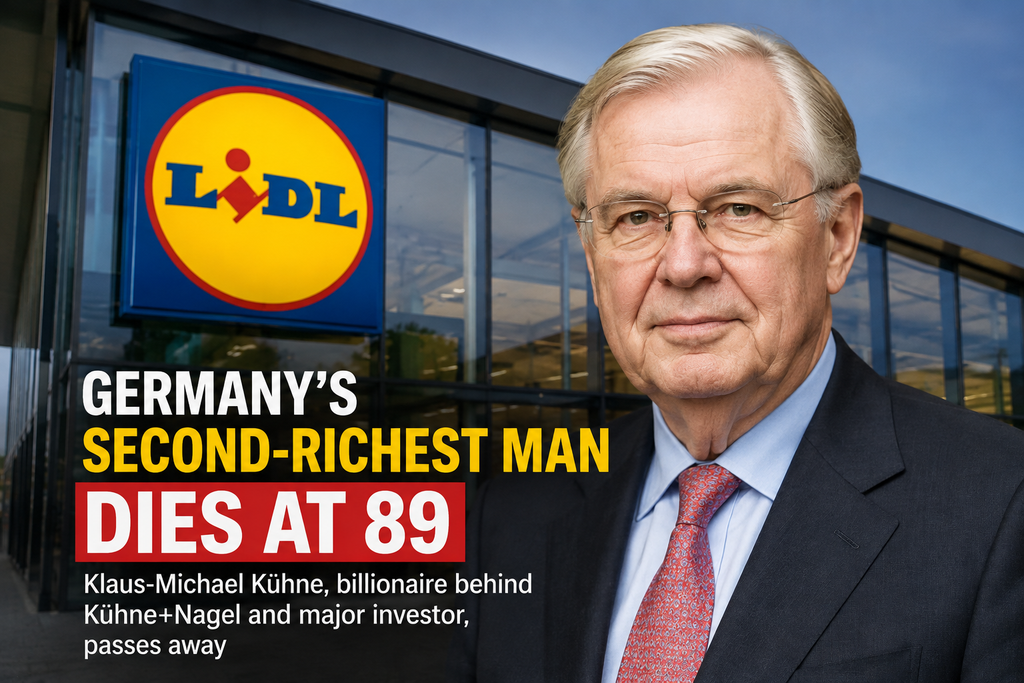
German billionaire Klaus-Michael Kühne, one of the world’s most influential logistics entrepreneurs and Germany’s second-richest person, has died at 89. The businessman helped transform Kühne+Nagel into a global logistics powerhouse while building major investments across shipping, aviation, transportation, sports, culture, and philanthropy.
Klaus-Michael Kühne Dies at the Age of 89
German billionaire and logistics entrepreneur Klaus-Michael Kühne has died at the age of 89, marking the end of an extraordinary business career that helped shape the modern global logistics industry.
Kühne died during the night of August 23 to 24, 2026, in Schindellegi, Switzerland, where he had lived for many years. His death was officially announced by Kühne+Nagel. The Kühne Foundation later said that the businessman died at his home following a long illness.
At the time of his death, Kühne ranked among Europe’s wealthiest individuals. German media described him as the second-richest person in Germany, behind Dieter Schwarz, the businessman behind the Schwarz Group, which owns Lidl and Kaufland.
Who Was Klaus-Michael Kühne?
Klaus-Michael Kühne was a German businessman, investor, and philanthropist best known for his decades-long involvement with international logistics company Kühne+Nagel.
He was born in Hamburg in 1937 and represented the third generation of the Kühne family involved in the logistics business. His grandfather, August Kühne, was one of the founders of Kühne+Nagel, which dates back to 1890.
Kühne joined the family company in 1958. His rise through the organization was rapid. By 1966, he had become chairman of the management board of Kühne+Nagel Speditions-AG.
He became CEO of Kühne+Nagel International in 1975. Between 1992 and 2011, he served as chairman of the company’s Board of Directors before becoming honorary chairman.
How Kühne+Nagel Became a Global Logistics Giant
Klaus-Michael Kühne played a central role in transforming the family business into one of the largest logistics organizations in the world.
International trade changed dramatically during his career. Container shipping expanded, air freight became increasingly important, and companies started building complex global supply chains.
Kühne recognized these developments and pushed the company toward international expansion.
Today, Kühne+Nagel operates a global network covering approximately 100 countries. Its activities include sea logistics, air logistics, road transportation, and contract logistics.
The company has grown far beyond the traditional freight-forwarding business from which it originated.
Kühne’s ability to understand the importance of global supply chains helped establish his reputation as one of the most influential entrepreneurs in modern logistics.
One of Germany’s Richest Businessmen
Klaus-Michael Kühne accumulated an enormous fortune during his lifetime.
Estimates published around the time of his death placed his wealth at approximately €36 billion, although billionaire rankings can fluctuate significantly because much of that wealth is connected to publicly traded companies.
This made him one of Europe’s richest individuals and reportedly Germany’s second-richest person behind Dieter Schwarz.
However, Kühne’s fortune was not based solely on Kühne+Nagel.
Over several decades, he built an investment portfolio focused heavily on transportation, logistics, shipping, and mobility.
His Business Empire Extended Beyond Kühne+Nagel
Through Kühne Holding, Klaus-Michael Kühne maintained major interests in several important European companies.
His holding company controlled approximately 53% of Kühne+Nagel and around 30% of container shipping company Hapag-Lloyd, according to reports published by German media.
Hapag-Lloyd is one of the world’s major container shipping companies and represents another important part of Kühne’s logistics and transportation investment strategy.
His investments therefore covered different stages of international transportation, from freight forwarding and supply-chain management to container shipping.
Klaus-Michael Kühne’s Major Investment in Lufthansa
Kühne also became one of the most influential investors in European aviation.
He built a substantial position in Lufthansa and became the airline group’s largest individual shareholder in 2022.
His stake was later reported at around 20%, giving him significant financial exposure to one of Europe’s best-known airline groups.
The investment fitted naturally into his broader portfolio. Logistics, aviation, shipping, and passenger transportation all formed part of a business strategy centered heavily on global mobility.
Kühne Also Invested in Flix
Another notable investment involved Flix, the transportation company known internationally for brands such as FlixBus.
Kühne acquired a significant minority investment through his holding company.
Once again, the investment reflected his preference for companies connected to transportation and mobility.
By combining holdings in freight forwarding, shipping, aviation, and passenger transportation, Kühne built a portfolio that touched many areas of the European transportation economy.
His Strong Connection With Hamburg
Although Klaus-Michael Kühne spent many years living in Switzerland, his relationship with Hamburg remained extremely important throughout his life.
Hamburg was his birthplace and one of Europe’s most important logistics and maritime centers.
Kühne invested substantial amounts of money in cultural, educational, medical, and sporting initiatives associated with the city and other regions.
His philanthropic activities extended beyond Germany through the Kühne Foundation.
The foundation supports projects involving logistics education, medicine, climate-related research, and culture. Hundreds of people are involved in projects and organizations connected to its activities.
Klaus-Michael Kühne and Hamburger SV
Football was another important part of Kühne’s public life.
For many years, he was closely associated with German football club Hamburger SV (HSV) as an investor and financial supporter.
His financial involvement became particularly significant during difficult periods for the club.
Kühne eventually became one of the major shareholders in HSV’s commercial structure and provided substantial financial support for the organization.
One of his most popular moves among supporters came in 2015.
Kühne purchased the naming rights to the club’s stadium and helped restore its traditional name, Volksparkstadion.
The decision had considerable symbolic importance for HSV supporters and strengthened Kühne’s connection with the club.
Philanthropy Became an Important Part of His Legacy
Klaus-Michael Kühne was not only an investor.
See also: Taylor Swift Teases ‘Patient Zero’ Ahead of MTV VMAs
During the later decades of his life, philanthropy became an increasingly visible part of his activities.
The Kühne Foundation supports projects across several fields, including logistics research and education, medicine, climate research, and culture.
One of the best-known institutions connected with this work is the Kühne Logistics University in Hamburg, which focuses on logistics, supply-chain management, and related business disciplines.
His charitable activities reflected the industry in which his family had built its fortune while also extending into broader social and cultural projects.
The Kühne Foundation has indicated that this work will continue following the founder’s death.
A Businessman Who Helped Shape Modern Logistics
Klaus-Michael Kühne entered the logistics industry at a very different time.
When he joined Kühne+Nagel in 1958, global supply chains were far less sophisticated than they are today. Containerization was still developing, digital logistics did not exist, and international commerce operated on a much smaller scale.
Over the following decades, almost every part of the industry changed.
Container ships became larger. Air freight expanded. Manufacturing became increasingly international. Companies began relying on complex supply chains stretching across multiple continents.
Kühne helped position Kühne+Nagel to benefit from these developments.
Rather than remaining a traditional forwarding company, the business expanded internationally and developed sophisticated logistics services for companies operating around the world.
Why Klaus-Michael Kühne Was So Influential
Kühne’s influence came from more than personal wealth.
Few European investors had such extensive exposure to the different parts of global transportation.
His interests included freight forwarding through Kühne+Nagel, container shipping through Hapag-Lloyd, aviation through Lufthansa, and passenger transportation through Flix.
This combination gave his business empire a unique position within Europe’s transportation sector.
At the same time, his investments in education and research helped connect commercial logistics with academic development.
His influence therefore reached beyond individual companies and into the wider logistics ecosystem.
What Happens to the Kühne Business Empire Now?
Klaus-Michael Kühne’s death naturally raises questions about the future of his enormous portfolio of corporate investments.
However, the organizations associated with him operate through established corporate structures rather than depending entirely on his daily involvement.
Kühne+Nagel has its own executive leadership and Board of Directors. Other publicly traded companies in which Kühne held shares also maintain independent management structures.
The Kühne Foundation has also indicated that it intends to continue its activities in accordance with the principles established by its founder.
The long-term handling of Kühne’s investments will nevertheless attract considerable attention because of the size and strategic importance of the holdings involved.
Frequently Asked Questions
How old was Klaus-Michael Kühne when he died?
Klaus-Michael Kühne died at the age of 89 in August 2026.
Where did Klaus-Michael Kühne die?
He died at his home in Schindellegi, Switzerland, where he had lived for many years.
What was Klaus-Michael Kühne’s cause of death?
The Kühne Foundation said he died following a long illness. Detailed private medical information was not publicly disclosed in the announcement.
What was Klaus-Michael Kühne famous for?
He was best known for transforming Kühne+Nagel into one of the world’s leading logistics companies and for building major investments across transportation and logistics.
How much was Klaus-Michael Kühne worth?
Reports around the time of his death estimated his fortune at approximately €36 billion. Such estimates can change because much of a billionaire’s wealth is linked to company valuations and share prices.
Was Klaus-Michael Kühne Germany’s richest person?
He was widely reported as the second-richest German, behind Dieter Schwarz.
Did Klaus-Michael Kühne own Kühne+Nagel?
Kühne controlled a majority interest in Kühne+Nagel through his investment structure. His holding was reported at approximately 53%.
Did Klaus-Michael Kühne own Lufthansa?
He did not own Lufthansa outright. However, he became its largest individual shareholder and held a substantial stake in the airline group.
What was his connection to Hapag-Lloyd?
Kühne was a major shareholder in Hapag-Lloyd, one of the world’s largest container shipping companies.
Was Klaus-Michael Kühne involved with Hamburger SV?
Yes. He was a longtime investor and financial supporter of Hamburger SV and played an important role in supporting the club financially.
The End of an Era in European Logistics
The death of Klaus-Michael Kühne marks the end of an extraordinary chapter in European business history.
He inherited a connection to a family logistics company, but his legacy extended far beyond maintaining that business. Under his leadership and influence, Kühne+Nagel developed into a global logistics powerhouse.
His investments in Hapag-Lloyd, Lufthansa, Flix, and other businesses expanded that influence across shipping, aviation, and transportation.
At the same time, his support for education, research, culture, medicine, and sport created another side to his legacy.
Klaus-Michael Kühne leaves behind not simply a multibillion-euro fortune, but a collection of companies, institutions, and projects that will continue operating long after his death.
⚠️ Disclaimer and Source Hygiene
This article is provided for informational and editorial purposes. Information was compiled from official corporate announcements and reputable media reporting available at the time of publication. Financial estimates, shareholder positions, and company valuations can change over time. Readers should consult official corporate disclosures for the latest financial information.
🔔 For more tutorials like this, consider subscribing to our blog.
📩 Do you have questions or suggestions? Leave a comment or contact us!
🏷️ Tags: Klaus-Michael Kühne, Klaus-Michael Kühne death, Kühne+Nagel, German billionaire, logistics industry, Hapag-Lloyd, Lufthansa, Hamburger SV, German entrepreneurs, logistics news
📢 Hashtags: #KlausMichaelKuehne, #KuehneNagel, #Logistics, #Germany, #Business, #Billionaires, #Lufthansa, #HapagLloyd, #Hamburg, #BusinessNews
📚 Sources and References
Kühne+Nagel: The company’s official announcement confirmed Klaus-Michael Kühne’s death and detailed major milestones from his career.
Kühne Foundation: The foundation provided information about Kühne’s death, philanthropic legacy, and the continuation of its activities.
Kühne Foundation official website
🕊️ Secondary Sources and Reporting
Additional reporting from major European and German media provided context about Kühne’s estimated fortune, corporate holdings, Hamburger SV involvement, and position among Germany’s wealthiest individuals.
NDR coverage of Klaus-Michael Kühne and HSV
