

⏲️ Estimated reading time: 27 min
Table of Contents
Narcissism does not automatically mean a personality disorder. There are important differences between narcissistic traits, repeated behaviors, and a clinical diagnosis. Discover where understanding ends, responsibility begins, and why the emotional impact of an unhealthy relationship deserves to be taken seriously.
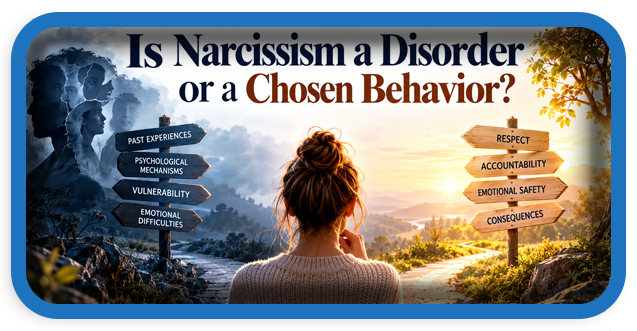
Is Narcissism a Disorder or a Chosen Behavior?
The word “narcissist” seems to be everywhere today. We hear it in conversations about relationships, breakups, families, workplace conflicts, and even friendships that have fallen apart. Sometimes, it describes someone who is selfish. At other times, it refers to a person who constantly seeks attention, controls conversations, avoids responsibility, or appears unable to acknowledge the pain they cause others. The problem begins when we place all these situations under the same label. Narcissism is far more complex. A person can display narcissistic traits without having a mental health disorder, and hurtful behavior does not automatically prove the presence of narcissistic personality disorder.
At the same time, avoiding an amateur diagnosis does not mean we should ignore harmful behavior. We can refuse to diagnose someone while still recognizing that they lie, manipulate, control, humiliate, dismiss other people’s feelings, or consistently refuse accountability. This is where one of the most important distinctions in this discussion appears. A psychological explanation for behavior and responsibility for the consequences of that behavior are not the same thing.
The American Psychiatric Association describes narcissistic personality disorder as a persistent pattern involving grandiosity, a need for admiration, and difficulties with empathy. However, it also emphasizes that having narcissistic traits is not automatically the same as having the disorder. A clinical diagnosis requires professionals to consider a persistent and inflexible pattern associated with significant impairment or distress.
Narcissism Is Not a Simple or Uniform Phenomenon
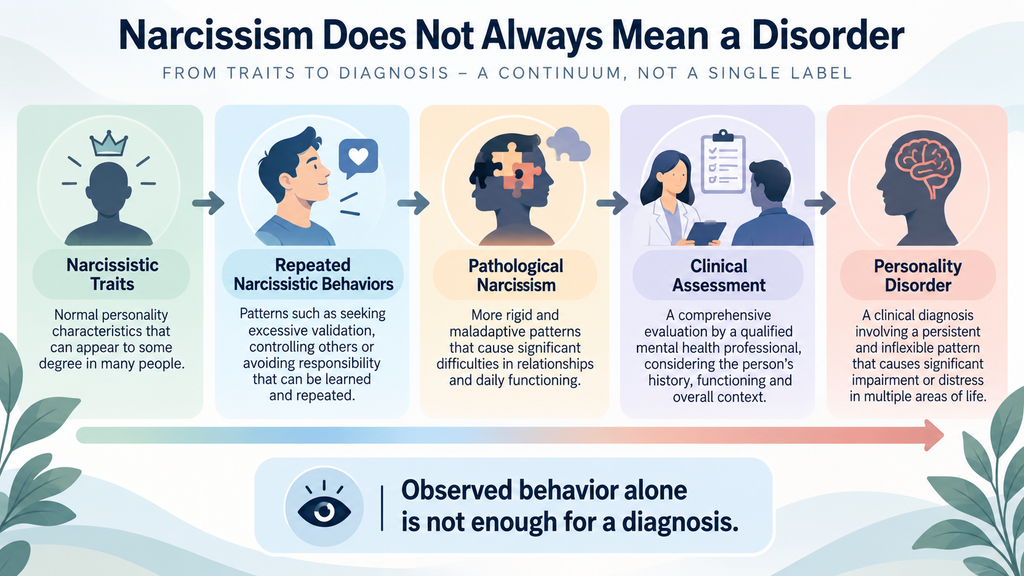
When we use the word “narcissism,” we may actually be talking about several different things. There are personality traits that can appear to some degree in people without a mental health disorder. There is pathological narcissism, which psychologists and psychiatrists study clinically. There is also narcissistic personality disorder, which requires specific diagnostic criteria and professional evaluation. Mixing these categories creates considerable confusion, especially when discussing relationships.
A person may be excessively concerned with their image, seek validation, or react badly to criticism without meeting the criteria for a personality disorder. Likewise, someone may behave in controlling or deeply selfish ways for reasons unrelated to narcissistic personality disorder. Behavior observed from the outside does not automatically give us access to the person’s complete psychological structure.
For this reason, statements such as “he is a narcissist” or “she is a narcissist” should be used carefully when no diagnosis exists. It is often more useful to describe what actually happens: “They constantly criticize me,” “They dismiss my feelings,” “They refuse to take responsibility for mistakes,” “They try to control my decisions,” or “I constantly feel diminished in this relationship.” These observations can matter even when we do not know, and may never know, what diagnosis the other person might receive.
Narcissistic Traits Do Not Automatically Mean a Disorder
One of the most common mistakes in online discussions is turning a personality trait into a diagnosis. Someone can be selfish without having narcissistic personality disorder. A person may seek admiration without meeting the full clinical criteria. Someone may react defensively to criticism, struggle with empathy, or become highly preoccupied with status and appearance. These characteristics must be understood in context rather than isolation.
The American Psychiatric Association explicitly makes this distinction. Many people can display characteristics considered narcissistic, while the disorder involves a more severe, persistent, and problematic pattern. Clinical evaluation considers how a person functions over time and across different situations, rather than focusing on what happened during one argument or one difficult relationship.
This distinction protects both sides of the conversation. On one hand, it prevents us from pathologizing every difficult person. On the other, it allows us to discuss harmful behaviors seriously without needing a diagnosis before recognizing them as problematic. We do not need to prove that someone has a personality disorder before acknowledging that a particular interaction is hurting us.
Trait, Pattern, and Disorder
A trait may appear occasionally. A behavioral pattern repeats itself and becomes predictable. A personality disorder, however, requires a much more comprehensive clinical assessment. This distinction may sound simple, but it fundamentally changes how we should discuss narcissism.
The World Health Organization’s ICD-11 includes a dimensional approach to personality disorders, recognizing that psychological characteristics do not always divide perfectly into “normal” and “disordered.” Clinical diagnosis, however, remains a task for qualified professionals and requires far more than identifying several behaviors within a relationship.
In everyday life, this means we may encounter people with varying degrees of self-centeredness, need for admiration, competitiveness, sensitivity to criticism, or difficulties with empathy. They do not all share the same psychological structure, and they would not necessarily receive the same diagnosis. Whenever possible, broad labels should therefore be replaced with concrete descriptions of behavior.
What Is Narcissistic Personality Disorder?
Narcissistic personality disorder, commonly abbreviated as NPD, is a real clinical condition. The DSM-5-TR, published by the American Psychiatric Association, describes a broad pattern involving grandiosity, a need for admiration, and problems related to empathy. Manifestations may include an exaggerated sense of self-importance, preoccupation with success or status, expectations of special treatment, interpersonal exploitation, and arrogant attitudes. However, diagnosis is never based on one characteristic alone.
The popular image of someone who is permanently confident and self-assured also fails to capture the full clinical complexity. Professional literature discusses both grandiose and vulnerable manifestations of narcissism. These features can interact, and the same individual may fluctuate depending on circumstances. Current research examines mechanisms involving self-esteem regulation, emotional regulation, interpersonal relationships, and empathy.
This complexity explains why a diagnosis cannot responsibly be made from social media posts or a checklist of “ten signs.” Mayo Clinic explains that diagnosis involves considering symptoms, their impact on life, and a thorough psychological evaluation. Some characteristics may overlap with other personality disorders or mental health conditions, making professional assessment particularly important.
How Common Is Narcissistic Personality Disorder?
Estimating prevalence is not straightforward. The American Psychiatric Association cites estimates of approximately 1–2% of the U.S. population, while older epidemiological studies have produced different results depending on methodology, samples, and diagnostic criteria.
A systematic review published in 2010 examined studies involving nonclinical adult populations using structured or semi-structured interviews. It reported an average prevalence of approximately 1.06%, although there was considerable variation among individual studies. Other American epidemiological research has produced higher estimates. These differences demonstrate why prevalence figures should be interpreted cautiously.
Therefore, it is not reasonable to assume that the large number of people described online as “narcissists” automatically have NPD. The popular use of the term is much broader than the clinical diagnosis. Sometimes it describes selfishness. At other times, it refers to a lack of reciprocity, manipulation, arrogance, or simply a relationship in which someone has been deeply hurt.
Can Narcissism Be a Chosen Behavior?
This is one of the most delicate parts of the question. It can be tempting to say that someone who repeatedly behaves hurtfully simply “chooses to be narcissistic.” Scientifically, however, that explanation is too simplistic. Personality disorders and pathological narcissism involve complex psychological mechanisms, and current research describes their development and maintenance as multifactorial. We cannot reduce these mechanisms to a conscious decision such as, “Today I choose to behave narcissistically.”
However, there is another dimension worth discussing: responsibility for one’s actions. The fact that behavior may have psychological explanations does not automatically make it acceptable. Someone may genuinely struggle with emotional regulation, empathy, or self-esteem while still having responsibility for addressing behaviors that harm other people.
This distinction helps us avoid two extremes. The first says, “They have a disorder, so they are not responsible for anything.” The second says, “Everything they do is intentional, and they could stop instantly if they wanted to.” Psychological reality can be far more complicated. Understanding causes and establishing responsibility can exist at the same time.
Between “Cannot” and “Will Not” Are Many Shades of Gray
In painful relationships, one question appears repeatedly: “Can this person not change, or do they simply refuse to change?” From the outside, we can rarely answer with certainty. Some reactions may be deeply automatic. Other behaviors may involve conscious decisions. Motivation can change over time, and a person’s ability to reflect on their own behavior can vary.
Clinical research on empathy in NPD highlights this complexity. Empathy does not appear to follow the simple model of either “having it” or “not having it.” Researchers discuss differences between cognitive and emotional empathy, as well as the influence of motivation and context on empathic responses.
This finding matters when discussing responsibility. We cannot assume that every reaction represents a completely free and calculated choice. At the same time, we should not automatically assume that a person is entirely incapable of reflection, learning, or changing their behavior. Research into psychotherapy suggests that change is possible for some people with NPD, although it can be slow and challenging.
Empathy in Narcissism Is More Complex Than It Appears
One of the most common statements about narcissism is that “narcissists have no empathy.” Research suggests a more nuanced picture. Empathy is not a single ability. In simplified terms, we can distinguish between understanding another person’s perspective and emotions and emotionally responding to that person’s experience.
A review published in Personality Disorders suggests that empathic functioning in NPD can be impaired without necessarily being completely absent. Researchers found evidence of greater impairment in emotional empathy in some studies, while cognitive empathy may remain relatively better preserved. These findings do not support the simplistic assumption that every person with NPD is completely unable to understand another person’s emotions.
This distinction may help explain why some individuals can appear remarkably attentive to other people’s emotions in certain situations but respond very differently at other times. Understanding another person’s emotional state does not automatically guarantee care, reciprocity, or prosocial behavior. However, this observation should not be transformed into a universal rule about everyone diagnosed with NPD.
Why Behavior Matters Even Without a Diagnosis
Imagine a relationship in which one partner is constantly criticized. Their feelings are minimized. Every attempt to discuss a problem becomes another argument about their supposed faults. Over time, they begin questioning their own perceptions and avoiding certain subjects simply to prevent conflict.
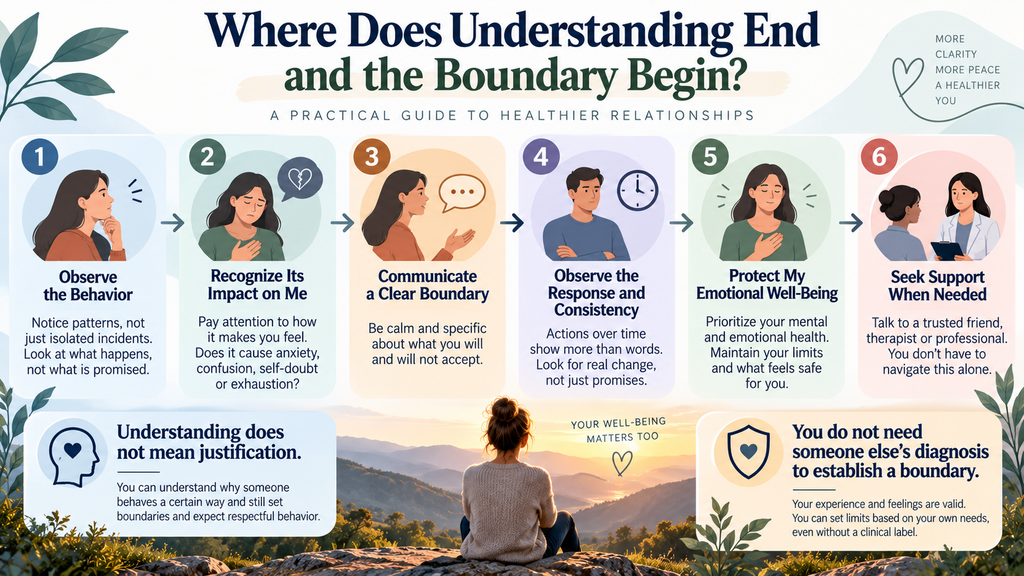
The problematic partner might have NPD. They might not. From the perspective of the person experiencing the relationship, the most useful first question is not necessarily the other person’s diagnosis. It may be more important to observe what is actually happening, how often the behavior repeats, how it affects emotional well-being, and whether personal boundaries are respected.
Research on pathological narcissism documents interpersonal difficulties and, in certain contexts, controlling, intrusive, or hostile behavior. Clinical literature also emphasizes the importance of boundaries in protecting personal safety and well-being. This does not mean every person with narcissistic traits behaves abusively. It does demonstrate why relationship functioning deserves serious attention.
A Diagnosis Should Not Excuse Harmful Behavior
A diagnosis can explain certain difficulties. It can guide treatment and help someone better understand patterns they repeatedly experience. However, it should not become a universal justification for every action.
Psychotherapy literature includes important discussions about the distinction between responsibility and blame. Research on personality disorders has argued that accepting responsibility for behavior can play an important role in treatment without requiring professionals to stigmatize or condemn the person. In other words, compassion and accountability do not have to be opposites.
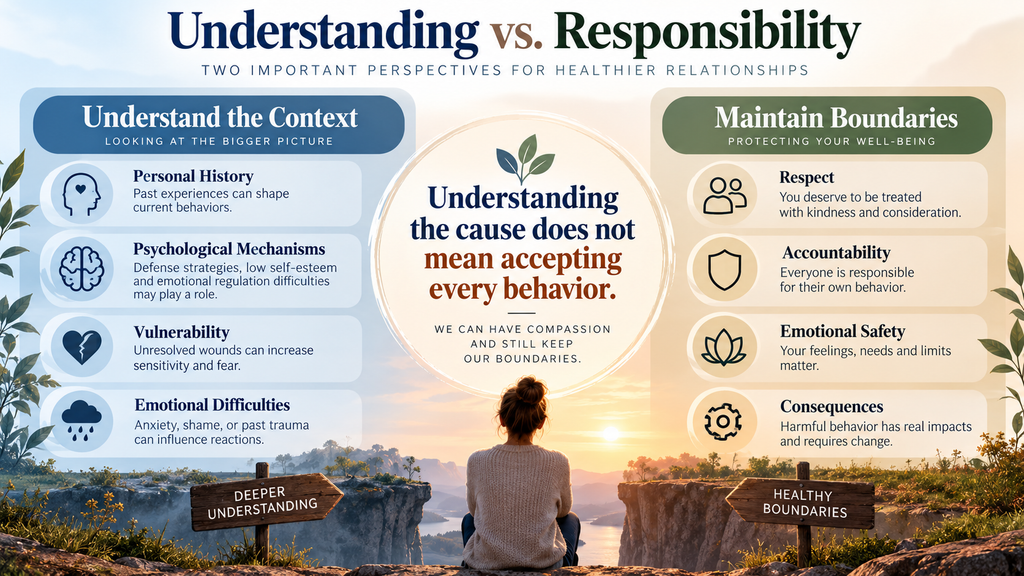
The same principle can apply within relationships. We can acknowledge that someone is struggling and still say, “I will not accept being insulted.” We can understand that someone experiences emotional difficulties while refusing excessive control. We can have compassion and maintain boundaries at the same time.
Behavior Should Not Automatically Become a Diagnosis Either
The opposite extreme is equally problematic. Someone lies, so they become a “narcissist.” Someone cheats, and the same label immediately appears. A partner behaves selfishly, and the internet quickly provides a diagnosis.
This approach oversimplifies human psychology. People can behave terribly without having NPD. They can manipulate without having the disorder. They can avoid responsibility, behave controlling, or hurt other people for many different reasons. A psychiatric diagnosis is not required for harmful behavior to exist.
Excessive use of the term can also stigmatize people who genuinely live with personality disorders and are trying to seek help. Responsible language allows us to criticize behavior without turning psychiatric diagnoses into insults.
Can Someone With Pathological Narcissism Change?
The claim that “a narcissist can never change” is too absolute. Professional literature indicates that change is possible, although the process can be slow and complex. Psychotherapy represents the main treatment approach for narcissistic personality disorder. Treatment goals may include improving relationships, emotional regulation, self-esteem management, and developing healthier ways of relating to others.
A qualitative study published in 2023 examined therapist reports concerning eight patients diagnosed with NPD who underwent long-term psychotherapy. Researchers described significant improvements in functioning and identified factors including motivation, engagement in therapy, reflective ability, emotional regulation, and a sense of agency. This was a small study, so its results cannot establish that everyone will experience the same outcome. Nevertheless, it challenges the claim that change is impossible by definition.
There is an important distinction for partners and families, however. The possibility of change does not mean another person can create that change for them. A partner cannot attend therapy on someone else’s behalf. They cannot create motivation through unlimited sacrifice, and patience alone cannot guarantee an outcome.
Promising to Change and Actually Changing Are Different Things
Promises often appear after intense conflicts in difficult relationships. “It will never happen again.” “I’ve changed.” “Things will be different from now on.” Sometimes those promises may be sincere. However, lasting change should be evaluated through observable behavior over time rather than the emotional intensity of a statement.
Someone seriously working on their difficulties may gradually become better able to tolerate responsibility, reflect on their reactions, and develop different responses. Professional literature on psychotherapy for NPD emphasizes clear goals, agency, the therapeutic relationship, and addressing difficulties that interfere with treatment.
For loved ones, this perspective can reduce the pressure to interpret every apology as proof of transformation. Meaningful psychological change is usually reflected in consistency, accountability, and different behaviors repeated over time.
When Understanding Starts Becoming Tolerance of Suffering
Empathy is valuable, but it can become harmful to our own well-being when we confuse it with an obligation to tolerate everything. “They had a difficult childhood.” “They were hurt.” “They are afraid of abandonment.” “They do not know how to express their emotions.” All these statements may be true and may help us understand someone.
None of these explanations, however, automatically mean another person must tolerate behavior that seriously damages their life. There is a difference between understanding where behavior comes from and removing all consequences for it. A healthy boundary does not necessarily say, “You are a bad person.” It says, “This behavior is not acceptable to me.”
This shift in perspective matters. Instead of spending all our energy trying to determine whether someone is “really a narcissist,” we can examine the actual relationship. Is there respect? Is there reciprocity? Can I say no? Can I express dissatisfaction without fear? Are mistakes acknowledged? Are my boundaries respected?
Emotional Exhaustion and Confusion Should Not Be Ignored
Dysfunctional relationships can create a state in which someone begins focusing almost entirely on the other person’s behavior. They analyze messages, conversations, tone of voice, and every disagreement. They search for psychological explanations and constantly wonder what they could do differently to make the relationship work.
At this stage, the partner’s potential diagnosis can become almost an obsession. “If I discover what they have, I will finally know what to do.” Unfortunately, the answer is not always that simple. Sometimes psychological information helps. At other times, the person already possesses the most important information: the relationship is causing fear, exhaustion, confusion, or loss of autonomy.
You do not need confirmation of another person’s diagnosis before seeking support. A psychologist or psychotherapist can help someone examine their own boundaries, emotions, and options even if the other person never participates in an evaluation.
The More Useful Question May Be What Is Happening to You
When someone spends months searching for an answer to “Is this person really a narcissist?”, another question may eventually become more important: “How do I feel in this relationship?” This is not a diagnostic method. Instead, it brings attention back to your own experience.
Do you feel free to speak? Can you disagree without being emotionally punished? Is there room for your needs? Can conflicts end through discussion, or are they consistently followed by accusations, threats, hostile silence, or humiliation? When the other person makes a mistake, can they acknowledge it? When you say something hurt you, are they willing to listen?
Answers to these questions can provide much more useful information for everyday life than a label found online. Healthy relationships are not free from conflict. The difference is that there is room for repair, reciprocity, respect, and responsibility.
Boundaries Are Not Punishments
A healthy boundary defines what you will accept and what you will do if a particular situation continues. It is not an attempt to control another person’s mind or personality.
“I will not continue this conversation if I am being insulted” is a boundary. “You must think exactly like me” is control. “I do not accept you checking my phone without permission” is a boundary. “You must constantly prove that you love me” can become a controlling demand.
This distinction becomes particularly useful in relationships where conflict has become normal. Clear boundaries reduce endless arguments about intentions that cannot be verified and redirect attention toward observable behavior. You do not need to prove that someone is a narcissist before asking for respect.
Why the “Narcissist” Label Can Become a Trap
The term can initially provide an explanation. After months or years of confusion, discovering a psychological concept can create the feeling that the pieces of a puzzle are finally coming together. Someone finds descriptions that resemble their experience and finally sees words for something they struggled to explain.
The problem begins when the label replaces analysis. Every gesture becomes “narcissism.” Every disagreement confirms the presumed diagnosis. Behaviors are interpreted exclusively through the same lens, while alternative explanations disappear.
A healthier approach is to use psychological concepts to improve understanding rather than diagnose someone from a distance. We can say that a behavior resembles certain patterns discussed in literature on narcissism. We do not need to conclude automatically that we know which personality disorder someone has.
“Narcissist” Should Not Become Another Word for “Bad Person”
This association creates stigma and helps neither people affected by harmful behaviors nor individuals genuinely living with personality disorders.
Mental health disorders are not moral verdicts. A diagnosis describes a clinical pattern. It does not determine a person’s human worth. At the same time, the absence of a diagnosis does not make harmful behavior acceptable.
This separation is essential. We can say, “This behavior hurts me” without saying, “This person is fundamentally bad.” We can establish boundaries without making a diagnosis. We can leave a relationship that harms us even when we do not have a psychiatric explanation for everything that happened.
Responsibility Does Not Disappear Because Psychological Suffering Exists
One of the most mature approaches to mental health is the ability to hold two truths at the same time. A person can suffer and cause suffering. They can carry old wounds and still hurt other people. They can have genuine psychological difficulties while still needing to take responsibility for their behavior.
This perspective avoids both demonization and endless justification. Research and clinical discussions surrounding personality disorders address the possibility of encouraging responsibility without turning that process into moral condemnation.
For personal relationships, the principle can be stated simply: an explanation does not erase the impact. If someone has psychological difficulties, they may deserve support and treatment. The person beside them also deserves respect, safety, and the right to decide what they can and cannot tolerate.
It Is Not a Partner’s Responsibility to “Heal” Someone
Love can support change, but it cannot replace treatment, motivation, and personal accountability. This is one of the hardest lessons for people who remain in difficult relationships hoping that enough patience will eventually change the other person’s behavior.
Sometimes a relationship can improve. Sometimes it cannot. No one can guarantee another person’s psychological transformation through personal sacrifice. Even specialized psychotherapy can require time, motivation, cooperation, and consistent effort.
Healthy support does not mean abandoning your own identity. It does not require accepting humiliation, fear, or control. A relationship does not become healthy simply because one partner perfectly understands the psychology of the other.
What Can We Control in a Difficult Relationship?
We cannot control another person’s diagnosis. We cannot decide whether they will begin therapy, acknowledge a problem, or want to change. We can, however, observe behavior, communicate clearly, and decide what boundaries we need.
Instead of becoming trapped in an endless battle over who is right, it may be more useful to watch patterns. What happens after you communicate a problem? Does behavior change, or are there only promises? Are boundaries respected? Is there accountability? Can you speak without fear?
If a relationship causes persistent emotional distress, support from a qualified mental health professional can provide a space to examine the situation outside the pressure of ongoing conflict. Where threats, violence, or immediate danger are present, personal safety and access to local emergency services or specialist support organizations should take priority.
Narcissism and Love: A Question Without a Simple Answer
“Can a narcissist love?” is one of the most frequently asked questions surrounding this subject. However, the question begins with the assumption that all people described as narcissistic are identical. They are not.
The capacity for attachment, empathy, intimacy, and reciprocity can vary. Clinical literature describes pathological narcissism as complex and heterogeneous. Grandiose and vulnerable manifestations can interact, while interpersonal difficulties may appear in different forms.
A more practical question might be: “What does love look like in this relationship?” Is care demonstrated through behavior? Are boundaries respected? Is there genuine interest in the other person’s experience? Is affection consistent, or does it mainly appear when the person receives what they want? These questions cannot provide a diagnosis, but they may help clarify the relationship.
Love Without Responsibility May Not Be Enough
Feelings do not automatically resolve dysfunctional behavior. Two people may love each other while still having a deeply unhealthy relationship. Someone may feel attachment while lacking the skills needed to maintain a stable and reciprocal partnership.
For this reason, the discussion about narcissism should not be reduced to whether someone “feels something.” What matters is how those feelings translate into behavior. Respect, responsibility, empathy, the ability to repair after conflict, and acceptance of another person’s autonomy are important elements of healthy relationship functioning.
Love does not provide immunity from the consequences of our actions. Nor does it obligate another person to remain in a situation that damages their emotional well-being.
When Is Professional Psychological Support Helpful?
Psychological support can be valuable not only for someone displaying narcissistic traits but also for people living in difficult relationships. Therapy should not be viewed exclusively as an attempt to “fix” another person.
For someone affected by a relationship, speaking with a qualified professional can help clarify boundaries, identify patterns, understand personal reactions, and rebuild autonomy. Therapy should not be used as an indirect method of diagnosing an absent partner. The primary goal can simply be understanding your own experience and making healthier decisions.
For someone diagnosed with NPD, psychotherapy remains the main treatment approach. Mayo Clinic identifies psychotherapy as the central treatment, while professional literature suggests that meaningful change can occur, although the process may be gradual.
The Essential Question: Where Does Understanding End?
Perhaps this is the most important question in the entire discussion. Understanding matters. It helps us avoid reducing people to their mistakes and allows us to recognize the complexity behind behavior. But understanding should not be confused with abandoning our own boundaries.
We can say, “I understand that you have been through difficult experiences, but I will not accept being insulted.” We can say, “I understand that trusting people is difficult for you, but I will not accept constant control.” We can say, “I understand that changing is difficult, but I need to see different behavior, not only promises.”
That is not a lack of empathy. It is recognition that at least two human experiences matter within a relationship. One person’s pain should not make the other person’s pain invisible.
Frequently Asked Questions – FAQ
Is narcissism a mental disorder?
Narcissism is a broader concept than narcissistic personality disorder. Someone can have narcissistic traits without having NPD. The disorder is a clinical diagnosis involving a persistent pattern and professional evaluation.
Is every selfish person a narcissist?
No. Selfish behavior can appear in many contexts and does not, by itself, prove the existence of a personality disorder. A diagnosis cannot responsibly be based on one behavior.
Is narcissism a choice?
It is not accurate to describe narcissistic personality disorder as a simple choice. Research indicates that multiple factors and psychological mechanisms are involved. However, psychological difficulties do not automatically eliminate responsibility for behavior.
Do people with NPD have no empathy?
That statement is too simplistic. Research suggests differences between components of empathy and indicates that empathic functioning can vary according to context and motivation.
Can someone with narcissistic personality disorder change?
Change is possible for some individuals, but it may be gradual and difficult. Psychotherapy is the main treatment approach, and motivation and engagement can play important roles.
Can I diagnose my partner based on their behavior?
Not responsibly. A diagnosis requires clinical assessment by a qualified professional. You can, however, identify and describe behaviors that affect you and seek support for your own situation.
Do I have to accept harmful behavior if someone has a disorder?
No. Understanding someone’s psychological difficulties does not require abandoning your own boundaries or safety.
How can I tell whether a relationship is affecting me?
Consider its impact on your life. Persistent fear, loss of autonomy, humiliation, control, isolation, or significant deterioration in emotional well-being deserve attention. A qualified professional can help you evaluate your situation.
Can love change someone with narcissistic patterns?
Support within a relationship can have value, but it cannot replace personal motivation, accountability, and professional therapy when treatment is needed. No one can complete another person’s change process for them.
What is the difference between understanding and excusing?
Understanding means recognizing factors that may contribute to behavior. Excusing behavior may involve removing responsibility or consequences. We can have compassion for someone while maintaining clear boundaries.
Perhaps the Diagnosis Is Not the Most Important Question
Narcissism does not fit neatly into one category. There are narcissistic traits, pathological forms of narcissism, and narcissistic personality disorder. Important differences exist between them, and only competent clinical assessment can clarify those distinctions when discussing a particular person.
It is equally important not to turn psychological complexity into an excuse for every behavior. We can understand without tolerating everything. We can have empathy without losing our boundaries. We can recognize someone else’s suffering without denying our own.
Perhaps the question “Is narcissism a disorder or a chosen behavior?” does not have a simple either-or answer. There is a real clinical disorder. There are narcissistic traits that do not reach the level of a disorder. There are also behaviors for which people need to take responsibility. The extent to which a reaction is voluntary, automatic, or influenced by psychopathology cannot responsibly be determined from a distance.
For someone living in a difficult relationship, the decisive question may eventually become something else: What effect is this relationship having on me, and what boundaries do I need to protect my emotional well-being?
Understanding matters. Compassion matters. But responsibility and boundaries matter just as much.
⚠️ Disclaimer and Source Hygiene
This article is intended for informational and educational purposes only. It does not provide a psychological or psychiatric diagnosis and should not replace assessment by a psychologist, psychotherapist, psychiatrist, or another qualified mental health professional.
Terms such as “narcissist,” “pathological narcissism,” and “narcissistic personality disorder” should not be used as improvised diagnoses for partners, family members, colleagues, or other individuals. The information presented here is based on established psychiatric, medical, and academic sources. Research into personality disorders continues to develop, and clinical understanding may evolve as new evidence becomes available.
🔔 For more tutorials like this, consider subscribing to our blog.
📩 Do you have questions or suggestions? Leave a comment or contact us!
🏷️ Tags: narcissism, narcissistic personality disorder, narcissistic behavior, narcissistic traits, psychology, unhealthy relationships, empathy, healthy boundaries, emotional responsibility, mental health
📢 Hashtags: #Narcissism, #Psychology, #MentalHealth, #Relationships, #Empathy, #HealthyBoundaries, #Accountability, #PersonalGrowth, #HealthyRelationships, #Psychotherapy
📚 Sources and References
American Psychiatric Association – What Is Narcissistic Personality Disorder?
Professional guidance explaining the distinction between narcissistic traits and narcissistic personality disorder, including clinical characteristics and treatment considerations.
American Psychiatric Association – DSM-5-TR
The DSM-5-TR is one of the principal clinical references used by mental health professionals for the classification and diagnosis of mental disorders.
World Health Organization – ICD-11 Clinical Descriptions and Diagnostic Requirements
International clinical guidance covering the identification and diagnosis of mental, behavioral, and neurodevelopmental disorders, including the dimensional approach to personality disorders.
Mayo Clinic – Narcissistic Personality Disorder: Diagnosis and Treatment
Medical information concerning professional assessment, diagnosis, and the role of psychotherapy in treating narcissistic personality disorder.
Weinberg & Ronningstam – Narcissistic Personality Disorder: Progress in Understanding and Treatment
Academic discussion of psychological mechanisms, grandiose and vulnerable manifestations, multifactorial development, and treatment of NPD.
Baskin-Sommers, Krusemark & Ronningstam – Empathy in Narcissistic Personality Disorder
Academic analysis examining the complexity of cognitive and emotional empathy in narcissistic personality disorder.
Ronningstam & Weinberg – Patterns, Processes, and Indicators of Change in Long-Term Psychotherapy
Research examining processes and indicators of change during long-term psychotherapy for narcissistic personality disorder.
Dhawan et al. – Prevalence and Treatment of Narcissistic Personality Disorder in the Community
A systematic review examining prevalence estimates for narcissistic personality disorder and limitations in available epidemiological evidence.
🕊️ Secondary Sources and Testimonials
Personal experiences from people who have lived through difficult relationships can help us understand the emotional impact of repeated unhealthy behaviors. However, individual testimonials cannot establish the presence of a personality disorder and should never be used to diagnose another person.
When researching or updating this article, clinical sources and peer-reviewed scientific research should take priority over viral videos, anonymous posts, online personality tests, or sweeping claims such as “all narcissists do this.” Personal experience deserves to be heard, but medical claims and psychiatric diagnoses require evidence and qualified professional assessment.
