


⏲️ Estimated reading time: 13 min
Table of Contents
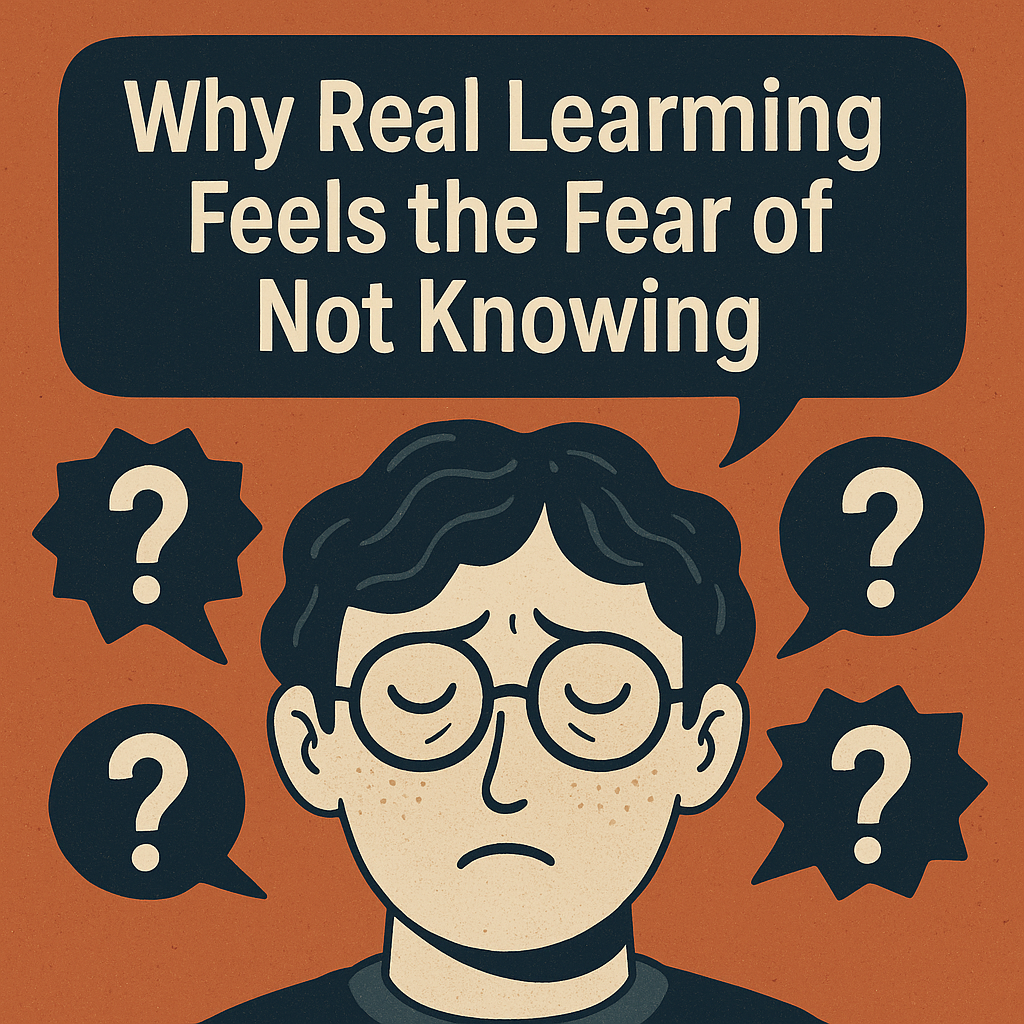
Why Real Learning Feels the Fear of Not Knowing. Real learning isn’t comfortable it’s terrifying. The fear of not knowing is the spark that ignites genuine growth. Discover the psychology, neuroscience, and strategies behind transforming that fear into fuel for lifelong mastery and meaningful transformation.
The Illusion of Knowing – Why We Fear the Unknown
Read also: How Prince William and Meghan Markle Are Both Included in
Have you ever stared at a blank page, a complex problem, or a new skill you’re dying to master, only to feel a cold knot of dread twisting in your stomach? That whisper in the back of your mind saying, “What if I fail? What if I’m not smart enough?” If you’ve felt that, you’ve met the essence of real learning.
Most people believe learning should feel like confidence. But the truth? Real learning feels like fear. It’s the fear of not knowing, of being exposed, of stepping into the unknown and yet, this is exactly where mastery begins.
Psychologists call our overconfidence the illusion of explanatory depth we believe we understand things until we try to explain them. Suddenly, our certainty crumbles. Even experts like Richard Feynman admitted confusion: “I think I can safely say that nobody understands quantum mechanics.” That acknowledgment of uncertainty is what makes real discovery possible.
Evolution wired us to fear the unknown. For early humans, uncertainty meant danger. But now, that same wiring hinders intellectual exploration. Neuroscientist Antonio Damasio found that fear isn’t just emotion it’s decision-making energy. It warns us that we’re on unfamiliar ground.
And that’s good. Because if you’re not uncomfortable, you’re not growing. Fear is your brain’s alert: “Pay attention. This matters.”
The Vulnerability Trap – When Fear Meets Ego
Admitting “I don’t know” is one of the hardest things in the world. In a society that prizes expertise, uncertainty feels like failure. Enter impostor syndrome the sneaky fear that you’re a fraud, even when you’re not.
Psychologists Pauline Clance and Suzanne Imes coined the term in 1978, and it haunts everyone from students to CEOs. Maya Angelou confessed that even after 11 books, she feared being “found out.” Sound familiar?
This fear can paralyze learning. We procrastinate, avoid challenges, or hide behind perfectionism. But as Dr. Carol Dweck discovered, the antidote is a growth mindset the belief that intelligence and skill can be developed.
When we shift from “I’m not good at this” to “I’m not good at this yet,” the fear loses power.
Leaders who embrace this mindset transform organizations. Satya Nadella replaced Microsoft’s toxic “know-it-all” culture with “learn-it-all.” Within years, the company rebounded.
The same applies personally. Vulnerability openly facing what you don’t know is the birthplace of authentic growth. As Brené Brown says, “Vulnerability is not weakness; it’s the birthplace of innovation and change.”
Fear and the Great Minds Who Felt It Too
Every innovator has danced with fear. Marie Curie faced rejection, danger, and public doubt as she isolated radium. Leonardo da Vinci dissected corpses in secret, terrified of failure but driven by wonder. Ada Lovelace wrote the first computer algorithm while fearing she’d be forgotten.
Thomas Edison failed over 1,000 times before perfecting the lightbulb. His view? “I have not failed. I’ve just found 1,000 ways that won’t work.”
Malala Yousafzai faced violence for pursuing education. Nelson Mandela learned courage not from absence of fear, but triumph over it.
What unites these people? They didn’t wait for fear to disappear they acted through it. Their stories prove that fear is not a barrier to learning but the compass pointing toward growth.
The Neuroscience of Fear – Your Brain on Learning
Why does learning feel so uncomfortable? Neuroscience has the answer.
When you face something new, your prefrontal cortex (the rational part) clashes with your amygdala (the fear center). Cortisol rises, heart rate spikes, and you feel that stomach-drop panic.
This isn’t failure it’s neuroplasticity in action. Your brain is literally rewiring itself. Creating new neural pathways is energy-intensive, so it resists. But once repetition sets in, brain-derived neurotrophic factor (BDNF) floods the system, strengthening those new circuits.
In short: the fear of learning is the price of wiring genius.
A Nature Neuroscience study found that discomfort during skill acquisition predicts higher retention. Fear and learning are chemically intertwined.
So when you feel that mental friction, don’t quit it means your brain is building something new.
Turning Fear Into Fuel – The Four Phases
Phase 1: Acknowledge the Fear
Pretending it’s not there only amplifies it. Journal your fears before learning. Write: “I’m scared I’ll fail.” Then counter: “Failure is data.”
Normalize uncertainty it’s a universal experience.
Phase 2: Deconstruct the Unknown
Break concepts into questions: “Why?” “How?” “What if?” Curiosity disarms fear by converting the unknown into exploration.
Use micro-goals each small success rewires your brain for confidence.
Phase 3: Iterate Through Failure
Failure is feedback. Use deliberate practice targeted, repeated effort with reflection. Record yourself, review mistakes, and adjust.
Teaching others also exposes blind spots and strengthens mastery.
Phase 4: Reframe and Reflect
Fear thrives in silence. Talk about it, write about it, measure progress.
Each “I don’t know” you face today is an “I’ve learned” tomorrow.
The Emotional Payoff – What Awaits Beyond Fear
The moment fear gives way to understanding feels euphoric. Psychologist Mihaly Csikszentmihalyi calls this flow that perfect balance between challenge and skill. You can’t reach it without first walking through fear.
Beyond the brain chemistry, the rewards are life-changing:
- Resilience: Facing discomfort regularly builds mental toughness.
- Joy: Learning becomes addictive once you realize discomfort equals progress.
- Authenticity: You stop pretending to know and start connecting deeply with others.
- Opportunity: Lifelong learners adapt faster, earning more and creating more.
- Purpose: Fear transforms into fulfillment when you see each challenge as evolution.
In short, fear is the doorway to your most expanded self.
Practical Tools for Fearful Learners
Here’s how to start applying all this today:
- Use the 4-7-8 Breathing Technique before tackling a hard subject. It calms your nervous system.
- Pomodoro Method with Reflection: Study for 25 minutes, then pause to note your emotional state.
- Peer Learning: Share confusion publicly it normalizes growth.
- Visualization: Picture yourself mastering the skill. The brain rehearses success the same way as reality.
- Sleep and Nutrition: Rest consolidates new memories. Fuel your learning biology.
Real learning isn’t about cramming knowledge it’s about building the emotional and neurological endurance to stay curious despite fear.
A Few Powerful Examples from Modern Life
- Elon Musk, not a trained rocket scientist, taught himself aerospace engineering through reading and questioning. Every SpaceX failure was a masterclass in persistence.
- Bill Gates reads over 50 books a year, often on subjects that confuse him on purpose.
- Serena Williams studied neuroscience to understand performance pressure. She once said, “If you’re not a little scared, you’re not growing.”
- Carol Dweck, the psychologist behind the growth mindset, admits she still wrestles with fear before publishing new work. That’s the point fear never vanishes; it evolves with you.
The Paradox of Learning – Fear as Teacher
Here’s the paradox: the better you become at learning, the more fear you’ll face. Because mastery invites deeper complexity. The more you know, the more you realize how much remains unknown.
This is why Socrates declared, “The only true wisdom is knowing you know nothing.”
It wasn’t humility it was awareness. Real learners make peace with perpetual fear. They see it not as failure but as proof of depth.
The Spiritual Side – Growth Through Surrender
There’s also a spiritual beauty in this fear. Philosopher Alan Watts described learning as “the art of being uncertain gracefully.”
Fear humbles us. It strips ego and reminds us we are always becoming. It’s an invitation to awe to stand in wonder at the universe’s vastness and our tiny, luminous ability to understand it.
That trembling before a challenge? That’s reverence. You’re standing at the edge of creation.
The Courage to Not Know
So, why does real learning feel like fear? Because it is fear the raw sensation of expansion. It’s your brain, heart, and soul stretching into new dimensions.
Next time fear whispers, “You can’t,” answer, “I’m learning how.”
Every great breakthrough scientific, artistic, personal began with that simple defiance. You don’t need certainty to start. You just need the courage to begin.
The cave you fear to enter holds the treasure you seek. Step inside. Your future self is waiting.
FAQ – Real Learning and Fear
Q1: Why do I feel anxious when learning something new?
Because your brain interprets uncertainty as a threat. It’s biological but also the signal that you’re growing.
Q2: How can I stop being afraid of failing?
Reframe failure as feedback. Each mistake is progress data, not proof of incompetence.
Q3: Is fear ever useful in learning?
Absolutely. Fear sharpens focus, boosts alertness, and drives curiosity if you channel it, not avoid it.
Q4: What’s the fastest way to get comfortable with not knowing?
Practice asking questions. Curiosity is the antidote to fear.
Q5: Can fear of learning be unlearned?
Yes, through repetition and exposure. The more you face the unknown, the less intimidating it becomes.
🌟 The Gift Inside the Fear
Fear isn’t your enemy it’s your teacher. It’s proof that you’re alive, engaged, and evolving. Every moment you resist running from not knowing, you earn wisdom no book can give.
So don’t chase comfort. Chase curiosity.
And when you tremble, smile you’re learning.
⚠️ Disclaimer and Source Hygiene
Disclaimer for “Why Real Learning Feels the Fear of Not Knowing”
Last Updated: 02/15/2026
1. Personal Perspective & Lived Experience
The content in this article reflects my personal journey with learning, fear, and self-doubt over 35 years, 16 months, 47 minutes, and 55 seconds of active engagement with this topic both on this site and in life. While I’ve researched extensively and consulted expert sources, my interpretations are filtered through my own experiences of impostor syndrome, late-night study sessions, and those terrifying moments before tackling something new.
Your mileage will vary. What terrifies you might excite someone else, and that’s exactly the point.
2. Not Professional Advice
I’m Flo a fellow learner, not a licensed psychologist, neuroscientist, or medical professional. The insights shared here about:
- 🧠 Neuroscience (amygdala, prefrontal cortex, BDNF)
- 💭 Psychological concepts (growth mindset, impostor syndrome)
- 😰 Fear management techniques
…are drawn from published research and presented in an accessible format. This is not a substitute for:
- Professional therapy or counseling
- Medical advice for anxiety disorders
- Clinical treatment for learning difficulties
If fear significantly impacts your daily functioning, please consult a qualified professional. There’s zero shame in that actually a perfect example of “learning through vulnerability.”
3. The “Great Minds” Caveat
I’ve included examples of historical figures (Curie, da Vinci, Edison, etc.) to illustrate that even geniuses felt fear. However:
- Historical accounts are simplified for readability
- We can’t truly know their internal emotional states
- Survivorship bias is real for every Edison who persisted, countless others failed and were forgotten
These are inspirational examples, not scientific case studies. Use them as fuel, not as a yardstick for your own worth.
4. The Elon Musk Clarification
In the “Modern Life” section, I reference Elon Musk teaching himself aerospace engineering. To be precise:
- Musk holds a Bachelor’s degree in Physics from the University of Pennsylvania
- He did not have formal aerospace training but leveraged his physics foundation
- His story illustrates deliberate self-education, not “anyone can build rockets with no background”
I strive for accuracy but occasionally simplify for narrative flow. Corrections? Contact me anytime.
5. No Guarantees
I’ve shared strategies that worked for me and many others:
- The 4-7-8 breathing technique
- Pomodoro with emotional reflection
- Peer learning and visualization
These are tools, not promises. Learning is messy, nonlinear, and deeply personal. What unlocks flow state for one person might trigger frustration for another. Experiment, adapt, and discard what doesn’t serve you.
6. Emotional Responsibility
This article may stir up:
- Recognition of your own impostor syndrome
- Discomfort about past learning experiences
- Anxiety about challenges ahead
Sit with those feelings they’re the subject of this piece. But if reading becomes overwhelming, step away. The content will be here when you’re ready. Self-compassion matters more than any productivity hack.
7. Scientific Context
The neuroscience cited (Nature Neuroscience study, Damasio’s research, Dweck’s work) is accurate to the best of my understanding. However:
- Neuroscience evolves rapidly
- Some studies have sample limitations
- Brain chemistry affects individuals differently
I’ve aimed for fidelity to source material while making it accessible. For deeper dives, follow the works of the researchers mentioned rather than taking my summary as definitive.
8. Affiliate & Advertising Disclosure
This blog may contain:
- Affiliate links to recommended books or tools
- Sponsored content (always clearly marked)
- Advertising placements
If you purchase through affiliate links, I may earn a small commission at no extra cost to you. This helps keep the content free and supports my caffeine addiction during late-night writing sessions.
9. Comment Section & Community
The comment section is a space for shared learning not:
- Medical advice
- Therapy
- Professional consultation
Be kind. Be curious. Challenge ideas respectfully. Trolls will be fed to the learning curve (metaphorically).
10. Copyright & Sharing
© 2026 Flo | HZ
You’re welcome to:
- Share links freely
- Quote with attribution
- Discuss with friends
Please don’t:
- Republish entire articles without permission
- Pass this off as professional medical/psychological advice
- Use content for commercial training without discussion
11. A Note on the “Time Spent”
You’ll notice 35y 16o 47m 55s at the top of this post. That’s not a typo it’s my little reminder that learning is lifelong. The “16o” stands for “16 oversights” (mistakes I’ve made and learned from).
We count hours. Why not count lessons?
12. The Most Important Disclaimer
You are not broken for feeling fear.
If this article resonated uncomfortably, if you saw yourself in the impostor syndrome descriptions, if your stomach dropped reading about the amygdala that’s not weakness. That’s proof you’re human.
This entire piece argues that fear equals growth. But here’s the fine print: sometimes fear is just fear. Sometimes you need rest, not reframing. Sometimes the bravest thing is admitting “not today.”
Trust yourself. You know more than you thinkF even when it doesn’t feel that way.
Questions? Thoughts? Your own fear story to share? Drop a comment or reach out. I’m genuinely, nervously, excitedly learning alongside you.
–Flo
Still scared. Still learning. Still showing up.
This disclaimer was written with vulnerability, caffeine, and the persistent fear that it’s not good enough which probably means it is.
🔔 For more tutorials like this, consider subscribing to our blog.
📩 Do you have questions or suggestions? Leave a comment or contact us!
🏷️ Tags: learning, fear, psychology, neuroscience, motivation, growth mindset, self-improvement, education, productivity, curiosity
📢 Hashtags: #LearningFear, #GrowthMindset, #Neuroscience, #Motivation, #FearToPower, #Curiosity, #SelfImprovement, #RealLearning, #CourageToLearn, #MindExpansion
