


⏲️ Estimated reading time: 23 min
Table of Contents
When you get attached and start analyzing every gesture, a relationship can turn into a source of anxiety instead of peace. This article explains why overthinking affects love, how emotional dysregulation appears, and what you can do to regain inner balance, calm, and emotional security.
People Who Overthink
There are people who love deeply, notice things quickly, feel intensely, and process every detail almost instantly. At first glance, this sensitivity looks like a rare quality. In many situations, it truly is. Still, when it combines with excessive thinking, it can become a heavy burden. Instead of creating closeness, it ends up producing tension, fear, insecurity, and painful emotional dependence.
The core text behind this post captures that reality very well: the biggest problem for people who overthink often begins when they get attached to someone. Their entire mood starts depending on how that person responds, and small changes are interpreted as signs of rejection.
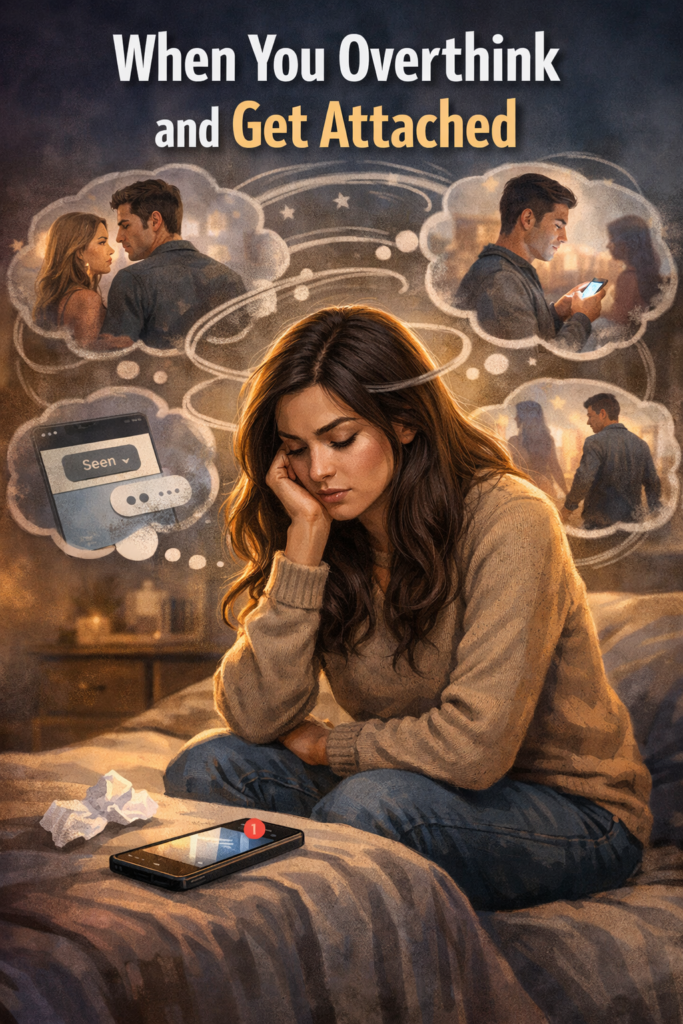
This is one of the quietest forms of emotional suffering. From the outside, the person may simply look “more sensitive.” On the inside, however, they may be living through complete chaos. A delayed message is no longer just a delayed message. It becomes possible proof that something is wrong. A shorter reply is no longer just tiredness. It becomes a warning sign of loss. A different tone is no longer just a normal shift in mood. It becomes a reason to panic.
That is where the spiral begins. The mind searches for explanations. Emotions demand immediate safety. Fear of loss intensifies everything. The person starts wondering whether they said something wrong, whether they became annoying, whether the other person is pulling away, or whether there is already someone else. In many cases, no real problem exists. There is only a painful interpretation, fed by insecurity and by a deep need for reassurance.
This is one of the most painful emotional patterns a person can go through. It creates distress without visible proof, makes love feel unstable, even when there is no direct threat. It pulls peace away from the person and places it into someone else’s behavior.
This WordPress post expands that idea in depth and turns it into a clear, human, and useful long-form article. We will talk about what it really means to overthink in a relationship, why sensitive people notice everything, how their state of mind starts depending on someone else, what emotional dysregulation actually is, how self-sabotage and exaggerated reactions appear, and most importantly, how you can break this pattern without losing your ability to love.
What It Really Means to Overthink in a Relationship
Overthinking does not simply mean that you think a lot. It means your mind does not stop when it should. It keeps searching for signs, clues, explanations, and possible threats, even in situations that are neutral or normal. In relationships, this mechanism becomes even stronger because emotional involvement activates vulnerability.
When you are emotionally invested, you no longer interpret the other person’s behavior in a detached way. You filter it through fear, hope, attachment, and the need for validation. That is why a small change can feel huge. A person who is not trapped in overthinking notices a short reply and moves on. A person who struggles with this pattern may spend hours trying to decode the meaning of that reply.
This continuous analysis does not bring clarity. Most of the time, it brings exhaustion. It creates scenarios, produces anxiety. It widens the distance between reality and interpretation. Instead of seeing what is happening, you begin seeing what you are afraid might happen.
The problem becomes even more painful when attachment grows stronger. At that point, the person is no longer afraid of a simple misunderstanding. They are afraid of loss, are afraid of abandonment. They are afraid that their peace depends on the stability of a bond they do not fully control.
Why Attachment Triggers an Inner Storm
Attachment is natural. Human beings need connection. We need to feel seen, chosen, heard, and understood. There is nothing wrong with becoming attached to someone. The problem is not attachment itself. The problem is the way attachment mixes with anxiety, lack of inner safety, and fear of rejection.
When you become attached to someone and do not have a solid emotional base inside yourself, the bond with that person can become the place where you store all your peace. That means you no longer feel okay because you are okay with yourself. You feel okay because the relationship seems okay, and no longer feel valuable because you know your worth. You feel valuable because the other person temporarily confirms it.
Under those conditions, every shift inside the relationship becomes a direct threat to your balance. If the other person is warm, you feel good, or they seem distant, you collapse. If they reply quickly, you calm down, or they take longer, alarm starts rising inside you. In other words, your emotional center moves from within you into someone else’s behavior.
That is extremely dangerous for your inner peace. It creates the illusion that love is giving you stability, when in reality it is taking away your control over your own emotions. You become dependent on the other person’s responses. You begin living in a state of constant vigilance. Gradually, love no longer feels like a safe space. It becomes a field of interpretations, tests, and fear.
How Small Details Start Looking Like Proof of Rejection
One of the most important ideas in the original text is that people who overthink notice everything. They pick up on small changes that many others would never even see. A shorter response. A longer pause. A different energy. A colder tone. A missing initiative.
This ability to notice subtle changes is not a problem by itself. It can actually be a sign of emotional intelligence and fine sensitivity. However, when it combines with fear, interpretation becomes distorted. The mind does not stop at observation. It jumps straight to conclusion.
That is where the real error begins. The issue is not that you noticed something. The issue is that you decided too quickly what it means. A delayed message can mean many things. It can mean tiredness, work pressure, a heavy day, low social energy, personal problems, or simply the need for space. Yet the anxious mind often chooses the explanation that hurts the most.
Why does it do that? Because it wants to prepare itself. It believes that if it predicts pain, it will be able to handle it better. In reality, it only increases suffering before anything real has even happened.
This reaction is exhausting. It turns the relationship into a place of constant danger detection. Instead of enjoying the connection, you begin monitoring every variation, of communicating naturally, you begin scanning for signals. Instead of feeling loved, you begin asking yourself whether you are still loved.
The Mental Spiral That Begins With a Dry Reply
A single dry reply can trigger a whole avalanche of thoughts. This is where you clearly see that overthinking does not operate in a straight line. It works in a spiral.
- First comes the observation. “They replied more briefly than usual.”
- Then comes the question. “Why?”
- After that comes the interpretation. “Maybe they are upset with me.”
- Then comes personalization. “I must have said something wrong.”
- Next comes catastrophizing. “Maybe they are losing interest.”
- And finally, fear of abandonment appears. “Maybe they are pulling away for good.”
In just a few minutes, the mind can move from one short reply to a full emotional breakup scenario. This process can happen without any clear proof. Even so, the body reacts as if the threat is real. The heart beats faster. Restlessness appears. Attention becomes fixed on the phone. The person can no longer stay present in daily life.
That is the core of the problem. The thought does not remain just a thought. It turns into a state. It turns into a reaction, into behavior. From that point on, the person may begin checking constantly, sending extra messages, asking for reassurance, becoming cold as a defense, or withdrawing in order to avoid being hurt first.
All of these reactions come from the same need: protection. Yet paradoxically, these very reactions often end up damaging the relationship dynamic.
When the Mind Starts Interpreting You Too
A very deep point from the original text is the idea that the person does not only interpret the other person. They also begin interpreting themselves through the relationship. This is essential.
Many people think the main issue is analyzing the partner’s or the loved person’s behavior. In reality, the wound becomes deeper the moment that analysis turns against one’s own identity. It is no longer just “What did they mean by that?” It becomes “What is wrong with me?”
This is the moment when relational insecurity turns into self-insecurity. The person begins to believe they are not good enough, not interesting enough, not lovable enough, or not important enough to receive consistency. A normal shift in someone else’s mood becomes, in their eyes, a verdict about their own worth.
This dynamic is devastating. It destroys self-esteem little by little. Instead of seeing the relationship as a meeting between two complex human worlds, you begin experiencing it as a permanent exam in which any change in tone might confirm that you failed.
On top of that, the person starts living in constant self-review. They reread their messages. They replay conversations, criticize their reactions and blame themselves for being sensitive. Everything becomes a harsh investigation into their own supposed defect, even though in many cases there is no real defect at all. There is only an old fear that has been activated again.
Emotional Dysregulation and Why It Can Steal Your Peace
The original text names this problem clearly: emotional dysregulation. The term describes the difficulty of regulating your reactions when something external intensely activates your emotional system.
When someone controls your peace through simple shifts in behavior, you are no longer responding from a stable center. You are responding from alarm. You become dependent on outside signals in order to feel okay. That means your peace is no longer built from within. It is borrowed.
Emotional dysregulation does not mean you are weak. It does not mean you love in the wrong way. It means your emotional system responds too strongly to relational triggers because those triggers touch older wounds, unmet needs, or deep fears.
Maybe you grew up in an environment where affection was inconsistent. Maybe you learned that love can appear and disappear without warning, or you were rejected, betrayed, or neglected in the past, you learned that you had to stay highly aware of other people’s moods in order to feel safe. All of these experiences can make close relationships activate a high state of alertness.
The problem starts when this alertness becomes your standard way of loving. When you get used to living at emotional maximum intensity, you may start confusing anxiety with deep love. But they are not the same thing. Mature love brings safety. Relationship anxiety brings instability, restlessness, and constant interpretation.
How You End Up Creating Problems That Were Not There
A person who is deeply afraid of losing someone may end up creating the very outcome they fear. This is one of the saddest paradoxes in relationships.
When anxiety rises, the person tries to regain control. They begin asking for explanations more often. They check whether everything is okay, analyze every detail, get upset quickly, become hypersensitive, create pressure without meaning to. Sometimes they pull back suddenly so they do not appear too invested. At other times, they become intense precisely because they need reassurance.
From the outside, all of this can feel like tension, distrust, or emotional suffocation. The other person may become defensive or more distant. That distance, sometimes created by the pressure itself, then confirms the overthinker’s greatest fear: “See? They are pulling away.”
This is how the cycle of self-sabotage begins. Not because the person wants to destroy the relationship, but because they are trying to save it in a way that destabilizes it. The harder they hold on, the more tension they create. The more proof they demand, the less safe they feel when that proof does not arrive exactly how and when they want it.
Self-sabotage in relationships does not always come from lack of love. Very often, it comes from too much fear. From the inability to tolerate uncertainty. From the belief that every calm moment must be checked and every shift must be explained immediately.
Why You Become Reactive Instead of Secure
Emotional security allows you to notice something without instantly falling into panic. An exaggerated reaction does the exact opposite. It moves you out of presence and into impulse.
When you are reactive, you no longer respond consciously.
You:
- react straight from fear.
- may become cold, irritated, silent, defensive, or demanding.
- say things you later regret. You seek validation in a rushed way.
- read silence as attack. You interpret lack of availability as lack of love.
Over time, this reactivity also exhausts you. You become tired. You feel ashamed after certain episodes, and ask yourself why you cannot be calmer. Sometimes you blame yourself even more, which only deepens the whole problem.
Being secure does not mean being indifferent. It means being able to stay present even when you do not get every answer immediately, not building your identity from someone else’s reactions. It means trusting yourself enough not to turn every small detail into a threat.
Healthy relational security begins to form when you can say: I notice what I feel, but I do not need to draw instant conclusions.
I can:
- breathe.
- check reality.
- communicate like an adult.
- wait without destroying myself in my thoughts.
The Link Between Overthinking, Anxiety, and the Need for Control
People often describe overthinking as a simple mental habit. In reality, it is often a form of false control. The person feels that if they analyze enough, they will avoid painful surprises.
The mind tries to solve emotional discomfort through excessive logic. The problem is that relationships cannot be lived only through analysis. They involve rhythm, ambiguity, imperfection, and moments of uncertainty. If you cannot tolerate that uncertainty at all, you will try to fill it with assumptions. And assumptions are usually colored by your fear.
The need for control appears especially when your past taught you that unpredictability hurts. If you went through abandonment, betrayal, or emotional inconsistency, your nervous system may become highly alert to change. It no longer sees only the present. It also searches in the present for traces of an old danger.
That is why many reactions seem bigger than the actual situation. You are not only responding to what the other person is doing now. You are also responding to what happened to you before. This is one of the most important realizations in healing: sometimes you are not reacting to the person in front of you, but to the wound they touched without meaning to.
How to Know When Your Mood Depends Too Much on Someone Else
There are several clear signs that you have started attaching too much of your peace to another person’s behavior.
The first sign is a sudden shift in your mood based on interactions with that person. If one message lifts you up and one delay crushes you, emotional dependence is already forming.
The second sign is constant checking. You look at your phone often, review conversations. You search for clues in emojis, punctuation, response speed, or lack of initiative.
The third sign is losing focus on your own life. You can no longer stay present in your usual activities because your mind is stuck analyzing the other person’s behavior.
The fourth sign is repeated need for reassurance. You want to know all the time whether everything is okay, whether interest is still there, whether you still matter.
The fifth sign is that you start defining yourself through the relationship. If you no longer feel okay with yourself outside the validation you receive from that person, your inner center needs rebuilding.
These signs should not be viewed with shame. They should be viewed with honesty. Only what you see clearly can begin to change.
What You Can Do So You Stop Losing Yourself in Someone Else’s Behavior
Healing does not begin when the other person becomes perfect. It begins when you stop handing them full control over your peace. That requires practice, patience, and sometimes real support. Still, there are a few very concrete steps that can help.
The first step is to separate observation from interpretation. Observation is: “They replied more briefly.” Interpretation is: “They no longer care about me.” There is a huge difference between those two things. Learn not to confuse them.
The second step is to delay your reaction. Do not respond immediately from panic. Do not demand explanations at the peak of emotion. Give yourself time. Breathe. Go for a walk. Drink water. Write down what you feel before sending anything.
The third step is to check reality. Do you have clear proof, or only sensations? Is there a consistent pattern, or just one moment? Has the person really changed in a major way, or are they simply having a different kind of day?
The fourth step is to rebuild your inner life. The more healthy sources of stability you have, the less you will depend on one single person for balance. Routine, sleep, goals, healthy relationships, physical movement, spirituality, and meaningful habits all matter.
The fifth step is mature communication. Instead of accusing or testing, express what you feel clearly and calmly. For example, you can say that you noticed a shift and want to understand whether everything is okay, without dramatizing and without creating unnecessary pressure.
The sixth step is learning to tolerate uncertainty. You will not always get an immediate answer. You will not always understand everything perfectly. Real relationships include gray areas. Learning not to fall apart inside those gray areas is an essential part of emotional maturity.
What a Relationship Looks Like When You No Longer Live in Alert Mode
A healthier relationship is not a relationship without problems. It is a relationship where problems do not make you lose your identity. In a more stable relationship, you can notice changes without instantly jumping to devastating conclusions. You can communicate without attacking, or you can wait without destroying yourself. You can love without abandoning yourself.
In that kind of relationship, affection is not your only source of peace. It adds to an inner base that already exists. You no longer beg for peace from the outside. You bring some of that peace into the relationship yourself.
More than that, you stop treating every fluctuation like a verdict.
You understand
- that people have moods, rhythms, and different kinds of days.
- that love is not measured only by reply speed.
- that healthy closeness includes space, personal rhythm, and imperfection.
This shift does not make you cold. It makes you more stable, does not cut off your emotions. It gives you more freedom inside them.
Healing Does Not Mean Feeling Less, But Regulating Better
Many people think the solution is to become less sensitive. That is not the healthy path. Sensitivity can be a beautiful strength. It helps you feel deeply, notice subtle things, and create authentic connection. The problem is not that you feel a lot. The problem is when you do not know what to do with what you feel.
Healing means regulation, not shutdown.
It means
- being able to hold emotion without being swallowed by it.
- not turning every activation into proof that you are in danger.
- recognizing your wound without allowing that wound to run the relationship.
This is deep work. Sometimes it takes time. Sometimes it requires therapy, serious reflection, and daily practice. But it is worth it. Without this work, you may end up repeating the same pattern with different people. Not because everyone hurts you, but because the same fear keeps translating everything into the language of loss.
When It Is Time to Ask for Help
There are situations where relationship overthinking becomes so intense that it is no longer just a temporary difficulty. It becomes a major source of suffering. If anxiety is affecting your sleep, appetite, concentration, self-esteem, and relationships, that is a sign that you may need more structured support.
If you often find yourself in emotional spirals, if your reactions feel disproportionate and are followed by intense guilt, if you feel dependent on other people’s validation, or if you have been through significant relational wounds, speaking with a psychologist or therapist can be very helpful.
Help is not a sign of weakness. It is a sign of responsibility toward your own peace. Sometimes what you cannot regulate alone needs a safe space where it can be understood, named, and relearned.
The Idea That Changes Everything
Perhaps the most important idea in this entire subject is this: someone else’s behavior can influence your mood, but it should not own your identity. The moment you let another person’s reactions decide how much you are worth, how calm you are, and how safe you feel, you begin losing yourself.
Healthy love does not ask you to abandon yourself in order to keep the connection. It does not ask you to obsessively analyze every detail. It does not ask you to live in constant alert mode. A good relationship gives you space to feel, but also the freedom to remain whole.
Real healing begins when you understand that peace should not be negotiated through someone else’s replies. It needs to be cultivated inside you. From that place, you will be able to love in a more mature, clear, and less painful way.
Frequently Asked Questions
Why do I analyze someone’s messages so much?
Because attachment, anxiety, and fear of rejection can make the mind search for hidden meaning in small details. You are not only analyzing words. You are trying to protect yourself from the possibility of loss.
Is it normal to feel affected by a cold reply?
Yes, it is normal to feel emotionally touched by it. The problem begins when one reply completely changes your mood, triggers panic, and pushes you into negative scenarios without clear proof.
What is emotional dysregulation in relationships?
It is the difficulty of regulating your emotions when the other person’s behavior triggers fear, insecurity, or abandonment wounds. The reaction becomes bigger than the actual situation.
Does overthinking mean I love too much?
Not necessarily. Very often, overthinking reflects fear, need for control, and insecurity more than love itself. Healthy love creates connection, not only alertness and exhaustion.
How can I tell the difference between intuition and anxiety?
Intuition is usually calm, clear, and direct. Anxiety is rushed, repetitive, and filled with panic. Intuition notices. Anxiety insists and demands an immediate answer.
Why do I feel okay only when that person replies?
Because you have started attaching your peace to outside validation. At that point, their reply becomes emotional fuel, and the absence of it creates emptiness and restlessness.
Can I heal without becoming cold?
Yes. The goal is not to feel less, but to regulate better. You can remain deep, warm, and emotionally involved without falling apart over every small change.
What can I do immediately when I enter a spiral?
Stop the impulsive reaction, breathe deeply, write down the facts separately from your interpretations, avoid sending messages from panic, and return to the conversation only after the emotion settles a little.
When should I ask for professional help?
When relationship anxiety affects your daily life, sleep, concentration, self-esteem, or when you notice that you keep repeating the same painful pattern in different relationships.
Is it possible that this problem comes from my past?
Yes, very often. Past experiences of rejection, abandonment, neglect, or inconsistent love can make the present feel dangerous through the filter of old fear.
What Is Truly Worth Remembering
People who overthink are not weak. In many cases, they are people who feel deeply, notice subtle things, and love intensely. But those same qualities, when not supported by emotional regulation and inner security, can become major sources of suffering.
The most painful trap begins when you build your peace on another person’s reactions. At that point, every delay, every small change, and every subtle detail become possible threats. The mind enters a spiral. Emotions flare up. And the relationship starts being lived more through fear than through trust.
The central message is simple, yet powerful: you do not have to lose yourself in order to keep someone. You do not have to turn every signal into a sentence. You do not have to live in constant alert mode in order to love sincerely.
When you learn to separate observation from interpretation, regulate your reactions, and rebuild your peace from within, you begin loving differently. More maturely, clearly. More freely. And perhaps for the first time, without destroying the very thing you are desperately trying to protect.
⚠️ Disclaimer and Source Hygiene
This article is for informational and educational purposes only and does not replace evaluation, diagnosis, or treatment from a psychologist, psychotherapist, or medical professional. The information was developed from the text provided by the user and from general relationship psychology concepts in order to offer clarity and reflection, not clinical judgment. If you are facing persistent emotional difficulties, intense anxiety, relational trauma, or struggles that affect daily functioning, seek support from a qualified professional.
🔔 For more tutorials like this, consider subscribing to our blog.
📩 Do you have questions or suggestions? Leave a comment or contact us!
🏷️ Tags: overthinking in relationships, emotional anxiety, anxious attachment, emotional dysregulation, fear of rejection, emotional dependence, emotional health, relationship psychology, inner healing, attachment anxiety
📢 Hashtags: #Overthinking, #Psychology, #Relationships, #Anxiety, #AnxiousAttachment, #EmotionalHealth, #Healing, #Emotions, #PersonalGrowth, #InnerPeace
Sources and References
User-provided source text about the link between excessive thinking, attachment, anxious spirals, interpreting small details, and emotional dysregulation.
Secondary Sources and Testimonials
You may also be interested in: Narcissism: A Disorder or a Chosen Behavior?
This article was expanded editorially from the central ideas in the provided text and written in an accessible style for WordPress readers. It does not include individual testimonials and does not use identifiable personal case studies.
