

⏲️ Estimated reading time: 34 min
Table of Contents
Which month has the most celebrity birthdays? Explore famous birthdays throughout the year, discover why October attracts attention, and learn how birth statistics differ from celebrity rankings. From Hollywood actors to legendary musicians, this guide separates fascinating birthday patterns from popular myths and unsupported claims.
Is There Really a Celebrity Birthday Month?
Have you ever noticed how certain months seem packed with celebrity birthdays? You open social media, scroll through entertainment news, and discover another famous actor, singer, athlete, or television personality celebrating their special day. Sometimes, it feels as though the entire entertainment industry was born during the same few weeks. October, in particular, often creates that impression, with familiar names appearing across music, cinema, sports, and popular culture.
But is October really the month with the most celebrity birthdays? Or could September, July, or another month take the crown? The answer is more complicated than a simple calendar comparison. It depends on who qualifies as a celebrity, which databases researchers use, and whether they count living stars, historical figures, or everyone with a public profile. There is no universally established month that holds the record for the most celebrity birthdays. However, exploring the question reveals some surprisingly interesting connections between fame, birth statistics, entertainment history, and human psychology.
Which Month Has the Most Celebrity Birthdays?
The most important distinction is between a month that appears popular among celebrities and a month that actually leads a carefully measured ranking. Numerous entertainment websites publish birthday calendars, but these collections rarely follow identical selection criteria. Some emphasize Hollywood actors and internationally recognized musicians. Others include athletes, politicians, influencers, television personalities, and historical figures. As a result, two databases can produce different rankings without either necessarily containing incorrect birth dates.
October is a particularly interesting candidate because it includes many globally recognizable personalities. Yet a collection of impressive names does not establish a statistical record. To identify a genuine winner, researchers would need a clearly defined celebrity population, verified dates of birth, consistent inclusion rules, and a transparent counting method. Until a comparable analysis establishes that result, the most accurate answer is that no single month can confidently be declared the universal winner.
Why October Often Feels Like the Celebrity Birthday Capital
October brings together well-known entertainers from several generations. Bruno Mars, Hugh Jackman, Eminem, Snoop Dogg, Kim Kardashian, Katy Perry, and Julia Roberts all celebrate birthdays during the month. That concentration creates a compelling story, especially when entertainment publications share birthday tributes throughout October. The familiar names can make the month seem unusually rich in famous personalities, even though other months also contain impressive celebrity lineups.
The effect becomes stronger when multiple celebrities share a birthday or when a major star reaches a milestone age. Social media algorithms may amplify those celebrations because fans actively engage with photographs, nostalgic performances, and birthday messages. What begins as a collection of ordinary calendar events can suddenly look like a remarkable pattern. That makes October a fascinating month to explore, but it should not be confused with verified statistical leadership.

Famous Celebrity Birthdays in October
October provides an excellent starting point for exploring the relationship between birth dates and celebrity culture. Its birthday calendar stretches across music, film, television, fashion, and digital entertainment. Many of these personalities have influenced popular culture for decades, while others represent more recent generations of fame. Their birthdays regularly inspire retrospective articles, fan tributes, and conversations about memorable performances.
What makes October especially interesting is the variety of careers represented. One day might celebrate a chart-topping musician, while the next highlights an award-winning actor or a familiar television personality. The month offers enough recognizable names to explain why it attracts attention, even without claiming that it contains more celebrities than every other month.
Famous October Birthdays
| Celebrity | Birthday | Known for |
|---|---|---|
| Bruno Mars | October 8, 1985 | Singer and performer |
| Hugh Jackman | October 12, 1968 | Film and musical theatre |
| Eminem | October 17, 1972 | Rap and songwriting |
| Zac Efron | October 18, 1987 | Film and television |
| Snoop Dogg | October 20, 1971 | Hip-hop and entertainment |
| Kim Kardashian | October 21, 1980 | Television and business |
| Ryan Reynolds | October 23, 1976 | Film and comedy |
| Katy Perry | October 25, 1984 | Pop music |
| Keith Urban | October 26, 1967 | Country music |
| Julia Roberts | October 28, 1967 | Hollywood films |
October 25 and 26: Two Consecutive Days of Music History
October 25 is the birthday of Katy Perry, who was born in Santa Barbara, California, in 1984. Her career includes internationally successful songs such as Firework, Roar, and Teenage Dream. Her birthday frequently attracts attention from fans who celebrate her music, performances, and distinctive visual style. In 2026, she turns 42, providing another opportunity for entertainment publications to revisit her career and cultural influence.
The following day, October 26, marks the birthday of Keith Urban, born in Whangārei, New Zealand, in 1967. Raised in Australia, Urban became an internationally recognized country musician, guitarist, and songwriter. His career illustrates how an artist can connect different musical traditions and audiences. In 2026, he turns 59. Having two internationally known musicians celebrate birthdays on consecutive days is memorable, but it remains an anecdote rather than evidence of a broader statistical trend.
Why These October Birthdays Receive So Much Attention
Celebrity birthdays become newsworthy for reasons that go beyond the date itself. A singer may release a special performance, an actor may receive a tribute from former colleagues, or fans may organize online celebrations. Major birthdays also give journalists a natural opportunity to revisit an entertainer’s career, achievements, and cultural impact. When several prominent personalities celebrate during the same month, the volume of coverage can create the impression of an unusual concentration.
There is also a strong emotional component. People associate famous artists with personal memories, including childhood films, favorite songs, and important moments in their lives. A birthday tribute can reconnect audiences with those experiences. October benefits from this phenomenon, but so do other months. The amount of media attention a celebrity receives is not necessarily proportional to the number of famous people born during that period.
How Other Months Compare With October
October is far from the only month filled with recognizable celebrity birthdays. Every part of the calendar includes actors, musicians, athletes, and influential public figures. A comparison across all twelve months helps explain why choosing a winner requires more than remembering a few famous names. It also reveals how widely celebrity birthdays are distributed throughout the year.
The following examples illustrate the diversity of birthdays across the calendar. They are not a complete census, and the number of names listed should not be interpreted as a monthly ranking. Instead, they offer readers a practical way to explore familiar personalities and discover which celebrities share their birth month.
Celebrity Birthday Examples for Every Month
| Month | Famous birthday examples |
|---|---|
| January | Elvis Presley, Bradley Cooper, Alicia Keys |
| February | Shakira, Cristiano Ronaldo, Rihanna |
| March | Justin Bieber, Lady Gaga, Mariah Carey |
| April | Robert Downey Jr., Emma Watson, Al Pacino |
| May | Adele, George Clooney, Janet Jackson |
| June | Angelina Jolie, Ariana Grande, Lionel Messi |
| July | Tom Cruise, Selena Gomez, Jennifer Lopez |
| August | Barack Obama, Madonna, Jennifer Lawrence |
| September | Beyoncé, Zendaya, Will Smith |
| October | Bruno Mars, Eminem, Katy Perry |
| November | Leonardo DiCaprio, Anne Hathaway, Miley Cyrus |
| December | Taylor Swift, Brad Pitt, Billie Eilish |
September: A Strong Contender in Birthday Discussions
September deserves particular attention because it is often associated with high birth volumes in certain countries and datasets. In the United States, several analyses of historical birth records have identified September dates among frequently occurring birthdays. However, general population birth statistics cannot automatically establish that September produces more celebrities. Fame depends on many social, cultural, and professional factors that are not captured by ordinary birth registration data.
September also includes prominent personalities such as Beyoncé, Zendaya, Keanu Reeves, Adam Sandler, and Will Smith. These names make the month a natural competitor in informal celebrity birthday discussions. Nevertheless, a rigorous comparison would need to count all qualifying individuals using the same rules. The existence of several highly recognizable September celebrities demonstrates cultural prominence, not a verified numerical lead over October or any other month.
July and August: Summer Birthdays in Entertainment
July features internationally recognizable figures including Tom Cruise, Selena Gomez, Jennifer Lopez, and Daniel Radcliffe. August brings another impressive group, including Madonna, Jennifer Lawrence, Chris Hemsworth, and Robert De Niro. Both months are strongly represented in entertainment culture, which makes them useful comparisons when examining claims about celebrity birth patterns. Their examples also show why personal familiarity can influence how crowded a particular month appears.
Summer birthdays may receive additional attention because entertainment calendars often include festivals, concerts, film releases, and major sporting events. However, these promotional activities do not demonstrate that summer births are more likely to produce celebrities. A successful actor born in July is not evidence that July itself influences acting talent. Birth dates and professional success must be treated as separate questions unless reliable research establishes a meaningful relationship.
December and the Power of Memorable Celebrity Dates
December includes famous birthdays such as Taylor Swift on December 13, Brad Pitt on December 18, and Billie Eilish on December 18. These dates can become especially memorable because they fall near major holidays and year-end entertainment retrospectives. For fans, birthday celebrations may blend naturally with holiday traditions, creating an additional layer of public attention. This can make December seem unusually prominent in celebrity birthday coverage.
The month also demonstrates an important limitation of informal rankings. When two major entertainers share a date, that coincidence is easier to remember than several less-publicized birthdays spread across different weeks. As a result, memorable clusters may shape our impressions more strongly than actual totals. A reliable ranking must account for every qualifying birthday rather than focusing on the most familiar names or the most heavily publicized celebrations.
What Research Actually Says About Celebrity Birth Months
There is an interesting twist in the celebrity birthday debate: October really has ranked first in a published comparison. A study discussed by Marie Claire UK examined a selected group of 300 successful and famous individuals. In that sample, 36 were born in October, more than in any other month. June followed with 30, while July placed third with 28. These findings help explain why October is frequently described as a standout month for celebrity birthdays. Marie Claire UK
However, the sample represented only 300 selected individuals, not the entire global celebrity population. Other analyses using larger or differently constructed datasets have reached different results. The useful takeaway is that October can legitimately be called the leading month in that particular 300-person study, but it cannot automatically be called the leading month among all celebrities worldwide.
The 300-Celebrity Study: Complete Monthly Ranking
Reported birthdays among 300 selected famous and successful people
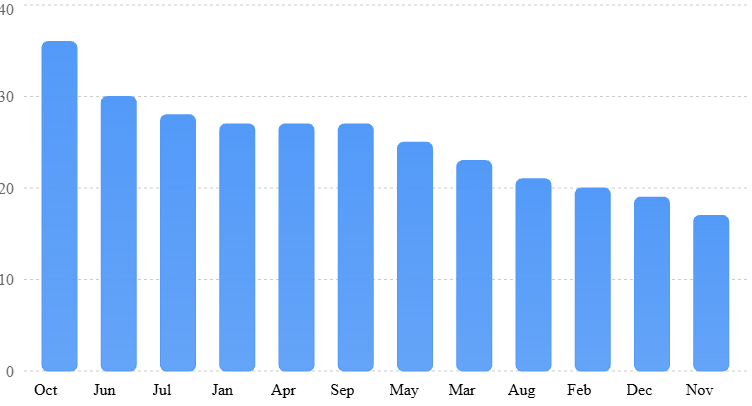
Source: Marie Claire UK reporting on a selected 300-person study. Not a worldwide census.
October leads this sample with 36 birthdays, representing 12% of the 300 people included. Marie Claire UK
The difference between October and June is six individuals, which may sound substantial in a small ranking. Yet the result could change if researchers selected different celebrities, included additional professions, or considered another time period. A ranking based on prominent entertainers and business figures may look very different from one focused exclusively on actors, musicians, or athletes. This is why a sample’s methodology matters just as much as the headline number.
A Much Larger Dataset Points Toward January
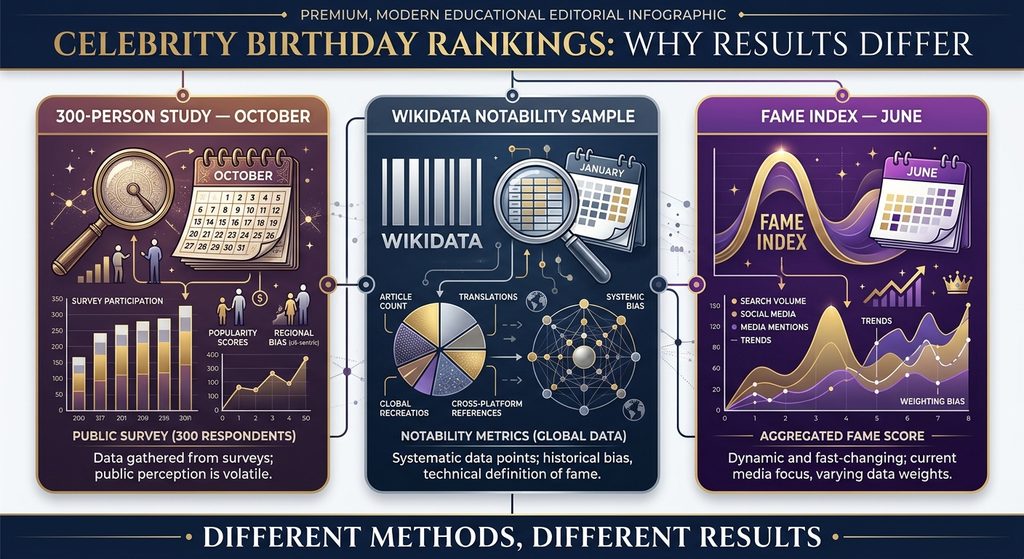
A separate birthday heat map based on 142,851 notable individuals represented in Wikidata found January leading when birthdays were averaged per calendar day. The analysis reported approximately 420 notable birthdays per day in January, compared with 381.4 in October and 363.5 in December. The dataset used people with articles in at least 15 Wikipedia language editions, making its definition of notability quite different from that of the 300-person study. The Print Year
This larger analysis also highlights an important limitation: Wikipedia coverage is not a perfect measurement of celebrity status. Historical figures, scientists, political leaders, and people whose birth dates were recorded imprecisely can influence the totals. For example, January 1 may appear unusually prominent because some historical records use it as a default or approximate birth date. Therefore, January’s lead in this dataset is informative, but it is not a universal measurement of entertainment fame.
Another Celebrity Database Places June First
The website Who Shares My Birthday takes a different approach. Rather than ranking months by raw birthday counts, it calculates a fame index based on the Wikipedia-language coverage of individuals in its database. Its October 23, 2026 statistics reported June as the leading month, with a fame index of 102, while October scored 98. The site also explains that its collection is designed to contain a similar number of famous people for each calendar date, making simple headcounts unsuitable. Who Shares My Birthday
These three examples reveal the central challenge. One study places October first, another identifies January, and a third favors June based on its own popularity metric. They are not necessarily contradictory because they measure different things. One counts selected successful individuals, another counts widely documented notable people, and the third estimates combined fame. Understanding those differences produces a much more meaningful answer than declaring a winner without explaining the evidence.
Why September Has So Many Birthdays in the General Population
One reason September frequently enters birthday discussions is that it performs strongly in several analyses of American birth records. A recent visualization of approximately 142.6 million United States births between 1989 and 2024 found that eight of the ten most common calendar birthdays occurred in September. September 9 occupied the top position. These findings describe recorded births in the general population, rather than birthdays among celebrities. Visual Capitalist
Another historical analysis, covering approximately 85.7 million American births between 1994 and 2014, also identified September as the leading month when births were compared on a per-day basis. It reported an average of 11,811 births per day during September. These numbers are useful because they show that birthday patterns are not always evenly distributed throughout the year. However, a birth pattern observed in the United States cannot be assumed to apply to every country or historical period. Birthday Traffic
Why Birth Rates Change Throughout the Year
Human birth patterns can vary because of seasonal behavior, holidays, family planning, healthcare practices, and social circumstances. Researchers studying birth seasonality consider several possible influences, including environmental conditions and the timing of conception. Planned medical deliveries may also affect the distribution of births around particular dates. The strength of these factors varies between countries, populations, and historical periods.
For example, a country experiencing higher birth rates in September may have experienced more conceptions approximately nine months earlier. Yet this observation does not prove that holidays alone caused the pattern. Birth seasonality involves multiple influences, and simple explanations can overlook important differences between populations. Readers should therefore treat seasonal birth statistics as descriptive findings rather than universal rules about when people are likely to have children.
Why Population Birth Rates Cannot Predict Celebrity Birthdays
Imagine a country where September consistently produces more births than February. It would be reasonable to expect more September-born individuals in a sufficiently large sample of that country’s population. However, becoming a celebrity is not a random process that depends only on how many people share a birthday. Professional opportunities, access to education, family circumstances, training, personal choices, and public exposure all influence who becomes famous.
International celebrity databases add another complication. They combine people from different countries, historical eras, and cultural backgrounds. A birth pattern from contemporary American records may have little relevance to an actor born in nineteenth-century Europe or a musician born in modern Asia. For that reason, population birth statistics can provide context, but they cannot independently determine which month contains the greatest number of celebrities.
Does Your Birth Month Influence Fame or Success?
The possibility that birth month might influence success is a popular topic because it connects personal identity with something mysterious and exciting. People enjoy discovering that they share a birthday with an accomplished musician, a famous athlete, or a successful entrepreneur. Such coincidences can feel meaningful, especially when several admired personalities were born in the same month. Yet emotional significance is not the same as scientific evidence.
There is no convincing basis for assuming that being born in October, June, January, or any other month automatically increases someone’s chances of becoming famous. Success depends on many interacting circumstances, and celebrity status itself is difficult to measure consistently. Some individuals become famous because of extraordinary artistic achievements, while others gain recognition through sports, business, public service, or online platforms. A birth month alone cannot explain these different career paths.
The Difference Between Correlation and Causation
Suppose researchers find that 12% of a selected celebrity group was born in October. That is a correlation between membership in the selected group and a particular birth month. It does not demonstrate that October births caused those individuals to become successful. To investigate causation, researchers would need to examine alternative explanations, selection effects, population birth rates, and other factors that influence the outcome.
A simple example makes this distinction clearer. If many successful singers were born on Fridays, it would not follow that Friday births improve musical ability. The same logic applies to birth months. A statistical pattern can be interesting without revealing a causal mechanism. Responsible interpretation means asking what the data actually measure, whether the sample is representative, and whether the apparent relationship survives more rigorous examination.
Can School Starting Ages Affect Later Opportunities?
There is one related area where birth timing can matter in specific circumstances: relative age within school or youth sports groups. Children born shortly after an eligibility cutoff may be older than classmates or teammates born shortly before the next cutoff. At young ages, even several months of developmental difference can influence physical maturity, confidence, and performance assessments.
Researchers have studied these relative-age effects in education and competitive sports. However, the findings depend on the country’s school calendar, sports eligibility rules, and other contextual factors. They do not establish that a particular calendar month universally produces more celebrities. An athlete’s birth month may interact with youth selection systems, but it cannot explain fame across music, cinema, television, and every other profession.
Why We Notice Celebrity Birthday Patterns
Our brains are remarkably good at finding patterns, even when those patterns are incomplete or misleading. If someone believes October is the month of famous birthdays, they may pay closer attention to October birthday announcements and overlook equally prominent celebrations in February or August. This is an example of confirmation bias, where people notice information that supports an existing belief more readily than information that challenges it.
Social media can intensify this effect. Platforms tend to promote content that generates reactions, comments, and shares. A birthday tribute featuring a globally recognized singer may receive enormous attention, while dozens of birthdays involving less familiar personalities pass almost unnoticed. As a result, public visibility can become confused with numerical frequency. The most talked-about month is not necessarily the month containing the most famous individuals.
The Role of Entertainment News and Social Media
Entertainment websites have good reasons to publish birthday features. These articles give audiences an opportunity to revisit beloved films, memorable performances, and significant career milestones. Birthday stories also remain relevant every year, making them useful for editorial calendars. When several major entertainers celebrate within a short period, publications may produce a series of related articles that makes the month appear especially active.
Fans contribute to this cycle by sharing photographs, favorite performances, and personal messages. A celebrity birthday can become a temporary online event, particularly when the person has an international following. Yet online engagement reflects popularity, audience behavior, and platform visibility. It does not provide a reliable census of everyone born during that month. Understanding this difference helps readers enjoy celebrity celebrations without drawing unsupported statistical conclusions.
Why Shared Birthdays Feel Special
Discovering that you share a birthday with a famous person creates an immediate sense of connection. You may have little else in common with the celebrity, but the shared date provides an easy conversation starter. People often use these coincidences to explore entertainment history, compare generations, or celebrate their own birthdays in a more playful way.
For example, someone born on October 25 might enjoy knowing that Katy Perry celebrates on the same day. A person born on October 28 could discover a connection with Julia Roberts. These comparisons are enjoyable precisely because birthdays are personal. However, sharing a date does not imply sharing personality traits, talents, or future achievements. The real value lies in curiosity, entertainment, and discovering interesting details about familiar public figures.
How to Research Celebrity Birthdays Accurately
Anyone interested in celebrity birthdays can conduct a useful investigation with publicly available resources. The first step is deciding what the research should measure. Are you looking for internationally famous entertainers, people with Wikipedia biographies, award-winning performers, or celebrities popular on social media? Each definition creates a different research population. Establishing that definition before collecting information helps prevent inconsistent results.
The second step is building a reliable list of individuals and their dates of birth. Official biographies, reputable entertainment publications, established reference databases, and verified professional profiles can provide useful information. Once the list is complete, researchers can group birthdays by month and compare the results. A spreadsheet makes this process manageable, especially when the dataset contains hundreds or thousands of entries.
Step 1: Define What Counts as a Celebrity
Begin by creating a clear inclusion rule. For example, a study might focus exclusively on actors who have received major film award nominations, or musicians whose recordings have appeared on recognized national charts. Another project might include anyone with a verified biography in a major public reference database. The exact definition matters less than applying it consistently.
Consider two hypothetical studies. The first examines 500 internationally known singers, while the second includes 50,000 notable people from history, politics, science, and entertainment. Even if both studies use accurate birth dates, their monthly rankings may differ substantially. Neither result should be presented as a universal answer. A trustworthy article should explain the population being studied before announcing its findings.
Step 2: Collect and Verify Birth Dates
After establishing the inclusion criteria, collect each person’s full name, birth date, profession, and supporting source. Cross-check information when reliable sources disagree. Celebrity birthdays are often easy to find, but historical figures and people using stage names may require additional verification. Avoid copying an unverified date simply because several websites repeat it.
For example, a spreadsheet entry for Katy Perry could contain her professional name, October 25, 1984, musician, and a reliable biographical reference. A similar entry for Keith Urban would record October 26, 1967. Using a consistent date format makes sorting and grouping easier. If a birth date cannot be verified, mark the entry for review instead of silently treating an uncertain date as established fact.
Step 3: Count Birthdays by Month
Once the records are organized, group them into January through December. In Microsoft Excel or Google Sheets, a MONTH formula can extract the month number from a properly formatted date. For example, if a person’s date of birth is stored in cell B2, entering =MONTH(B2) in another cell returns a number from 1 to 12. October returns 10, while June returns 6.
You can then use a pivot table to count how many individuals belong to each month. Make sure every person appears only once unless your research deliberately uses a different counting method. Duplicates can occur when celebrities have multiple stage names or when data is imported from overlapping sources. Cleaning these records is essential because even a modest number of duplicates can change a close monthly ranking.
Step 4: Adjust for Different Month Lengths
Comparing raw monthly totals can create misleading results because months have different numbers of days. January and October contain 31 days, while February contains 28 days in a common year. Even if birthdays were distributed uniformly across calendar days, longer months would tend to accumulate more birthdays.
One useful approach is to calculate the average number of celebrity birthdays per day. Divide each month’s birthday count by its number of calendar days. For instance, a hypothetical month with 310 celebrity birthdays across 31 days would average 10 birthdays per day. A 30-day month containing 300 birthdays would produce the same daily average. This adjustment makes the comparison fairer, although it does not eliminate sampling bias or incomplete records.
Step 5: Interpret the Results Without Exaggeration
Suppose your research finds October first with 400 celebrities, followed by June with 395 and September with 390. The temptation might be to publish a headline claiming that October produces the most successful people. However, the data would only establish that October leads within your particular dataset and definition of celebrity. It would not prove that October causes success or that the same ranking applies globally.
A more accurate headline would describe the sample and method. For example, “October Leads Our Study of 1,000 Entertainment Personalities” communicates the result without suggesting universal certainty. Readers benefit from this transparency because they can understand what the numbers represent. Clear methodology also makes the research easier to update when new records become available.
How to Find Celebrities Who Share Your Birthday
Finding celebrities born on your birthday can be a fun way to explore entertainment history. You do not need advanced research skills or specialized software to get started. Several public resources organize notable people by birth date, while search engines can help identify musicians, actors, athletes, and historical figures associated with a particular day.
The most useful approach is to compare multiple sources instead of relying on a single entertainment website. Some birthday directories focus on social media personalities, while others emphasize historical importance or established professional achievements. Exploring more than one source gives you a broader picture and reduces the chance of overlooking interesting individuals.
Use Wikipedia and Wikidata
Start by searching Wikipedia for a particular date, such as “October 25”. Date pages often contain a section listing notable births, organized chronologically. These entries may include actors, scientists, musicians, athletes, and historical personalities. Follow the links to individual biographies to learn more about their achievements and verify relevant details.
Wikidata provides a more structured approach because it stores biographical information in fields that can be queried and analyzed. Researchers can use it to assemble larger datasets of notable people and their birth dates. However, both resources have limitations. Wikipedia coverage varies by language, geography, and profession, while historical birth dates may be incomplete or uncertain. Treat the information as a useful starting point rather than an automatically perfect dataset.
Explore Entertainment Birthday Calendars
Specialized entertainment websites often make birthday discovery easier for casual readers. They may organize celebrities by date, profession, popularity, or age. Some include biographies, photographs, and career summaries that help readers understand why a particular individual is famous. These features are particularly convenient when looking for contemporary actors, musicians, or internet personalities.
For example, someone researching October 26 might search for famous musicians born on that date and discover Keith Urban. The next step would be reading a reliable biography to learn about his career and background. This approach turns a simple birthday search into a broader exploration of music history. It also encourages readers to learn something meaningful instead of collecting names without context.
Create a Personal Celebrity Birthday Calendar
A personal birthday calendar can become a useful reference for entertainment enthusiasts, bloggers, and social media creators. Begin by selecting the celebrities you genuinely follow, then record their birthdays in a spreadsheet or calendar application. Add their profession and a link to a reliable biographical source. You can also note milestone birthdays that may be worth covering in future articles.
For a WordPress entertainment blog, this calendar can support a consistent editorial schedule. A birthday article might discuss an artist’s career, most influential work, cultural impact, and memorable achievements. Avoid publishing only a short congratulatory message when readers would benefit from a richer story. Well-researched background information makes birthday content more informative, distinctive, and useful throughout the year.
Celebrity Birthday Myths That Deserve a Closer Look
Celebrity birthday discussions often blend legitimate data with popular assumptions. A month may appear unusually successful because a few influential figures were born during it, or a viral article may repeat an older ranking without explaining its limitations. These stories can be entertaining, but they become misleading when a narrow observation is presented as a universal scientific conclusion.
A useful way to evaluate these claims is to ask three questions. What exactly was counted? How were the individuals selected? Does the conclusion go beyond what the evidence supports? These simple checks help separate genuine findings from exaggerated interpretations. They are especially important when a claim connects birth month with intelligence, talent, wealth, or personal destiny.
Myth: October Automatically Produces More Successful People
October ranked first in the previously discussed 300-person sample, but that does not mean people born in October have a built-in advantage in achieving fame. The result describes the selected individuals, not an inherent characteristic of October-born people. Other datasets produce different rankings, demonstrating how strongly the outcome depends on methodology.
Success also has no single universal definition. A celebrated scientist, an internationally known singer, and a successful entrepreneur may all qualify as notable, but their achievements are measured differently. Combining them into one ranking requires deliberate choices about inclusion and weighting. Without those choices, a claim about the most successful birth month remains too vague to evaluate properly.
Myth: September Must Lead Because It Has So Many Births
September performs strongly in American birth statistics, but population birth frequency and celebrity frequency are different measurements. A large number of births during one month may increase the number of people born during that period, yet it does not establish that those individuals are more likely to become famous.
The distinction becomes particularly important when comparing international celebrities. Different countries experience different birth patterns, and famous individuals come from many generations. A statistical trend in one country’s recent birth records cannot explain the birth distribution of a worldwide celebrity population spanning centuries.
Myth: People Born in the Same Month Have Similar Personalities
Popular culture frequently associates birth months with personality traits, compatibility, or particular talents. These descriptions can be entertaining, but they should not be treated as reliable predictors of individual behavior. Two people born on the same day can develop very different personalities, careers, interests, and life experiences.
For instance, Katy Perry and another person born on October 25 may share a birthday without sharing musical talent or professional ambitions. Their opportunities, education, environments, and personal choices are far more relevant to their individual stories. Birthday coincidences are enjoyable connections, not scientific explanations for personality or achievement.
Myth: One Viral Ranking Settles the Debate Forever
A ranking can be accurate for its own dataset while remaining unsuitable as a universal conclusion. Celebrity databases change as new people become famous, public interest shifts, and historical records improve. Different researchers may also define celebrity status differently, leading to legitimate differences in results.
A credible ranking should therefore include its publication date, sample size, selection criteria, and counting method. Readers should be especially cautious when a headline presents a dramatic conclusion without identifying the underlying research. A useful article does more than repeat a number; it explains what the number means and where its limitations begin.
What Celebrity Birthday Trends Teach Us About Fame
The debate over celebrity birth months reveals something larger than a calendar curiosity. Fame is shaped by public attention, cultural history, and the way information is collected. A celebrity who dominates international headlines may appear more important in a small sample than dozens of accomplished individuals who receive less media coverage. This means the definition of fame can influence the result before researchers even begin counting birthdays.
It also shows why numbers need context. A study involving 300 famous individuals can produce an interesting finding, but its result should not be presented as equivalent to an analysis involving more than 100,000 notable people. Sample size, selection rules, and the quality of the records all affect reliability. Readers who understand these differences can appreciate celebrity birthday trivia while recognizing the limitations of broader claims about birth months and success.
The Difference Between Popularity and Historical Importance
Popularity often reflects how much attention someone receives at a particular moment. Historical importance, however, may be measured through long-term cultural influence, academic recognition, or documented achievements. A contemporary social media personality could attract millions of followers, while a historical scientist might have fewer online fans but greater long-term significance in reference databases.
When a birthday study combines these individuals, researchers must decide whether to treat them equally. Counting each person once is straightforward, but weighting individuals by fame introduces additional judgments. This helps explain why some datasets rank months by raw counts while others calculate popularity indexes. Both approaches can provide information, but they answer different questions.
Why Celebrity Birthday Rankings May Change
The celebrity landscape never stays completely still. New performers achieve international recognition, emerging athletes become household names, and digital creators develop audiences that rival traditional entertainment stars. Meanwhile, historians continue documenting notable individuals from earlier periods. As these records change, birthday databases can grow and their monthly rankings may shift.
A ranking published several years ago may still be useful as a historical snapshot, but it should not automatically be described as the current global result. For a reliable comparison, readers need to know when the data was collected and how the database was constructed. This is particularly important for entertainment websites that regularly publish birthday rankings as timeless facts.
Frequently Asked Questions
1. Which month has the most celebrity birthdays?
There is no universally accepted winner. October led a published comparison of 300 successful and famous individuals, with 36 birthdays. However, a much larger Wikidata-based analysis ranked January first by average notable birthdays per day. A separate fame-index analysis identified June as its leader. The answer depends on how researchers define and count celebrities.
2. Why is October considered a popular month for celebrity birthdays?
October includes many internationally recognized personalities, such as Bruno Mars, Eminem, Snoop Dogg, Kim Kardashian, Katy Perry, Keith Urban, and Julia Roberts. It also ranked first in a widely discussed 300-person celebrity sample. These factors contribute to October’s reputation, although they do not establish that it leads every possible celebrity database.
3. Is September the most common birth month?
September ranks particularly highly in several analyses of United States birth records. Historical American data covering 1994–2014 identified September as the leading month by average births per day. However, birth patterns differ by country and period. The result should not be interpreted as a universal global ranking or as proof that September has the most celebrities.
4. What is the most common birthday in the United States?
September 9 ranks first in a historical analysis of approximately 85.7 million American births recorded between 1994 and 2014. A broader dataset covering 1989–2024 also identifies September 9 as the most common calendar birthday. These results describe recorded population births, not celebrity birthdays. How Rare Is My Birthday?
5. Which famous celebrities were born in October?
Notable October birthdays include Bruno Mars on October 8, Hugh Jackman on October 12, Eminem on October 17, Snoop Dogg on October 20, Kim Kardashian on October 21, Katy Perry on October 25, Keith Urban on October 26, and Julia Roberts on October 28. These examples represent several entertainment fields and generations.
6. Does being born in October make someone more likely to become famous?
No reliable evidence establishes that October births automatically increase someone’s chances of becoming famous. A high number of October birthdays in a selected celebrity sample does not demonstrate causation. Professional success depends on numerous factors, including opportunities, training, circumstances, persistence, and personal choices.
7. Which month has the fewest celebrity birthdays?
The answer depends on the dataset. November ranked last in the 300-person sample discussed by Marie Claire UK, with 17 birthdays. Another large notability dataset identified December as the lowest month when comparing average birthdays per day. Neither finding establishes a universal record for all celebrities.
8. Do celebrities born in the same month share personality traits?
There is no dependable scientific basis for concluding that celebrities share personality traits simply because they were born during the same month. Individuals develop through a combination of biological, environmental, social, and personal influences. Shared birthdays are interesting coincidences, but they cannot reliably predict talent, ambition, creativity, or career success.
9. How can I find celebrities born on my birthday?
Search your birth date on Wikipedia, consult established biographical databases, or explore dedicated celebrity birthday calendars. Compare information across reliable sources when necessary. You can also create a personal spreadsheet containing celebrity names, dates of birth, professions, and source links to organize your discoveries.
10. What is the best way to compare celebrity birthdays by month?
Start with a clearly defined celebrity population and collect verified birth dates. Remove duplicate records, group individuals by birth month, and compare both monthly totals and average birthdays per day. Explain your selection criteria and limitations before publishing a ranking. This approach produces a more meaningful result than simply counting familiar celebrity names.
The Final Birthday Surprise: There Is More Than One Winner
So, which month has the most celebrity birthdays? October is the winner in one widely reported 300-person study, but there is no single universally established winner across all celebrity databases. Other research identifies January or June depending on how notability and fame are measured. That difference is not a failure of the research. It is a reminder that statistics only become meaningful when we understand what they measure.
Perhaps the most enjoyable part of celebrity birthdays is not discovering a winning month at all. It is exploring the people, careers, and cultural moments associated with each date. Whether you were born in October, September, June, or December, your birthday connects you with an extraordinary range of human stories. And while sharing a birthday with a famous person will not determine your future, it can certainly make the calendar more interesting.
⚠️ Disclaimer and Source Hygiene
This article is intended for general educational and entertainment purposes. Celebrity birth dates and research findings are based on publicly available biographical records, statistical analyses, and published reference material. Different datasets use different definitions of fame, and their results should not be treated as universal conclusions.
Population birth statistics are not equivalent to celebrity birth statistics. Claims concerning personality, career success, or life outcomes should not be inferred from a person’s birth month. Readers conducting formal statistical or academic research should consult original datasets, relevant researchers, and qualified statistical professionals.
Sources and References
The following sources support the article’s discussion of celebrity birthday rankings, statistical methods, and population birth patterns.
1. Marie Claire UK – Babies Born in These Months Become the Most Successful (and Famous). Reports the selected 300-person study in which October led with 36 birthdays.
2. The Print Year – Notable Birthdays Across the Calendar. Presents a Wikidata-based analysis of 142,851 notable people, including monthly averages and methodological limitations.
3. Who Shares My Birthday – Celebrity Birthday Statistics. Explains a fame-index approach and reports June as the highest-ranking month under that methodology.
4. Visual Capitalist – Most and Least Common Birthdays in America. Visualizes historical American birth records and the concentration of common birthday dates in September.
5. Birthday Traffic – September Birthdays and Historical Birth Records. Provides historical American birth-frequency calculations and methodology.
6. Wikidata – Structured Knowledge Base. A resource for researching biographical records and dates of birth.
7. Calendar-12 – Famous People’s Birthdays. Provides a separate exploration of notable birthdays using historical Wikipedia records.
Secondary Sources and Testimonials
Secondary entertainment sources and birthday directories can help identify celebrities worth researching, but their inclusion criteria and editorial standards vary. Individual biographies should be checked against dependable references when exact dates or historical claims matter.
This article does not include invented testimonials, fabricated interviews, or unsupported claims from celebrities. Its comparisons distinguish reported research findings from editorial interpretation, and the illustrative birthday lists are not presented as complete statistical datasets.
