

⏲️ Estimated reading time: 9 min
Table of Contents
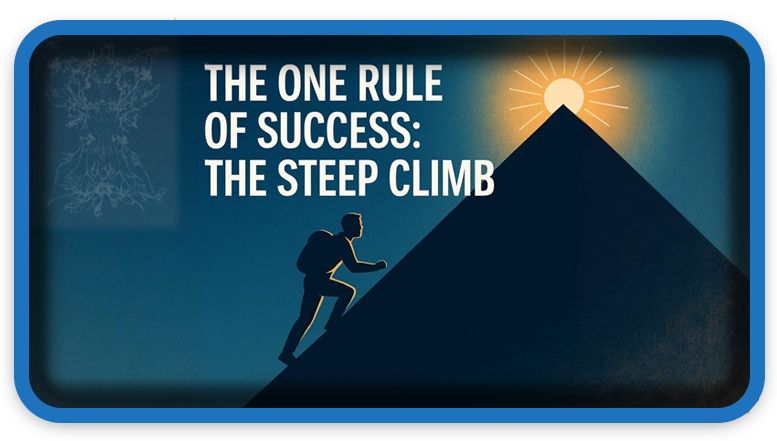
Success demands stressful and risky climbs. The Steep Climb, the faster you reach the top but never without pain. The key rule: protect your vision from the moral obstacles around you and keep climbing, until you reach the peak.
Why Every Level of Success Hurts
Every level of success has a price: a stressful, risky, emotionally demanding climb. You can’t reach the top without pain. This doesn’t glorify suffering it highlights that each “level” changes gravity: responsibilities increase, stakes rise, and social resistance becomes visible. The steeper the slope, the faster you climb, but the more intense the pressure on your psychological muscles.
The real challenge is not just technical (skills, strategy, execution), but social and psychological: as you risk for higher peaks, the people around you especially those who sense your intentions can become moral brakes. Not always out of malice; sometimes from fear, envy, or the instinct to preserve the status quo.
The Slope Metaphor: Slow Serpentines vs. Vertical Ascent
There are two main ways to climb:
- Slow serpentines: long road, less risk, prolonged fatigue, slower speed.
- Steep ascent: short road, higher risk, intense effort, faster time if you endure.
The choice depends on risk tolerance and time horizon. If you aim for rapid transformation (scaling, rebranding, personal growth acceleration), the steep ascent becomes inevitable. The key is preparation: equipment (systems), training (disciplines), the right teammates (filtered social circle), and safety nets (limits, backup plans, scenarios).
The One Rule: Protect Your Climbing Vector
Your “climbing vector” means your direction plus your speed. Once the environment understands your intention, social braking begins:
- subtle irony that undermines confidence,
- “innocent” invitations pulling you out of rhythm,
- “prudent” advice that dilutes objectives,
- pressure to stay the same to avoid “disturbing others.”
The one rule: Protect your climbing vector. Don’t overexpose it, don’t negotiate it at every table, don’t trade it for quick validation. Say “no” more often than is comfortable, structure your social access, and set elegant boundaries: “I’m in a sprint now. I’ll reconnect after date X.”
Who Are the “Moral Obstacles” (Without Demonizing)
Two classic social phenomena explain much of the resistance:
- Tall Poppy Syndrome: the group tends to “cut down” whoever grows too fast, too high.
- Crab Bucket Effect: when one climbs, others pull them down not because they want to stay low, but because they don’t want to remain “lower.”
Most common types:
- The Anxious Protector – loves you but projects their fears onto your plan.
- The Comfort Comrade – wants you to stay the same, constantly invites you to distractions.
- The Prudent Advisor – always gives you the perfect reason to delay.
- The Hidden Competitor – praises you publicly, sabotages subtly in private.
- The Failure Chronicler – reminds you of every failure, never of what you’ve learned.
You don’t need to fight them; just control access to your time, energy, and critical data.
Early Signs Someone Becomes a Brake
- Obsessive questions about “why such a hurry?”
- Repeated jokes about your dream, disguised as “humor.”
- “You’ve got time” when they know it’s a critical window.
- Exaggerated concern that immobilizes you.
- Tense reactions to your good news.
Standard, firm yet warm response:
“Thanks for caring. I’m in execution mode now; I’ll share updates when we hit milestone X.”
The Proximity Circle Strategy (5 Rings)
Imagine access to you in 5 concentric circles:
- Core (3–5 people): fully aligned, actively supportive, genuinely happy for you.
- Supporters (5–10): loyal, not always tactically aligned let them in doses.
- Neutrals: inform them only after milestones.
- Opportunists: minimal reporting, no strategic details.
- Toxics: no access during sprint; no explanations.
Golden rule: During steep ascent, communicate real-time only with the core.
Steep Ascent Requires Systems, Not Just Motivation
Motivation starts you; systems take you up. Minimum three systems:
- Deep Work Timeboxing: 90–120 minutes daily on Goal A.
- Entry Ritual: 5 minutes of breathing + setting intention + 3 key deliverables.
- Exit Ritual: mini-journal with “what I delivered / what I learned / what blocks me.”
Add weekly sprints (5 days ON, 2 days ON-light or recovery): in review, adjust the plan, not the goal.
Managing Stress: Eustress vs. Distress
- Eustress: challenge with meaning + enough resources + visible progress.
- Distress: vague demands + deadlines out of your control + lack of feedback.
Stress Converter:
- Clarify progress unit (pages written, calls made, prototypes tested).
- Shorten feedback loop (daily demo, journal, micro-metrics).
- Protect schedule (focus windows, real breaks).
- Fuel: 7–8 hours of sleep, simple meals, hydration, 20–30 min walk.

Risk Decisions: When a Steeper Slope Is Worth It
A steep slope is worth it if you meet 3 criteria:
- Asymmetry: potential gain outweighs potential loss.
- Safety nets: cash buffer, plan B, exposure limits.
- Learning rate: you can iterate fast and cheaply.
70/20/10 risk portfolio:
- 70% – safe, predictable ROI missions.
- 20% – moderate innovations, parallel.
- 10% – bold bets, limited exposure.
Social Anti-Sabotage: Useful Scripts
- Elegant “No”: “Love the idea, but I’m protecting my sprint window. Let’s revisit after X.”
- Clear boundary: “No operational details until milestone Y.”
- Redirect: “Great question; we test this next week. I’ll share results.”
- Irony disarm: “I prefer concrete feedback, humor distracts my focus.”
Visibility Equation: Who Sees What and When
- During sprint: updates only to the core, short and measurable.
- At milestone: share results (not plans) with rings 2–3.
- During pivot: explain reason, keep direction; don’t seek permission.
Principle: Announce after delivery, not before.
30-Day Steep Ascent Checklist
- Define peak (measurable result + date).
- Cut 50% of activities unrelated to peak.
- Set 1–2 deep work windows daily.
- Filter access circles (core, supporters, others).
- Choose one progress metric and display it.
- Build 3 safety nets (money, time, people).
- Predefine “NO” messages.
- Create entry/exit ritual for work.
- Learn one micro-skill weekly.
- Eliminate digital triggers 2 hours/day.
- Weekly postmortem (stop/start/double down).
- Celebrate micro-wins (healthy dopamine anchors).
Common Mistakes That Break the Climb Vector
- Oversharing: telling everyone, drowning in opinions, blocking action.
- Perfectionism: delaying launch until irrelevant.
- Process = identity confusion: mistake ≠ “I’m not good.”
- No access limits: accepting all “15-minute” meetings.
- Confusing fatigue with lack of purpose: you need rest, not quitting.
Micro-Tools That Multiply Leverage
- 3×3 Rule: 3 priorities/day, 3 actions/priority, 3 real breaks.
- Start–Stop–Continue Table: weekly review of what to launch, cut, maintain.
- Effort–Impact Matrix: execute High Impact/Low Effort first.
- Friction Journal: log daily slowdowns; remove one friction/day.
- QoD (Question of the Day): solve one meaningful question each morning.
Relationship with Pain: Turning It into Fuel
Pain is not the enemy, but the indicator of growth. Learn to differentiate:
- Healthy pain: controlled effort, visible progress, useful feedback.
- Toxic pain: humiliation, lack of meaning, confusing or absent feedback.
Reframe: “If it hurts because I’m growing, I continue. If it hurts because I’m shrinking, I change context.”
Case Study (Generic, Adaptable)
Anna launches a digital product in 60 days. Chooses steep ascent.
- Social filter: reduces announcements to 4 core people.
- Systems: 2×90 min deep work/day; metric: validated versions every 48h.
- Risk: 70% safe tasks (content), 20% experiment (pricing), 10% bold bet (partnership).
- Result: launched on day 58, first 200 clients; only then went public.
Moral: controlled exposure + rapid iterations = speed without chaos.
Journal Questions for Steep Climb
- What is my measurable peak in the next 90 days?
- What 3 activities slow me down that I can cut today?
- Who are my 3 core people and what updates do they get weekly?
- What is my financial and time safety net?
- What feedback do I need, from whom, and when (after delivery)?
- What is my daily entry/exit ritual for deep work?
- What “no” must be said this week?
- What does today’s pain teach me about tomorrow’s strength?
When to Announce, When to Stay Silent
- Announce when you have proof (version, sale, result).
- Stay silent when it’s just a hypothesis; protect start-up energy.
- Adapt when data demands it; protect mission, not ego.
Inner Leadership: Who You Are When Nobody Sees
Success is not negotiated in public; it’s earned in invisible hours. Inner leadership means keeping promises to yourself. It’s not glamour, it’s consistency. The steep slope punishes lack of discipline but rewards every meter you climb daily.
Quick Guide to Communicating with “Moral Obstacles”
- Be empathetic, yet firm.
- Explain why your goal matters, not why they are wrong.
- Invite them to support you with concrete actions (e.g., “don’t message me between 8–11 AM”).
- If they can’t, thank them and limit access until the sprint ends.
Key Point
The climb to the top is stressful and risky, but that’s what makes it short and transformative. The steeper the slope, the faster you reach the peak if you have systems and protect your climbing vector. The one rule is simple yet hard: protect your intention from moral obstacles. Choose your core, shorten feedback loops, convert stress into eustress, and let results speak. Announce after delivery. In the meantime, climb.
Read also: Frontier Airlines A321 Incident at Denver Airport
⚠️ DISCLAIMER
The content shared in this post is intended for inspirational and informational purposes only. The views and opinions expressed are those of the author, “Flo,” and do not constitute professional advice whether financial, psychological, medical, or legal.
Success is a highly personal journey, and what works for one individual may not be suitable for another. The concepts discussed, including “The Steep Climb,” involve risk, stress, and significant personal effort. Readers are encouraged to:
- Assess their own physical, mental, and emotional well-being before undertaking any demanding pursuit.
- Consult with relevant professionals (e.g., financial advisors, therapists, coaches) for guidance tailored to their specific circumstances.
- Recognize that social dynamics are complex; the categorization of “moral obstacles” is a metaphorical framework, not a prescription for judging relationships.
The author and publisher are not responsible for any decisions made, actions taken, or consequences resulting from the application of ideas presented in this article. Your journey and its outcomes are your own responsibility.
Proceed with self-awareness, caution, and personal discernment.
🔔 For more tutorials like this, consider subscribing to our blog.
📩 Do you have questions or suggestions? Leave a comment or contact us!
🏷️ Tags: success, motivation, personal growth, mindset, discipline, goals, resilience, productivity, leadership, social psychology
📢 Hashtags: #success, #motivation, #personalgrowth, #mindset, #discipline, #goals, #resilience, #productivity, #leadership, #socialpsychology
