


⏲️ Estimated reading time: 8 min
Table of Contents
The year 1917 was one of the darkest moments of the First World War. Europe was devastated by relentless fighting, while the North Atlantic became a strategic lifeline for transporting weapons, ammunition, and supplies to the Allied fronts. Canada, as part of the British Empire, played a crucial role in this global effort.
1917 – The Halifax Explosion (Canada): the largest non-nuclear man-made disaster in history
The port city of Halifax was one of the most important Allied naval bases in North America. Its natural harbor, well protected and easily accessible, made it a key departure point for military convoys crossing the Atlantic. Every day, dozens of ships entered and left the harbor, many carrying extremely dangerous cargo.
In this tense wartime environment, a single navigational mistake would trigger one of the most devastating disasters in human history.
The Port of Halifax – a vital wartime hub
At the beginning of the 20th century, Halifax was a thriving city with around 60,000 inhabitants. Its economy revolved around the harbor, where dockworkers, sailors, soldiers, and merchants crossed paths daily.
The port was overcrowded. Military vessels, commercial cargo ships, and supply transports constantly maneuvered through relatively narrow waters. Although navigation rules existed, the pressure of war often led to rushed decisions, miscommunication, and risky maneuvers.
On the morning of December 6, 1917, no one imagined that this busy harbor would soon become the epicenter of the most powerful man-made explosion prior to the nuclear age.
The ships involved: Mont-Blanc and Imo
At the heart of the disaster were two vessels:
- SS Mont-Blanc, a French cargo ship loaded with high explosives
- SS Imo, a Norwegian relief ship on a humanitarian mission
The deadly cargo of SS Mont-Blanc
SS Mont-Blanc was carrying an exceptionally dangerous load:
- approximately 2,300 tons of picric acid
- 200 tons of TNT
- 10 tons of guncotton
- barrels of highly flammable benzol stored on deck
This combination turned the ship into a floating bomb. Because of the wartime threat from German submarines, Mont-Blanc carried no visible warning flags indicating its explosive cargo, making it even more dangerous within a civilian harbor.
SS Imo – a ship under pressure
SS Imo was departing Halifax to deliver humanitarian aid to Belgium. Delays had already put the ship behind schedule, and its crew navigated aggressively, violating several harbor navigation rules.
This fatal mix of haste, stress, and miscommunication set the stage for catastrophe.
The collision that changed history
At around 8:45 a.m., the two ships found themselves on a collision course in the Narrows, the narrow channel connecting Halifax Harbour to the open sea.
Sound signals were exchanged but misunderstood. Each vessel interpreted the other’s intentions differently. In a last-second attempt to avoid impact, Imo turned sharply, but it was too late.
The ships collided.
The impact itself was not initially severe. However, barrels of benzol on Mont-Blanc’s deck were knocked over, spilling fuel across the ship. A spark ignited the vapors.
SS Mont-Blanc caught fire.
The fire and the fatal 20 minutes
After the collision, Mont-Blanc’s crew immediately understood the danger. They knew that an explosion was almost inevitable. Without clearly warning harbor authorities either out of panic or lack of protocol they abandoned the ship in lifeboats.
The burning vessel drifted slowly toward Halifax’s crowded waterfront.
Meanwhile:
- residents watched the fire with curiosity
- dockworkers approached for a closer look
- schoolchildren pressed against classroom windows
- firefighters prepared to intervene
No one realized they were watching a massive floating bomb.
The 9:04 a.m. explosion – hell on earth
At 9:04:35 a.m., SS Mont-Blanc exploded.
The blast was so powerful that it:
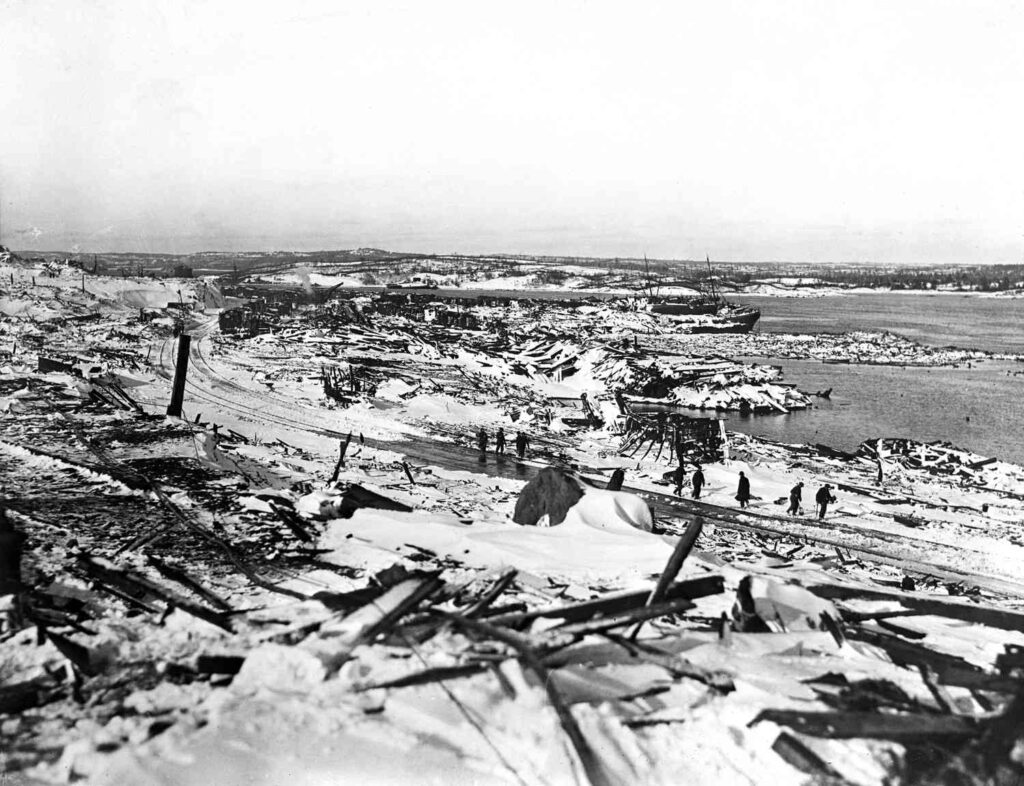
- obliterated the harbor district
- flattened entire neighborhoods
- created a massive fireball and mushroom cloud rising over 6,000 meters into the sky
- generated a shockwave felt more than 400 kilometers away
The explosion also triggered a tsunami inside the harbor, throwing ships onto land and drowning dozens of people.
Until Hiroshima, no explosion caused by human activity had ever released such destructive force.
Human losses and material destruction
The aftermath was catastrophic.
Casualties
- approximately 2,000 people were killed
- more than 9,000 were injured
- thousands suffered permanent or temporary blindness from flying glass
Many victims had been watching the fire from their windows. When the shockwave hit, windows shattered instantly, turning glass into deadly projectiles.
Read also: How to Fix “Too Many Preconnect Connections” in
Physical destruction
- over 1,600 buildings were completely destroyed
- around 25,000 people were left homeless
- hospitals were damaged or destroyed
- the city’s infrastructure collapsed
An entire city was devastated in less than a second.
Chaos in the immediate aftermath
Survivors described scenes of absolute horror:
- people wandering through rubble in shock
- cries for help coming from collapsed buildings
- fires breaking out simultaneously across the city
- complete communication breakdown
Local authorities were overwhelmed. Many firefighters, doctors, and emergency responders had been killed or injured in the blast.
Just hours later, a powerful snowstorm struck Halifax, further complicating rescue efforts.
International solidarity and emergency aid
Help arrived quickly from across Canada and the United States. Trains loaded with doctors, nurses, food, and medical supplies reached Halifax in record time.
The city of Boston played a crucial role in the relief effort. As a lasting symbol of gratitude, Halifax has sent a Christmas tree to Boston every year since, a tradition that continues to this day.
The investigation and lessons learned
Official inquiries concluded that:
- both ships violated navigation rules
- poor communication was a decisive factor
- no strict safety protocols existed for transporting explosives through civilian ports
As a result, the Halifax Explosion led to:
- stricter international regulations for hazardous cargo
- improved maritime signaling standards
- the development of modern emergency response planning for ports
The tragedy fundamentally reshaped maritime safety.
The reconstruction of Halifax
Rebuilding Halifax was a long but carefully planned process. The most heavily damaged areas were redesigned according to modern urban planning principles.
The Richmond district, which suffered the worst destruction, was rebuilt with:
- wider streets
- safer building standards
- improved access for emergency services
Out of devastation, a more resilient city emerged.
The Halifax Explosion in collective memory
Today, the Halifax Explosion is:
- studied in military, engineering, and disaster-management institutions
- remembered as a defining moment in Canadian history
- commemorated annually through memorials and ceremonies
Monuments, museums, and plaques preserve the memory of the victims and the hard lessons learned from this tragedy.
Why this disaster still matters
The Halifax Explosion is not merely a historical event. It remains a powerful warning about:
- the dangers of negligence
- the critical importance of communication
- the risks of transporting hazardous materials
- the fragility of human life
In a modern world with increasingly dense maritime traffic, the lessons of 1917 remain painfully relevant.
Frequently Asked Questions
When did the Halifax Explosion occur?
On December 6, 1917, at 9:04 a.m.
What caused the explosion?
A collision between two ships, one of which was carrying massive quantities of explosives.
How many people died?
Approximately 2,000 people lost their lives.
Was it the largest explosion in history?
It was the largest man-made explosion before the use of nuclear weapons.
Which ship exploded?
The French cargo ship SS Mont-Blanc.
Why wasn’t the city evacuated?
Authorities and civilians were unaware of the ship’s explosive cargo.
Did the explosion cause a tsunami?
Yes, a large wave surged through the harbor following the blast.
Which city provided the most aid?
Boston, USA, sent rapid and substantial assistance.
A lesson written in fire and ash
The Halifax Explosion remains one of the most devastating disasters of the modern era. In a single moment, a thriving city was shattered, thousands of lives were lost, and the world was forced to confront the consequences of human error.
Remembering this tragedy is not only about honoring the victims, but also about reinforcing the responsibility, vigilance, and respect for human life that such a disaster demands.
⚠️ DISCLAIMER
This article is intended for informational and educational purposes only. The information is based on historical archives, official Canadian records, and academic research on maritime and industrial disasters.
🔔 For more tutorials like this, consider subscribing to our blog.
📩 Do you have questions or suggestions? Leave a comment or contact us!
🏷️ Tags: Halifax Explosion, Halifax 1917, historical disasters, World War I, Canadian history, maritime explosions, urban tragedy
📢 Hashtags: HalifaxExplosion #Halifax1917 #History #Canada #HistoricalDisasters #WWI #NeverForget
