


⏲️ Estimated reading time: 13 min
Table of Contents
The Armero Tragedy: What Happened During the Nevado del Ruiz Eruption. The 1985 eruption of Nevado del Ruiz in Colombia triggered massive mudflows that buried the town of Armero, killing around 23,000 people in one of the deadliest volcanic disasters of the 20th century. This comprehensive article explains what happened, why warnings failed, and how a 13-year-old girl became the tragedy’s symbol.
The Armero Tragedy: Understanding One of the Deadliest Volcanic Disasters in Modern History
The Armero tragedy remains one of the most devastating natural disasters in Latin America. The eruption of the Nevado del Ruiz volcano on November 13, 1985, transformed a moderate volcanic event into a catastrophic humanitarian crisis. Although the eruption itself was not exceptionally large, the combination of melted glaciers, unstable valleys, and unprepared communities produced deadly mudflows that swept through towns and farmlands. Entire families vanished, and thousands of lives ended within hours.
The loss of roughly 23,000 people shocked the world. It was not only a geological event but also a human tragedy shaped by ignored warnings, incomplete planning, political hesitation, and poor communication. The disaster occurred during the night, when darkness hid the deadly mudflows. People had no time to react, and many were sleeping when the lahars invaded Armero. Because of these factors, the incident became a painful lesson about disaster preparedness.
This article offers a detailed exploration of the Nevado del Ruiz eruption, the final hours before the lahars struck, the destruction of Armero, the stories of survivors, and the legacy of the tragedy. It also highlights one of the most symbolic human figures of the event: Omayra Sánchez, whose final hours captured the attention of millions and became a powerful reminder of the suffering caused by the disaster.
The Volcano: A Beautiful Summit With a Violent Past
Nevado del Ruiz is a towering stratovolcano located in the Andes. Its snow-covered summit appears peaceful from a distance, but the mountain hides a complex and dangerous history. For centuries, eruptions have generated deadly mudflows that traveled down its slopes into valleys and settlements.
Historical records show that in 1595, a massive lahar killed around 600 people. In 1845, another eruption caused mudflows that destroyed roads, homes, and farmlands, killing more than 1,000 people. These events made scientists aware that Nevado del Ruiz was capable of producing catastrophic lahars. Still, by the late 20th century, the region had grown comfortable. Many residents believed the volcano was dormant, and new generations were unaware of its full danger.
When activity increased in 1984, the volcano began releasing gases, ash, and heat. Scientists detected seismic tremors and changes in the glacier surface. They warned authorities and published hazard maps showing that mudflows could reach Armero. Even with this knowledge, the local population continued daily life without major concern. Some residents were skeptical, while others were encouraged by political leaders who insisted that there was no immediate danger.
The volcano continued to show signs of unrest, setting the stage for a tragic outcome.
Early Warnings and Missed Opportunities
Throughout 1984 and 1985, experts monitored the volcano. They saw clear signs of rising magma and increasing internal pressure. Scientists from Colombia and abroad analyzed data, held meetings, and sent reports. They created risk maps that clearly marked Armero and nearby communities as high-risk zones. The maps showed that if lahars occurred, they would travel along the Azufrado and Lagunilla river channels directly into populated areas.
However, communication between scientists, authorities, and local residents was inconsistent. Many people did not understand the maps. Some questioned whether the warnings were exaggerated. Others viewed volcanic monitoring as a political issue, not a scientific fact. Local governments hesitated to approve evacuations, fearing economic losses and community unrest.
As the volcano intensified its activity during mid-1985, disagreements grew. Some officials wanted more information before acting. Others said the risk was real, but that the population was not prepared to evacuate quickly. These conflicting opinions created confusion. The lack of a unified strategy left communities vulnerable.
The situation worsened when ash fall increased in November 1985. Heavy rains mixed with ash and mud, making roads slippery. Authorities communicated partial warnings, but they never issued a full evacuation order for Armero.
The stage was set for disaster.
The Eruption of November 13, 1985: A Night That Changed Everything
On the afternoon of November 13, Nevado del Ruiz erupted. The explosion sent ash into the atmosphere, affecting towns miles away. At first, many residents believed the eruption was small and harmless. The sky darkened, but life continued in Armero. People stayed indoors. Children did homework. Families ate dinner. No major alert reached them.
But above the city, disaster was forming.
Hot volcanic material melted parts of the summit glacier. The melting ice mixed with ash, rocks, and volcanic debris. Within minutes, powerful lahars formed. These mudflows traveled down the mountain’s sides at dangerous speeds. The steep river valleys guided them straight toward Armero and other settlements.
Darkness made the danger invisible. The lahars traveled quietly at first, then roared like crashing waves. By the time residents heard the sound, it was too late. The first lahar reached the outskirts of Armero around 11:30 p.m., destroying everything in its path.
Within minutes, the mud buried the city.
Armero: A Town Buried Under Mud and Silence
Armero was a farming town of nearly 30,000 people. Located on a flat valley floor, it was surrounded by river channels that acted as natural pathways for the lahars. The mudflows struck the town with unstoppable force. Houses collapsed instantly. Streets disappeared beneath meters of thick, cement-like mud.
Families woke up to chaos. Many people were thrown out of their homes. Others found themselves trapped in the dark, fighting to breathe. Debris, rocks, and broken trees floated in the mud. The air smelled of ash and wet earth. Panic spread rapidly.
Entire neighborhoods vanished. Buildings that had stood for decades became unrecognizable. Cars floated like toys. Many victims could not escape because the mud hardened quickly, trapping them by the legs or torso.
By dawn, Armero was no longer a town. It was a gray wasteland. The silence that followed made the destruction even more heartbreaking. Survivors stood shocked, covered in ash and mud, trying to understand what had happened.
The tragedy had unfolded in less than 20 minutes.
Omayra Sánchez: The Child Who Became the Symbol of Armero
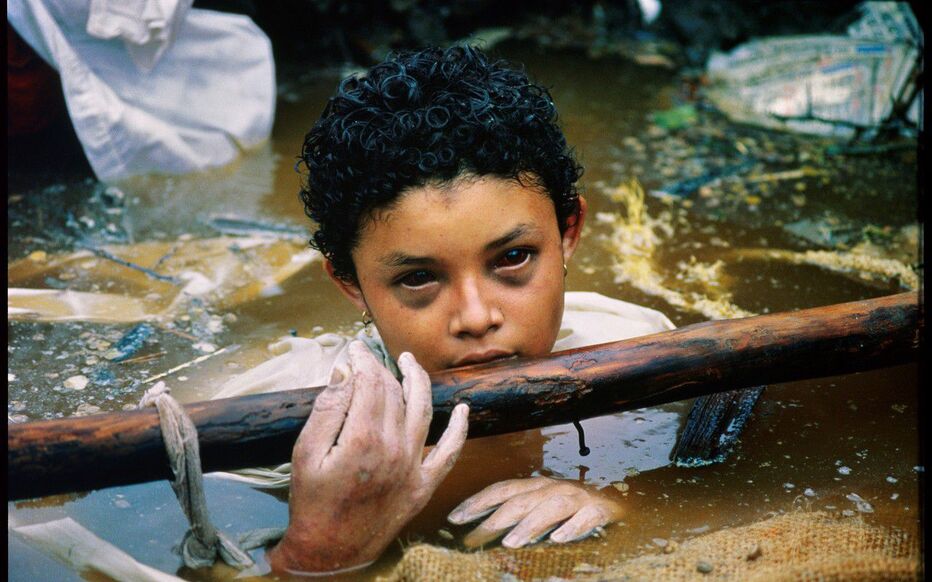
Among the thousands affected was a young girl whose courage touched the entire world: Omayra Sánchez, a 13-year-old girl who became a symbol of the Armero tragedy. In 1985, she was trapped beneath the remains of her home, pinned by concrete and wooden beams. Mud and water surrounded her legs, making rescue nearly impossible.
When journalists and rescue workers found Omayra, she was calm and remarkably strong. She spoke clearly. She smiled at times. She asked for food and water. She worried about her family. Her dignity moved everyone who saw her. Cameras captured her final hours, and her face traveled across newspapers and television screens worldwide.
Her situation revealed the harsh reality of the disaster. Despite global attention, rescuers lacked the equipment needed to free her safely. The debris held her legs underwater. Pulling her out would have caused fatal injuries. For nearly three days, she remained trapped, fighting to stay conscious.
Her story became a symbol of the suffering caused by the volcano and the failures that allowed the tragedy to unfold. When she passed away, the world mourned her. Even today, Omayra remains a powerful reminder of the human cost of the Armero disaster.
The Global Response and the Emotional Impact
When news of the disaster spread, the world reacted with shock and grief. Images of Armero’s destruction reached millions. International organizations sent rescue teams, medical supplies, and food. Donations arrived from many countries. Helicopters flew over the ruins, searching for survivors trapped in mud and debris.
However, challenges made rescue efforts slow. Roads were destroyed. Bridges had collapsed. Communication lines were down. Rescuers struggled to reach survivors in time. The hardened mud made it extremely difficult to dig. Many people remained missing for days.
Hospitals in nearby cities filled quickly. Doctors treated fractures, infections, dehydration, and shock. Volunteers helped identify victims and support grieving families. The emotional toll was enormous.
Every survivor had a painful story. Some lost entire families. Others carried deep psychological trauma. Many never recovered from the loss.
The tragedy also triggered global debates about disaster preparedness. Governments, scientists, and media outlets questioned why earlier warnings had been ignored. As the world searched for answers, Colombia faced one of the darkest moments in its history.
Why the Disaster Became So Deadly
Several factors contributed to the tragic scale of the event. Understanding these factors is essential to prevent similar disasters in the future.
First, warnings were misunderstood or ignored. Hazard maps existed, but many people did not know how to interpret them. Authorities hesitated to order evacuations. As a result, residents remained in dangerous areas.
Second, communication failed at critical moments. Ashfall, storms, and technical issues disrupted radio messages. Many residents never received evacuation alerts.
Third, the eruption happened at night. Darkness prevented people from seeing the approaching mudflows. By the time they realized what was happening, escape was nearly impossible.
Fourth, Armero’s location increased vulnerability. Built on a floodplain between river channels, the town sat in a direct lahar pathway. The hazard was known, yet development continued without strong evacuation plans.
Finally, the population lacked information about volcanic risks. Many had never heard of lahars and did not understand that mudflows could travel faster than people could run.
These conditions combined to create one of the deadliest volcanic disasters of the century.
How Lahars Form and Why They Are So Destructive
Lahars are among the most dangerous volcanic hazards. They form when volcanic material mixes with water. In the case of Nevado del Ruiz, the water came from melted glacial ice. Ash and debris formed a dense, concrete-like mixture that traveled rapidly through valleys.
These flows can reach speeds of more than 60 kilometers per hour. They destroy everything in their path. Lahars can remain hot for hours. They can bury towns under meters of mud and prevent rescue operations.
Because they follow natural river channels, they reach populated areas quickly. Armero’s position on a valley floor made it an unavoidable target.
Lahar science explains why the Nevado del Ruiz eruption was so devastating even though the eruption itself was moderate. The true danger came from the interaction between heat, ice, and gravity.
Survivors: Stories of Strength and Resilience
In the aftermath of the tragedy, stories of survival inspired the world. Some people escaped by running toward higher ground as soon as they heard the roar of the mudflows. Others clung to rooftops, floating debris, or anything they could hold on to.
Rescuers found survivors trapped under mud, calling for help. Many worked through the night, using whatever tools were available. Their bravery saved hundreds of lives.
One man recalled being thrown out of his house and carried by a wave of mud. He survived by grabbing a piece of wood. Another survivor described floating for hours before being rescued at dawn.
Each story showed resilience, courage, and determination. Although thousands perished, these stories revealed the strength of the human spirit.
Rebuilding After the Tragedy
Colombia faced an overwhelming challenge after the disaster. Thousands of families needed homes, food, and medical care. Entire neighborhoods had disappeared. The government built “Nuevo Armero,” a new settlement created for survivors. However, emotional wounds ran deep.
The tragedy caused long-term economic damage. Farmland remained buried under thick mud. Livestock died. Infrastructure required complete reconstruction.
Still, the country united to help survivors rebuild their lives. Communities organized donations, psychological support, and memorial events. Schools reopened. New farms were created. Slowly, life returned to the region.
Although recovery took years, the tragedy transformed Colombia’s approach to natural disasters. It encouraged stronger emergency plans, better scientific monitoring, and improved communication systems.
Lessons Learned and the Legacy of Armero
The Armero tragedy became a turning point in global disaster management. Countries around the world studied it to understand how to prevent similar failures. Experts emphasized clear communication, strong evacuation planning, and public education.
Colombia improved its volcanic monitoring network. Scientists now track volcanic activity across the country with advanced equipment. Communities receive regular training about natural hazards. Alerts are clearer and more frequent.
Nevado del Ruiz remains active today. Monitoring continues 24 hours a day. Authorities maintain evacuation routes and safety plans. Armero’s memory ensures that complacency never returns.
The disaster also serves as a reminder of human responsibility. Natural hazards cannot be avoided, but their impact can be reduced. When scientific warnings are respected, lives can be saved.
Frequently Asked Questions
Why was the Armero tragedy so deadly?
Because warnings were ignored, communication failed, and the lahars struck at night when residents had no time to escape.
How many people died?
Approximately 23,000 people died, making it one of the deadliest volcanic disasters of the 20th century.
What is a lahar?
A lahar is a volcanic mudflow formed when water mixes with ash, rocks, and debris.
Could the disaster have been prevented?
Yes. Earlier evacuations and better communication could have saved many lives.
Who was Omayra Sánchez?
She was a 13-year-old girl trapped after the disaster. Her bravery made her a global symbol of the tragedy.
Disclaimer and Source Hygiene
This article is for educational and informational purposes. It is based on public historical facts and geological studies. No copyrighted material was used, and all text is original. Readers should consult official geological sources for updated volcanic activity information.
🔔 For more tutorials like this, consider subscribing to our blog.
📩 Do you have questions or suggestions? Leave a comment or contact us!
🏷️ Tags: Armero tragedy, Nevado del Ruiz, Colombia history, Omayra Sanchez, volcanic eruptions, lahars, natural disasters, Armero 1985, disaster preparedness, volcano safety
📢 Hashtags: Armero, #NevadodelRuiz, #OmayraSanchez, #VolcanicEruption, #ColombiaHistory, #NaturalDisaster, #Lahar, #VolcanoSafety, #1985History, #DisasterManagement
Echoes of a Night That Should Never Be Forgotten
Read also: Vitamin B Does Not Cause Neuropathy: What Really Does?
The Armero tragedy remains one of the most painful reminders of how nature and human decisions can collide. Thousands of lives were lost not only because of volcanic power but also because critical warnings went unheard. Remembering Armero means remembering the value of preparedness, the importance of science, and the stories of courage like that of young Omayra Sánchez.
