


⏲️ Estimated reading time: 23 min
Table of Contents
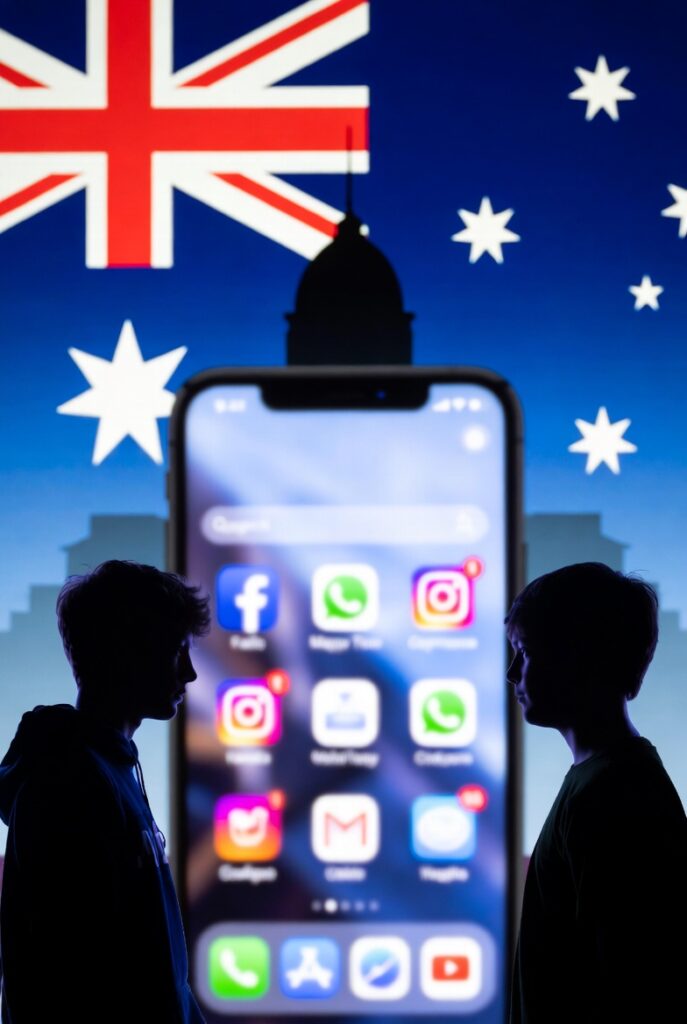
Australia has introduced a world-first law banning under-16s from major social media platforms. The government says it’s about safety and mental health. Two teenagers, however, are taking the law to the High Court, arguing it violates their right to political expression. Here’s the full story behind this historic clash.
A World-First Ban Meets a New Generation of Activists
The Australian government says it has banned under-16s from using social media to keep children safe from online harm.
From 10 December 2025, major platforms like TikTok, Instagram, Snapchat, YouTube, Facebook, X, Reddit and others must block users under 16, or risk multi-million-dollar fines.(People.com)
At almost the same moment that the law came into force, two 15-year-olds, Noah Jones and Macy Neyland, supported by the Digital Freedom Project, launched a High Court challenge. They argue that the ban unreasonably restricts their ability to participate in political debate and civic life, especially because so much of modern conversation now happens online.(The Australian)
This clash between child protection and digital rights is already being called a test case for the future of the internet. In this article, we’ll unpack:
- What the new law actually does
- Why the government pushed so hard for it
- What Noah and Macy are arguing in court
- How the case could reshape online life for young people in Australia and beyond
What Exactly Is Australia’s Under-16 Social Media Ban?
The Law Behind the Ban
The new rules come from the Online Safety Amendment (Social Media Minimum Age) Act 2024, which amends the existing Online Safety Act 2021.(Wikipedia)
Key points about the law:
- It bans children under 16 from having accounts on specified social media platforms.
- It puts the responsibility on companies, not kids or parents.
- Platforms must take “reasonable steps” to prevent under-16s from holding or using accounts.
- Companies that fail to comply can face fines of up to A$49.5–50 million.(Reuters)
- There is no parental consent exception: even if parents agree, under-16s still cannot legally use those platforms.(Wikipedia)
The law passed in late 2024 after intense debate, with the government pointing to rising concerns about youth mental health, bullying, and exposure to harmful content online.(Wikipedia)
Which Platforms Are Covered?
The ban applies to a list of major social media platforms chosen by the government and the eSafety Commissioner. These currently include:(Wikipedia)
- TikTok
- Snapchat
- X (formerly Twitter)
- YouTube
- Threads
- Twitch
- Kick
Some platforms and services used primarily for education or health such as Google Classroom, Kids Helpline, WhatsApp or Messenger Kids can be treated differently or exempted, because the law targets mainstream social media rather than all digital tools.(Wikipedia)
When Did the Ban Take Effect?
- The Act was assented to in December 2024.(Wikipedia)
- The key provisions allowing the government to “switch on” the ban were set to commence later.
- The federal government proclaimed 10 December 2025 as the start date for enforcement, making Australia the first country in the world to fully ban social media for under-16s.(Reuters)
From that day, platforms had to ensure that users under 16 could no longer create or maintain accounts, or they would risk heavy penalties.
How Age Verification Is Supposed to Work
The law does not mandate one specific verification method. Instead, it requires platforms to take “reasonable steps” to check ages. In practice, this can include:(Reuters)
- Self-reported date of birth when creating an account
- ID checks (such as uploading a passport or driver’s licence for older users)
- Biometric tools, like video selfies used to estimate age
- Data analysis, such as looking at behaviour or existing data to guess likely age
Importantly, the government has said companies should not be forced to collect more personal data than necessary. That is meant to reduce privacy risks, although some critics argue the opposite is happening.
What Happens to Existing Under-16 Accounts?
If a teenager already had an account before the ban:
- Platforms must identify and disable under-age accounts.(People.com)
- Many teens reported seeing their accounts suspended or deleted as the law came into force.
- Some platforms have given a notice period or a chance to download data.
- There are no fines or criminal penalties for the teenagers or parents themselves; only platforms face legal consequences.(Wikipedia)
In reality, the rollout has been messy. Some teens have openly boasted online that they slipped through the cracks or used fake birthdates to stay on their favourite apps. Regulators say those accounts will be removed “in time” as enforcement tightens.(The Guardian)
Why the Government Says the Ban Is Necessary
Rising Alarm Over Youth Mental Health
The Albanese government argues that social media has become a huge, largely unregulated experiment on children. Ministers point to:(Reuters)
- Increased anxiety and depression among teens
- Cyberbullying and harassment
- Body image issues, especially for girls
- Exposure to self-harm and suicide content
- Online grooming and exploitation
Advocates have shared stories of children whose mental health suffered severely after negative experiences online. Some grieving parents became outspoken campaigners, pushing hard for stricter age limits and stronger protections.(The Guardian)
“Let Them Be Kids” and the Politics of Protection
The ban is closely linked to public campaigns such as “Let Them Be Kids”, which argue that constant scrolling, comparison, and algorithm-driven feeds can rob children of a healthy childhood.(TIME)
Key political messages from supporters include:
- Kids should spend more time offline, especially during school holidays.
- Big tech companies have too much power over children’s attention and emotions.
- Governments have a duty to step in when something threatens kids’ wellbeing.
Prime Minister Anthony Albanese has framed the reform as similar to earlier public-safety milestones like seatbelts or tobacco control.(The Guardian)
Strong Public Support
Opinion polls reported by Australian media show that around three-quarters of the public back the idea of an under-16 social media ban. Many parents say they feel relieved that they can now point to the law when negotiating screen time with their children.(People.com)
Teachers and school leaders have also expressed support, hoping for fewer online conflicts spilling into the classroom.
Support from States and Regulators
State governments such as New South Wales (NSW) and South Australia (SA) have firmly backed the federal ban, even formally intervening in court to support it.(The Australian)
The eSafety Commissioner, Julie Inman Grant, plays a central role in:(The Guardian)
- Monitoring platform compliance
- Issuing notices and guidance
- Investigating breaches and recommending fines
Officials acknowledge “teething problems”, but insist the law will tighten over time and underage users who slipped through “will be booted off in time.”(The Guardian)
The Teens Taking the Government to Court
Who Are Noah and Macy?
The High Court challenge grabbing headlines is led by two 15-year-olds, Noah Jones and Macy Neyland. They are represented and supported by civil-liberty advocates from the Digital Freedom Project.(The Australian)
Noah and Macy say they grew up with social media and see it as a core part of their social world, education, and political life.
Their Core Argument: Political Expression in a Digital Age
Australia’s Constitution does not have a US-style, written Bill of Rights. However, the High Court has recognised an implied freedom of political communication. That freedom doesn’t belong to individuals as a personal “right”, but it limits how far governments can go when they regulate communication related to politics and government.(Wikipedia)
Noah and Macy argue that:
- Social media is where much political debate now happens.
- They use platforms to follow news, discuss policy, and campaign on issues they care about.
- Completely banning all under-16s from major social platforms shuts them out of modern democratic conversation.
- The law is too broad and not “reasonably appropriate and adapted” to its goal of protecting children.(The Australian)
In other words, they say the government has overreached. Yes, safety matters but not at the cost of cutting young people off from political life.
Everyday Life Under the Ban: What Teens Say They Lose
From the perspective of teenagers like Noah and Macy, the ban affects more than entertainment. They say they use social media to:(YouTube)
- Organize around climate protests or other causes
- Connect with student councils, youth organisations, and MPs
- Share and respond to news about elections and campaigns
- Learn from diverse voices they might never meet offline
Under the ban, they feel:
- Silenced on big political conversations
- Isolated from peers who are old enough to stay online
- Forced back to slower, less visible channels like email or physical meetings
- Treated as “too young to have a voice” in decisions that directly affect them
Their case asks the High Court to decide whether this trade-off is constitutionally acceptable.
Inside the High Court Fight: What’s Really at Stake?
The Implied Freedom of Political Communication
The High Court has repeatedly confirmed that Australia’s system of representative democracy requires an implied freedom of political communication, so people can discuss government and political matters.
The tests the Court usually applies include questions like:(Wikipedia)
- Does the law burden political communication?
- If so, is the law reasonably appropriate and adapted (or proportionate) to a legitimate purpose compatible with democratic government?
Noah and Macy’s claim is that the ban clearly burdens their ability to engage in political communication. The government accepts there is some impact, but says the law’s child-protection goal justifies it.
Proportionality: Is the Ban Too Extreme?
A central issue will likely be proportionality. The Court may consider questions such as:
- Could the government have chosen a less restrictive option, like stronger parental controls or time limits?
- Is an absolute ban for all under-16s necessary, or could a system of supervised access and graduated rights have done the job?
- Does the law target specific harms, or does it sweep too widely?
- How strong is the evidence that this exact measure will actually improve mental health outcomes?
If the Court decides the ban goes further than needed, it could strike down parts of the law or require changes.
States Lining Up Behind the Ban
The governments of NSW and SA have announced they will intervene in the case to support the federal law, arguing that:(The Australian)
- Social media is an “unregulated experiment on children”.
- Strong action is needed to protect children from serious harm.
- Tech companies should carry the burden of adjustment, not families.
Western Australia has also signalled support for the federal ban, while some libertarian and civil liberties voices argue the measure is paternalistic and disproportionate.(Wikipedia)
Possible Outcomes
The High Court could:
- Uphold the law entirely, confirming that the ban is a valid safety measure.
- Strike down parts of it, for example, ruling that a total under-16 ban is too broad.
- Clarify principles on how governments can regulate social media and digital communication more generally.
Even if the teens do not win outright, their case is likely to shape future laws on age verification, online safety and digital rights.
Supporters vs. Critics: The Big Arguments on Both Sides
Key Arguments Supporting the Ban
Supporters say the ban is overdue and necessary. Their main arguments include:(Reuters)
- Child safety comes first. The mental health harms and risks of grooming, bullying and self-harm content justify tough action.
- Platforms had years to act voluntarily and didn’t do enough.
- Age limits already exist in many terms of service; the law simply enforces what the platforms themselves claim to require.
- Offline life matters. Kids need sleep, time outdoors, and face-to-face social skills.
- Parents needed help. Many families felt powerless against addictive design and constant notifications.
For them, the ban is a strong signal that children are not just data points for algorithmic profit.
Key Arguments Against the Ban
Critics don’t deny the harms. Instead, they argue that this particular solution is flawed. Their concerns include:(The Australian)
- Free political communication: Cutting off under-16s from major platforms sidelines their voice in democratic debate.
- Privacy risks: Age verification often pushes companies to collect more IDs, biometrics, and sensitive data.
- Workarounds: Teens can still use VPNs, fake ages, or move to smaller, less regulated apps, potentially making them less safe, not more.
- Inequality: Tech-savvy or better-resourced families may bypass controls, while others cannot.
- One-size-fits-all: A mature 15-year-old is treated the same as an 8-year-old, despite very different needs.
Some critics also worry that the law normalises broad state control over communication technologies, potentially opening the door to future restrictions.
What the Evidence Actually Shows
Research on social media and youth mental health is complex and sometimes contradictory. Many studies show links between heavy use and poorer mental health, especially when:
- Teens passively scroll and compare themselves to others.
- They face bullying, harassment or exclusion.
- Algorithms push them towards extreme content.
At the same time, other studies highlight positive effects when social media is:
- Used for connection, especially by isolated or marginalised teens
- A tool for activism, education and creativity
- Moderated effectively, with strong community guidelines
That tension lies at the heart of this debate. For some young people, social media is a lifeline. For others, it is a source of real harm.
Could a Middle-Ground Approach Work Better?
Alternatives to a full ban could include:
- Time-limited access for under-16s (for example, a few hours per day)
- Stronger parental control tools baked into platforms
- Default safety modes with no algorithmic recommendation of potentially harmful content
- Verified educational or civic channels that allow young people to stay politically engaged while reducing risk
Whether the High Court can push policy in that direction is a different question. Courts interpret law; they do not rewrite it. But a strong ruling could encourage parliament to consider more nuanced models in the future.
How the Ban Is Being Enforced in the Real World
The eSafety Commissioner’s Role
The eSafety Commissioner is at the centre of enforcement. The office can:(The Guardian)
- Investigate whether platforms are taking “reasonable steps”
- Issue compliance notices and guidance
- Recommend or trigger substantial fines
- Work with international regulators watching Australia’s experiment
Julie Inman Grant has emphasised that there will be “teething issues”, but has promised that underage accounts that slipped through will be removed over time.
Platforms, AI and Age-Checking Tools
Platforms have taken different approaches to compliance, including:(Reuters)
- Blocking sign-ups when the user enters a date of birth showing they are under 16
- Running AI-powered age estimation on video selfies
- Analysing existing user data to identify likely underage users
- Asking some users to provide extra proof of age
Each method raises its own issues:
- Accuracy: AI tools may misjudge age, especially across different ethnicities.
- Privacy: Biometric tools and ID uploads raise fears of data misuse or breaches.
- Accessibility: Teens without official IDs or stable internet may struggle even once they turn 16.
Loopholes, VPNs and “Ban-Hopping” Apps
As expected, some teens have used workarounds:(News.com.au)
- Signing up with a fake date of birth
- Moving to less regulated or foreign apps not yet on the banned list
- Using VPNs to appear to be outside Australia
- Borrowing or sharing accounts with older siblings or parents
Officials say they are monitoring these trends and may expand the list of regulated platforms as needed. Meanwhile, some safety experts warn that pushing teens off large platforms and onto obscure apps may make monitoring and support harder, not easier.
What Parents and Schools Are Seeing So Far
Early reports suggest a mixed picture:
- Some parents feel relief and say family time has improved.
- Others report conflict, especially when older siblings still have access.
- Teachers notice some reduction in online drama spilling into classrooms, but also hear students complaining about feeling cut off from friends.(People.com)
The long-term impact will likely take years to measure properly, which is one reason the law includes evaluation in partnership with researchers, including teams at institutions such as Stanford University.(People.com)
Global Ripple Effects: Is Australia Setting a New Standard?
Why the World Is Watching
Australia is not the only country worried about youth and social media. But it is the first to introduce such a broad, fully enforced ban for under-16s.(Reuters)
Governments in countries like Denmark and Malaysia have already shown interest in similar measures, and many more are watching the results of this experiment closely.(People.com)
Comparisons with Europe and the United States
Elsewhere, the focus has generally been on:(Wikipedia)
- Stricter data rules (like the EU’s GDPR)
- Platform duties to remove harmful content quickly
- Age-appropriate design codes, limiting the way apps can nudge and manipulate children
- Parental consent models, rather than outright bans
In the United States, for example, several states have proposed or passed laws to restrict social media for minors, but the details vary and many face legal challenges under the First Amendment. Australia’s model is therefore unusually strong.
Data Privacy and Biometric Concerns
One of the most controversial aspects of any age-verification law is data. To check ages, companies often need:(TIME)
- Government-issued IDs
- Facial scans or biometric estimates
- Additional personal information
Civil liberties advocates worry that:
- This data could be hacked or misused.
- It may be linked or brokered across platforms, building invasive profiles.
- Vulnerable groups, such as undocumented families, might be locked out of vital services.
Australia’s law tries to soften this by focusing on “reasonable steps” rather than mandating one single, invasive method. Still, Noah and Macy’s case ensures that privacy remains a central part of the public debate.
Lessons Other Nations Might Learn
Depending on how the ban plays out, other countries may learn that:
- Bold action can force platforms to take child safety more seriously.
- But overly broad restrictions can trigger backlash, court challenges and workarounds.
- Transparent evaluation and willingness to adapt may be just as important as the initial law.
Whatever the High Court decides, Australia has already become a reference point in the global conversation about kids, screens and rights.
Practical Guide for Australian Families and Teens
For Parents: Navigating the Ban Calmly
If you are a parent in Australia, the law may bring mixed feelings. Here are some practical steps:
- Talk openly with your child about the ban. Explain that it is about safety, not punishment.
- Acknowledge their frustration. Teens may feel excluded or angry. Listening carefully matters.
- Discuss what they used social media for: friends, hobbies, activism, or news. Then explore offline or alternative ways to meet those needs.
- Set clear home rules on devices, even outside social media (gaming, messaging apps, streaming).
- Focus on skills, not just control: critical thinking, spotting misinformation, resisting peer pressure and managing emotions.
The law changes what is legal, but family conversations still shape how young people use technology.
Helping Teens Stay Politically Engaged Without Social Media
One of Noah and Macy’s main concerns is losing access to political debates online. Even under the ban, there are ways for teens to stay informed and involved, such as:
- Reading news directly from trusted outlets’ websites
- Attending community forums, school debates and youth councils
- Writing letters or emails to MPs
- Joining youth organisations that run workshops and events
- Discussing politics at home in a respectful, open way
While none of these fully replicate the reach and immediacy of social media, they can still help young people learn how democracy works and how to make their voices heard.
Healthy Digital Habits for When They Turn 16
Eventually, under-16s will become 16-year-olds with access restored. Families can treat this period as a chance to prepare for future digital independence by:
- Talking about time limits, “no phone in the bedroom”, and app-free hours.
- Agreeing on non-negotiables, like not sharing passwords or personal details with strangers.
- Practising how to report, block and mute abusive accounts.
- Exploring positive uses of tech: online courses, creative projects, coding, design or digital art.
If and when the ban lifts or a teen ages out of it, they will be better equipped to handle the online world.
Nobody Seeks You Unless You’re Useful? The Truth
Where to Get Support If Your Teen Is Struggling
If your child is anxious, angry or depressed whether because of the ban, social isolation or something else it’s important to seek support. Options can include:
- Talking to your GP or family doctor
- School counsellors or psychologists
- National or state-based helplines for young people and families
- Reputable online mental-health resources and services
The law is about safety, but it cannot replace the role of supportive adults and professional help when needed.
Frequently Asked Questions
What exactly does the Australian under-16 social media ban do?
It prohibits children under 16 from having accounts on specified major social media platforms, including TikTok, Instagram, Snapchat, Facebook, YouTube, Reddit, X, and others. Platforms must take reasonable steps to prevent under-16s from creating or maintaining accounts, or they face heavy fines.(People.com)
Are children or parents fined if they break the law?
No. The law targets companies, not families. There are no criminal penalties or fines for children or parents who try to bypass the ban. The focus is on pushing platforms to verify ages and close under-age accounts.(Wikipedia)
Why did the government introduce this ban?
The government says the ban aims to protect children from online harm, including cyberbullying, grooming, self-harm content and addictive algorithms. Ministers argue that social media has become a major risk to youth mental health and that strong action was necessary.(Reuters)
Who are the teenagers challenging the law?
Two 15-year-olds, Noah Jones and Macy Neyland, are challenging the ban in the High Court with support from the Digital Freedom Project. They argue that the law violates the implied freedom of political communication by cutting them off from social media, where much modern political debate takes place.(The Australian)
What is the implied freedom of political communication?
It is a principle the High Court has found within the Australian Constitution. The Court says that because Australia is a representative democracy, people must be free to communicate about politics and government. Laws that burden that freedom must be justified as reasonably appropriate and adapted to a legitimate purpose.(Wikipedia)
Does the ban stop teens from using all online services?
No. The law focuses on specified social media platforms. Teens can still use many other online tools, including educational platforms, messaging apps that are treated differently, and general websites. However, many of the largest social networks that shape public conversation are covered by the ban.(Wikipedia)
Can teens still access news and political information?
Yes, but it becomes harder to do so through social media feeds. Teens can still visit news websites directly, watch television, read newspapers, attend local events, or join youth organisations, but they may miss the fast, interactive discussions that happen on platforms like Instagram, X or TikTok.
How might the High Court decision change things?
If the Court upholds the law, the ban will likely continue largely as it is, and other countries might take inspiration from Australia. If the Court finds parts of the law unconstitutional, parliament may be forced to redesign it, possibly moving towards more nuanced or flexible models of online safety for young people.(Wikipedia)
Will other countries copy Australia’s approach?
Some may. Governments in places like Denmark and Malaysia have already shown interest in age-based social media rules. Others might prefer softer measures, such as age-appropriate design codes or parental-consent models. Either way, Australia’s experiment is likely to influence global debates.(People.com)
What can parents do right now to support their children?
Parents can talk openly about the ban, validate their child’s feelings, and help them find alternative ways to connect with friends and stay informed. They can also set healthy boundaries around devices, focus on building digital resilience, and seek professional help if their child seems overwhelmed or distressed.
Looking Ahead: Rights, Risks and Growing Up Online
Australia’s under-16 social media ban sits at the intersection of three powerful forces:
- The urgent desire to protect children from real harm
- The growing recognition that digital spaces are public spaces
- A new generation of young people who are not afraid to challenge the rules
On one side, grieving parents, teachers and health professionals say the law is a long-overdue correction to a chaotic online environment. On the other, Noah and Macy stand in a long line of people who have gone to court to test the limits of state power and defend the space for public debate.
Whatever you think of the ban, one fact is hard to ignore: social media is now deeply woven into how we learn, argue, organise and dream. Removing millions of teenagers from those platforms may reduce some harms, but it also raises profound questions about voice, belonging and democracy in a digital age.
As the High Court hears arguments and governments around the world watch closely, the outcome of this case will likely echo far beyond Australia’s borders. The conversation it has sparked about safety, rights and responsibility online is one that families, schools, platforms and lawmakers will need to keep having, long after the headlines fade.
Disclaimer and Source Hygiene
This article is for informational and educational purposes only. It does not constitute legal advice, political advice, or mental-health guidance. Laws and policies may change, and individual situations can differ.
For specific legal questions, always consult a qualified lawyer in your jurisdiction. For concerns about your or your child’s mental health, please speak with a medical or mental-health professional.
The information in this article is based on publicly available reporting and analysis from reputable news outlets, official government publications, and recognised organisations at the time of writing.(Wikipedia)
You may also be interested in: Paris Knife Attack Leaves Three Women Injured: Investigation
🔔 For more tutorials like this, consider subscribing to our blog.
📩 Do you have questions or suggestions? Leave a comment or contact us!
🏷️ Tags: Australia social media ban, under 16 social media law, Online Safety Amendment Social Media Minimum Age Act, teen digital rights Australia, Noah Jones Macy Neyland case, Australian High Court political communication, youth online safety, social media age verification, children mental health online, global social media regulation
📢 Hashtags: #australia #socialmedia #onlinesafety #digitalrights #teensonline #mentalhealth #childprotection #freedomofexpression #ageverification #internetregulation
