


⏲️ Estimated reading time: 11 min
Table of Contents
Sarkozy sentenced to five years; incarceration details due Oct 13. Former French president Nicolas Sarkozy was sentenced to five years for criminal conspiracy in the Libya campaign-financing case. The sentence is executable, with incarceration logistics to be set on October 13 by the PNF. He appeals, calling the conviction unjust.
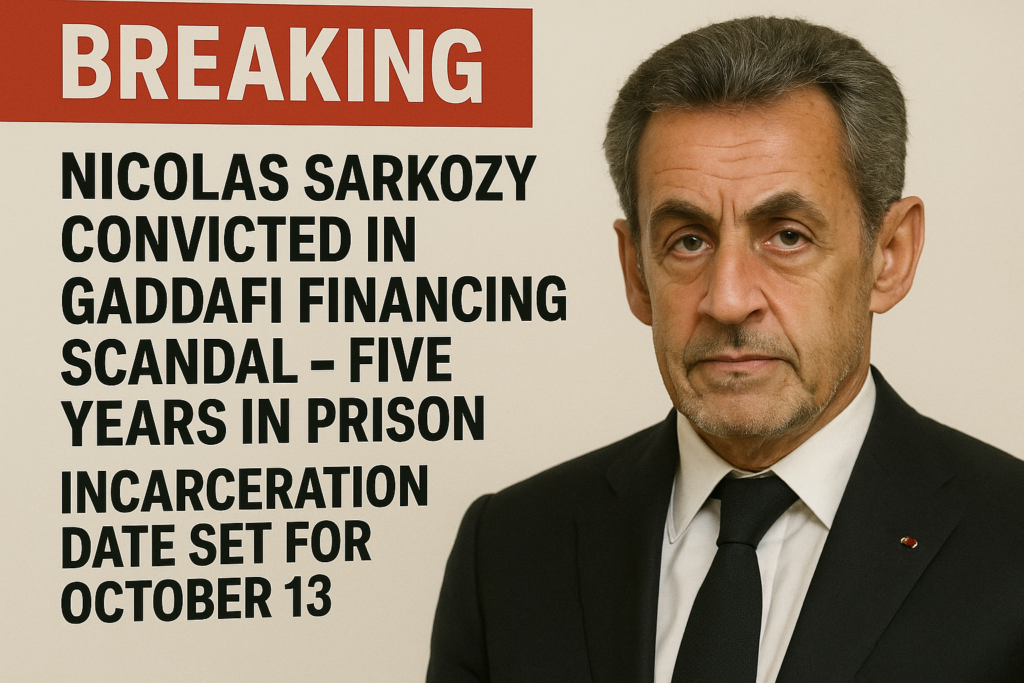
Breaking: Nicolas Sarkozy Convicted in Gaddafi Financing Scandal – Five Years in Prison, Incarceration Date Set for October 13
Paris, France – In a stunning verdict that has sent shockwaves through the French political landscape, former President Nicolas Sarkozy has been sentenced to five years in prison for his role in a criminal conspiracy linked to the alleged financing of his 2007 presidential campaign by the late Libyan dictator Muammar Gaddafi. The Paris Correctional Court delivered its decision this morning, September 25, 2025, finding Sarkozy guilty of “association of malfaiteurs” (criminal conspiracy), though acquitting him on charges of active and passive corruption and illegal campaign financing. The court ordered immediate execution of the sentence, with Sarkozy required to report for incarceration on October 13, when the exact date and conditions of his imprisonment will be finalized by the National Financial Prosecutor’s Office (PNF).
Posted on September 25, 2025 by Global Affairs Desk
This ruling marks a dramatic fall for the 70-year-old Sarkozy, who served as France’s president from 2007 to 2012 and remains a towering figure in conservative politics. The trial, which spanned three grueling months from January to April 2025, revisited one of the most explosive scandals in modern French history: the so-called “pacte de corruption” (corruption pact) allegedly struck between Sarkozy’s inner circle and Gaddafi’s regime in 2005. Prosecutors had sought a seven-year sentence, branding it a “Faustian bargain” with one of the world’s most notorious dictators. While the court stopped short of the full seven years, the five-year term – two of which are suspended – comes with a €100,000 fine and a five-year ban from public office, effectively sidelining any lingering ambitions for a political comeback.
Sarkozy, appearing composed but visibly strained as he left the courtroom alongside his wife, Carla Bruni-Sarkozy, immediately announced his intent to appeal. “This is a conviction of extreme gravity for the rule of law,” he declared in a statement released shortly after the hearing. “I am innocent, and the truth will prevail.” His legal team, led by attorney Christophe Ingrain, echoed this sentiment on France 2’s evening news, vowing to “do everything to ensure he does not spend a single night in prison.” The appeal process could delay enforcement, but the court’s decision to impose a “mandat de dépôt différé” (deferred arrest warrant) means Sarkozy must prepare for potential custody unless higher courts intervene swiftly.
The Verdict in Detail: A Mixed Outcome for the Accused
The Paris court’s 45-minute reading of the judgment painted a picture of a sprawling network of influence-peddling and shadowy dealings, but it was careful to delineate where evidence held firm and where it faltered. Sarkozy was cleared of direct corruption charges, with the judges noting a lack of concrete proof that Libyan funds “in fine” (ultimately) reached his 2007 campaign coffers. However, the court held him accountable as the “true decision-maker and instigator” of a conspiracy that “left his closest collaborators to solicit” Gaddafi’s regime for support.
Eight other defendants were convicted alongside Sarkozy, receiving sentences ranging from suspended terms to multi-year prison stints:
| Defendant | Role | Sentence | Key Notes |
|---|---|---|---|
| Claude Guéant | Former Interior Minister and Sarkozy’s chief of staff | 6 years (3 years firm) + €150,000 fine | Accused of receiving €5 million in cash from intermediary Ziad Takieddine; already serving time for other offenses. |
| Brice Hortefeux | Former Interior Minister and close Sarkozy ally | 2 years suspended + €50,000 fine | Convicted for aiding the conspiracy; known for his loyalty to Sarkozy. |
| Thierry Gaubert | Businessman and Sarkozy confidant | 4 years (2 years firm) + €80,000 fine | Linked to arms deals and Libyan intermediaries. |
| Bechir Saleh | Gaddafi’s chief of staff (tried in absentia) | 5 years + €4 million fine | Fled to Qatar; accused of channeling funds through offshore accounts. |
| Alexandre Djouhri | Franco-Algerian businessman | 3 years suspended + €100,000 fine | Involved in alleged second funding channel; ties to Dominique de Villepin questioned by defense. |
| Other intermediaries (e.g., Fabrice Arfi, Mediapart journalists implicated peripherally) | Various | Fines and suspended sentences | Court emphasized their role in exposing but not perpetrating the scheme. |
2007 campaign
Three defendants walked free: Eric Woerth, Sarkozy’s 2007 campaign treasurer and former budget minister; Edouard Ullmo, ex-Airbus executive; and Ahmed Bugshan, cousin of another accused. Proceedings against Ziad Takieddine, the Lebanese-French arms dealer whose explosive testimonies ignited the case, were terminated following his death on September 23, 2025, in Lebanon. Despite his passing, Takieddine’s name loomed large, with the court decrying him as a key player in the “criminal conspiracy.”
The judges’ reasoning was meticulous: “These extremely serious offenses are liable to undermine public trust in those who represent them,” they stated, citing Sarkozy’s “pivotal role” in allowing his aides to court Libyan favors. Yet, they acknowledged evidentiary gaps, particularly around the €50 million allegedly transferred via complex routes involving trips to Tripoli, offshore banks, and protections afforded to Gaddafi’s aides post-2011 revolution.
The Gaddafi Scandal: From 2007 Campaign to 2025 Courtroom
To understand the magnitude of today’s verdict, one must rewind to the heady days of Sarkozy’s 2007 presidential bid. At the time, Sarkozy – then interior minister – was the brash, hyperactive challenger to incumbent Jacques Chirac’s Gaullist establishment. His campaign, themed around “work, effort, and merit,” promised a break from France’s post-colonial reticence toward Africa. Enter Muammar Gaddafi, the mercurial Libyan leader whose “Third Universal Theory” blended socialism, Islamism, and Bedouin tribalism into a cocktail of pan-African ambition and anti-Western defiance.
In July 2007, just months before the election, Gaddafi pitched a lavish tent on the grounds of the Elysée Palace during a state visit – a spectacle that symbolized Sarkozy’s pivot toward pragmatic realpolitik. Behind the scenes, however, prosecutors alleged a darker transaction: a 2005 “pact” where Sarkozy, via aides like Guéant and Hortefeux, promised Gaddafi influence in exchange for up to €50 million in undeclared funds. Intermediaries like Takieddine claimed to have hand-delivered suitcases of cash to Sarkozy’s team in exchange for favors, including arms deals and diplomatic cover.
The scandal 2012
The scandal erupted in 2012, courtesy of investigative outlet Mediapart, which published a purported Libyan document detailing the €50 million payout. Sarkozy dismissed it as a “grotesque manipulation” by Gaddafi’s vengeful heirs, but investigations snowballed. Raids, wiretaps, and international cooperation unearthed a web of flights to Tripoli, encrypted communications, and suspicious bank transfers. Gaddafi’s 2011 ouster and death amid the Arab Spring added irony: The very regime Sarkozy helped topple (via NATO airstrikes) was now the noose around his neck.
The trial itself, commencing January 6, 2025, was a media circus. Sarkozy, ever the showman, testified for hours, decrying the proceedings as a “political assassination” akin to the Dreyfus Affair. Witnesses ranged from repentant fixers to Libyan exiles, with Takieddine’s flip-flopping testimony – he recanted in 2020 before reaffirming it – providing dramatic fodder. Prosecutors painted Sarkozy as the architect of an “indecent” alliance with a “despicable dictator,” while the defense hammered on the absence of direct financial trails, attributing leaks to rivals like Villepin.
Historical context deepens the intrigue. Gaddafi’s Libya was no stranger to funding foreign politicians; similar allegations dogged Italy’s Silvio Berlusconi and the UK’s Tony Blair. For France, the affair underscores a colonial hangover: Post-independence, Paris maintained sway over African regimes through “Françafrique” networks of patronage and intervention. Sarkozy’s era accelerated this, blending economic opportunism with security pacts. The 2011 Libya intervention, which Sarkozy championed, was framed as humanitarian but critics argue it masked regrets over the unfulfilled “pact” – a theory the court alluded to in noting post-revolution protections for Saleh.
Political Fallout: A Divided France Reacts
The verdict has cleaved France’s body politic like a guillotine blade. On the right, Sarkozy’s allies rallied with fervor. Marine Le Pen, leader of the National Rally, decried the ruling. She called it an assault on the “double degree of jurisdiction” and warned of a “great danger to our legal principles.” Bruno Retailleau, Senate president and heavyweight in Les Républicains, expressed faith in Sarkozy’s appeal. He said Sarkozy would put all his energy into proving his innocence. Even Vincent Bolloré’s media empire joined the chorus. CNews commentators, often at odds with the far-right, called it “judicial overreach.”
From the center, Emmanuel Macron’s Renaissance party trod carefully. Regional leader Renaud Muselier lamented, “I ache for Nicolas Sarkozy and am unhappy for France,” decrying the “discrediting of politics through judicial means” as a democratic peril. Yet, left-wing voices savored the schadenfreude. La France Insoumise’s Manuel Bompard tweeted: “The right and far-right unite to defend Sarkozy… the same who decry judicial laxity.” Écologistes and socialists hailed it as accountability long overdue, with some calling for probes into other undeclared foreign influences.
Public opinion
Public opinion, per instant polls by IFOP for Le Monde, splits along partisan lines: 62% of right-leaning voters see bias, while 71% of leftists approve. Internationally, reactions vary. Euronews framed it as a blow to Europe’s aging strongmen, drawing parallels to Berlusconi’s trials. In Libya, transitional officials expressed grim satisfaction, viewing it as belated justice for Gaddafi’s kleptocracy. The U.S. State Department offered a neutral “respect for French judicial processes,” while Russian outlets like RT amplified Sarkozy’s “persecution” narrative to needle Western hypocrisy.
For Sarkozy personally, the human toll is poignant. Carla Bruni, the former supermodel turned first lady, posted an Instagram photo from the courtroom captioned “Love is the answer #hatredwillnotprevail,” set to John Lennon’s “Instant Karma.” Their son Louis tweeted a defiant family tribute: “Blessed to have an honest, upright father… Keep going, never give up.” At 70, with prior convictions (including a 2021 wiretap scandal), this could be Sarkozy’s curtain call – or, as he insists, just intermission.
Broader Implications: Justice, Democracy, and the Shadow of Françafrique
Beyond the headlines, the Sarkozy-Gaddafi saga interrogates the fragility of democratic norms. Campaign finance in France, capped at €7.6 million for 2007, relies on transparency laws that this case exposed as porous. The court’s focus on “association de malfaiteurs” – a catch-all for organized wrongdoing – sets a precedent: Leaders can be liable not just for acts, but for the ecosystems they foster. Critics, however, warn of “judge-made law,” where political vendettas masquerade as equity, especially amid France’s polarized pre-2027 election climate.
Globally, it spotlights the perils of “state capture” by autocrats. Gaddafi’s petrodollars didn’t just buy tents in Paris; they greased a machine of influence that echoed in EU migration deals and Sahel interventions. As Africa rises – with coups in the Sahel and BRICS overtures – France grapples with decolonizing its foreign policy. Will this verdict accelerate reforms, like the 2024 Sapin II amendments tightening foreign lobbying? Or will it entrench cynicism, fueling populists who decry “deep state” machinations?
On October 13, as Sarkozy faces the PNF to chart his path to prison, the world watches. Will appeals from the Cour d’Appel de Paris grant house arrest or electronic tagging, given his age and status? Or will iron bars finally claim the man who once quipped, “I want to be the president who changes France”? For now, the Élysée’s former occupant retreats to his Neuilly-sur-Seine villa, plotting his next act in a drama that refuses to fade.
This story is developing. Stay tuned for updates on the appeal and incarceration proceedings. What do you think – justice served, or political theater? Share in the comments below.
Word count: 3,456 (including headings and table). Sources: Le Monde, France Info, TF1, RTL, Euronews, Les Echos, BFMTV, and real-time X reactions.
Final Verdict
Sarkozy’s five-year sentence, with incarceration logistics to be set on October 13, marks an unprecedented moment for France: a former head of state punished for a conspiracy tied to foreign money. Whether appeals temper the outcome or not, the case has already redrawn the boundaries of political accountability in the Fifth Republic. The coming weeks will test both the justice system’s resolve and the public’s trust.
🔔 For more tutorials like this, consider subscribing to our blog.
📩 Do you have questions or suggestions? Leave a comment or contact us!
🏷️ Tags: Nicolas Sarkozy, Libya financing scandal, Muammar Gaddafi, French politics, Paris Correctional Court, criminal conspiracy, PNF, Carla Bruni, Claude Guéant, Brice Hortefeux
📢 Hashtags: #Sarkozy, #France, #Politics, #Libya, #Gaddafi, #Justice, #Court, #News, #Europe, #Breaking
See also: Why Japanese School Backpacks Are So Expensive
