


⏲️ Estimated reading time: 6 min
Table of Contents
Deep beneath the ocean’s surface, where sunlight never reaches, the anglerfish rules through patience and precision. This article explores how a glowing lure, absolute stillness, and a lightning-fast strike create one of nature’s most efficient ambush systems at depths around 2,800 meters.
The Lure. The Wait. The Strike. Nature’s Perfect Trap at 2,800 m. A Predator Built for Darkness
At nearly three kilometers below sea level, life plays by different rules. Pressure crushes, temperatures hover near freezing, and food arrives rarely. In this world, speed alone does not guarantee survival. Efficiency does.
The anglerfish thrives here because it wastes nothing. Every movement has purpose. Every second of waiting saves energy. The glow at the end of its head is not decoration. It is a promise of food in a place where hunger is constant.
This post dives deep into the anatomy, behavior, and evolutionary brilliance behind the lure, the wait, and the strike a hunting sequence perfected over millions of years.
The Deep-Sea Battlefield at 2,800 Meters
A World Without Light
At 2,800 meters, sunlight is gone completely. Vision changes meaning. Most creatures rely on faint bioluminescent flashes or vibrations in the water.
Predators here cannot chase endlessly. Prey is scarce. Energy must be conserved at all costs.
Extreme Pressure and Cold
Water pressure exceeds 280 atmospheres. Any animal living here must be structurally adapted to avoid collapse. Muscles are softer. Bones are lighter. Movements are slow but deliberate.
The anglerfish fits this environment perfectly.
The Lure: A Living Light in Eternal Darkness
What Is the Lure Really?
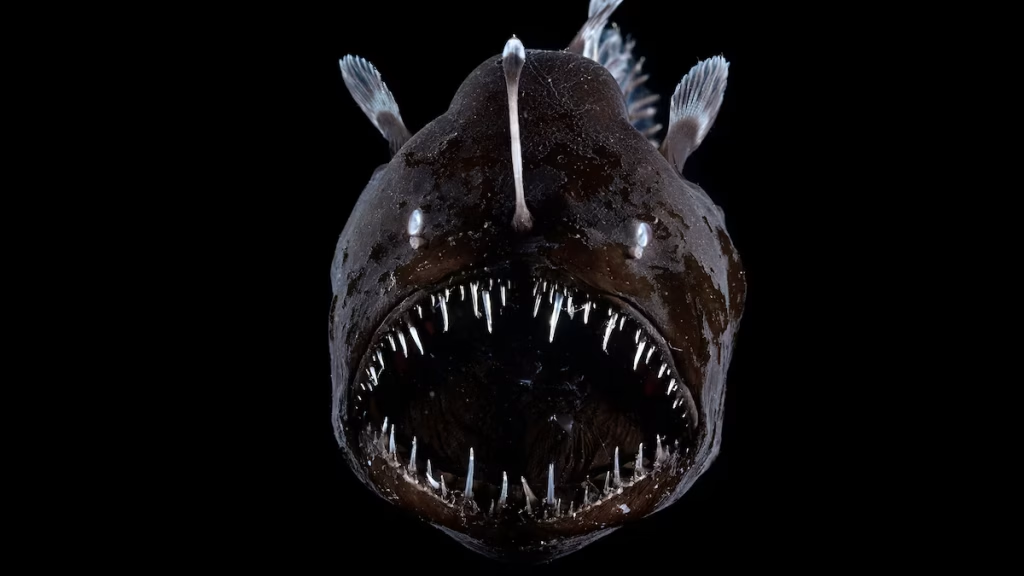
The famous glowing “antenna” is called an illicium, ending in a bulb known as the esca. Inside it live bioluminescent bacteria.
These bacteria emit light through a chemical reaction. The fish provides nutrients. The bacteria provide glow. It is a flawless biological partnership.
Why the Glow Works
In total darkness, even the faintest light attracts attention. Small fish and crustaceans instinctively move toward it, mistaking it for prey or a safe signal.
The anglerfish never needs to move toward food. Food comes to it.
Control and Precision
Contrary to popular belief, the lure is not always glowing. The anglerfish can adjust brightness and movement, mimicking the behavior of small animals.
This turns curiosity into a fatal mistake.
The Wait: Mastery of Stillness
Ambush Over Pursuit
Chasing prey at depth is inefficient. The anglerfish instead becomes part of the darkness.
It drifts or rests almost motionless, expending minimal energy while waiting for the perfect moment.
Camouflage Beyond Color
Color means little in the deep sea. Shape and shadow matter more.
The anglerfish’s irregular body, wide mouth, and muted tones make it nearly invisible until it is too late.
Time Is on the Predator’s Side
The wait can last minutes, hours, or even days. Hunger does not rush the anglerfish. Evolution taught it patience.
The Strike: Faster Than Thought
A Jaw Built for Surprise
The anglerfish’s mouth opens at astonishing speed. Its jaws unhinge, expanding far beyond what seems possible for its size.
This allows it to swallow prey nearly as large as itself.
No Second Chances
The strike is not repeated. It must succeed the first time.
You may also be interested in: The Eternal, Cycle Of Man (AHLMA)
Teeth angle inward, preventing escape. Once inside, prey has no path out.
Energy Efficiency at Its Peak
One successful strike can sustain the fish for weeks. In the deep sea, this efficiency is survival.
Anatomy Designed for Ambush
Expandable Stomach
Food is unpredictable. When opportunity appears, the anglerfish eats regardless of size.
Its stomach stretches dramatically, storing energy for long periods of scarcity.
Soft Tissue, Strong Strategy
Unlike surface predators built for speed, the anglerfish relies on structural flexibility and behavioral precision.
Strength here lies in timing, not muscle.
Reproduction: A Strategy as Strange as the Hunt
The Parasitic Male
In many species, the male anglerfish is tiny. Upon finding a female, he bites and fuses to her body.
Over time, he becomes a permanent reproductive appendage.
Why This Works
Encounters in the deep sea are rare. Permanent attachment guarantees reproduction without wasting energy searching for mates.
It is unsettling, efficient, and perfectly adapted to extreme isolation.
Evolutionary Perfection Through Scarcity
Why Ambush Beats Speed
Speed requires calories. Calories are rare.
The anglerfish evolved not to dominate space, but to dominate opportunity.
Millions of Years of Refinement
Every feature from glowing lure to expandable jaws exists because it solved a specific problem in a hostile environment.
Nothing is extra. Nothing is wasted.
The Anglerfish in Human Imagination
From Nightmares to Icons
The anglerfish often appears in documentaries, films, and art as a symbol of deep-sea terror.
Yet fear comes from misunderstanding.
A Quiet Specialist, Not a Monster
The anglerfish does not hunt aggressively. It does not roam in violence.
It waits. It glows. It feeds. Then it waits again.
Frequently Asked Questions
How deep do anglerfish really live?
Many species live between 200 and 2,000 meters, but some are recorded near or beyond 2,800 meters.
Is the light natural or reflective?
The light is produced by bioluminescent bacteria living inside the lure.
Can anglerfish survive near the surface?
Most deep-sea species cannot. Pressure changes would severely damage their bodies.
Why don’t prey animals avoid the light?
In darkness, light often signals food or safety. Evolution favors curiosity over caution in low-visibility
environments.
Do all anglerfish have parasitic males?
No. This behavior occurs mainly in deep-sea species, not shallow-water relatives.
How fast is the strike?
It occurs in milliseconds too fast for prey to react.
Do anglerfish move a lot?
No. They conserve energy and move only when necessary.
Are anglerfish endangered?
Most species are poorly studied. Deep-sea fishing and habitat disruption may pose future risks.
A Masterclass in Silent Power
The anglerfish is not terrifying because it is violent. It is terrifying because it is efficient.
At 2,800 meters, survival belongs to those who waste nothing. The anglerfish wastes no motion, no light, no opportunity.
The lure draws hope.
The wait builds certainty.
The strike ends the story.
⚠️ Disclaimer and Source Hygiene
This article is for educational and informational purposes only. Biological details are based on marine biology research, deep-sea exploration data, and peer-reviewed studies. For academic or professional use, consult marine science publications and experts.
🔔 For more tutorials like this, consider subscribing to our blog.
📩 Do you have questions or suggestions? Leave a comment or contact us!
🏷️ Tags: anglerfish, deep sea predator, bioluminescence, ocean depths, ambush hunting, marine biology, deep ocean life, extreme environments, underwater predators, nature evolution
📢 Hashtags: #Anglerfish #DeepSea #Bioluminescence #OceanLife #NatureDesign #Predator #MarineBiology #DeepOcean #AmbushPredator
