


⏲️ Estimated reading time: 19 min
Table of Contents
Naomi Seibt: Asylum Application in the U.S. Explained. German activist Naomi Seibt has filed for political asylum in the United States, citing alleged persecution in Germany due to her views. This post explores her background, claims of threats and surveillance, asylum process in the U.S., and broader implications for free speech and politics.
Naomi Seibt
The recent news that German activist Naomi Seibt has applied for asylum in the United States has stirred significant media attention. She claims she faces persecution in Germany because of her political views and public activism. At the same time, she is a controversial figure known for her opposition to mainstream climate science, her far-right associations, and her social media presence. In this article we will provide a comprehensive overview: who Naomi Seibt is, what her claims are regarding persecution, the legal and practical aspects of her asylum application in the U.S., the reactions and controversies surrounding her case, and the broader significance for politics, free speech, migration and international relations.
Who is Naomi Seibt?
Early life and rise to public attention
Naomi Seibt was born on 18 August 2000 in Münster, Germany. (Wikipedia) From a young age she produced videos for YouTube and engaged in online activism. She dropped out of university after one semester in economics and focused on social media and public speaking. (Wikipedia)
The “Anti-Greta” label
Seibt gained international attention when she was labelled the “anti-Greta” in reference to Greta Thunberg, the prominent Swedish climate activist. In contrast to Thunberg’s message of urgency around climate change, Seibt positioned herself as a “climate realist” sceptical of dominant climate science narratives. (Wikipedia) Her activity includes speaking at conservative conferences, posting videos, and aligning with think tanks. For instance, she worked for a period with the U.S.-based Heartland Institute, a climate-change-sceptic policy group. (Wikipedia)
Political views and affiliations
Seibt describes herself as libertarian and anarcho-capitalist. (Wikipedia) She has publicly voted for the German party Alternative for Germany (AfD) though she denies formal membership. (Wikipedia) Her activism crosses into far-right politics, including criticism of immigration, climate activism, and the so-called “woke” culture. Analysts have described her as aligned with the new right and having ties with identitarian movements. (Greenpeace)
Social media and influence
Seibt built a large following on platforms like X (formerly Twitter), YouTube and Instagram. By early 2025, her online presence had expanded significantly; for example, she engaged in public exchanges with Elon Musk, who responded to her posts and asked her about German politics. (The Business Standard) Her influence is part of a broader trend of young right-wing influencers leveraging digital platforms.
The asylum application: claims and context
What has she claimed?
According to media reports, Seibt filed an application for political asylum in the United States in October 2025. (The Sun) She alleges that she faces serious threats in Germany: death threats from groups like Antifa, surveillance by German domestic intelligence agencies, and lack of protection from the German police. (New York Post) She claims these threats stem from her political views and activism especially her outspoken stance on immigration, climate, and free speech.
For example, in one quote she said: “I have received many death threats from Antifa … When I showed it to the police, they said they couldn’t do anything because I wasn’t raped or killed.” (The Sun) She also stated that German authorities ignored her complaints and she fears that upon return she could face arrest or harm.
Why the U.S.?
Seibt indicated that she sought asylum in the U.S. because she felt the German authorities had failed to protect her. She expressed admiration for American patriotism and free speech culture, stating that she did not find that same sentiment in Germany. (The Sun) Her filing comes at a time of rising trans-Atlantic conservative cooperation and perceptions of political targeting for right-wing activists in Europe.
Legal framework: U.S. asylum basics
To understand her claim, let’s briefly review how asylum works in the U.S. under the Immigration and Nationality Act (INA). Under U.S. law, a non-citizen may apply for asylum if they are physically present in the U.S. (or arriving) and they fear persecution in their home country on account of race, religion, nationality, membership in a particular social group, or political opinion. They must demonstrate a “well-founded fear” of persecution and that their government is unwilling or unable to provide protection.
Seibt’s claim appears to assert persecution on the basis of political opinion (her activism) and perhaps social group (her conservative activist identity). If accepted, the asylum process could lead to her obtaining lawful permanent resident status after one year. However, asylum claims are judged case by case, and credibility, documentation, and country-conditions play critical roles.
Key hurdles and considerations
There are several obstacles she will face:
- Burden of proof: She must present credible evidence of threats and lack of protection. Vague statements or uncorroborated claims may weaken her case.
- Internal protection alternative: The U.S. courts often ask whether the applicant could safely relocate to another part of Germany rather than leaving the country entirely.
- Exclusion grounds: Applicants may be excluded if they have committed serious crimes, are a threat to public order, or engaged in persecution themselves. Given Seibt’s public political activism and ties to controversial movements, this might come up in her case.
- Political climate and policy discretion: Asylum decisions also depend on U.S. policy priorities, resource constraints, and the geopolitical context. The fact that the asylum seeker is politically motivated (and high profile) may draw more scrutiny.
- Public and media attention: High-profile cases can be double-edged: they can bring support but also sensationalism and backlash, which can affect how authorities view credibility and motive.
Implications of her claim
Seibt’s asylum request has multiple implications:
- It raises questions about the treatment of political dissidents or activists in Germany whether her claims are indicative of broader issues of free speech, monitoring of politically active citizens, or data surveillance.
- It highlights the shifting migration-politics landscape, where individuals not escaping war or persecution in the traditional sense seek refuge based on ideological or political persecution.
- It may set or test precedents for other European activists seeking asylum in the U.S. on political opinion grounds especially on the right-wing spectrum.
- It reflects the transnational dimension of political activism and how U.S. immigration law interacts with European political dynamics.
Reactions and controversies
Supporters and sympathisers
Some conservative circles in Germany and abroad view Seibt as a defender of free speech and dissenting views. Her supporters argue that she is being punished for speaking against the dominant “woke” narratives, climate panic, and open-border immigration policies. The fact that Elon Musk has publicly interacted with her content (on X) has been pointed to as evidence of her influence and network. (The Business Standard)
Critics and skeptics
Many critics question her motives, background and associations:
- Analysts note her ties to far-right movements, identitarian groups, and the AfD. For example, the German Wikipedia entry reports that she was classified as right-extremist by German commentators. (Wikipedia)
- The NGO Greenpeace USA has documented her appearance at events with neo-Nazi participants and her promotion of white-nationalist viewpoints. (Greenpeace)
- Media outlets have raised questions about the credibility of her persecution claims whether she faces institutional persecution in Germany or is simply using asylum for strategic advantage.
- Some argue her case may be politically symbolic rather than grounded in real persecution, pointing to the fact that Germany is a liberal democracy with many protections for speech and assembly.
Media framing and public perception
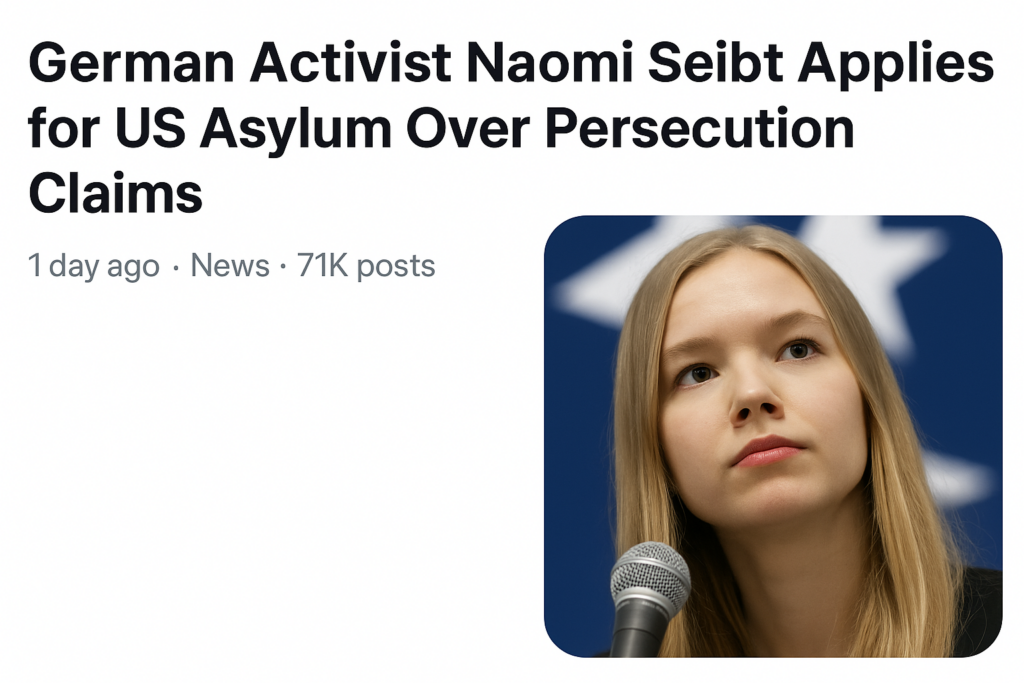
The case has generated headlines such as “German activist Naomi Seibt applies for U.S. asylum over persecution claims” (see screenshot). The tone of coverage varies: some treat it as a serious claim of rights abuse; others view it as a challenge to asylum norms and a potential abuse of the system.
Coverage from tabloid outlets (e.g., The Sun) emphasises dramatic language (“death threats”, “fled Germany”) which may amplify sensationalism rather than detailed legal analysis. (The Sun) Mainstream outlets (e.g., Reuters) focus more on her political background and the broader context of her influence.
The German context: politics, surveillance and activism
Germany’s political climate
The German political scene has undergone significant turbulence with rising support for the AfD, debates over immigration, climate policy, and national identity. Analysts have flagged how far-right narratives, climate denial and disinformation are increasingly part of the public discourse. For instance, a CAAD analysis noted that “climate misinformation … was slotted in alongside AI influencers, deep-fakes, public-health disinformation, claims of electoral fraud and attacks on migrants and asylum seekers.” (Climate Action Against Disinformation)
Free speech vs. extremist monitoring
Germany maintains laws that ban extremist symbols, restrict some forms of hate speech, and authorise surveillance of organisations deemed extremist. Critics argue this can sometimes chill legitimate political dissent, while supporters say it prevents radicalisation. Seibt claims she was targeted by intelligence agencies and ignored by police. Whether those claims hold up is part of the asylum assessment.
Cultural and ideological dimensions
Seibt’s narrative emphasises “free speech under threat”, “German guilt” over WWII, and resistance to what she calls “eco-socialist national suicide”. Her supporters view her as championing a view suppressed by mainstream media and institutions. (Wikipedia) Meanwhile, critics highlight her links to identitarian ideology and question whether her vision of “free speech” implicitly excludes minorities or dissenters.
U.S. asylum system: How this case fits
Eligibility and process
Asylum seekers in the U.S. apply under section 208 of the INA. They must establish:
- they are present in the U.S. or at the border,
- they have a well-founded fear of persecution in their country of origin,
- due to one of the protected grounds (race, religion, nationality, membership of a particular social group, or political opinion), and
- they cannot or will not accept the protection of their home country.
In Seibt’s case, the claimed “political opinion” ground is central. If her activism is the root of the alleged persecution, she may qualify. But the burden of proof is high.
How credibility is assessed
U.S. asylum officers and immigration judges evaluate evidence of threats, patterns of persecution in home country, independent reports, and consistency of the applicant’s story. If internal relocation within the home country is feasible and safe, then asylum may be denied. If the applicant has engaged in serious criminal conduct, they may be barred.
The political-ideological asylum claim
Seibt’s case is somewhat atypical in that she is not fleeing war, ethnic violence or traditional political persecution. Rather, she claims suppression due to her ideological views and activism. Such cases can face more scrutiny because they sit at the intersection of free speech, political activism and immigration policy. The decision may hinge on questions like: is Germany truly unwilling or unable to protect her? Are her claims of death-threats documented? Are her views so extreme that they themselves trigger exclusion grounds?
Precedent and policy implications
This type of asylum claim could influence how future ideological-activist asylum requests are treated. If granted, it may open pathways for similar claims by European activists. If denied, it may reinforce that European democracies are generally considered safe and that asylum must align with traditional templates of persecution.
Possible outcomes and scenarios
If asylum is granted
- Seibt could receive asylum status, work authorization, and after one year apply for permanent residence.
- Her case might become a symbol for right-wing activism transnationally and inspire other similar claims.
- It could spark political controversies in Germany and the U.S., especially around free speech, immigration and trans-Atlantic conservative networks.
If asylum is denied
- She may face deportation back to Germany or be required to leave the U.S.
- The denial might discourage similar claims, or prompt appeals to immigration courts.
- It may shift her activism to a different domain e.g., online media, influence campaigns, or U.S.-based political speaking engagements.
Intermediate outcomes
- She may receive some protection but not full asylum (e.g., withholding of removal) which offers a more limited status.
- She may negotiate a settlement or adjust her status via other immigration pathways (e.g., student visa, work visa) if asylum fails.
- The case may drag through legal appeals, generating media and public attention for months or years.
Broader implications
For free speech and activism
Seibt’s case raises important questions about when activism becomes persecution. If one side claims “free speech under threat” in a democratic state, while the other side points to extremist ideology, how should asylum frameworks respond? Also, how do we balance legitimate political activism with concerns about extremism, misinformation, or hate speech?
For asylum policy and migration
Her case may challenge the boundary of asylum eligibility. Historically asylum claims are about severe persecution not merely ideological disagreement or political controversy in a democratic country. If European activists start using U.S. asylum as a refuge for ideological activism, this may impact asylum policy debates and raise concerns of system abuse.
For trans-Atlantic politics
The case underscores how U.S. immigration policy intersects with European domestic politics. Influencers like Seibt operate across borders, social media platforms link activists and billionaires (e.g., Elon Musk) transnationally, and U.S. policy may implicitly affect European political movements.
For Germany’s image
If her claims of persecution are found credible, this could damage Germany’s image as a country protecting free speech and democratic dissent. Whether or not the claims hold up, the fact that they are being made publicly matters for public discourse in Germany about surveillance, policing, intelligence agencies and the treatment of dissenting voices.
For media and disinformation
Seibt’s background in climate-denial activism, far-right networks, and social media influence means the case also touches on issues of disinformation, digital politics and how extremist actors use media. Studies have shown how climate denial and far-right activism overlap with anti-immigration narratives and influencer networks. (Climate Action Against Disinformation)
Critical analysis: Strengths and weaknesses of her claim
Strengths
- Seibt has a high public profile and can generate media attention, which may increase transparency in proceedings.
- She claims concrete threats (death threats, surveillance) and a stated lack of police protection, which are relevant factors in asylum claims.
- She has voluntarily exposed her case publicly, which may deter hidden retaliation and support her “well-founded fear” argument.
Weaknesses
- Germany is widely regarded as a safe democratic country with functioning institutions; showing that the state is unwilling or unable to protect her may be difficult.
- Her activism is highly politicised and controversial; this may lead adjudicators to examine whether her claims are driven by strategy rather than genuine persecution.
- Her affiliations with far-right movements may work against her exclusion grounds or credibility concerns may arise.
- The internal relocation alternative (could she move to another region of Germany?) may be considered by authorities as reducing risk, which could weaken her claim.
- The media portrayal of her case via sensationalist outlets may reduce the legal seriousness of the claim and lead decision-makers to value documentary evidence more strongly.
The case in the context of global asylum trends
Shifting nature of asylum seekers
Traditionally, asylum seekers have fled war, genocide, political imprisonment or persecution based on race, religion, or sexual orientation. In recent years, however, we have seen a broadening of claims: climate refugees, ideological‐activist refugees, digital activists facing surveillance, etc. Seibt’s case fits into this newer category of “political/ideological asylum” rather than purely demographic persecution.
Europe to U.S. asylum dynamics
It is relatively rare for citizens of Western European countries (e.g., Germany) to apply for asylum in the U.S. based on political opinion. Most asylum claims in the U.S. come from countries with weaker democratic institutions or high‐risk persecution environments. A successful Seibt claim could shift perceptions of asylum flows and highlight ideological migration.
Intersection with digital activism
Because Seibt is a social-media influencer, her case also touches on digital rights, online speech, surveillance, and how states monitor or restrict digital activists. The asylum review may need to consider whether online threats constitute persecution and whether state oversight of social media activism counts as a threat or simply as normal regulation in a democratic society.
Ethical and normative questions
Free speech vs. extremist speech
Where is the line between legitimate dissent and extremist ideology? Seibt framed her activism as protecting free speech from a “woke” culture. Critics argue she supports or amplifies ideologies that scapegoat minorities. The asylum system must navigate this tension: should someone be protected because their speech is unpopular or offensive? How do we treat speech that others consider harmful?
Persecution vs. political consequence
Is being harassed online or criticised enough to count as “persecution”? Threats from non-state actors (e.g., Antifa, extremist groups) can be serious but the law generally requires that the government is unable or unwilling to protect the applicant. If the threats come primarily from private actors, and the state takes reasonable steps, asylum may be harder to claim.
The role of self-inflicted risk
Activists sometimes choose risky paths; does that reduce their entitlement to asylum? For instance, if Seibt chose to engage in highly controversial activism knowing the risks, does that change how we view her claim? Immigration authorities sometimes scrutinise whether the applicant knowingly accepted the risk or could relocate internally.
Symbolic activism and migration
If asylum becomes a tool for activists to relocate to a more favourable country rather than a last-resort refuge, this may strain asylum systems. Should asylum be available for people who seek a new platform for activism rather than escape imminent physical danger? That question is central in this case.
What happens next: timeline & likely developments
- Initial intake and interview: Seibt’s asylum application will enter the U.S. immigration system. She will have an interview with an asylum officer (or immigration judge if she is in removal proceedings).
- Evidence gathering: She will need to document threats, police/authority responses in Germany, surveillance claims, etc. German government reports, media coverage and expert declarations may help.
- Decision: The asylum officer (or judge) will decide whether she meets the legal standard of “well-founded fear” and inability of her home state to protect her.
- Appeals: If denied, she may appeal to the Board of Immigration Appeals (BIA) and potentially federal courts.
- Implications: During the process, her case may continue in media and public discourse, potentially influencing public opinion, activism networks and transnational political debate.
- Outcome: Either grant of asylum, denial (with potential deportation), or settlement via other status (e.g., withholding). Each outcome has distinct consequences for her rights, status, and activism platform.
Lessons and observations
- The case underscores how digital activism, influencer culture and migration are increasingly intertwined.
- It demonstrates the complexity of asylum law when applied to politically-active individuals from democratic states.
- It highlights the importance of credible evidence and home-country conditions in asylum adjudication.
- It prompts reflection on how democracies protect dissenting voices, how surveillance and threats are handled, and how these translate into claims for international protection.
- It also shows how global politics, social media networks (including high-profile figures like Elon Musk), and ideological movements cross national borders and affect immigration issues.
FAQs
Q1: What is political asylum and how does it differ from refugee status?
A1: In the U.S., asylum allows individuals physically present in or arriving in the U.S. to apply for protection from persecution in their home country. Refugee status is granted to those outside the U.S., usually abroad, by the U.S. government or the UN for resettlement. Both provide protection, but the channels and criteria differ.
Q2: Can someone from Germany realistically succeed in a U.S. asylum claim?
A2: Success is possible but more challenging. Because Germany is considered a secure, democratic country with strong institutions, asylum claims from German citizens must show exceptionally specific and credible threats, and show that the state is unwilling or unable to protect them.
Q3: Does activism alone qualify for asylum?
A3: Not automatically. The activism must be linked to persecution (i.e., threats, harm, inability of state protection) and based on a protected ground (e.g., political opinion). General activism or unpopular speech typically does not meet the asylum threshold unless combined with credible risk of persecution.
Q4: What are non-state actor threats (like from Antifa) and how do they factor into asylum?
A4: If threats come from non-state actors, the applicant must show that the home government is unwilling or unable to provide protection. Non-state actor threats alone are insufficient without demonstrating this governmental failure.
Q5: What happens if the asylum claim fails?
A5: The applicant may be placed in removal proceedings and be subject to deportation. They may seek other forms of relief (e.g., withholding of removal, temporary protected status) or pursue other visa pathways. Appeals may prolong the process.
Final thoughts
The case of Naomi Seibt is a complex intersection of free speech, political activism, ideology, migration policy and digital influence. Her application for U.S. asylum raises fundamental questions: should someone from a wealthy democratic country seek refuge for ideological persecution? What counts as persecution in the era of social media activism? How do states protect free speech while guarding against extremist speech? Whether her claim succeeds or not, her case will likely reverberate in public debate about migration, activism, and transnational politics.
🔔 For more tutorials like this, consider subscribing to our blog.
📩 Do you have questions or suggestions? Leave a comment or contact us!
🏷️ Tags: Naomi Seibt, asylum, political activism, free speech, Germany, U.S. immigration, AfD, climate scepticism, far-right influence, digital activism
📢 Hashtags: #NaomiSeibt, #AsylumUSA, #FreeSpeech, #PoliticalActivism, #GermanyPolitics, #AfD, #ClimateScepticism, #DigitalInfluence, #ImmigrationLaw, #FarRight
See also: World Cup Final Battle Between Messi and Yamal: A Football
