


⏲️ Estimated reading time: 12 min
Table of Contents
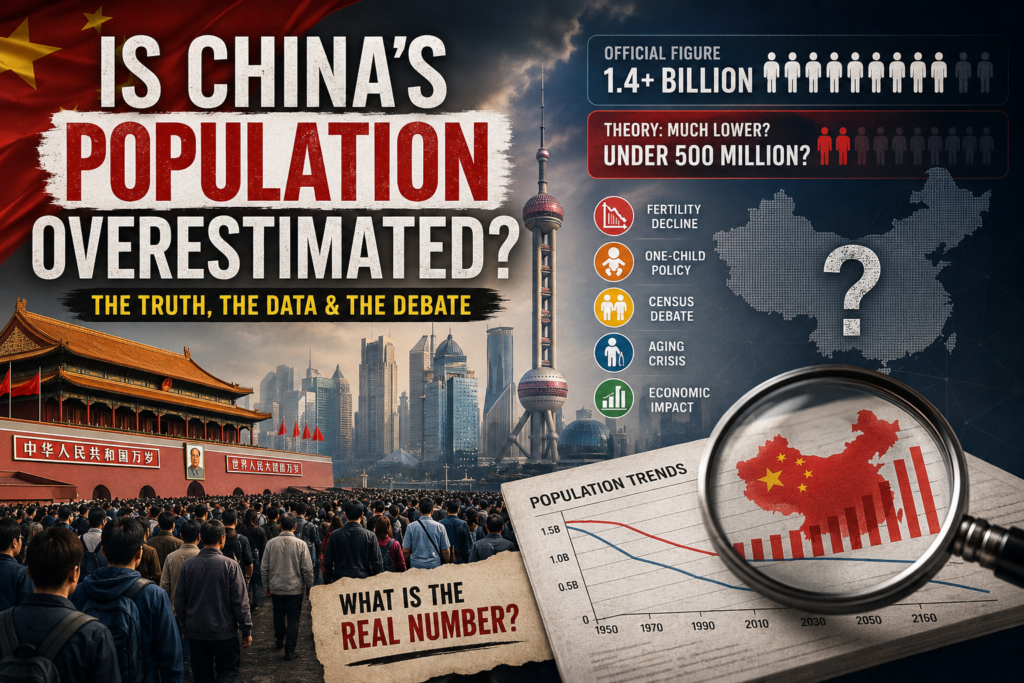
Could China’s real population be far lower than official numbers suggest? This article explores the controversial theory, the mathematics behind demographic growth, China’s one-child policy, fertility trends, census debates, and what experts actually say about the world’s most populous nation.
The Global Debate Around China’s Population
For decades, China has been described as the world’s demographic superpower. Official figures long placed the country above 1.4 billion people before India recently surpassed it in many international estimates.
However, a controversial theory has gained popularity online. Some commentators argue China’s real population could be dramatically lower than official reports suggest. A few even claim the country may be “missing” nearly one billion people.
These claims spread rapidly through podcasts, online discussions, independent analysts, and social media clips. One uploaded transcript includes statements suggesting China’s population may actually be “under 500 million.”
Such arguments immediately attract attention because they challenge one of the most accepted demographic assumptions in modern history. But are these theories supported by evidence?
Or do they misunderstand how population growth actually works? This article explores the mathematics, historical context, demographic science, and expert opinions behind one of the internet’s most fascinating population debates.
Why China’s Population Size Matters
Population numbers influence almost every aspect of national power.
They affect:
- Economic growth
- Military capacity
- Housing demand
- Food production
- Labor markets
- Energy consumption
- Pension systems
- Consumer markets
- Global influence
A country with 1.4 billion citizens functions very differently from one with only 500 million. If China’s official numbers were dramatically inaccurate, the consequences would reshape global economics and geopolitics. That is why this debate matters far beyond internet speculation.
The Origin of the “Missing Billion” Theory
The theory became widely known through podcasts and viral video clips discussing demographic mathematics. One key argument focuses on fertility rates. The uploaded transcript argues that China’s population allegedly grew from around 500 million in 1950 to roughly 1.27 billion by 2000.
According to the speaker, such growth would have required Chinese women to average around five children each.
The speaker then argues this could not have happened because China experienced:
- The Great Chinese Famine
- The Cultural Revolution
- Economic hardship
- Political instability
- The One-Child Policy
As a result, the conclusion presented is that official Chinese population statistics must be heavily inflated.
Understanding the Mathematics of Population Growth
At first glance, the argument sounds convincing.
However, population growth is more complicated than simple multiplication.
Demographic change depends on several variables:
- Birth rates
- Death rates
- Infant survival
- Healthcare access
- Life expectancy
- Age distribution
- Urbanization
- Nutrition improvements
A population can grow rapidly even without every woman continuously having five children. The key factor is often declining mortality.
The Demographic Transition Model
Demographers use a framework called the Demographic Transition Model to explain how populations evolve over time.
Stage One: High Births and High Deaths
Poor agricultural societies usually experience:
- Large families
- High infant mortality
- Widespread disease
- Slow overall population growth
Stage Two: Mortality Falls
As healthcare and sanitation improve:
- More children survive
- Life expectancy rises
- Disease decreases
- Food systems improve
Birth rates often remain high temporarily. This creates rapid population growth.
Stage Three: Fertility Declines
As economies modernize:
- Urbanization increases
- Women gain education
- Career opportunities expand
- Families become smaller
Stage Four: Aging and Low Growth
Developed societies often experience:
- Low birth rates
- Aging populations
- Slower population growth
China followed much of this demographic path during the twentieth century.
Did Chinese Women Really Need Five Children?
- This question sits at the center of the controversy.
- The transcript suggests China’s official growth would require extremely high fertility rates.
- Historical demographic records show that fertility in China actually was very high during the 1950s and 1960s.
- In many rural regions, women often had more than five children on average before strict birth controls were introduced.
- This pattern was not unique to China.
- Many developing countries experienced similar fertility levels during industrialization and modernization.
Why Mortality Decline Changed Everything
One major factor frequently ignored in internet theories is survival. If fewer children die young, population growth accelerates dramatically.
China experienced major improvements in:
- Vaccination
- Basic healthcare
- Clean water access
- Food distribution
- Public sanitation
As infant mortality declined, millions more children survived into adulthood.
This significantly increased total population growth.
The Great Chinese Famine and Population Decline
- The Great Chinese Famine between 1959 and 1961 caused catastrophic human losses.
- The uploaded transcript directly references the famine and notes that millions died during that period.
- Historians estimate tens of millions of deaths occurred.
- Yet demographic growth resumed strongly after the famine ended.
- This rebound effect is common after large disasters and wars.
- Countries often experience temporary fertility surges once conditions stabilize.
The Cultural Revolution and Demographics
- China’s Cultural Revolution created enormous political and social disruption.
- Education collapsed in many areas. Families suffered persecution. Economic development slowed.
- Still, population growth can continue during instability if fertility remains above replacement levels.
- Historical examples across multiple nations show that political chaos does not automatically stop demographic expansion.
Understanding the One-Child Policy
- The One-Child Policy began in 1979.
- Its purpose was to slow population growth and reduce pressure on resources.
- However, several important details are often misunderstood.
The Policy Was Not Completely Universal
- Many rural families received exceptions.
- Some minority ethnic groups followed different rules.
- Certain provinces allowed second children under specific conditions.
Population Momentum Already Existed
By 1979, China already had hundreds of millions of young citizens approaching adulthood.
Even after fertility declined, these large generations continued producing substantial numbers of births.
This phenomenon is called population momentum.
What Is Population Momentum?
- Population momentum occurs when a large young generation enters reproductive age simultaneously.
- Even if each family has fewer children, the total number of births can remain high for decades.
- This helps explain how population growth can continue despite falling fertility rates.
Why Some Analysts Distrust Chinese Population Data
Although most experts reject extreme theories, skepticism toward Chinese statistics is not entirely new. Several factors contribute to this distrust.
Administrative Incentives
Local officials in China have sometimes faced pressure to report favorable numbers.
Critics argue this may affect:
- Economic statistics
- Employment reports
- Industrial output
- Census accuracy
Hukou Registration Complexity
China’s household registration system creates administrative challenges. Migration between rural and urban areas can complicate accurate counting.
Hidden Births During the One-Child Era
Some families reportedly concealed unauthorized births to avoid penalties. Ironically, this may have caused undercounting in certain periods rather than overcounting.
Ghost Cities and Empty Buildings
Videos showing empty apartment complexes and quiet urban developments often fuel conspiracy theories.
Critics ask:
“If China truly has over one billion people, why are there empty cities?”
However, several alternative explanations exist:
- Real estate speculation
- Poor urban planning
- Delayed migration
- Investment-driven construction
- Regional economic imbalances
Empty apartments alone cannot prove fake population numbers.
Mobile Phones, Electricity, and Consumer Data
Some independent researchers analyze indirect indicators such as:
- Mobile phone usage
- Electricity consumption
- Transportation activity
- Consumer spending
They claim these metrics sometimes appear inconsistent with official population estimates.
Still, indirect data has limitations.
For example:
- Many people own multiple phones
- Consumption varies widely by income
- Rural and urban behavior differ significantly
Indirect indicators cannot definitively determine national population size.
What Most Demographers Actually Believe
- Professional demographers generally reject claims that China has only 500 million citizens.
- However, some researchers do believe official numbers may contain moderate inaccuracies.
- The debate usually concerns tens of millions, not an entire missing billion.
Could China’s Population Be Lower Than Official Figures?
Possibly.
Some analysts suggest the population may be somewhat lower due to:
- Registration duplication
- Census delays
- Administrative inconsistencies
- Statistical adjustments
But mainstream demographic experts overwhelmingly reject extreme undercount theories.
Why Massive Fabrication Would Be Difficult
Modern population systems involve enormous amounts of interconnected data.
A fake population of hundreds of millions would likely affect:
- School enrollment
- Food demand
- Transportation systems
- Healthcare infrastructure
- Labor markets
- Housing needs
Maintaining such a large deception across decades would be extraordinarily difficult.
China’s Real Demographic Problem Today
Ironically, the greatest demographic challenge facing China today is not overpopulation. It is population decline. Birth rates have fallen sharply in recent years.
Many young adults now delay or avoid having children because of:
- Housing costs
- Career pressure
- Education expenses
- Economic uncertainty
- Urban lifestyles
China’s Aging Population Crisis
China is aging rapidly.
This creates serious long-term challenges.
Shrinking Workforce
Fewer workers can slow economic growth.
Rising Pension Costs
Aging populations increase pressure on retirement systems.
Higher Healthcare Demand
Older societies require more medical services and long-term care.
Slower Consumer Expansion
Younger populations generally spend more aggressively than older populations.
Why China Ended the One-Child Policy
Chinese policymakers eventually recognized the dangers of declining fertility. The government gradually shifted from strict birth limits to encouraging larger families.
China moved from:
- One-child restrictions
- To two-child policies
- Then three-child encouragement
Yet fertility continued declining. This surprised many officials.
Urbanization Changed Family Culture
Modern urban life dramatically changed family priorities.
Young professionals increasingly focus on:
- Career development
- Financial security
- Education
- Personal independence
Large families became less attractive economically and socially.
China Is Not Alone
Several developed countries face similar fertility problems.
These include:
- Japan
- South Korea
- Italy
- Germany
Economic development often naturally reduces birth rates.
The Psychology Behind Population Conspiracy Theories
Why do extreme demographic theories spread so quickly online? Several psychological factors help explain it.
Large Numbers Feel Unreal
Most people cannot easily visualize billions of individuals. This makes dramatic claims easier to believe.
Distrust of Governments
Public distrust toward institutions encourages alternative explanations.
Viral Content Rewards Extremes
Social media platforms favor shocking headlines and emotional reactions.
Mathematics Sounds Convincing
Simple numerical arguments often appear persuasive even when important variables are missing.
The Problem With Simplified Demographic Equations
The uploaded transcript argues that China’s population growth mathematically required unrealistically high fertility.
However, demographic systems involve far more than average births per woman.
They also include:
- Falling mortality
- Age distribution
- Healthcare improvements
- Rural fertility variation
- Longer life expectancy
Population dynamics are highly complex.
India Versus China
India recently surpassed China as the world’s most populous country according to many global estimates.
This transition is historically important.
India currently benefits from:
- A younger population
- Higher fertility
- Faster labor force growth
Meanwhile, China faces demographic contraction and rapid aging.
The Economic Effects of Population Decline
Demographic decline influences nearly every major sector.
Housing Markets
Fewer young families reduce long-term housing demand.
Manufacturing
Labor shortages increase production costs.
Economic Growth
Smaller workforces can slow national output.
Consumer Markets
Aging populations often spend differently than younger generations.
Government Budgets
Healthcare and pensions become more expensive.
Why This Debate Will Continue
The China population debate will likely remain controversial because:
- Independent verification is difficult
- Political distrust remains strong
- Economic implications are enormous
- Demographic decline creates uncertainty
As China’s population continues aging, global scrutiny will increase.
The Most Important Reality
- Whether China’s official population is slightly overstated or not, one major trend is undeniable:
- China’s demographic growth era is ending.
- The country now faces long-term population decline, aging, and falling fertility.
- That reality may shape the global economy more than any conspiracy theory ever could.
Frequently Asked Questions
Is China’s population really under 500 million?
Most demographic experts reject this claim. Mainstream research still places China’s population above one billion.
Where did the “missing billion” theory originate?
The theory gained popularity through podcasts, internet discussions, and independent analysts questioning demographic mathematics.
Did the One-Child Policy reduce China’s population growth?
Yes. The policy significantly reduced fertility rates after 1979.
Could China’s official numbers contain inaccuracies?
Possibly. Some researchers believe moderate discrepancies may exist due to registration and census issues.
What is population momentum?
Population momentum occurs when large younger generations continue producing many births even after fertility declines.
Why is China concerned about low fertility today?
Low birth rates threaten economic growth, labor supply, and pension systems.
Did the Great Chinese Famine affect population growth?
Yes. Tens of millions died, but population growth later resumed strongly.
Why do people distrust Chinese demographic data?
Some critics cite political incentives, administrative complexity, and transparency concerns.
Has China ended the One-Child Policy?
Yes. China replaced it with more relaxed family policies.
Will China’s population continue declining?
Many forecasts predict long-term demographic decline during the coming decades.
A Final Look at China’s Demographic Mystery
- The debate around China’s population reflects a much larger modern phenomenon.
- People increasingly question official narratives, especially when governments control information tightly. At the same time, social media rewards dramatic claims more than nuanced analysis.
- Some skepticism toward official statistics is healthy. No census system is perfect.
- However, extraordinary claims require extraordinary evidence.
- Current research suggests China may face demographic distortions, census complexities, and population decline. Yet the idea that the country has only a few hundred million people remains unsupported by mainstream demographic science.
- The real challenge for China is likely not a hidden billion.
- It is the economic and social impact of a rapidly aging society.
⚠️ Disclaimer and Source Hygiene
This article is intended for informational and educational purposes only. Population estimates may vary depending on methodology and source. Readers should consult official census reports, demographic studies, and academic research for authoritative analysis. Some claims discussed in this article originate from an uploaded transcript and are presented as debated theories rather than verified facts.
🔔 For more tutorials like this, consider subscribing to our blog.
📩 Do you have questions or suggestions? Leave a comment or contact us!
🏷️ Tags: China population, China demographics, China census, one child policy, population decline, demographic crisis, Chinese economy, fertility rates, world population, population statistics
📢 Hashtags: #ChinaPopulation, #Demographics, #OneChildPolicy, #PopulationDecline, #ChinaEconomy, #PopulationCrisis, #CensusData, #GlobalEconomy, #AsiaNews, #DemographicTrends
📚 Sources and References
- Uploaded demographic transcript discussing China population theories
- United Nations Population Division
- World Bank demographic datasets
- Chinese National Bureau of Statistics
- Academic research on fertility transition and demographic momentum
- Historical studies regarding the Great Chinese Famine
🕊️ Secondary Sources and Testimonials
- Independent demographic analysts
- Public podcast discussions on population mathematics
- International reporting on China’s aging population
- Research discussing fertility decline in East Asia
See also: How to Fix Received Discarded Packets in Windows 11
