


⏲️ Estimated reading time: 22 min
Table of Contents
Following your highest excitement can become a simple, powerful way to design your entire life. This in-depth guide explains the “excitement formula,” how beliefs create your reality, and how to use joy, synchronicity, and conscious choices to transform daily life in practical, grounded ways.
What This Guide Is Really About
This guide explores one core idea:
At every moment, you can choose the option that feels most exciting and build your life around that choice.
The original text you shared describes excitement as much more than a pleasant feeling. It presents it as:
- A guiding compass that shows you your most aligned path.
- A driving engine that gives you energy and momentum.
- An organizing principle that uses synchronicity to connect the right people, ideas, and opportunities at the right time.
- A mirror that shows you where your beliefs are out of alignment, so you can transform them.
This post takes those ideas and turns them into a complete, practical roadmap you can actually use in daily life.
You will learn:
- How to apply the three-part excitement formula step by step.
- Why beliefs create your emotional state and your experience.
- How to work with fear, doubt, and “stuck” energy.
- Ways to apply excitement to work, money, relationships, and health.
- How to give a positive meaning to any situation and shift your results.
By the end, you will have a complete framework you can test in your own life, starting today.
The Core Formula: Living Your Highest Excitement
The heart of the teaching can be summarized as a three-step formula:
- Act on your highest excitement.
- To the best of your ability.
- With zero insistence on the outcome.
These three parts look simple. However, they contain a radical way of living.
Let us unpack each part carefully.
Things People Experience Before Dying
Step 1: Choosing the Most Exciting Option in the Moment
In any moment, you never have infinite choices.
You have a set of options: big or small, obvious or subtle.
The key instruction is:
From the options you actually have, choose the one that feels the most exciting, joyful, or alive even if it feels only slightly more exciting than the others.
A few important clarifications:
- You work with what is available.
Maybe you cannot quit your job today. However, you can choose how to spend your next hour after work. Your choices are always within your current reality. - Excitement can feel subtle.
Sometimes the most exciting choice will not feel like fireworks. It may simply feel “a bit lighter,” “a bit more open,” or “a bit more interesting.” - You do not chase fantasy.
Many people confuse excitement with escape. This formula is not about running away from responsibilities. It is about moving toward what feels most alive within your real situation today.
To start, you simply ask:
“Given my actual options right now, what feels a little more exciting than the rest?”
Then you choose that one.

Step 2: Acting on Excitement to the Best of Your Ability
Choosing in your mind is not enough.
The formula asks you to act.
Once you find the most exciting option, you:
- Commit to it.
- Take concrete steps.
- Use the resources you have right now.
“Acting to the best of your ability” means:
- You invest your time, energy, focus, and awareness as fully as you reasonably can.
- You stay with the action and follow it through until you cannot move it forward any further for now.
For example:
- If the most exciting thing is to start a podcast, acting to the best of your ability might mean:
- Researching equipment today.
- Recording the first test episode.
- Learning basic editing.
- Publishing the first episode as soon as it feels ready.
You do not just think, visualize, or dream.
You also do.
Step 3: Releasing All Insistence on the Outcome
This is the part most people find difficult.
You take inspired action, but you do not insist that:
- It must succeed in a specific way.
- It must bring a specific person, amount of money, or status.
- It must look exactly like the scenario in your mind.
- It must happen in a specific time frame.
You still prefer positive outcomes.
You still set intentions and work intelligently.
However, you let go of emotional rigidity. You do not say:
- “If this does not work exactly like I imagine, then it is a failure.”
- “If this person does not respond how I want, my excitement was wrong.”
- “If I do not make money from this within three months, it was a waste of time.”
Instead, you treat outcomes as feedback and redirection:
- If something flows, you follow it.
- If something stops, you accept the pause and look for the next most exciting option.
This flexibility keeps you open to better paths that you could not see at the start.
Why Excitement Is a Powerful Life Toolkit
The original text describes excitement as a toolkit. When you live this formula, excitement supposedly activates many supportive functions automatically.
Here is how this toolkit works conceptually.
Excitement as Your Driving Engine
When you follow genuine excitement, you usually feel:
- More energy.
- More motivation.
- Less resistance.
- Deeper willingness to overcome obstacles.
This does not mean you never feel tired or challenged.
Yet, you notice a natural fuel that keeps you moving.
Instead of pushing yourself with guilt, fear, or pressure, you move with enthusiasm.
Excitement as an Organizing Principle (Synchronicity)
The text links excitement with synchronicity:
- The more you follow what excites you,
- The more your life appears to “line up” with meaningful coincidences.
Examples:
- You start a project, and suddenly you meet a person who has exactly the skill you need.
- You feel drawn to read a specific book, and it contains the answer to a problem you have been facing.
- You take an unusual path home and bump into an old friend who connects you to a new opportunity.
From this perspective, excitement does not just feel good.
It organizes your experiences, so you meet the right elements at the right time.
Excitement as the Path of Least Resistance
Many people believe the “hardest” path is the most valuable.
This teaching suggests the opposite:
- The path that feels more exciting is also the path of least resistance.
- It may still require effort, but the effort feels meaningful, not heavy.
- You struggle less with internal conflict and self-sabotage.
When you move along this path, you often experience:
- Clarity.
- Flow.
- Creative insights.
- A sense of “rightness.”
Excitement as a Reflective Mirror
One of the most important functions of excitement is its ability to act as a mirror.
When you follow excitement, anything in you that does not match that frequency shows up more clearly:
- Fears.
- Doubts.
- Limiting beliefs.
- Old definitions about yourself and life.
Instead of seeing this as a “sign you are on the wrong track,” you interpret it as:
“This part of me is ready to be seen, healed, and updated.”
In this way:
- Excitement reveals misaligned beliefs.
- You identify them, question them, and replace them with beliefs that support you.
- The energy stuck in the old belief becomes more fuel for your excitement.
How Your Beliefs Shape Your Reality
The text emphasizes a simple but powerful model:
- Beliefs create…
- Feelings, which influence…
- Thoughts, which drive…
- Behaviors, which generate…
- Your experience of reality.
Let us break it down more clearly.
Beliefs → Feelings
Beliefs are definitions you hold as true, such as:
- “I am not good enough.”
- “People cannot be trusted.”
- “I always find a way through.”
- “Life supports me when I follow my joy.”
Each belief acts like a filter.
When something happens, you interpret it through that filter.
Your interpretation then generates your feelings.
For example:
- If a friend forgets to reply to your message and you believe “People always abandon me,”
- You may feel hurt, angry, or scared.
- If the same event happens and you believe “My relationships are stable even when people are busy,”
- You might feel relaxed, curious, or mildly annoyed, but not deeply wounded.
The event is the same.
Your feeling changes because your belief is different.
Feelings → Thoughts
Your emotional state strongly influences your thoughts:
- When you feel hopeless, you think in negative spirals.
- When you feel inspired, you think in possibilities, solutions, and creative ideas.
So your beliefs create an emotional baseline, and your emotions color the kind of thoughts you can easily access.
Thoughts → Behaviors
Your thoughts then guide your actions:
- “It is useless” leads to giving up or never starting.
- “There must be a way” leads to research, experimentation, and persistence.
- “People will judge me” leads to hiding your talents.
- “Some will like it, some will not, and that is okay” leads to sharing your work anyway.
Behaviors → Experience
Finally, your behaviors lead to concrete outcomes:
- The job you choose.
- The relationships you build or avoid.
- The skills you develop or ignore.
- The opportunities you accept or reject.
From this model, if you want a different experience, you eventually must examine and update your beliefs.
How to Trace Unwanted Experiences Back to Beliefs
The teaching suggests a very practical method:
- Notice a behavior, thought, or feeling you do not prefer.
- Acknowledge it fully, without judging yourself.
- Ask: “What would I have to believe is true for this reaction to make sense?”
- Listen for the answer, even if it arrives as a faint idea.
- Question whether that belief truly serves you.
- Replace it with a belief that is more aligned with your true self.
For example:
- You procrastinate on a creative project that excites you.
- You ask, “What must I believe to keep delaying this?”
- Possible inner answers:
- “If I fail, it will prove I am not talented.”
- “If I succeed, people will expect more from me and I will not cope.”
- “I am not allowed to enjoy work.”
Once these beliefs surface, you can consciously choose new definitions, such as:
- “I am allowed to explore and learn without being perfect.”
- “Success expands my options; I can handle growth step by step.”
- “Enjoying my work makes me more effective, not less responsible.”
You then practice acting as if these new beliefs are truer than the old ones.
Over time, your feelings, thoughts, and behaviors shift accordingly.
Giving Positive Meaning to Every Situation
According to the original teaching, any situation that arises from your actions can become beneficial if you give it a positive meaning.
This does not mean you deny pain or pretend problems do not exist.
Instead, you consciously choose how to interpret events.
You ask:
- “How could this be serving me?”
- “What might this be showing me about my beliefs, patterns, or choices?”
- “What new direction or insight does this open?”
Turning Setbacks into Feedback
Here are some examples:
- You launch a product, and it sells poorly.
Negative meaning: “I am a failure. People do not want what I offer.”
Positive meaning: “This result is feedback. I can improve my skills, refine my message, and better understand my audience.” - A relationship ends unexpectedly.
Negative meaning: “I am unlovable. I will always be hurt.”
Positive meaning: “This experience shows what no longer matches my true self. I can heal, learn, and attract more aligned relationships.” - You get rejected from a job you wanted.
Negative meaning: “I will never find a good job.”
Positive meaning: “This particular path was not for me. Something more aligned may be coming, and I can use this as motivation to grow.”
Again, you still feel emotions. You still process grief, frustration, and disappointment.
However, your chosen meaning directs how you move forward.
Common Misunderstandings About the Excitement Formula
When people first hear about “following excitement,” they sometimes misunderstand it.
Let us clear up a few common mistakes.
Misunderstanding 1: Excitement Means Impulsiveness
Some people think:
“If I follow my excitement, I will become irresponsible, reckless, or selfish.”
Genuine excitement is not the same as reckless impulse.
- Impulse often comes from fear, escape, or addiction.
- Excitement has a deeper quality of clarity, inspiration, and expansion.
You can tell by asking:
- “Does this choice feel aligned with my long-term values?”
- “Does it feel clean and uplifting, or more like a quick escape?”
- “If I imagine living this way for a year, do I feel more free or more trapped?”
Excitement that aligns with your deeper self often brings a quiet sense of right direction, not just a short-lived high.
Misunderstanding 2: Excitement Means Zero Discipline
The formula does not say:
“Only act when you feel like it.”
Instead, it suggests:
- Use excitement as your compass,
- Then bring discipline to the actions that excitement points toward.
For example:
- You feel excited to become a musician.
- Practicing scales daily may not always feel thrilling, yet it supports the larger excitement.
- You can still find smaller forms of enthusiasm: the joy of progress, the pleasure of mastering a song, the satisfaction of consistency.
Discipline becomes a tool of excitement, not a punishment.
Misunderstanding 3: If It Is Difficult, It Cannot Be My Excitement
Many people assume that if they face resistance, they must be on the wrong path.
However:
Read also: Perez Hilton Treated After Disturbing Livestream Incident
- Challenges often appear precisely because you are growing.
- Excitement does not remove all obstacles.
- It gives you energy and meaning to move through them.
You can ask:
- “Is this difficulty a sign to change direction, or an invitation to grow in skill and resilience?”
- “Does the deeper vision still feel exciting, even if the current step is hard?”
Applying the Excitement Formula to Key Areas of Life
Now let us go practical.
Here is how you can apply this approach to different life domains.
Career and Work
- Scan your current role.
Ask: “Which tasks feel most energizing, even if only slightly?” - Do more of those tasks when possible.
Can you schedule them earlier in the day? Can you expand your responsibility in that direction? - Explore new paths.
If your job as a whole feels draining, use your free time to follow exciting side projects:- Learning a skill.
- Building a portfolio.
- Testing a small freelance service.
- Stay open to unexpected changes.
As you follow excitement, new options may appear: a new team, a lateral move, a fresh career direction.
Money and Abundance
Excitement does not mean ignoring money.
Instead, it suggests a different order:
- First, align with what feels authentic and joyful.
- Then, look for ways to create value through that excitement.
- Finally, allow income channels to form around that value.
Practical steps:
- List the activities that excite you and ask:
- “How could this help others?”
- “Is there a problem this passion can solve?”
- “What skills can I build around this?”
- Start small:
- Offer a simple service.
- Sell a basic product.
- Share valuable content consistently.
As you act, maintain flexibility about how money arrives.
It may come through your main job, side projects, partnerships, or unexpected opportunities.
Relationships and Social Life
In relationships, following excitement means:
- Being honest about which connections feel nourishing.
- Communicating from a place of authenticity and curiosity.
- Choosing interactions that feel alive, not just familiar or convenient.
You can ask:
- “Which conversations feel energizing?”
- “Which people inspire my best self?”
- “Where do I feel safe to be fully me?”
You then prioritize:
- Spending more time with aligned people.
- Setting boundaries where necessary.
- Letting certain dynamics fade if they consistently drain you.
Health and Physical Well-Being
Health often improves when you follow excitement because:
- Stress decreases when you live more authentically.
- Motivation to care for your body increases.
- You become more sensitive to what feels good or heavy in your system.
You can:
- Choose movement that feels enjoyable: dancing, walking in nature, a sport you love.
- Explore nutrition from curiosity, not punishment: “Which foods help me feel light and clear?”
- Treat self-care as an exciting experiment rather than an obligation.
Creativity and Self-Expression
Creative flow is deeply connected with excitement.
To use the formula:
- Follow the ideas that keep returning to your mind.
- Create not only for results, but for the joy of the process.
- Share your work without obsessing about likes, views, or immediate success.
When you let go of outcome insistence, you:
- Take more creative risks.
- Experiment freely.
- Discover styles and voices you did not know you had.
A Simple Daily Practice to Live Your Excitement
Here is a practical routine you can use every day.
Morning: Alignment Check-In
- Sit quietly for a few minutes.
- Ask yourself:
- “What feels most exciting to do today?”
- “What one or two actions would make today feel meaningful?”
- Write down the answers.
- Choose actions that are realistic within your schedule.
During the Day: Micro-Choices
Throughout the day, ask:
- “Given my real options right now, what feels a bit more exciting?”
Examples:
- Answering emails now vs. taking a short walk to reset your mind.
- Eating lunch at your desk vs. taking fifteen minutes outside with fresh air.
- Watching random videos vs. spending twenty minutes on a skill you care about.
These micro-choices may look small, but they shift your energy and direction.
Evening: Reflection and Belief Work
Before sleep, take a few minutes to:
- Review the day.
- Where did you follow your excitement?
- How did it feel?
- Notice resistance.
- Where did you avoid what excited you?
- What fears or beliefs showed up?
- Ask the key belief question:
- “What must I believe to react this way?”
- Write down insights and gently design new beliefs that serve you better.
Over time, this simple loop transforms your inner and outer reality.
Handling Fear, Doubt, and Resistance
You will not always feel confident.
Fear and doubt are natural, especially when you step into new territory.
Here is how to work with them constructively.
Recognize Fear as a Sign of Growth
Fear often shows up when:
- You move toward something important.
- You expand beyond your usual comfort zone.
- You challenge old labels you have placed on yourself.
Instead of interpreting fear as “Stop,” interpret it as:
- “I am moving into a new layer of growth.”
- “My system is adjusting to a bigger version of me.”
Differentiate Between Intuition and Avoidance
Not every uncomfortable feeling is fear. Sometimes it is genuine guidance to pause or change direction.
To distinguish:
- Intuition often feels calm, grounded, and clear, even when it says “No.”
- Avoidance feels scattered, anxious, and full of stories and excuses.
You can ask:
- “If I remove fear for a moment, do I still feel a ‘no’?”
- “Does this choice feel deeply wrong, or just unfamiliar and challenging?”
Use Fear as Data
When fear arises, ask:
- “What exactly am I afraid of?”
- “What belief gives this fear power?”
- “Is that belief absolutely true?”
Then experiment with new beliefs and small actions to prove them.
When You Feel No Excitement at All
Sometimes people say:
“I do not feel excited about anything. I feel numb or empty.”
If this happens, consider these possibilities:
You Might Be Exhausted
Chronic stress, burnout, or lack of sleep can shut down your ability to feel excitement.
In this case:
- Prioritize rest as your first “highest excitement.”
- Simplify your commitments where possible.
- Restore basic energy through sleep, hydration, movement, and gentle self-care.
Your Expectations About Excitement Might Be Unrealistic
Maybe you are expecting fireworks and huge visions.
Try to:
- Look for small sparks: curiosity, a subtle interest, a tiny pull toward something.
- Treat these as valid forms of excitement and follow them gently.
You Might Be Avoiding Your True Desires
Sometimes we suppress excitement because:
- It threatens our current identity.
- We fear failure or judgment.
- We do not want to disappoint others.
In these cases, journaling can help:
- “If I did not worry about what anyone thinks, what would I love to do?”
- “If success were guaranteed, what path would I choose?”
Even if you cannot act fully on these answers yet, acknowledging them can reignite your inner fire.
Integrating Excitement with Real-World Responsibilities
Following excitement does not mean:
- Quitting your job overnight without a plan.
- Ignoring family responsibilities.
- Refusing to pay bills because they are not exciting.
Instead, it means:
- Using excitement as your central orientation,
- While honoring your current commitments in the most aligned way possible.
Practical approach:
- Stabilize your basic needs.
- Food, shelter, essential bills, core responsibilities.
- Within that stability,
- Use your free time and mental space to follow excitement.
- Grow new paths gradually.
- Look for win–win solutions.
- A job that pays the bills and supports a skill you care about.
- Hobbies that could slowly turn into income streams.
- Ways to bring more creativity and joy into existing tasks.
This integration keeps you balanced while you transform your life.
Long-Term Benefits of Living Your Highest Excitement
People who consistently apply this formula often report:
- Greater sense of purpose and meaning.
- Reduced inner conflict and self-sabotage.
- Increased creativity and productivity.
- More aligned relationships and communities.
- A feeling that life is co-creating with them, not against them.
They also become more resilient:
- Setbacks still happen, but they recover faster.
- They see challenges as feedback, not as personal doom.
- They trust that as long as they follow excitement with integrity and flexibility, life will keep revealing the next step.
Frequently Asked Questions
How do I know if something is genuine excitement or just a short-term distraction?
Genuine excitement usually:
- Feels expansive and inspiring.
- Aligns with your deeper values.
- Stays meaningful even after the initial rush fades.
A distraction often:
- Feels like escape from discomfort.
- Leaves you drained or guilty afterward.
- Does not contribute to growth or long-term joy.
You can ask:
- “Does this still feel right when I imagine living with it for months or years?”
- “Do I respect myself more after choosing this?”
What if my highest excitement seems unrealistic or impossible right now?
You do not need to jump directly to the end result.
Instead:
- Ask: “What is the smallest step toward this that I can take today?”
- Maybe it is research, practice, saving money, learning from others, or creating a simple prototype.
Work with what is available now and allow the path to unfold gradually.
Can I follow my excitement if I have a family and many responsibilities?
Yes, but your approach will be different from someone with fewer obligations.
You can:
- Start with small pockets of time.
- Infuse excitement into shared activities (games with children, creative meals, fun routines).
- Build new paths slowly and safely.
The goal is not to abandon your responsibilities.
It is to live them in a way that feels more alive and authentic.
What happens if I follow my excitement and things go “wrong”?
If you interpret an unexpected result as failure, you will feel discouraged.
If you interpret it as feedback, you gain:
- Information about what works and what does not.
- Clarity about your preferences.
- New directions and creative solutions.
By giving every situation a positive, growth-based meaning, you transform “wrong” into “useful.”
How does this approach relate to mental health issues like anxiety or depression?
This formula is a self-development tool, not a replacement for professional help.
If you experience anxiety, depression, or other mental health challenges:
- Consider working with therapists, doctors, or trained professionals.
- Use the excitement formula gently, at your own pace, as a supportive framework.
- Always prioritize safety and professional guidance where needed.
Can following excitement help me make more money?
It can contribute, but there are no guarantees.
However, when you follow excitement:
- You are more likely to develop skills deeply.
- You create value that feels authentic.
- You stay more motivated over the long term.
These factors often support financial growth.
Still, wise planning, learning about business, and managing money consciously remain important.
Is it selfish to follow my own excitement?
Not necessarily.
When you are truly aligned:
- You tend to act with more kindness, presence, and creativity.
- You bring more value to others.
- You contribute to the world from a fuller cup.
Selfishness usually arises from fear and scarcity.
Genuine excitement often leads to generous action.
What if I change my mind about what excites me?
That is normal and healthy.
You are not required to stay loyal to an old version of yourself.
As you grow:
- Your interests evolve.
- Your values refine.
- Your sense of purpose deepens.
Simply keep applying the formula:
- In each new moment, choose what now feels most aligned and exciting.
- Let the path update as you do.
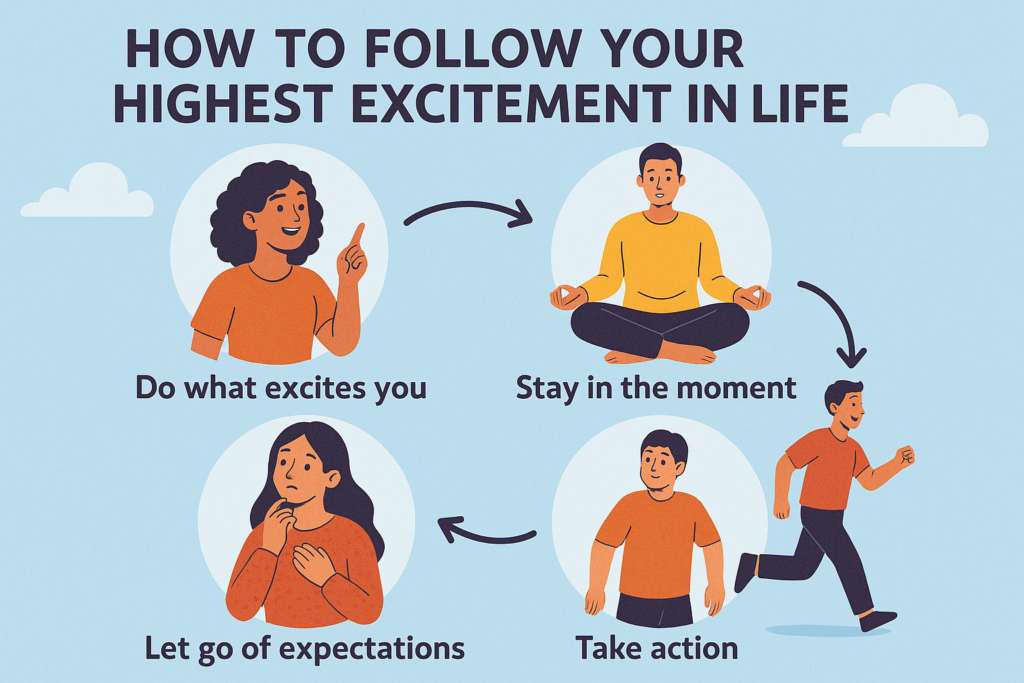
Walking the Path of Living Excitement
Living your highest excitement is not a one-time decision.
It is an ongoing practice of:
- Listening to your inner guidance.
- Acting courageously and intelligently.
- Updating beliefs that no longer serve you.
- Giving positive, growth-centered meaning to whatever happens.
You are invited to:
- Start small today.
- Notice even tiny sparks of joy and curiosity.
- Follow them with integrity and flexibility.
- Watch how synchronicities and new opportunities begin to appear.
Over time, this way of living can transform not only what you do, but who you know yourself to be.
Disclaimer and Source Hygiene
This article is for informational and educational purposes only.
It does not replace professional advice from psychologists, therapists, coaches, financial advisors, or medical specialists.
The core ideas are adapted and expanded from a text you provided, which presents a spiritual and psychological framework around following excitement, synchronicity, and belief work.
Always use your own judgment, and consult qualified professionals when making important decisions about your mental health, finances, relationships, or career.
🔔 For more tutorials like this, consider subscribing to our blog.
📩 Do you have questions or suggestions? Leave a comment or contact us!
🏷️ Tags: highest excitement, conscious living, belief systems, synchronicity, self growth, emotional guidance, spiritual development, mindset shift, personal transformation, life purpose
📢 Hashtags:
