


⏲️ Estimated reading time: 7 min
Table of Contents
Before you speak or act, pause and check the evidence. This practical guide shows you how to stop, verify facts, clarify your intent, assess impact, and express responsibly. A clear framework for wiser communication and decision-making every day.
[ip_live_timer]
Why You Need a Protocol Before Speaking or Acting
In our fast-paced world, the temptation to react instantly has become the norm. We send messages within seconds, share posts without thinking, and draw conclusions from headlines or “what we heard.” Yet every word and every action adds a piece to a bigger puzzle: your reputation, the trust others place in you, the quality of your relationships, even your professional outcomes. That’s why having a short protocol a sequence of clear steps works as your safety brake, keeping you lucid and consistent whenever you’re about to say or do something with impact.
This article gives you a complete, practical, reusable system. It’s not abstract theory but a tool you can turn into a checklist, a phone note, a team ritual, or even a fridge card. The goal: fewer mistakes, fewer regrets, more clarity, and a better impact on the people around you.
The 5-Step Map (Ultra-Short Version)
- Stop – break the automatic reaction.
- Evidence – what do I actually know vs. what do I assume?
- Intention – why do I want to say/do this? Does it help?
- Impact – who will be affected and how?
- Expression – share clearly, honestly, with nuance and sources.
Remember: if steps 2–4 leave you uncertain, don’t move to 5. Wait, verify, then act.
Step 1: Stop – Put a Barrier Between Stimulus and Response
What to do in 30–60 seconds:
- Take three slow breaths.
- Tell yourself: “I don’t need to respond right now.”
- Ask: “Does this really need my immediate reaction? What happens if I wait?”
Why it works: a pause lowers emotional reactivity, strengthens your executive control, and gives you space to analyze instead of react.
Mini-rule: if your emotional intensity is at “8 out of 10,” delay your response for at least 10 minutes.
Step 2: Evidence – “What Do the Facts Say?”
Evidence hierarchy (3 levels):
- Strong: official records, data, primary sources, recordings.
- Medium: credible secondary sources, expert reports, consistent witness accounts.
- Weak: rumors, opinions, screenshots without context.
Fact-cleaning checklist:
- Which parts are facts, and which are interpretations?
- Can I cite a verifiable source?
- How current is this information?
- Did I actively look for counter-evidence?
- Can I phrase it with healthy nuance? (“According to X… Data suggests… Possibly…”)
Heuristic: if you can’t say in one sentence what you know for sure and how you know it, you need another source.
Step 3: Intention – “Why Do I Want to Say/Do This?”
Control questions:
- Is it for clarity, safety, or help? Or just to vent emotion?
- Am I seeking truth or just validation?
- What value does this add to others?
- Is there a better way to phrase or act?
Mirror test (10 seconds): if tomorrow your words were read out loud in public, would you feel at peace? If not sure, wait.
Step 4: Impact – “Who Is Affected and How?”
RISC grid:
- Reputation – could this unfairly harm someone’s image?
- Information – could this mislead or create confusion?
- Safety – could it cause panic or danger?
- Consequences – if I’m wrong, can I repair easily?
Reversibility principle: only say what you’d be ready to publicly correct if proven wrong.
Read also: Why Some Women Cheat and Show No Guilt
Step 5: Expression – How to Communicate Responsibly
Style rules:
- Avoid absolutes. Stay away from “always,” “never,” “everyone.”
- Show your source. “According to [source]…”
- Separate fact from opinion. “Fact: … My view: …”
- Use qualifiers. “Data suggests… It seems likely… It appears…”
Useful templates:
- Responsible statement:
“Based on [source], I understand that . If new credible info emerges, I’ll adjust my view.” - Exploratory question:
“What evidence supports ? What’s missing? Who can verify?” - Correction:
“Earlier I stated . After review, the correct info is . Sources: . Apologies for the error.”
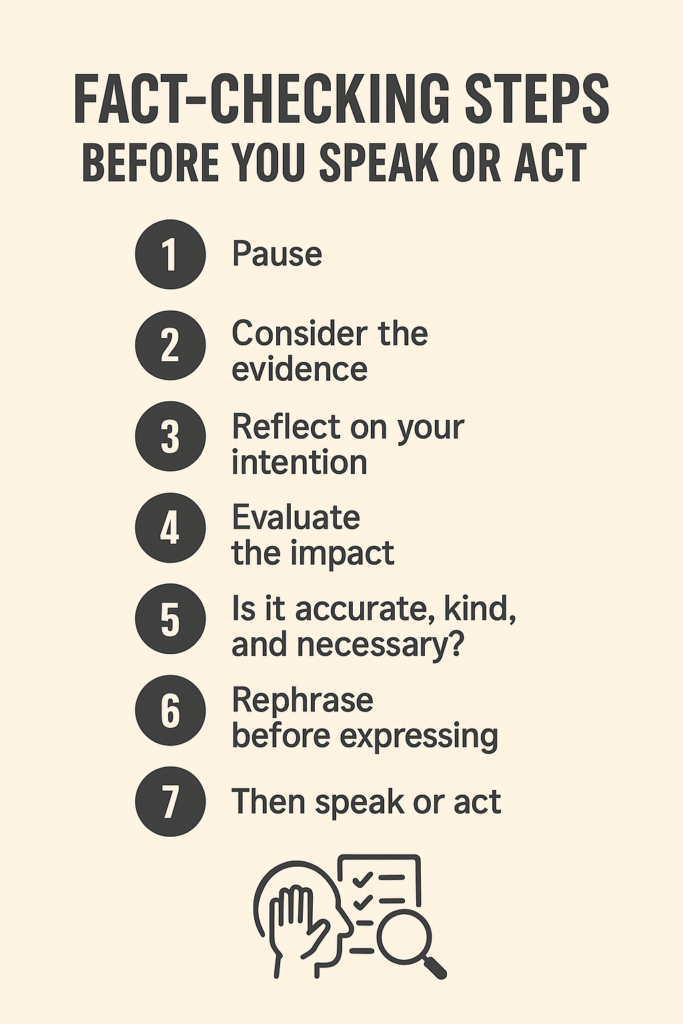
The Three Filters Test (Modernized)
- Truth: Can I back this up with evidence or at least solid reasoning?
- Kindness: Am I protecting the other person’s dignity?
- Necessity: Is this the right moment and channel? Does it truly need to be said?
Rule of 2 out of 3: if you don’t pass at least truth + necessity, don’t say it.
Avoiding Mental Traps That Break Verification
Common biases and antidotes:
- Confirmation bias: you only seek supporting data. → Actively look for disconfirming evidence.
- Anchoring bias: first info weighs too heavily. → Check a second independent source.
- Availability bias: what comes to mind fastest seems true. → Ask, “What am I not seeing?”
- Halo effect: one trait colors the whole picture. → Judge facts separately.
- Overconfidence: trusting memory too much. → Write it down; don’t rely on recall.
Quick exercise (2 minutes):
- Write the claim.
- Bold what is fact.
- Italicize what is interpretation.
- Ask: “What must be true for this to hold?” Check that.
Crisis Protocol: When Emotions Run High
- If angry: draft but don’t send. Revisit in 1 hour.
- If provoked: reply with a clarifying question, not a conclusion.
- If public: say “I’ll check and update shortly.”
- If safety risk: escalate responsibly to the right authority.
The 5-Minute Espresso Check
- Does the title match the content, or is it clickbait?
- Who says it? Is the source credible, identifiable?
- When was it published?
- Does media (photo/video) match time/place/context?
- Is there an independent second source?
Labels to use: confirmed / likely / speculative / unconfirmed / false. Use them visibly.
Workplace Application
Meetings:
- Start with 3 points: what we know, what we don’t know, what we’re checking.
- One claim = one source.
Email:
- Subject: “[DECISION] + topic.”
- Body: context → facts + sources → options + risks → recommendation → next step.
Chat (Slack/Teams):
- Keep threads short. If complex, move to a doc.
- Use reactions for quick acknowledgment.
Real-Life Example
Rumor in a team:
“Project X failed because of department Y.”
- Stop.
- Evidence: do you have logs, emails, data?
- Intention: do you want blame or solutions?
- Impact: public blame destroys collaboration.
- Expression: “Timeline shows Y caused a 3-day block (source: JIRA). Let’s hold a retro to prevent repeats.”
Ready-to-Use Phrases
- Responsible claim: “Based on [data], it seems… There are still uncertainties…”
- Source request: “Can you share the primary source or official record?”
- Public correction: “Earlier I wrote… The accurate info is… Here are the sources.”
The 10-Point Checklist (Fridge Note)
- Did I pause?
- Do I have a clear source?
- Did I separate fact vs. opinion?
- Did I look for counterexamples?
- Is my intention constructive?
- Who’s most affected?
- Did I phrase with nuance?
- Would I correct this publicly if wrong?
- Is this the right channel?
- Does it need to be now?
The Essence
Truth without kindness can wound. Kindness without truth can deceive. The balance lies in disciplined verification. Using a short protocol Stop → Evidence → Intention → Impact → Expression you tame impulse, separate facts from beliefs, choose the right moment, and speak with strength and respect. Repeat, refine, learn from mistakes, correct publicly when needed, and keep moving. That’s how you build a reputation people can trust.
🔔 For more tutorials like this, consider subscribing to our blog.
📩 Do you have questions or suggestions? Leave a comment or contact us!
🏷️ Tags: fact checking, critical thinking, decision making, communication, leadership, cognitive bias, checklist, productivity, ethics, relationships
📢 Hashtags: #criticalthinking, #factchecking, #communication, #decisions, #leadership, #ethics, #productivity, #bias, #responsibility, #mindset
