


⏲️ Estimated reading time: 7 min
Table of Contents
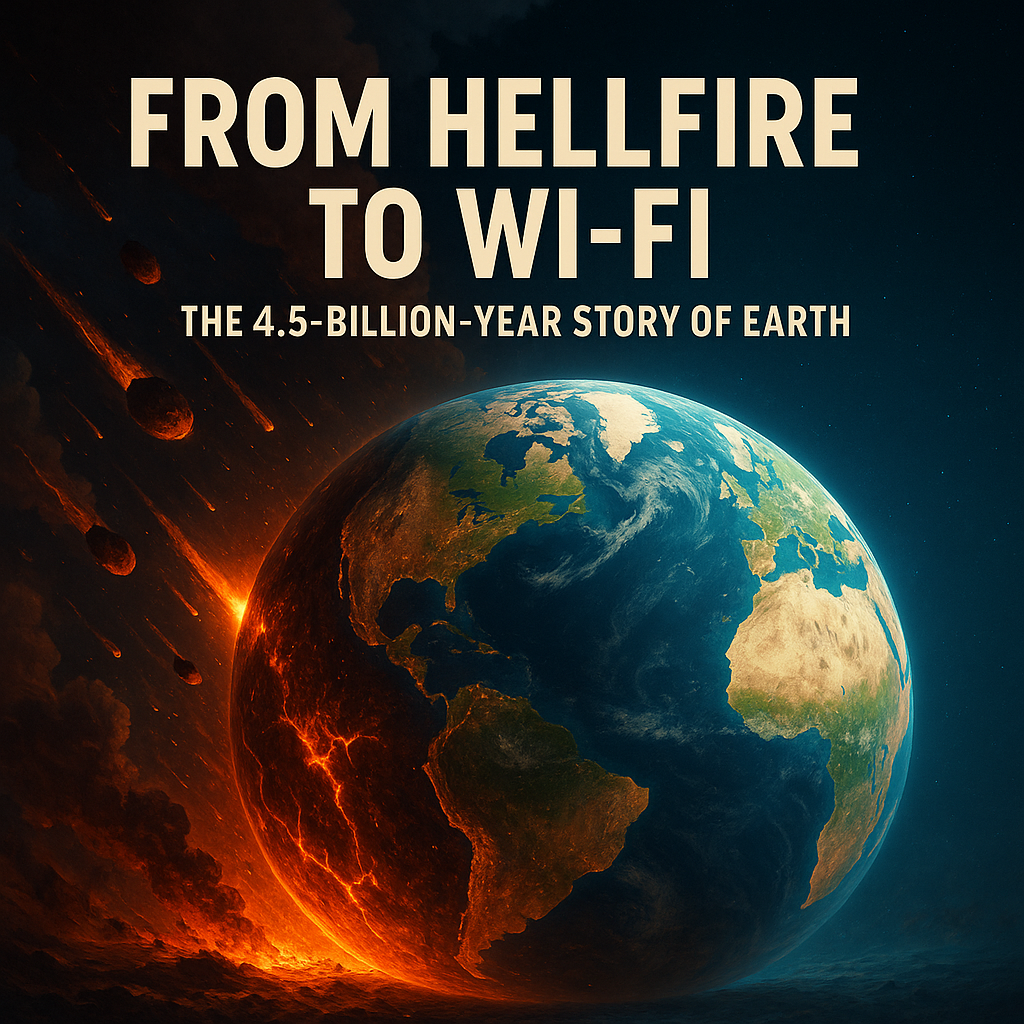
Discover the breathtaking journey of Earth from molten chaos and toxic skies to intelligent life holding smartphones. In just 4.5 billion years, our planet transformed from fiery rock to a world buzzing with Wi-Fi, oceans, and oxygen.
You may also be interested in: Martin Luther King, Jr., (January 15, 1929-April 4, 1968)
The Fiery Beginning: Earth’s Violent Birth
About 4.5 billion years ago, Earth wasn’t the calm blue planet we know today. It was a world of molten rock, blazing heat, and relentless meteor bombardments. Oxygen didn’t exist. Instead, the young planet’s surface boiled with magma oceans, and chaos ruled the skies.
This endless storm of cosmic collisions eventually did something remarkable it gave birth to the Moon. When a Mars-sized body slammed into the proto-Earth, the debris that shot into orbit gradually formed our lunar companion. The Earth-Moon system was born from violence and destruction, yet that same chaos paved the way for balance and stability.
Life Finds a Way: The First Signs of Existence
Fast forward about a billion years, and something incredible happened in the ocean life appeared. Not big creatures or plants, but microscopic slime. Simple, single-celled organisms began to form, feeding off the minerals in the water.
These tiny organisms didn’t look impressive, but they set off one of the most important events in planetary history. They learned to harness sunlight, and in doing so, they changed the chemistry of the atmosphere forever.
The Great Oxygenation Event: Earth’s First Mass Extinction
Around 2.4 billion years ago, photosynthetic bacteria began releasing oxygen as a by-product. For them, it was a survival strategy. For everything else, it was poison.
Oxygen, while essential to us today, was lethal to most early life forms. The air filled with this new, reactive gas, and nearly all anaerobic life the kind that thrived without oxygen was wiped out.
Scientists call it the Great Oxygenation Event Earth’s first mass murder. Yet from this catastrophe came the breathable atmosphere we depend on. The sky turned blue, and the groundwork was laid for complex life to evolve.
The Cambrian Explosion: Life’s Creative Outburst
Roughly 600 million years ago, evolution hit the accelerator. Known as the Cambrian Explosion, this period saw the sudden appearance of countless new species in Earth’s oceans.
Creatures with shells, eyes, and complex body plans emerged almost overnight (geologically speaking). The oceans teemed with bizarre forms spiky worms, five-eyed alien-like animals, and trilobites crawling across the seabed.
Life was diversifying at an unprecedented rate, driven by rising oxygen levels and new ecological interactions like predation. This explosion of life would eventually lead to fish, plants, and ultimately, land animals.
The Rise and Fall of Supercontinents
By about 250 million years ago, all the landmasses had merged into one giant supercontinent Pangaea. It was surrounded by a single, vast ocean called Panthalassa.
But nature wasn’t done reshaping the planet. Massive volcanic eruptions in Siberia lasted for nearly a million years, releasing immense amounts of carbon dioxide. The result was catastrophic climate change and the Great Dying the largest extinction event in Earth’s history.
Nearly 90% of marine species and 70% of land species vanished. It was a brutal reset button, clearing the stage for the next act in the evolutionary story.
The Age of Dinosaurs and Mammals
After the Great Dying, dinosaurs rose to dominance, ruling Earth for over 160 million years. They evolved into every shape and size imaginable from tiny hunters to colossal giants like Argentinosaurus.
Then, 66 million years ago, another catastrophe struck. A massive asteroid hit the Yucatán Peninsula, triggering wildfires, tsunamis, and a nuclear-winter-like sky. Dinosaurs (except birds) disappeared, and mammals began to take over.
Small, adaptable, and intelligent creatures thrived in the new world. Among them were the ancestors of primates our distant relatives.
From Apes to Humans: The Spark of Intelligence
Roughly two million years ago, some clever apes in Africa started using stones as tools. This simple act changed everything.
Over time, tool use evolved into fire control, language, and culture. Early humans learned to cooperate, hunt, and build. Civilizations emerged. Agriculture appeared around 10,000 years ago, allowing people to settle, form cities, and shape the land.
The same species that once chipped rocks for survival now builds satellites, creates art, and explores Mars.
From Fire to Fiber Optics: Humanity’s Technological Leap
In just a blink of geological time, humanity has moved from striking flint to manipulating atoms and bits. Our ancestors stared at stars, wondering what they were. Today, we send probes to them.
The smartphone in your hand or the computer you’re reading this on is the product of 4.5 billion years of cosmic evolution. It represents energy from ancient stars, mined metals, and the ingenuity of countless generations.
Every click, every connection, every message traces back to the first atoms forged in long-dead suns.
The Future: A Billion Years from Now
Earth’s story isn’t over. Scientists predict that in about a billion years, the Sun will grow brighter, heating the planet and eventually boiling away the oceans.
Life, as we know it, may not survive. Yet the legacy of Earth the traces of its living history might continue somewhere else, carried by future explorers or intelligent machines.
For now, we live in Earth’s golden age: a rare moment when the planet is balanced, alive, and beautiful.
A Cosmic Perspective
Think about it: from fiery beginnings to digital civilizations, all in one planet’s lifespan. We are the latest chapter in a 4.5-billion-year epic, and the universe keeps turning the page.
So take a breath. The air in your lungs is ancient, recycled from stars and primordial seas. Every heartbeat is part of an unbroken chain stretching back to the first cell that dared to live.
Enjoy this moment. You’re part of something vast, strange, and miraculous.
FAQs
What was Earth like 4.5 billion years ago?
It was a molten, lifeless planet bombarded by asteroids, with no oxygen and constant volcanic activity.
What is the Great Oxygenation Event?
It was a global transformation 2.4 billion years ago when bacteria began producing oxygen, leading to the first mass extinction.
What caused the Great Dying?
Massive volcanic eruptions in Siberia released toxic gases and greenhouse emissions, wiping out 90% of species.
When did humans first appear?
Our earliest ancestors emerged in Africa around two million years ago, gradually evolving into modern humans.
What will happen to Earth in the far future?
In about a billion years, the Sun’s heat will boil the oceans and make Earth uninhabitable.
A Universe Still Unfolding
Earth’s past is full of destruction and creation, and its future will be no different. What matters is that right now, this fragile planet is alive and so are we. Every sunrise is a reminder that chaos can create beauty.
🔔 For more tutorials like this, consider subscribing to our blog.
📩 Do you have questions or suggestions? Leave a comment or contact us!
🏷️ Tags: Earth history, evolution, Cambrian explosion, oxygenation event, Great Dying, Pangaea, dinosaurs, human evolution, geology, science
📢 Hashtags: #EarthHistory, #Evolution, #ScienceFacts, #Cosmos, #Pangaea, #CambrianExplosion, #LifeOnEarth, #GreatDying, #OxygenationEvent, #Geology
The Long Journey Home
From fire and chaos to digital wonder, Earth’s saga is proof that even destruction can lead to creation. Every second you exist is built on billions of years of survival, change, and cosmic luck. Treasure this golden age we’re the universe experiencing itself.
