


⏲️ Estimated reading time: 12 min
Table of Contents
From Expulsion to Extermination: How Nazi Policy Against Jews Evolved. Many believe Hitler’s early plan was to expel, not kill, Europe’s Jews. This article explains how Nazi anti-Jewish policy evolved from forced deportation to systematic genocide tracing the ideological, political, and military steps that led to the Holocaust.
“Hitler didn’t want to exterminate the Jews at the time.
He wanted to expel the Jews.”
From Expulsion to Extermination: The Evolution of Nazi Policy Against the Jews
History often compresses events into simple labels, but reality is rarely simple. The Holocaust the systematic murder of six million Jews by Nazi Germany did not begin overnight. It was the result of a long, evolving process that began with discrimination, exclusion, and expulsion, and ultimately turned into industrialized mass murder.
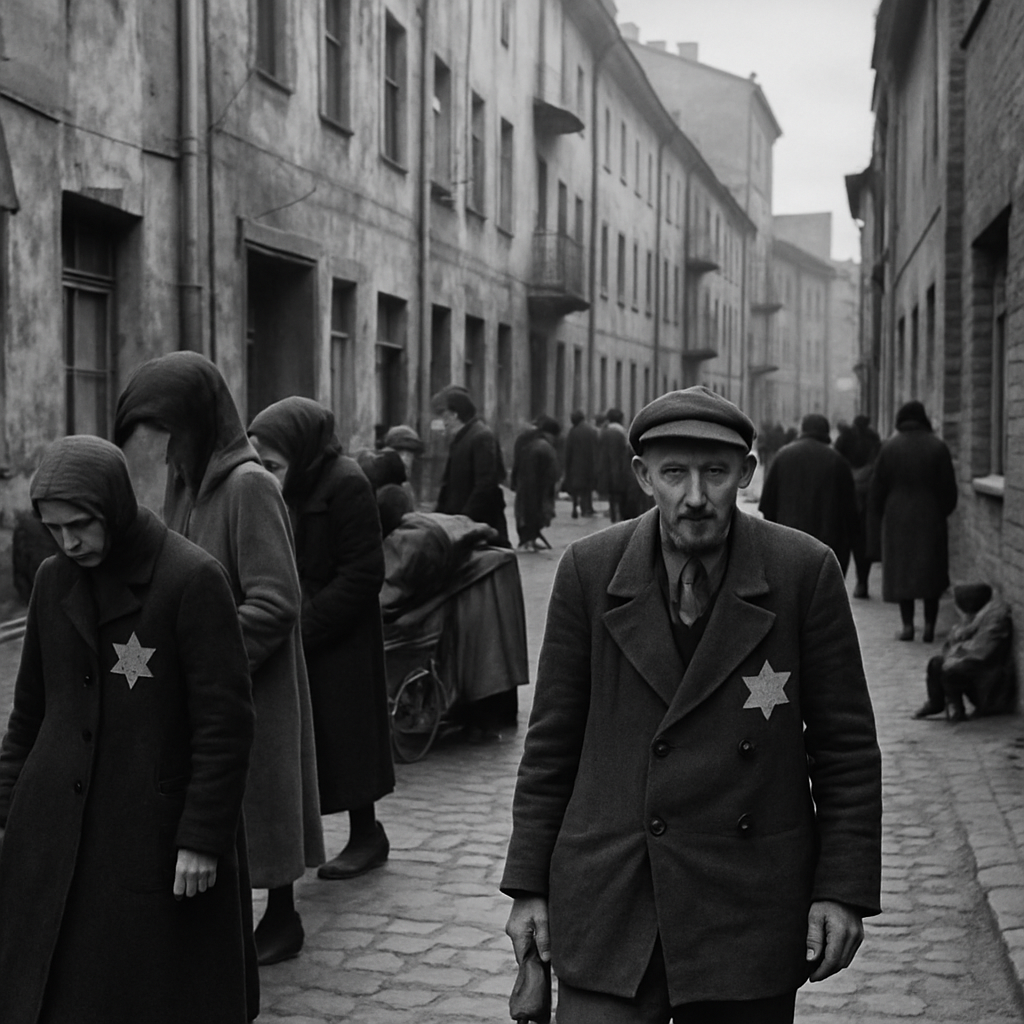
The idea expressed in the image that “Hitler didn’t want to exterminate the Jews at the time; he wanted to expel them” reflects a partial truth. In the early years of Nazi rule, policies indeed focused on removing Jews from German society. However, these actions were motivated by deep-rooted antisemitism and were part of a broader ideology that would soon escalate to genocide.
Understanding how this evolution occurred is essential not only for historical accuracy but also for preventing future distortions of history.
The Ideological Foundation: Antisemitism at the Core
Adolf Hitler’s hatred of Jews was not a policy decision; it was the foundation of his worldview. In Mein Kampf (1925), he described Jews as a “race” responsible for Germany’s decline, communism, capitalism’s excesses, and cultural decay. His belief system was not built on economics or politics it was built on a racist mythology that saw Jews as subhuman and dangerous.
Long before the Nazi Party gained power, antisemitic propaganda circulated across Europe. But Hitler transformed prejudice into state ideology. Once he became Chancellor in January 1933, antisemitism became law, bureaucracy, and national policy.
Early Nazi Policy (1933–1938): Exclusion and Emigration
In the first years of Nazi rule, extermination was not yet an official objective. The goal was to make life so unbearable for Jews that they would leave voluntarily.
Between 1933 and 1938, the Nazi regime passed over 400 antisemitic laws, systematically excluding Jews from all aspects of public life:
- The Law for the Restoration of the Professional Civil Service (1933) dismissed Jews from government positions.
- The Nuremberg Laws (1935) stripped Jews of German citizenship and prohibited marriage or sexual relations between Jews and “Aryans.”
- Jewish businesses were boycotted, confiscated, or “Aryanized.”
Jews were banned from schools, professions, and public spaces. Emigration became the only option for survival. By 1938, more than 150,000 Jews had fled Germany nearly a quarter of its Jewish population.
However, escaping was not easy. Many countries closed their doors to Jewish refugees, a failure that would have tragic consequences later.
Kristallnacht: A Turning Point
On the night of November 9–10, 1938, Nazi paramilitary forces carried out a violent pogrom across Germany and Austria known as Kristallnacht, or “The Night of Broken Glass.” Synagogues burned, Jewish shops were destroyed, and 30,000 Jewish men were sent to concentration camps.
This was not spontaneous rage. It was a government-orchestrated warning: Jews were no longer welcome anywhere in German society.
After Kristallnacht, Hitler’s focus shifted from “forcing Jews out” to a more aggressive “solution.”
The Madagascar Plan: An Unrealistic ‘Alternative’
In 1940, after Nazi Germany conquered much of Western Europe, officials proposed a shocking idea deporting Europe’s Jews to the island of Madagascar, then a French colony. The plan, known as the Madagascar Plan, imagined turning the island into a vast ghetto under SS control.
This proposal was not motivated by mercy. It was an attempt to isolate Jews, control them, and ultimately let them perish under harsh conditions. The logistical challenges of moving millions of people during wartime made the plan impossible, and by 1941, it was abandoned.
But the plan’s failure accelerated the shift toward what the Nazis would soon call the “Final Solution.”
War and Radicalization: 1939–1941
The invasion of Poland in 1939 marked a critical turning point. Suddenly, Nazi Germany ruled over millions of Jews. Deportation and forced emigration were no longer practical there were simply too many.
Ghettos were established in cities like Warsaw, Łódź, and Kraków. Jews were forced into overcrowded, sealed districts with little food or medical care. Disease and starvation spread rapidly.
At the same time, the SS (Schutzstaffel) and Einsatzgruppen (mobile killing units) began mass shootings in Eastern Europe. Tens of thousands of Jews were murdered in open fields and forests.
By 1941, Nazi policy had shifted from exclusion to systematic extermination.
The “Final Solution”: Bureaucracy of Death
In January 1942, senior Nazi officials gathered near Berlin for the Wannsee Conference. Chaired by Reinhard Heydrich, this meeting coordinated the “Final Solution to the Jewish Question” a euphemism for genocide.
It formalized the plan to deport Jews from all over Europe to extermination camps such as:
- Auschwitz-Birkenau
- Treblinka
- Belzec
- Sobibor
- Chelmno
- Majdanek
These were not labor camps they were death factories, designed for mass murder using gas chambers and crematoria.
Historians estimate that between 1941 and 1945, six million Jews two-thirds of Europe’s Jewish population were murdered.
The Language of Deception
One of the most chilling aspects of the Holocaust is how ordinary bureaucratic language was used to disguise genocide. Terms like “resettlement,” “evacuation,” and “special treatment” were used in official documents to hide the true nature of Nazi policies.
This deception helped maintain public ignorance and bureaucratic compliance. It also reveals the terrifying power of language to manipulate moral perception.
Why “Expulsion” Was Only the Beginning
While it is true that Hitler initially sought to remove Jews from German territory, it is misleading to suggest that this was a humane or moderate stance.
Read also: Ilie Năstase and Nike: The Deal That Made History
The early expulsion plans were grounded in the same ideology that would later justify extermination the belief that Jews were a biological threat. Forced emigration, ghettoization, and extermination were not separate policies but successive phases of the same genocidal logic.
In other words: the goal was always a “Jew-free” Europe. The methods evolved as circumstances changed.
International Indifference: A Tragic Enabler
When Jews tried to flee Nazi persecution, the world largely turned its back. At the Evian Conference in 1938, representatives from 32 countries met to discuss the refugee crisis and most refused to accept more Jews.
This global inaction sent a clear message to Hitler: no one would intervene.
Historians argue that this lack of response emboldened the Nazis to escalate their persecution, believing that the world was indifferent to the fate of the Jews.
The Path to Auschwitz
By 1942, deportations to death camps were underway. Entire communities were rounded up, transported in cattle cars, and sent to their deaths.
Trains left from cities like Paris, Amsterdam, Budapest, and Prague. The process was so vast and systematic that it required coordination between multiple government agencies the railways, the police, the army, and the SS.
The Holocaust was not just the work of a few fanatics. It was a bureaucratic collaboration involving thousands of ordinary people who obeyed orders, filled out forms, and looked the other way.
Denial and Distortion in the Modern Era
Today, statements like “Hitler didn’t want to exterminate the Jews” are sometimes used to minimize or distort the Holocaust. This is known as Holocaust revisionism a dangerous form of historical denial.
While it is true that Nazi policy evolved, there is overwhelming evidence that by 1941–1942, extermination was a deliberate, planned objective. Hitler’s own speeches, the writings of Himmler, Goebbels, and Heydrich, and the testimony of survivors confirm this.
Denying or softening this truth dishonors the victims and enables hate to reemerge in new forms.
Lessons from History: From Words to Atrocities
The Holocaust teaches that genocide does not begin with gas chambers. It begins with words with dehumanization, stereotypes, and propaganda.
It begins when a society allows lies to spread unchecked. It begins when fear and prejudice become normalized.
Understanding the gradual progression from exclusion to extermination is essential to recognize early warning signs in any society.
The Importance of Historical Responsibility
Germany has confronted its past more honestly than many nations. Memorials, museums, and education programs ensure that new generations learn the truth.
However, misinformation continues to circulate online, often stripped of historical context. Every false claim or misleading statement must be met with truth, documentation, and education.
The Holocaust is not a “topic” it is a warning.
The Evolution of Hate
At first, Hitler wanted to “remove” Jews from German life by law, by force, by fear. When expulsion became impossible, extermination became the next step.
The two ideas were not opposites but stages in the same genocidal continuum.
History reminds us that evil rarely declares its full intentions at once. It grows through words, policies, and silence.
Recognizing that pattern is the only way to ensure “never again” truly means never again.
FAQ Section
1. Did Hitler really plan to kill all Jews from the beginning?
Not initially in concrete policy form. Early measures focused on exclusion and forced emigration, but his ideology always viewed Jews as a “problem” to be eliminated.
2. What was the Madagascar Plan?
A Nazi proposal in 1940 to deport Europe’s Jews to Madagascar. It was never implemented but shows the regime’s obsession with removing Jews from Europe.
3. When did the Holocaust begin?
Historians mark the transition to systematic extermination between 1941 and 1942, during and after the invasion of the Soviet Union.
4. Were all Germans aware of the exterminations?
While most Germans didn’t know all the details, many were aware of deportations and mass killings. Rumors, propaganda, and visible disappearances made total ignorance unlikely.
5. Why is Holocaust denial dangerous?
Because it erases truth, dishonors victims, and allows antisemitic ideologies to resurface under new forms.
⚠️ Disclaimer and Source Hygiene
Content Sensitivity & Educational Purpose
This article, “From Expulsion to Extermination: How Nazi Policy Against Jews Evolved,” addresses the Holocaust, genocide, and crimes against humanity. The content is provided strictly for educational, historical, and research purposes to promote understanding of how state-sponsored persecution escalated to industrial-scale murder.
Content Warning: This material contains descriptions of genocide, mass murder, antisemitic ideology, ethnic cleansing, and human rights atrocities that may be distressing to readers.
Historical Accuracy & Scholarly Consensus
While every effort has been made to present historically accurate information based on established scholarship, primary source documentation, and survivor testimony:
- This article represents interpretations of historical events that continue to be studied and debated by professional historians.
- The evolution of Nazi policy remains a subject of legitimate historical inquiry regarding timing, decision-making processes, and implementation.
- All historical claims should be verified against peer-reviewed academic sources, official documentation (including Nuremberg Trial records), and recognized Holocaust research institutions (Yad Vashem, United States Holocaust Memorial Museum, Institute of Contemporary History, etc.).
No Endorsement or Minimization
We explicitly condemn antisemitism, Holocaust denial, distortion, or any attempt to use historical nuance to minimize Nazi crimes:
- References to early expulsion policies or the Madagascar Plan do not suggest these were “humane alternatives” to genocide. Forced deportation, ghettoization, and ethnic cleansing are crimes against humanity.
- Any quotation or description of Nazi ideology is presented for analytical purposes only and does not reflect the views of the publisher.
- We reject any interpretation that separates “moderate” from “radical” Nazism all phases of persecution were part of a continuum of genocidal intent.
Terminology & Definitions
- “Holocaust” refers to the systematic, state-sponsored persecution and murder of approximately six million Jews by Nazi Germany and its collaborators.
- “Final Solution” (Endlösung) was the Nazi euphemism for genocide against European Jews.
- We acknowledge the parallel persecution of Roma, disabled persons, LGBTQ+ individuals, political prisoners, and other groups targeted by the Nazi regime.
Contextual Understanding
The article discusses:
- The functionalist vs. intentionalist debate regarding Hitler’s role and premeditation
- The evolutionary nature of Nazi Jewish policy (1933–1945)
- International response failures and refugee policy
These discussions reflect ongoing historiographical debates and should not be read as definitive conclusions.
Legal & Ethical Boundaries
In many jurisdictions, Holocaust denial and distortion are criminal offenses. This article:
- Does not question the historical reality of the Holocaust
- Does not minimize the six million Jewish victims
- Does not promote hate speech, discrimination, or violence against any group
Violations of these principles in comments or user-generated content will be removed and may be reported to authorities.
Sources & Further Research
Readers are encouraged to consult:
- Yad Vashem (yadvashem.org)
- United States Holocaust Memorial Museum (ushmm.org)
- Institute of Contemporary History, Munich (ifz-muenchen.de)
- Nuremberg Trial Documents (avalon.law.yale.edu)
Memorial Commitment
We publish this material in memory of the six million Jews murdered in the Holocaust and all victims of Nazi persecution. We affirm the importance of Holocaust education in combating antisemitism, racism, and genocide denial worldwide.
“Never Again” requires constant vigilance and truth-telling.
This disclaimer was prepared in accordance with international standards for Holocaust education and remembrance.
🔔 For more tutorials like this, consider subscribing to our blog.
📩 Do you have questions or suggestions? Leave a comment or contact us!
🏷️ Tags: Holocaust, Hitler, Nazi Germany, World War II, Jewish History, Genocide, Wannsee Conference, Antisemitism, Madagascar Plan, Auschwitz
📢 Hashtags: #HolocaustHistory, #NeverForget, #WWII, #NaziGermany, #JewishHistory, #HistoricalTruth, #Antisemitism, #HolocaustEducation, #HumanRights, #HistoryMatters
The Shadow of History and the Light of Truth
History is not just a record of what happened it is a reflection of what we allow to happen. Understanding the Holocaust’s evolution reminds us how silence and indifference can empower hatred.
The past cannot be changed, but how we remember it determines the future.
