


⏲️ Estimated reading time: 35 min
Table of Contents
Discover how Romanian tennis legend Ilie Năstase became Nike’s first professional athlete endorser in 1972. This detailed story explores the historic agreement, the reported $5,000 payment, Năstase’s global influence, and the truth behind claims that he helped transform Nike into a sporting giant.
Ilie Năstase and Nike: The Historic Partnership Explained
Long before Michael Jordan turned Nike sneakers into global cultural symbols, a charismatic Romanian tennis player helped the young company enter professional sport.
His name was Ilie Năstase.
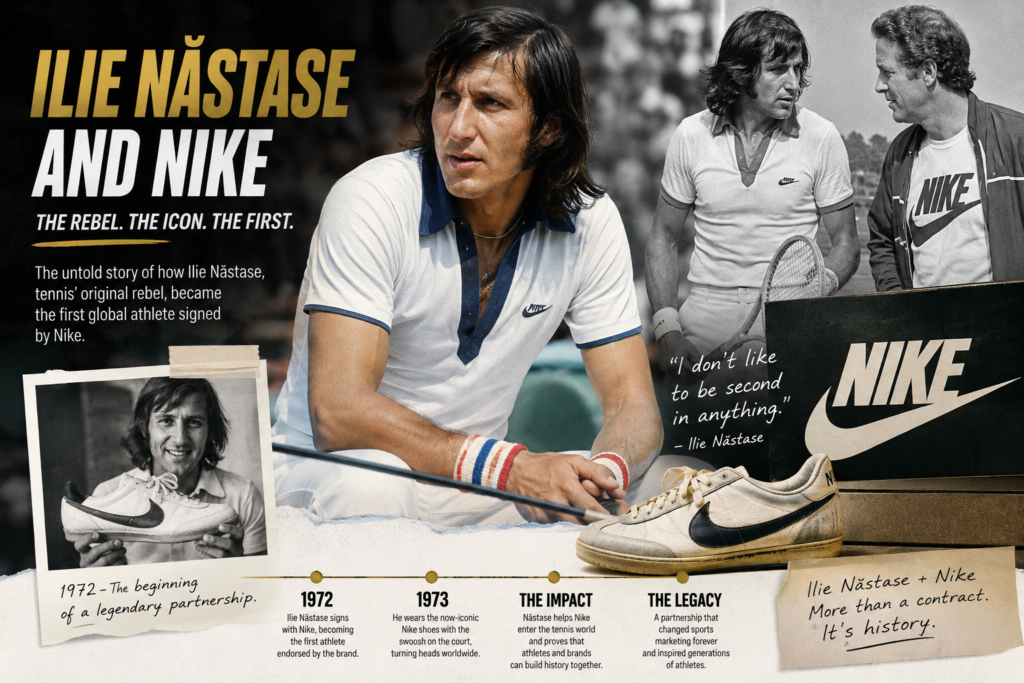
In 1972, Năstase became widely recognized as the first professional athlete to sign an endorsement agreement with Nike. The partnership happened when Nike was still a small and uncertain footwear business.
The company did not yet dominate sportswear stores. It had no Air Jordan line, no “Just Do It” campaign, and none of the worldwide power it possesses today.
Credibility
Nike needed credibility. Ilie Năstase already had it.
He was one of the most talented, entertaining, and recognizable tennis players in the world. His spectacular style made him an ideal figure for a company that wanted people to notice its shoes.
The agreement did not instantly turn Nike into the largest sportswear company on Earth. However, it became an important early step in Nike’s athlete-marketing strategy. That strategy would later define the company.
Nike eventually built extraordinary partnerships with athletes such as Steve Prefontaine, John McEnroe, Michael Jordan, Andre Agassi, Serena Williams, Roger Federer, Rafael Nadal, Tiger Woods, Cristiano Ronaldo, and LeBron James.
Before those famous relationships, there was Ilie Năstase. His story deserves more than a brief sentence in Nike’s history.
Who Was Ilie Năstase?
Ilie Theodoriu Năstase was born in Bucharest, Romania, on July 19, 1946.
He developed into one of the most gifted tennis players of his generation. His combination of speed, touch, anticipation, creativity, and theatrical personality made him different from almost every opponent.
Năstase did not simply play points. He performed.
He could produce delicate drop shots, sharp angles, unexpected lobs, disguised passes, and remarkable changes of rhythm. Spectators never knew exactly what he might try next.
His emotional behavior sometimes created controversy. He argued with officials, distracted opponents, entertained crowds, and occasionally lost control of important matches.
Nevertheless, his talent was never seriously questioned.
The ATP describes him as an exceptionally gifted and unpredictable player who could perform almost every shot when his concentration remained intact. He combined athletic movement with originality and remarkable racket control.
Năstase won 64 tour-level singles titles and reached the highest ranking in men’s tennis. He also earned major victories in singles, doubles, and mixed doubles.
His greatest achievements included:
- Winning the 1972 US Open singles championship
- Winning the 1973 French Open singles championship
- Reaching the Wimbledon singles final in 1972 and 1976
- Winning four season-ending Masters titles
- Winning major doubles titles with Ion Țiriac and Jimmy Connors
- Winning two Wimbledon mixed doubles titles with Rosie Casals
- Helping Romania reach three Davis Cup finals
- Becoming the first official ATP world No. 1
The first computerized ATP rankings appeared on August 23, 1973. Năstase occupied the top position, making him the first official No. 1 in ATP ranking history.
- His official ATP record lists 908 career singles victories, 64 titles, and a career-high ranking of No. 1.
- These achievements explain why a small American footwear company wanted him.
- Nike was not signing an unknown player.
- It was signing one of the biggest personalities in international sport.
Tennis During the Early 1970s
To understand the importance of the Nike agreement, it helps to understand professional tennis during that period.
The Open Era had started in 1968. Professional and amateur players could finally compete together in major tournaments. The sport entered a period of rapid commercial development. Television coverage increased. International tournaments attracted larger audiences. Players became recognizable celebrities rather than competitors known only to dedicated tennis followers.
However, the commercial system surrounding athletes remained much smaller than it is today.
Modern stars can sign agreements covering shoes, clothing, watches, rackets, nutrition products, cars, financial services, and technology companies. In the early 1970s, endorsement deals were usually simpler.
A company might pay a player to wear a specific shoe, use a particular racket, or appear in limited advertising. Athletes were becoming valuable marketing figures, but the modern sponsorship industry had not fully developed.
Năstase arrived at exactly the right moment.
He was successful enough to represent performance. More importantly, he possessed a personality that audiences remembered.
That combination made him commercially valuable.
Nike Before It Became Nike
Nike’s early history began with Blue Ribbon Sports.
Phil Knight and Bill Bowerman established Blue Ribbon Sports in 1964. The company initially distributed Japanese Tiger running shoes produced by Onitsuka.
Knight had studied at Stanford Graduate School of Business. He developed the idea that affordable Japanese athletic shoes could compete with established German manufacturers.
Bowerman was a respected track coach at the University of Oregon. He contributed knowledge about athletes, performance, materials, and shoe construction.
During its earliest period, Blue Ribbon Sports operated with limited resources.
Phil Knight famously sold shoes at track meetings from the trunk of his car. The company did not begin as a giant corporation with global stores and enormous advertising budgets.
It began as a risky business idea.
The Nike name appeared during the company’s transition away from its relationship with Onitsuka. The name referred to the Greek goddess of victory.
The Swoosh logo was created in 1971 by graphic design student Carolyn Davidson.
Therefore, when Năstase became associated with Nike in 1972, the brand itself was extremely young.
Nike still needed to prove three things:
- Its shoes could perform at the highest level.
- Elite athletes would trust the products.
- Customers should recognize and remember the new Swoosh.
A globally famous tennis champion could help with all three challenges.
Why Nike Needed a Famous Athlete
A sports shoe can look attractive in an advertisement. However, competitive athletes want evidence that the product works.
The strongest evidence comes from another successful athlete.
- When consumers see a champion wearing a product during a major match, the product gains immediate legitimacy.
- The message is simple:
- If the shoe performs at the US Open, it should perform at a local tennis club.
- Nike understood this principle early.
The company could describe its footwear as comfortable, lightweight, durable, or responsive. Yet those claims became more persuasive when a world-famous player competed in the shoes.
Năstase offered something more valuable than technical credibility.
He offered attention.
He was expressive, unpredictable, stylish, controversial, and entertaining. Crowds watched him even when they disliked his behavior.
His presence naturally attracted cameras.
Every televised close-up of his movement could potentially display the Nike Swoosh.
That visibility mattered greatly to a company introducing a relatively unfamiliar brand.
Why Ilie Năstase Was the Perfect Choice
- Nike could have chosen a quieter player.
- Instead, it became connected with one of tennis’s greatest showmen.
- The choice made sense for several reasons.
He Was Already a Major Champion
Năstase was not only entertaining. He was a genuine elite competitor.
In 1972, he reached the Wimbledon final and then won the US Open. In the US Open final, he defeated Arthur Ashe in five sets after trailing by two sets to one.
The International Tennis Hall of Fame describes that final as a sensational match in which Năstase recovered to win 3–6, 6–3, 6–7, 6–4, 6–3.
A major champion brought immediate sporting authority to Nike.
He Had an International Audience
Năstase came from Romania, competed throughout Europe and North America, and faced the leading players of his era.
His appeal was not limited to one national market.
Nike wanted to become more than a small American running-shoe company. A Romanian tennis star competing internationally gave the brand valuable exposure beyond the United States.
He Was Visually Memorable
Some athletes succeed without developing a strong public identity.
Năstase was impossible to ignore.
His facial expressions, conversations with spectators, disputes with officials, playful shots, and emotional reactions made him highly visible.
Nike needed recognition.
Năstase generated recognition naturally.
He Represented Individuality
The young Nike brand did not yet possess a fully developed public personality. However, it was already connected with competition, experimentation, independence, and challenging established companies.
Năstase embodied many of those qualities.
He did not behave like a traditional, restrained tennis gentleman. He played with imagination and resisted predictability.
Decades before Nike built advertising around bold personalities, its first professional athlete already represented rebellion and individuality.
How the Nike Agreement Began
The precise story is often reduced to one sentence:
“Ilie Năstase was the first athlete signed by Nike.”
The real story contains more detail.
Accounts based on Phil Knight’s recollections indicate that Năstase was already wearing Nike footwear when Knight became interested in formally signing him.
That detail matters.
Nike did not necessarily discover Năstase through a traditional advertising campaign. Instead, Knight recognized the value of having an established star already competing successfully in the company’s shoes.
According to a published summary of Knight’s memoir, Knight contacted Năstase’s agent and offered $5,000 for the Romanian player to continue wearing Nike products. Knight reportedly considered the amount substantial for his small company at that time.
By modern sponsorship standards, $5,000 sounds small.
For a young and financially vulnerable company in 1972, it represented a serious commitment.
Nike was not operating with the resources it later used to sign Michael Jordan, Tiger Woods, LeBron James, or Cristiano Ronaldo.
Every dollar mattered.
Knight’s decision reflected confidence in athlete endorsement before Nike had enough money to approach sponsorship casually.
Was the Contract Really Worth $5,000?
The figure most frequently connected with Năstase’s first Nike agreement is $5,000.
This amount appears in accounts based on Phil Knight’s description of the deal.
It is important to present the figure carefully.
Public retellings often omit details about duration, bonuses, product supply, renewal terms, territories, and additional compensation.
Therefore, the safest historical description is that Knight reportedly offered approximately $5,000 for Năstase to wear Nike equipment or footwear.
That amount should not automatically be treated as the complete lifetime value of every arrangement between the athlete and the company.
Even so, the reported figure remains historically interesting.
Nike later created sponsorship agreements worth millions or even billions of dollars in combined commercial value.
The Năstase agreement belonged to a very different era.
It was small in money but enormous in symbolism.
Did Ilie Năstase Sign With Nike or Blue Ribbon Sports?
This question can create confusion.
Blue Ribbon Sports was the company founded by Phil Knight and Bill Bowerman. Nike began as a footwear brand associated with the company before Nike became the permanent corporate identity.
Some historical accounts describe Năstase as signing with Nike. Others describe the agreement as involving Blue Ribbon Sports and its Nike shoes.
- Both descriptions refer to the same early business period.
- The important point is that Năstase endorsed footwear carrying the young Nike identity and Swoosh.
- The corporate structure and branding were still developing.
Modern readers should not imagine the mature Nike corporation of the 1990s or 2000s negotiating the deal.
This was a young company still establishing its name.
When Did Ilie Năstase Sign With Nike?
The widely reported year is 1972.
Some online accounts provide September 1972 as the approximate timing.
That date fits the broader historical context because Năstase won the US Open that year and had become one of tennis’s most visible competitors.
However, exact retellings sometimes differ regarding whether the formal agreement occurred shortly before or after a specific tournament.
The strongest widely repeated conclusion is straightforward:
Ilie Năstase became Nike’s first professional athlete endorser in 1972.
Multiple historical summaries, tennis sources, and company-history accounts consistently identify him in that role.
What Shoes Did Ilie Năstase Wear?
Năstase has frequently been associated with Nike’s early tennis shoes, including the Nike Wimbledon.
The Nike Wimbledon appeared in the early 1970s as one of the brand’s first notable attempts to create footwear for tennis.
Tennis shoes needed different features from running shoes.
A running athlete generally moves forward. A tennis player must accelerate, stop, slide, pivot, and change direction repeatedly.
The footwear must offer lateral stability, court grip, comfort, and durability.
Early Nike tennis models were far simpler than today’s technologically advanced shoes. They did not use modern Zoom Air systems, complex stability frames, advanced foams, or computer-designed traction patterns.
Nevertheless, the shoes gave Nike access to another major sport.
Historical sneaker coverage identifies the Nike Wimbledon as a 1972 model worn by Năstase during Nike’s early expansion into tennis.
The company later developed a stronger tennis presence through players such as John McEnroe, Andre Agassi, Pete Sampras, Serena Williams, Roger Federer, Maria Sharapova, Rafael Nadal, and Carlos Alcaraz.
Năstase stood near the beginning of that history.
The Importance of the 1972 US Open
The 1972 US Open became one of the defining tournaments of Năstase’s career.
He reached the final against Arthur Ashe.
Ashe was respected for his intelligence, composure, and elegant playing style. Năstase represented a different kind of tennis personality.
Their contrast made the final especially compelling.
- Năstase lost the first set, won the second, and then lost a close third-set tiebreak. Ashe appeared to have control.
- However, Năstase recovered.
- He won the fourth set and then completed the comeback in the fifth.
- The victory gave him his first major singles championship.
- For Nike, the timing could hardly have been better.
A young footwear brand needed its shoes to appear on the feet of winners. Năstase had just won one of the sport’s most prestigious tournaments.
His success communicated performance without requiring an elaborate advertising explanation.
The champion wore Nike.
That image had commercial value.
Năstase’s Extraordinary 1973 Season
- The year after his US Open triumph, Năstase produced one of the strongest seasons of his career.
- He won the French Open singles championship in 1973 without losing a set.
- He also won numerous other tournaments and later became the first official ATP world No. 1.
- The ATP rankings launched on August 23, 1973, with Năstase in first place. He remained at No. 1 for 40 weeks.
- His results strengthened Nike’s early connection with elite tennis.
- The company had not signed a player who briefly attracted attention and disappeared.
- It had signed the man who became the first official leader of the ATP rankings.
- That achievement gives the Nike partnership additional historical importance.
- Nike’s first professional endorser became tennis’s first computer-ranked No. 1.
Did Ilie Năstase Make Nike Famous?
The honest answer requires balance.
Năstase helped Nike gain visibility and credibility. However, he did not single-handedly create the company’s global success.
Nike’s growth resulted from many factors:
- Phil Knight’s business strategy
- Bill Bowerman’s product ideas
- The development of original Nike footwear
- The Swoosh logo
- Strong distribution
- Running culture in the United States
- Partnerships with athletes
- Product innovation
- Aggressive advertising
- Expansion into basketball, tennis, football, and other sports
- The Air technology platform
- Michael Jordan and the Air Jordan line
- International retail growth
- Lifestyle and streetwear adoption
Năstase contributed to one important part of this larger development.
He demonstrated that a famous athlete could give the young brand attention and legitimacy.
His partnership helped validate the basic model Nike later refined:
Find distinctive athletes, connect them with the brand, and allow their performances and personalities to communicate Nike’s identity.
Therefore, saying Năstase “created Nike” would be inaccurate.
Saying he played a pioneering role in Nike’s athlete-marketing history is justified.
Did Nike Become Successful Because Năstase Wore Its Shoes?
Nike did not become an immediate global empire because one tennis player wore its shoes.
The company’s expansion unfolded over many years.
Nevertheless, early endorsements can influence a young brand in ways that are difficult to measure only through direct sales.
Năstase offered Nike several benefits.
Professional Validation
A top player would not normally risk his performance by wearing completely unsuitable shoes.
His use of Nike suggested that the product was credible at the highest level.
Television Exposure
Major tennis tournaments reached international audiences.
Whenever cameras focused on Năstase, Nike could gain visibility.
Retailer Confidence
Sporting-goods retailers were more likely to notice a shoe worn by a major champion.
Athlete recognition could make sales conversations easier.
Consumer Curiosity
Fans often want to use equipment associated with successful players.
Even people who did not buy the exact model could begin remembering the Nike name.
Marketing Experience
The agreement gave Nike early experience in working with a professional sports celebrity.
That knowledge became useful when the company pursued other athletes.
No single benefit proves that Năstase caused a specific increase in Nike’s total revenue. However, the partnership clearly supported the company’s early effort to build legitimacy through sport.
The Difference Between “First Nike Athlete” and “First Track Athlete”
Historical discussions sometimes produce disagreement because people use different definitions.
Ilie Năstase is commonly identified as Nike’s first professional athlete endorser.
Steve Prefontaine is often described as Nike’s first track athlete or one of its foundational athlete partners. Both statements can be accurate. Prefontaine had a close relationship with Nike’s Oregon-based founders and became central to the company’s running identity.
Nike’s own historical material presents Prefontaine as a pioneering figure whose competitiveness, personality, and relationship with the brand helped show Nike how athletes could inspire others.
Năstase’s distinction is different.
He is widely credited as the first professional sports figure to sign a formal Nike endorsement contract.
Therefore:
- Ilie Năstase was Nike’s first professional athlete endorser.
- Steve Prefontaine became Nike’s first major track endorser and an essential early brand figure.
Confusing the two roles creates unnecessary historical arguments.
Why Nike Did Not Begin With a Basketball Player
Modern audiences strongly associate Nike with basketball.
- That connection became especially powerful after the company signed Michael Jordan in 1984.
- However, basketball was not Nike’s original foundation.
- The company emerged from running footwear.
Tennis then provided another attractive opportunity because its leading competitors enjoyed international visibility.
A tennis player’s shoes were also relatively easy for audiences to see.
Unlike equipment hidden under uniforms, tennis footwear remained visible during movement, television close-ups, serves, and changeovers.
- Players also competed as individuals rather than representing a large team.
- That allowed consumers to associate one athlete directly with one product.
- Năstase gave Nike a bridge between its running origins and a broader sporting future.
How Năstase Changed the Meaning of Athlete Endorsement
- Năstase did not invent sports sponsorship.
- Athletes had promoted products before 1972.
- His importance comes from his position inside Nike’s particular history.
- Nike later became one of the world’s greatest practitioners of athlete-centered marketing.
- Its campaigns often focused on more than results.
- They presented athletes as personalities, rebels, innovators, cultural symbols, or representatives of personal ambition.
- Năstase already fit that model.
He possessed a clear identity that extended beyond statistics.
Fans remembered how he played, how he reacted, how he entertained, and how he challenged tennis traditions. Nike eventually became famous for selecting athletes with compelling stories and strong public images.
Năstase was an early example of that approach, even before the company had perfected it.
The Personality Behind the Partnership
Năstase earned the nickname “Nasty,” partly because of the similarity to his surname and partly because of his behavior.
He could be charming one moment and furious the next.
He joked with spectators, imitated opponents, delayed play, challenged umpires, and transformed ordinary matches into dramatic events. Some audiences loved him. Others considered him disrespectful.
Sponsors often prefer predictable athletes who avoid controversy. Yet predictability does not always create attention.
Năstase created attention everywhere.
His personality made him commercially powerful because people formed opinions about him.
- They discussed him.
- They watched him.
- They remembered him.
Nike later built partnerships with other strong personalities, including John McEnroe, Charles Barkley, Andre Agassi, and Dennis Rodman.
Those athletes did not all behave like Năstase. However, they shared an ability to remain culturally visible beyond their results.
The Role of Ion Țiriac in Năstase’s Rise
Ilie Năstase’s story cannot be separated completely from Ion Țiriac.
The two Romanians travelled and competed together during an important period in their careers.
They formed a successful doubles partnership and helped Romania reach the Davis Cup final three times.
In 1970, they won the French Open men’s doubles title.
Țiriac presented a serious, disciplined, physically imposing image. Năstase offered creativity, speed, unpredictability, and theatrical energy. Their contrasting styles made them memorable. International success with Țiriac helped Năstase gain experience, recognition, and credibility before the Nike partnership.
The International Tennis Hall of Fame records their French Open doubles victory and recognizes Țiriac’s significance within Romanian tennis history.
Năstase later won major doubles titles with Jimmy Connors, including Wimbledon in 1973 and the US Open in 1975.
His visibility extended well beyond singles competition.
Năstase as a Global Sports Celebrity
Modern social media allows athletes to communicate directly with millions of followers.
Năstase had no Instagram account, YouTube channel, TikTok page, or personal streaming platform.
His fame developed through tournament performances, newspapers, magazines, television broadcasts, photographs, interviews, and public appearances. Despite those limitations, he became a global celebrity.
A historical analysis published by Tennis Abstract notes that Năstase attracted extraordinary international attention during the early 1970s and was among the era’s most visible sporting personalities.
His fame demonstrates why Nike found him attractive.
The company was not buying digital impressions or social-media posts.
It was buying association.
Every time people discussed Năstase, Nike had an opportunity to become part of the conversation.
The Nike Wimbledon Shoe
The Nike Wimbledon belonged to the company’s first generation of tennis footwear.
Its design followed the traditional appearance of court shoes from that era.
- The upper was relatively clean and simple. The shoe used a low-cut profile and displayed the Nike Swoosh prominently on the side.
- Modern tennis footwear emphasizes advanced cushioning, energy return, reinforced zones, lateral containment, and specialized outsole patterns.
- The Nike Wimbledon came from a more basic period of shoe construction.
- Its importance is historical rather than technological.
- It represented Nike’s attempt to move from running into tennis while building recognition among professional players.
- Năstase gave the shoe a story.
- Without an athlete, an early model can disappear into a catalogue.
- With a champion, it becomes part of sporting history.
From Ilie Năstase to John McEnroe
Nike’s relationship with tennis did not end with Năstase.
The company later signed John McEnroe, another brilliant and controversial player.
McEnroe became one of Nike’s longest-serving athlete partners. Nike has publicly described him as a major figure in its athlete history and recognized the longevity of that relationship.
- The progression from Năstase to McEnroe appears logical.
- Both athletes possessed extraordinary touch and creativity.
- Both could produce shots that other players rarely attempted.
- Both challenged officials and traditional expectations.
- Most importantly, both attracted attention.
Nike’s early tennis identity became connected with expressive athletes rather than anonymous competitors.
That approach helped distinguish the company from more conservative sporting brands.
From John McEnroe to Andre Agassi
Andre Agassi brought Nike’s tennis marketing into a new era.
During the late 1980s and early 1990s, Agassi’s colorful clothing, long hair, aggressive image, and rebellious public identity attracted younger audiences.
- Nike campaigns presented him as more than a tennis player.
- He became a cultural figure.
- The famous phrase “Image is everything” captured the period’s focus on style, perception, and celebrity.
- Agassi’s partnership was larger, more organized, and more commercially sophisticated than Năstase’s early agreement.
- However, the fundamental principle remained familiar.
- Nike connected with a player who could generate emotion and conversation.
- Năstase had demonstrated the value of that personality-based approach years earlier.
From Early Tennis Deals to Michael Jordan
The signing of Michael Jordan in 1984 transformed Nike.
Jordan’s success, athletic ability, visual style, and global appeal created a relationship unlike anything previously seen in sports footwear. The Air Jordan line became a commercial phenomenon.
It expanded beyond basketball into fashion, music, collecting, street culture, and personal identity.
- Năstase’s reported $5,000 agreement and Jordan’s enormous partnership belong to completely different commercial worlds.
- Yet a historical line connects them.
- Nike learned early that athletes could do more than demonstrate products.
- They could give a brand human meaning.
- Năstase represented creativity and unpredictability.
- Prefontaine represented courage and determination.
- McEnroe represented intensity and defiance.
- Jordan represented excellence, flight, confidence, and competitive obsession.
- Nike’s athlete portfolio became a collection of stories.
- Năstase helped open that chapter.
Why the Agreement Was Risky for Nike
The deal appears obvious when viewed from the present. Nike became enormously successful, while Năstase became a tennis legend.
In 1972, neither outcome looked guaranteed.
- Nike faced financial pressure and intense competition.
- Adidas and Puma already possessed international recognition. Established tennis brands had stronger traditions and distribution networks.
- Paying a professional athlete required money that the young company could have used for production, shipping, salaries, or inventory.
- Năstase also carried reputational risk.
- His emotional behavior could create negative publicity.
- A cautious company might have selected a calmer representative.
- Nike accepted the risk because Năstase provided something valuable: visibility.
- The decision reflected the entrepreneurial mentality that later shaped the company.
- Nike was willing to bet on personality.
Was Ilie Năstase Nike’s First Signature Athlete?
The words “endorsement athlete” and “signature athlete” should not always be used as exact synonyms.
- An endorsement athlete receives compensation or products to wear and promote a brand.
- A signature athlete usually receives a product carrying the athlete’s name, logo, or personal design identity.
- Năstase was Nike’s first professional athlete endorser.
- However, describing him as Nike’s first signature athlete may create confusion unless a source refers to a specific Năstase-branded model.
- His historical importance does not depend on having a modern signature-shoe line.
- The endorsement itself was groundbreaking for Nike.
Did Năstase Design Nike Shoes?
There is no strong evidence that Năstase created the Nike brand, designed the Swoosh, founded the company, or personally engineered its early shoes.
- Those claims sometimes appear in exaggerated social-media posts.
- Carolyn Davidson designed the Swoosh.
- Phil Knight and Bill Bowerman founded Blue Ribbon Sports.
- Bowerman played a major role in footwear experimentation.
- Năstase’s contribution was different.
- He wore and represented the brand as an elite professional athlete.
- That role was extremely valuable, but it should not be confused with product design or corporate creation.
Accurate history gives Năstase enough credit without inventing achievements.
Did Năstase “Launch” Nike?
The answer depends on how the word “launch” is being used.
- Năstase did not launch Nike as a company.
- Nike products and branding already existed before his endorsement.
- However, he helped launch Nike’s professional athlete partnership strategy.
- He gave the brand early exposure in elite international tennis.
- Therefore, the following statement is reasonable:
- Ilie Năstase helped launch Nike’s history of professional athlete endorsements.
- The following statement is misleading:
- Ilie Năstase founded Nike or single-handedly made the company successful.
- The difference matters.
Why the Myth Became Bigger Than the Facts
People prefer dramatic stories.
“Năstase received a modest early contract and helped Nike gain credibility” sounds less exciting than “Năstase made Nike explode worldwide.”
Social media often transforms nuanced history into a heroic claim.
Several factors encouraged the myth:
- Nike later became one of the world’s largest sports brands.
- Năstase was genuinely its first professional athlete endorser.
- He won major tournaments near the beginning of the relationship.
- Most people know Michael Jordan’s Nike story but not Năstase’s.
- The contrast between a Romanian tennis player and a future American corporate giant feels surprising.
- Short videos and posts reward dramatic wording.
The basic story is already remarkable.
It does not need exaggeration.
A Romanian athlete became the first professional sports figure formally endorsed by a small brand that later changed global sports marketing. That fact deserves recognition.
What Nike Gained From Ilie Năstase
Nike gained far more than a photograph of a champion wearing its shoes.
Legitimacy
Năstase demonstrated that Nike footwear belonged in elite competition.
International Exposure
His tournament schedule carried the Swoosh across different countries and audiences.
A Memorable Personality
His behavior and style attracted press coverage.
A Major Champion
His 1972 US Open and 1973 French Open victories connected Nike with success.
The First ATP No. 1
His position in the inaugural ATP rankings strengthened the historical value of the relationship.
A Sponsorship Blueprint
The company learned that a player’s personality could become as commercially important as product features.
What Ilie Năstase Gained From Nike
The partnership also benefited Năstase. Professional tennis was becoming more commercial, but prize money remained modest compared with modern standards.
Endorsement income offered players financial support beyond tournament results.
Nike also connected Năstase with an emerging American brand that valued individuality.
The reported $5,000 payment may appear limited today, but it represented meaningful compensation during that period.
- Furthermore, the partnership gave him a permanent place in business history.
- Năstase is not remembered only as a champion.
- He is also remembered as the first professional athlete in Nike’s endorsement story.
The Financial Difference Between 1972 and Modern Sponsorship
Modern sports contracts can include:
- Guaranteed annual payments
- Sales royalties
- Performance bonuses
- Equity
- Signature product revenue
- Personal logos
- Social-media obligations
- Global advertising campaigns
- Appearance fees
- Exclusive licensing rights
- Long-term ambassador roles
Năstase’s early Nike arrangement was much simpler.
The reported $5,000 amount reflects a time when athlete endorsement had not yet become a vast global industry.
Nike itself did not have the financial power it later developed.
The contrast shows how dramatically sports business changed.
A relationship that began with a few thousand dollars helped establish a model that later produced agreements worth hundreds of millions.
The Romanian Contribution to Nike History
Nike’s story is usually told through American figures.
Phil Knight, Bill Bowerman, Steve Prefontaine, Michael Jordan, and advertising leaders receive most of the attention. Yet a Romanian athlete occupies one of the earliest chapters.
That fact carries cultural importance.
Năstase emerged from a communist country during the Cold War and became a globally recognized individual sports star. His nationality made Nike’s first professional endorsement more international than many people realize. The partnership was not limited to an American athlete promoting an American company inside the United States.
Nike began its professional athlete history with a European tennis star known throughout the world.
Năstase’s Place in Tennis History
- The Nike story should not overshadow Năstase’s sporting achievements.
- His career included major success in every important format.
- He won Grand Slam titles in singles, men’s doubles, and mixed doubles.
- He excelled at the season-ending Masters, winning the competition in 1971, 1972, 1973, and 1975.
- His 1975 victory was particularly impressive. He defeated Björn Borg in the final in straight sets.
- He also reached three Davis Cup finals with Romania.
- The International Tennis Hall of Fame inducted him in 1991.
- He remains one of Romania’s greatest sports figures.
- His talent influenced players and entertained audiences long before digital highlights made unusual shots instantly available.
The Complicated Legacy of Ilie Năstase
- A balanced article must acknowledge that Năstase’s legacy includes controversy.
- His behavior sometimes crossed the line between entertainment and unacceptable conduct.
- He received penalties, suspensions, and criticism during and after his career.
- Some incidents damaged his reputation.
- Historical recognition should not require ignoring those events.
- At the same time, controversy does not erase his athletic achievements or his role in Nike’s early history.
- Both parts can be true.
- He was a brilliant champion and an influential sports personality.
- He was also unpredictable and frequently controversial.
- Nike’s first professional endorser was not a carefully manufactured corporate representative.
- He was a complicated human figure.
How Nike’s Athlete Strategy Evolved
- After its early agreements, Nike gradually developed a sophisticated athlete-marketing system.
- The company began connecting product innovation with personal storytelling.
- Athletes participated in development, testing, advertising, public events, and cultural campaigns.
- Nike no longer relied only on the statement that a champion wore its shoes.
- It built entire narratives around ambition, adversity, identity, competition, and social change.
- The company also created long-term relationships.
- Some athletes remained connected with Nike for decades.
- This evolution transformed endorsement from a simple wearing agreement into a strategic partnership.
- Năstase’s deal belonged to the first stage of that evolution.
- It demonstrated the core idea before the machinery became enormous.
Why This Story Still Matters
The Năstase-Nike partnership remains relevant because it explains how modern sports marketing began to take shape.
Today, seeing an athlete wear branded equipment feels completely normal.
Every major tournament contains logos, sponsored clothing, branded accessories, and commercial partnerships.
In 1972, the system was less developed. Nike was still learning how athlete visibility could build a brand. Năstase offered proof. His story also reminds readers that major companies often begin with uncertain decisions. Nike’s leaders could not know that their company would eventually dominate global sportswear.
They simply believed a famous tennis player could help people notice their shoes. That modest decision became part of an extraordinary corporate history.
Lessons for Modern Brands
The partnership offers several useful marketing lessons.
Credibility Can Matter More Than Company Size
Nike lacked the history of older competitors.
A respected athlete allowed it to borrow credibility.
Personality Creates Memory
People remember distinctive individuals more easily than ordinary advertisements.
Năstase’s personality made the partnership noticeable.
Timing Can Multiply Impact
The agreement coincided with major victories and the rise of professional tennis.
International Figures Can Expand a Young Brand
Năstase gave Nike visibility beyond its home market.
Early Partnerships Can Define Future Strategy
Nike’s later success with athlete marketing did not emerge from nothing.
Its early experiments helped shape the approach.
Authentic Use Is Powerful
Historical accounts suggest that Năstase was already comfortable wearing Nike shoes.
A partnership feels more convincing when the athlete genuinely uses the product.
Lessons for Modern Athletes
- Athletes can also learn from Năstase’s experience.
- Performance remains essential, but personality can increase commercial value.
- Sponsors often seek people who attract attention, communicate clearly, and represent a recognizable identity.
- However, visibility carries responsibility.
- Controversy can create short-term attention while damaging long-term reputation.
- Năstase’s history demonstrates both sides.
- His personality made him commercially attractive.
- Some of his behavior later complicated his public legacy.
- Modern athletes must balance authenticity with professionalism.
A Timeline of Ilie Năstase and Nike
1964: Blue Ribbon Sports Is Established
Phil Knight and Bill Bowerman begin the business that eventually becomes Nike.
1971: The Nike Identity Emerges
The Nike name and Swoosh become central to the company’s new footwear direction.
1972: Năstase Reaches the Wimbledon Final
He loses a dramatic five-set final to Stan Smith.
1972: Năstase Wins the US Open
He defeats Arthur Ashe in five sets and becomes a major singles champion.
1972: Năstase Signs With Nike
He becomes widely recognized as Nike’s first professional athlete endorser.
1973: Năstase Wins the French Open
He captures the singles title without losing a set.
August 23, 1973: Năstase Becomes the First ATP No. 1
The first official computerized ATP rankings place him at the top.
1973: Năstase Wins Wimbledon Doubles
He claims the championship with Jimmy Connors.
1975: Another Major Doubles Victory
Năstase and Connors win the US Open doubles title.
1991: Hall of Fame Induction
Năstase enters the International Tennis Hall of Fame.
Frequently Asked Questions
Was Ilie Năstase the first athlete signed by Nike?
Ilie Năstase is widely recognized as Nike’s first professional athlete endorser. He signed an agreement with the young company in 1972.
How much did Nike pay Ilie Năstase?
Phil Knight reportedly offered approximately $5,000 for Năstase to wear Nike products. Public accounts do not always provide complete details about the agreement’s duration or additional benefits.
Did Ilie Năstase create Nike?
No. Phil Knight and Bill Bowerman founded Blue Ribbon Sports, the company that became Nike. Năstase contributed as the brand’s first professional athlete endorser.
Did Ilie Năstase make Nike famous?
He helped Nike gain early visibility and credibility, especially in international tennis. However, Nike’s global success resulted from decades of product development, advertising, distribution, innovation, and many athlete partnerships.
What Nike shoes did Ilie Năstase wear?
He is commonly associated with Nike’s early tennis footwear, including the Nike Wimbledon. Exact models may have varied during different tournaments and seasons.
Did Ilie Năstase win the US Open while wearing Nike?
Năstase won the 1972 US Open during the period in which he became connected with Nike. Historical retellings sometimes differ about the exact timing of the formal contract relative to individual matches.
Was Steve Prefontaine Nike’s first athlete?
Prefontaine was a foundational Nike partner and is often described as the company’s first major track athlete. Năstase is generally identified as Nike’s first professional athlete to sign an endorsement agreement.
Was Ilie Năstase Nike’s first signature-shoe athlete?
He was Nike’s first professional endorser. A modern signature athlete usually has a shoe line carrying the athlete’s name or personal branding, so the terms should not automatically be treated as identical.
When did Ilie Năstase become world No. 1?
He became the first official ATP world No. 1 when the computerized rankings launched on August 23, 1973.
Why did Nike choose Ilie Năstase?
Nike chose him because he combined elite performance, international fame, major tournament success, and an unforgettable personality. He offered both sporting credibility and public attention.
The Partnership That Opened Nike’s Sporting Future
Ilie Năstase did not build Nike alone, design the Swoosh, or transform the company overnight.
His real contribution was more precise and historically meaningful.
He became the first professional athlete to formally represent a young footwear brand that was still trying to establish itself.
At the time, Nike lacked worldwide recognition, enormous advertising budgets, and decades of sporting history.
Năstase supplied credibility and visibility.
He wore the Swoosh while competing against the best players in the world. He won the US Open, captured the French Open, and became the first official ATP world No. 1.
His creativity and unpredictable personality ensured that audiences watched him.
Nike later developed much larger relationships with Michael Jordan, Tiger Woods, Serena Williams, Rafael Nadal, Cristiano Ronaldo, LeBron James, and many other global stars.
- However, the company’s professional endorsement history began with a Romanian tennis player.
- The reported agreement was worth only a few thousand dollars.
- Its historical value became immeasurable.
- Ilie Năstase should not be described as the man who created Nike.
- He should be remembered as the champion who helped Nike understand the power of the athlete.
⚠️ Disclaimer and Source Hygiene
This article is intended for educational and informational purposes. Historical sponsorship details may differ between memoirs, interviews, media reports, and archived commercial records.
The reported value and timing of the original agreement should be understood as historical estimates based on publicly available accounts. Readers conducting academic, legal, or commercial research should consult original contracts, company archives, published memoirs, and verified historical records.
Information about Năstase’s tennis career was checked against ATP and International Tennis Hall of Fame records. Nike-related claims were compared across company history material, sports-business coverage, and published accounts connected with Phil Knight’s recollections.
🔔 For more tutorials like this, consider subscribing to our blog.
📩 Do you have questions or suggestions? Leave a comment or contact us!
🏷️ Tags: Ilie Năstase, Nike history, first Nike athlete, Nike endorsement deal, Ilie Năstase Nike contract, tennis history, Phil Knight, Nike Wimbledon shoes, Romanian tennis legends, sports marketing history
📢 Hashtags: #IlieNastase, #NikeHistory, #TennisHistory, #Nike, #RomanianTennis, #PhilKnight, #SportsMarketing, #TennisLegend, #NikeAthlete, #USOpen
Sources and References
ATP Tour
The ATP player biography, career statistics, ranking history, and heritage articles provide verified information about Năstase’s titles, playing style, career record, and position as the first official ATP world No. 1.
International Tennis Hall of Fame
The Hall of Fame records Năstase’s major achievements, doubles partnerships, tournament performances, and induction into the institution in 1991.
Nike Historical Material
Nike’s historical publications provide context about Blue Ribbon Sports, Steve Prefontaine, the company’s early development, and the long-term importance of athlete voices within Nike’s culture.
Published Nike and Business Histories
Business and footwear-history sources consistently identify Năstase as Nike’s first professional athlete endorser in 1972. Accounts based on Phil Knight’s memoir report an offer of approximately $5,000.
Secondary Sources and Testimonials
Secondary tennis and footwear histories describe Năstase as an internationally visible sports personality and connect him with Nike’s early tennis expansion and the Nike Wimbledon model. These sources support the broader historical context but should not replace original contracts or company archives when exact commercial terms are required.
