


⏲️ Estimated reading time: 12 min
Table of Contents
Difference Between a Nice Guy and a Good Man. This article explores the difference between a nice guy and a good man, why being good often requires difficult choices, how ideals, boundaries, and responsibility shape character, and ways to grow from niceness to principled strength in relationships and life.
Psyhology:
- https://www.psychologytoday.com – ideas about personality, boundaries, and interpersonal behavior.
- https://en.wikipedia.org/wiki/Character – background on character, virtue, and ethics.
Difference between a nice guy and a good man
People often use “nice guy” and “good man” interchangeably. On the surface they sound similar: both are pleasant to be around, neither intentionally harms others, and both want to be liked. Yet the lived difference how they act when challenged, what they protect, and what they will sacrifice can be profound. This article unpacks the difference between a nice guy and a good man, explores the psychology and ethics behind each, offers concrete examples and case studies, lays out pros and cons, gives practical steps for personal growth, and finishes with clear takeaways you can use immediately.
Why language matters: “nice” vs “good”
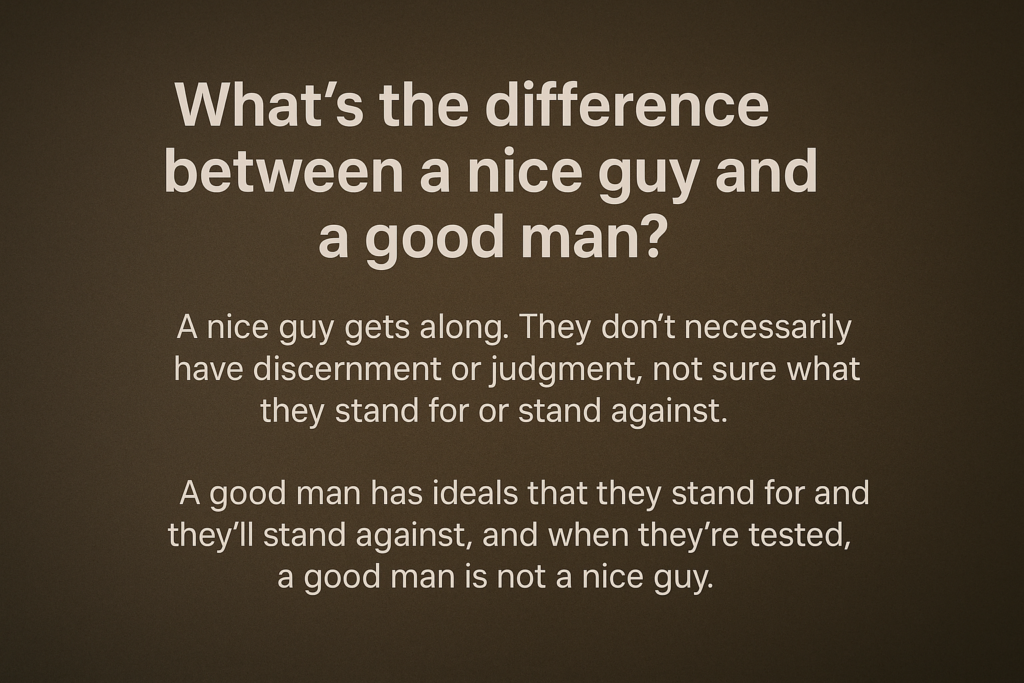
Words shape expectations. “Nice” often refers to manner, sociability, and agreeableness: being pleasant, avoiding conflict, and not causing friction. “Good,” when used to describe a person, implies a moral quality principles, courage, responsibility, and willingness to accept costs to uphold values.
A useful shorthand:
- Nice guy = agreeable, pleasant, conflict-averse, popularity-oriented.
- Good man = principled, discerning, protective, willing to take unpopular stands.
These are archetypes, not immutable categories. People can shift along the axis; the point is to illuminate patterns so you can choose which you want to cultivate.

The core differences (conceptual overview)
- Motivation
- Nice guy: motivated by acceptance, harmony, and avoiding negative judgment.
- Good man: motivated by ideals, responsibility, and integrity.
- Decision basis
- Nice guy: choices often driven by pleasing others or avoiding conflict.
- Good man: choices often driven by values and long-term good even if unpopular.
- Boundary enforcement
- Nice guy: hesitates to enforce boundaries to avoid conflict or rejection.
- Good man: sets and enforces boundaries to protect self and those he loves.
- Response under test
- Nice guy: likely to back down or accommodate when challenged.
- Good man: stands firm when core values or loved ones are threatened.
- Popularity vs respect
- Nice guy: may be liked, but not necessarily respected for integrity.
- Good man: may be less universally liked, and more consistently respected.
A deeper psychological view
Basic personality research (big five traits) separates agreeableness (which correlates with “niceness”) from conscientiousness and moral reasoning (which map onto the “good” axis). Highly agreeable people tend to avoid conflict; though they’re valuable socially, that trait can make them less likely to create or defend structure. Moral courage and virtue ethics involve more than warmth they require judgment, sacrifice, and moral imagination.
Also consider attachment and validation needs: some “nice” behavior stems from anxious attachment or high extrinsic validation needs actions done to gain approval. “Good” behavior tends to be less motivated by approval and more by internalized principles.
Real-world markers: how to tell the difference in practice
Below are everyday scenarios and how a “nice guy” and a “good man” typically act.
1: A friend disrespects your partner in public
- Nice guy: laughs it off, tries to smooth things, avoids confrontation to keep atmosphere light.
- Good man: calmly, clearly defends partner, sets consequence if needed; may try to resolve verbally first but won’t ignore harm.
2: Workplace ethical breach
- Nice guy: may ignore or rationalize the breach to stay liked or keep job harmony.
- Good man: raises the issue, reports if needed, accepts risk of friction for the sake of integrity.
3: Parenting and discipline
- Nice guy (as parent): risks permissiveness to stay your child’s friend; avoids discipline to avoid immediate upset.
- Good man (as parent): imposes fair limits, enforces consequences, models responsibility even when it’s hard.
Why being a good man is harder and why that’s why it’s more important
Being “good” often requires sacrifice: lost popularity, social friction, and short-term discomfort. Values demand trade-offs. A good man sometimes refuses what’s pleasant for what’s right. He accepts that moral responsibility can be lonely, and that doing the right thing often means accepting consequences.
This difficulty matters because stability, safety, and flourishing both individual and collective depend on people who will act rightly under pressure, not only when applause is available.
Pros and Cons
| Feature | Nice Guy (Pros) | Nice Guy (Cons) | Good Man (Pros) | Good Man (Cons) |
|---|---|---|---|---|
| Social likability | High | Can be shallow | Often lower than “nice” | May be less liked |
| Conflict handling | Avoids conflict | Avoids necessary boundary enforcement | Confronts harmful behavior | Faces more conflict |
| Moral courage | Low to medium | May compromise values | High | May pay social or economic price |
| Long-term reliability | Lower | May crumble under pressure | Higher | Costs of consistency |
| Parenting | Gentle | Overpermissive risk | Firm and fair | Seen as strict |
Case studies / examples
1 – The neighborhood dispute
Situation: A neighbor repeatedly leaves hazardous waste near shared property.
- Nice guy neighbor: apologetic but lets it slide. Tries to be friendly to avoid escalation. Problem persists.
- Good man neighbor: documents incidents, raises the issue with the neighbor clearly and firmly, involves HOA or local authorities if the behavior continues protects communal safety.
Lesson: Niceness without boundary enforcement is ineffective; goodness without action risks safety lapses.
2 – The workplace whistleblow
Situation: A co-worker manipulates timesheets and the team leader ignores it.
- Nice guy employee: feels uncomfortable, avoids “making waves,” says nothing.
- Good man employee: raises concern with HR or through proper channels; if suppressed, escalates or uses anonymous reporting to protect colleagues and company integrity.
Lesson: Ethical responsibility sometimes requires pushing against institutional inertia.
3 – The relationship test
Situation: Your partner faces slander from a close friend.
- Nice guy: might let the gossip continue to avoid drama.
- Good man: defends the partner and addresses the friend directly. May sacrifice friendships to protect relationship and truth.
Lesson: Protection of close relationships is a hallmark of goodness.
Practical steps to move from “nice” toward “good”
- Clarify your values. Write down 5–7 principles you stand for (e.g., honesty, loyalty, fairness, protection of the vulnerable). Values become rails for action.
- Practice boundary setting. Start small: say “no” to low-stakes requests you genuinely don’t want. Move to larger boundaries: protect your time, finances, family.
- Learn to tolerate discomfort. Doing what’s right often produces friction. Train by taking small risks: call out a microinjustice, ask for needed changes at work.
- Define consequences, and communicate them. If someone crosses a line, know what you’ll do and tell them (calmly). Follow through if necessary.
- Build moral imagination. Read, discuss, role-play scenarios where values are tested. Consider possible outcomes before you act.
- Practice courageous speech. Be direct, concise, and calm when standing up for your beliefs or people you protect.
- Forge a support network. Goodness isn’t isolation; reliable friends, mentors, or community give strength when you need to stand alone.
- Commit to repair when you’re wrong. Being a good man includes humility admit mistakes, apologize, and make amends.
How to be firm without becoming harsh
A common fear: “If I stop being a nice guy, will I become an asshole?” No. Firmness and compassion can coexist. The model is courage + empathy:
- Courage: say what must be said.
- Empathy: say it in a way that respects the dignity of the other.
Firm boundaries delivered with calm empathy communicate strength and respect. Practiced often, this becomes the hallmark of someone who is both good and humane.
Visual comparison
| Behavior | Nice Guy Response | Good Man Response |
|---|---|---|
| Offended friend insults your partner | Laughs it off | Intervenes, protects partner |
| Boss asks you to fudge numbers | Stays silent | Refuses and reports |
| Child breaks rule repeatedly | Avoids discipline | Sets clear consequences and follows through |
| Stranger encroaches on family space | Hopes it stops | Defends family, escalates if needed |
| Moral dilemma public vs private | Chooses harmony | Chooses principle |
Real-life role models and cautionary tales
There are many cultural and historical figures who demonstrate the difference: people who acted for the common good at cost to themselves (soldiers who refused illegal orders, activists who endured imprisonment). Conversely, history is full of people liked in their circles but complicit with harm because they prioritized harmony over justice.
When studying role models, notice both their courage and their humility true “goodness” is rarely perfect; it’s a practiced orientation.
Frequently encountered objections and responses
1: “Being ‘good’ just means being strict or authoritarian.”
Response: No. Goodness involves values and proportionality. It requires fairness and humility firm but not vindictive.
2: “If I stop being nice, I’ll lose my relationships.”
Response: You may lose some connections, but likely you’ll gain deeper, more honest relationships. Surface-level approval is different from mutual respect.
3: “I don’t want to fight all the time.”
Response: Being a good man isn’t about seeking fights. It’s about being willing to act when values or people you love are threatened most days will still be ordinary and calm.
Exercises to practice being a good man (30-day plan)
1 – Values & Boundaries
- Day 1: Write 5 core values.
- Day 2–3: Identify 3 areas where you’re too accommodating.
- Day 4–7: Practice saying “no” in small situations.
2 – Speaking up
- Role-play a difficult conversation with a friend or mirror.
- Day 8–14: Have one direct conversation about an important boundary.
3 – Responsibility
- Volunteer or take responsibility in a community setting.
- Document one instance where you chose principle over popularity.
4 – Reflection & Repair
- Journal about outcomes.
- If you failed a test, apologize and plan repair.
When “nice” is actually manipulative (warning sign)
Some people weaponize “niceness” as a social strategy being superficially agreeable while seeking control or external validation. This is different and unhealthy. Authentic goodness is compatible with humility, not manipulation.
Be honest with yourself: are you being nice to avoid discomfort, or to influence others? Awareness helps you choose integrity.
Supporting relationships: partner expectations
If you’re in a relationship, being a good man means communicating your values to your partner, aligning on boundaries, and showing you’ll protect the relationship. A partner who values integrity will respect your willingness to act even if your decisions sometimes create short friction.
Pros and Cons (expanded, bullet list)
Pros of cultivating ‘good man’ traits
- Greater long-term trust and respect.
- Stronger protection of family and community.
- Clearer sense of purpose and moral coherence.
- Increased ability to act in crises.
Cons / costs
- Loss of some popularity or easy social approval.
- More frequent short-term conflicts.
- Potential professional or social cost if others resist your stance.
- Emotional labor: the burden of responsibility can be heavy.
Example mini case study “The Family Decision”
Context: A family member struggles with addiction and repeatedly puts kids at risk.
- Nice guy approach: tolerates behavior, makes excuses to avoid drama, hopes it will pass.
- Good man approach: intervenes, arranges for help, places children’s safety first even if it fractures family dynamics temporarily.
Outcome: Short-term conflict, long-term child safety and potential for recovery. This exemplifies the moral calculus: immediate discomfort for long-term good.
How communities benefit from more “good men”
Communities with people willing to enforce fair rules, intervene against harm, and sacrifice for public goods tend to be safer and more flourishing. Niceness alone can’t carry institutions; virtues like courage, justice, and prudence are needed.
Mistakes to avoid while trying to be “good”
- Confusing stubbornness with integrity. Integrity involves listening and changing when appropriate.
- Using “good” as moral superiority. Real goodness is humble and self-critical.
- Failing to practice empathy. Protecting others doesn’t mean abandoning kindness.
- Neglecting self-care. You can’t protect others if you burn out set limits on your own obligations.
A quick self-assessment quiz (informal)
Answer honestly on a scale of 1–5 (1 = rarely, 5 = always):
- I define clear principles I try to live by.
- I enforce boundaries even when it costs social approval.
- I act to protect people I love when they are threatened.
- I admit mistakes and repair harm.
- I avoid action primarily to maintain popularity.
High scores on 1–4 and low on 5 suggest movement toward “goodness.”
Key Takeaways
- “Nice” focuses on agreeableness; “good” focuses on principled action.
- A good man often chooses difficult paths because he values responsibility over popularity.
- Being good requires boundary-setting, courage, and the willingness to accept consequences.
- You can cultivate goodness through deliberate practice: clarify values, practice discomfort, and communicate consequences.
- Goodness is compatible with compassion; firmness need not equal cruelty.
🔔For more tutorials like this, consider subscribing to our blog.
📩 Do you have questions or suggestions? Leave a comment or contact us!
🏷️ Tags: difference between a nice guy and a good man, nice vs good, boundaries and integrity, moral courage, relationship advice, personal growth, masculinity, values and ethics, how to set boundaries, emotional maturity
📢 Hashtags: #GoodMan #NiceGuy #Boundaries #Character #PersonalGrowth #MoralCourage #Relationships #Integrity #Manhood #Leadership
Final Reflections
Becoming a “good man” is a practice more than an identity. It asks for clarity about what matters, discipline to enforce it, courage to accept consequences, and compassion to temper strength with care. If you already lean toward niceness, that is a foundation build on it intentionally, add principles, and practice the small acts that prepare you for the big tests.
You may also be interested in: WPZone Neon Clock – Digital Clock for WordPress
