

⏲️ Estimated reading time: 35 min
Table of Contents
Italy has announced tougher measures against violent demonstrations, property damage, and youth involvement in public disorder. This detailed guide explains the government’s proposals, potential penalties, parental responsibility, policing changes, and the importance of peaceful protest, while examining what these developments could mean for ordinary residents and businesses.
Why Italy Is Taking a Tougher Approach to Public Violence
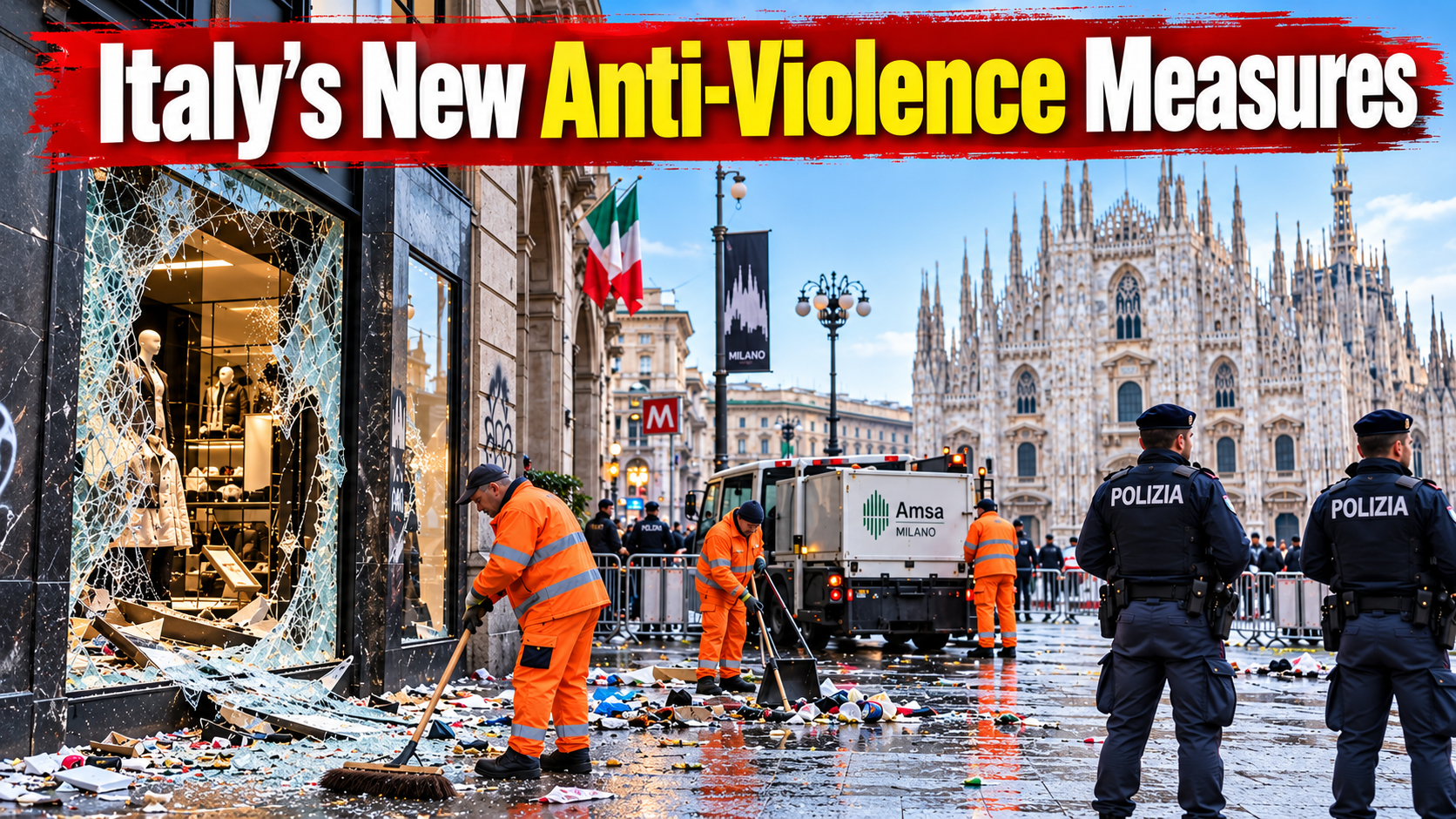
Italy is facing renewed questions about public safety, protest rights, and the responsibilities of people who participate in demonstrations. According to a government statement reproduced in the supplied transcript, violent incidents in Milan and other Italian cities prompted officials to announce additional security measures. The statement describes damaged storefronts, looted shops, attacks on police officers, and public property destruction. These events have raised concerns among business owners, residents, parents, and public authorities. At the center of the discussion is a difficult question: how can a democratic country protect peaceful demonstrations while responding effectively to people who commit violence?
The government’s answer, as presented in the statement, involves stronger penalties, faster procedures for recovering damages, additional police support, and changes affecting minors. Officials also emphasize the importance of distinguishing peaceful protesters from people who use public gatherings as opportunities to commit crimes. That distinction matters because protests can involve thousands of people with different motivations. Someone holding a sign, chanting peacefully, or expressing political disagreement should not automatically be treated like someone breaking windows or attacking others. Understanding this difference is essential when discussing the announced measures.
What Happened in Milan and Other Italian Cities?
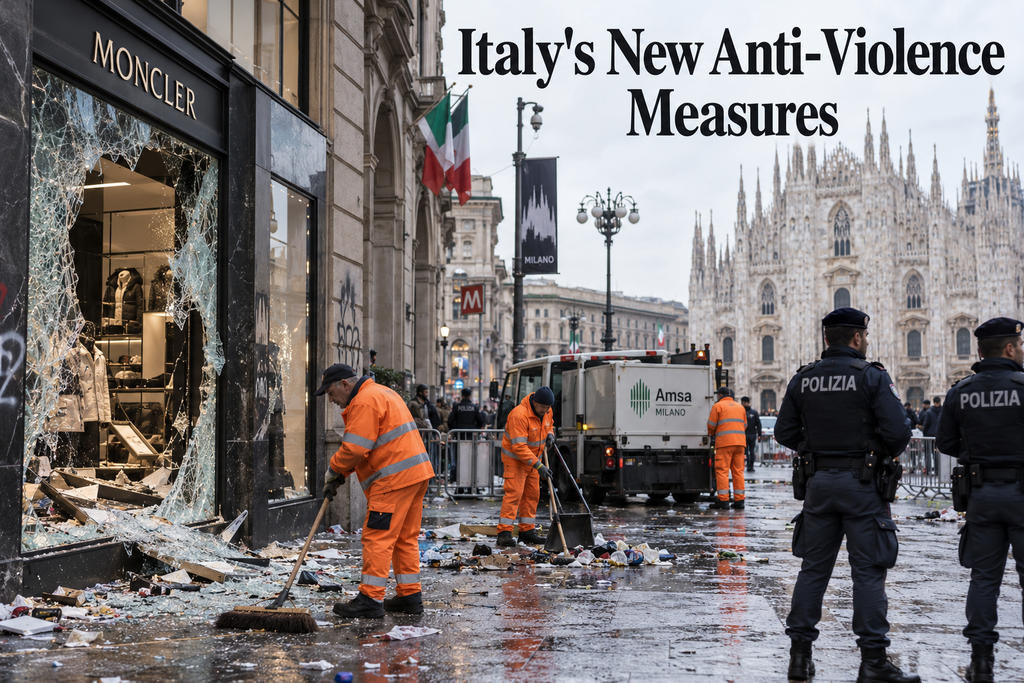
The supplied statement describes scenes of disorder during a weekend of demonstrations. Shops reportedly suffered damage, windows were broken, and law enforcement officers faced attacks. The government also referred to people stealing merchandise and recording destructive acts for social media. Although the statement presents these incidents as serious public safety concerns, it does not provide a complete timeline, independently verified incident reports, or court findings establishing individual responsibility. For that reason, readers should distinguish the government’s account from conclusions reached through investigations and judicial proceedings.
According to figures quoted in the statement, nearly 200 law enforcement officers were injured, while approximately 330 people were detained or arrested. It also attributes an estimated €1 million in damage in Milan to Confcommercio, an Italian business association. These numbers are significant, but they should be treated as reported figures until corroborated through official records. Arrests do not establish guilt, and damage estimates can change after insurers, businesses, and investigators complete their assessments. Nevertheless, the statement illustrates why authorities are placing considerable attention on security, compensation, and the prevention of further incidents.
Why the Government Says Existing Rules Are Not Enough
The government argues that ordinary law enforcement responses may not sufficiently discourage coordinated violence during public demonstrations. Its announced approach combines criminal penalties with financial consequences and preventive measures. The underlying idea is that people should understand the possible legal and financial costs before participating in destructive behavior. Officials also want damaged businesses and public authorities to recover money more efficiently. However, a stronger legal framework does not automatically guarantee fewer incidents. Effective prevention also depends on fair enforcement, credible investigations, proportionate penalties, community cooperation, and confidence in the justice system.
Another concern involves younger participants. The statement claims that groups of minors were drawn into disorder through videos circulated on social media. It describes some participants as unusually young and suggests that filming destruction became part of the attraction. These claims highlight a broader issue: online attention can sometimes reward dangerous behavior. Yet it would be inaccurate to suggest that social media alone causes youth violence. Family circumstances, peer pressure, education, economic opportunities, and individual decisions can all influence behavior. A serious response should examine these factors alongside law enforcement.
New Penalties for Violent Participation in Demonstrations
One of the central announcements concerns a proposed or newly approved offense described as violent participation in a demonstration. According to the transcript, the measure targets people who join a group of at least five individuals and engage in dangerous actions during a march or protest. Examples include throwing stones, firecrackers, or sticks. The statement says offenders could face imprisonment of up to five years and fines reaching €20,000. These are the penalties described by the government, not independently confirmed sentencing rules. Their exact application would depend on the final legal text, the evidence, and judicial interpretation.
The distinction between participating in a demonstration and participating in violence is crucial. A peaceful protester should not be presumed responsible merely because someone nearby commits an offense. In criminal proceedings, the authorities generally need to establish the legal elements of the alleged crime and connect them to an individual’s conduct. For example, imagine a demonstration involving 2,000 participants. Most are walking peacefully, but a smaller group begins throwing objects toward a police line. Investigators would need to determine who actually participated in the prohibited behavior, rather than treating everyone in the crowd as equally responsible.
How the Five-Person Group Rule Is Described
The government statement specifically refers to groups containing five or more people. Under the described measure, the number of participants becomes relevant when violent acts occur during a public gathering. Consider a fictional example involving six individuals who arrive at a demonstration and begin throwing dangerous objects toward buildings and police officers. If the announced offense becomes legally applicable and prosecutors prove the required elements, those involved could face the penalties described in the statement. The number of people alone would not establish guilt; the nature of each person’s conduct would still matter.
Now consider a different situation. Six friends attend the same demonstration, carry signs, and remain peaceful. Another group, unrelated to them, begins damaging nearby property. Their mere presence in the same public space should not automatically make them participants in the violence. This distinction is important for protecting freedom of assembly and ensuring that criminal liability remains connected to conduct. Readers should also remember that the transcript does not provide the complete statutory definition, including any requirements relating to intent, knowledge, or individual participation.
Covered Faces, Injuries, and Aggravating Circumstances
The statement indicates that penalties may increase when someone covers their face or injures another person during violent disorder. It also refers to tougher treatment of group-related property destruction. These circumstances are presented as factors that could make an offense more serious. For example, a person who intentionally injures someone while taking part in coordinated violence may face different legal consequences from a person who commits a lesser offense without causing injury. The precise relationship between these circumstances and sentencing must be established by consulting the enacted legislation.
Face coverings require particularly careful discussion. People cover their faces for many legitimate reasons, including medical protection, religious practices, cold weather, and personal safety. Whether a particular covering has legal significance depends on the applicable law and circumstances. The transcript does not establish that every person wearing a mask at a demonstration would face increased punishment. Responsible reporting should avoid that interpretation. The relevant question is how lawmakers define prohibited conduct and how courts apply those definitions while respecting fundamental rights.
Who Pays When Public or Private Property Is Damaged?
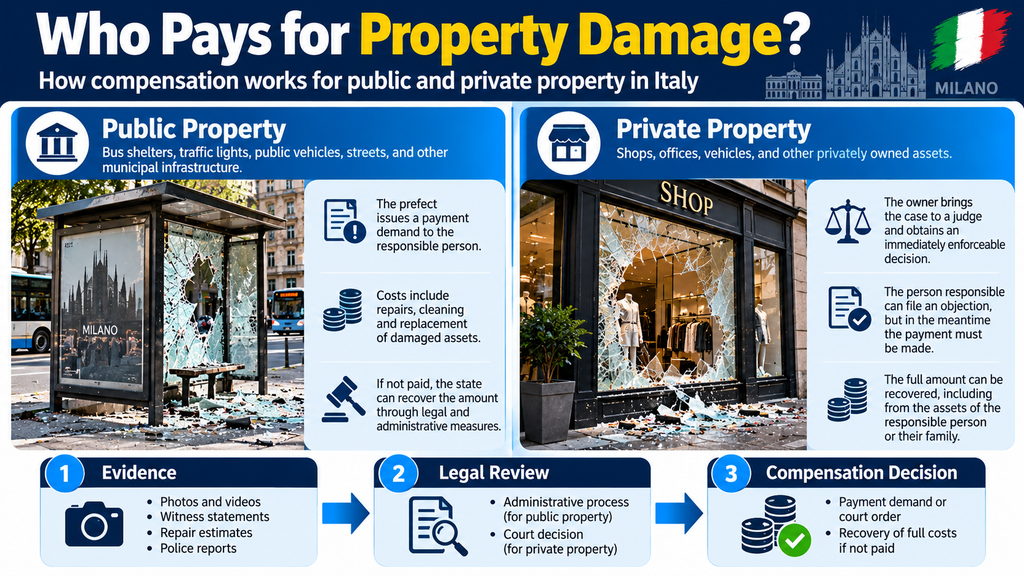
The second major announcement focuses on financial responsibility. The government argues that people who damage property should bear the resulting costs. This principle may sound straightforward, but recovering compensation can involve several legal questions. Authorities must identify the responsible person, establish the damage, determine its value, and follow an appropriate legal procedure. The statement proposes different routes depending on whether the damaged property belongs to a public authority or a private owner. It also discusses the potential financial responsibility of parents when minors cause damage.
For ordinary residents, the financial consequences can sometimes be more immediate than the criminal proceedings. A broken storefront may require emergency repairs, temporary closure, replacement glass, cleaning, and additional security. A damaged public bus shelter may affect commuters until repairs are completed. Compensation procedures are intended to address these losses, although the amount recoverable depends on applicable law and supporting evidence. The government statement suggests a more direct approach, but the exact legal safeguards and recovery mechanisms require confirmation from the official decree.
Damage to Public Property
Public property includes infrastructure maintained for community use, such as traffic lights, bus shelters, public vehicles, and municipal facilities. According to the statement, when someone damages these assets, the prefect could issue a payment demand to the responsible person. The prefect is an important representative of the Italian state’s administration at the local level. The announcement suggests that this procedure would allow authorities to pursue recovery without following the same initial route as a private owner. However, the transcript does not explain every administrative step or available safeguard.
Imagine a fictional situation in which a group damages a bus shelter during a demonstration. The repair costs include replacement panels, installation work, and removal of broken materials. Under the announced approach, authorities might seek repayment from those legally responsible. This would require reliable identification and an appropriate assessment of the damage. Simply being present near the bus shelter would not prove that a person caused the loss. The effectiveness and fairness of such a procedure depend on evidence, transparent cost calculations, and meaningful opportunities to challenge an incorrect demand.
Damage to Shops, Cars, and Other Private Property
Private property damage can affect businesses, families, and individuals. The transcript explains that an owner whose shop window, vehicle, or other property has been damaged could approach a judge and seek an immediately enforceable decision. The government presents this as a way to speed up compensation. It also says the person required to pay could oppose the decision. What remains unclear from the transcript is the precise procedural timetable, the conditions for enforcement, and the legal standards that the judge must apply.
Consider a small shop that suffers €8,000 in documented losses after its entrance is damaged. The owner may have invoices for emergency glass replacement, photographs of the scene, and records of other direct expenses. These materials could help establish a compensation claim. However, not every requested amount is automatically recoverable, and insurance coverage may affect how losses are handled. The court would still need to apply the relevant legal rules. Business owners should preserve evidence, report incidents promptly, and seek qualified legal advice before assuming that a particular recovery procedure is available.
Could Parents Be Required to Pay for Damage Caused by Minors?
The statement gives particular attention to parental responsibility. It says parents could be required to pay when their underage children cause damage. The government presents this as a way to make families more aware of the consequences of destructive behavior. Yet parental liability is a complex legal subject. Its application can depend on the child’s age, the circumstances, the relationship between the parties, and the legal basis of the claim. The transcript’s simplified explanation should not be treated as a complete description of Italian civil liability law.
Imagine a 16-year-old who is found legally responsible for damaging several parked vehicles. Repair costs might reach thousands of euros, creating significant financial pressure for the family. The government’s announcement suggests that parents could face recovery proceedings, potentially involving family assets. However, the statement does not establish that every parent must automatically pay every claim without a judicial assessment or available defense. Families facing such allegations should obtain legal advice, review the evidence carefully, and understand the difference between criminal responsibility and civil compensation.
Changes Affecting Minors Between 14 and 18 Years Old
Another major part of the announcement concerns juvenile justice. The government statement discusses how Italian law assesses criminal responsibility for young people aged 14 to 18. It claims that authorities previously had to demonstrate, in individual cases, that a minor understood the nature of their actions. The statement then describes a change under which this capacity would be presumed unless evidence showed otherwise. It says a related provision was already under parliamentary consideration and that the newly announced decree would make the approach immediately operational.
This issue deserves particular care because the legal position of minors cannot be fully explained through a short political statement. Criminal responsibility, capacity to understand, pretrial detention, sentencing, and rehabilitation are different legal questions. Italy’s juvenile justice system also includes protections that recognize children’s age and development. Before publishing a definitive claim about a reversal of the burden of proof, the exact legislative language and its legal status should be checked. The announcement alone does not establish how courts must decide every future case.
What Does the Presumption of Capacity Mean?
In simple terms, a legal presumption is a starting assumption that may apply unless contrary evidence is presented. The statement suggests that, for certain minors, the law would begin from the position that they could understand the significance of their actions. This does not mean that a teenager would automatically be convicted. Prosecutors would still need to prove the alleged offense according to the applicable criminal procedure, while the defense could raise relevant arguments concerning capacity and other legal issues.
For example, imagine a 15-year-old accused of participating in serious property destruction. Investigators would need to establish what happened and what role the teenager played. Questions about the young person’s understanding, maturity, and circumstances could also become relevant. The announced change concerns the starting legal approach to capacity, not a replacement for a criminal trial. Readers should avoid interpreting it as a rule that all children aged 14 or older are automatically guilty whenever police accuse them of wrongdoing.
Pretrial Detention and Young Offenders
The statement also announces broader use of pretrial detention involving minors. Pretrial detention means holding a person in custody before a final judgment under conditions established by law. It is not the same as a criminal sentence, and it should not be described as proof of guilt. The transcript characterizes the change as extending a measure to minors, but it does not provide enough detail to determine which forms of juvenile custody are being modified or whether comparable procedures already existed.
For example, if a minor is accused of a serious violent offense, a court may need to consider risks, available alternatives, and the safeguards required by juvenile law. The government argues that stronger preventive tools could help address dangerous conduct. Critics of expanded detention powers may question their impact on education, rehabilitation, and the presumption of innocence. Both public safety and children’s rights deserve consideration. The exact detention conditions, judicial oversight, and eligibility requirements should be verified against official legal sources.
Why Rehabilitation Still Matters
Young people differ from adults in emotional development, judgment, and susceptibility to peer influence. These differences do not excuse violence, but they help explain why juvenile justice systems often include educational and rehabilitative goals. A teenager who damages property may need to accept responsibility, compensate victims where legally appropriate, and participate in programs that reduce the risk of repeating the behavior. A response focused only on punishment may miss opportunities to address underlying causes and prevent future incidents.
Consider two fictional teenagers accused of similar offenses. One has repeatedly engaged in serious violence, while the other has no previous record and was influenced by peers. The appropriate legal response may differ depending on the evidence, seriousness of the conduct, personal circumstances, and applicable law. Courts and juvenile professionals must make these assessments rather than assuming that every young offender presents the same risk. The broader public interest includes both protecting communities today and helping young people avoid further harm.
Additional Military Personnel and Security Support in Milan
The government statement announces that 500 additional military personnel would be deployed to Milan by the end of the year, alongside police and Carabinieri. This is presented as a reinforcement of existing public security arrangements. However, the transcript does not identify the year of deployment, the precise start date, or the legal framework governing the personnel’s duties. It also does not confirm that the deployment has already occurred. Readers should therefore understand the figure as part of the announced plan rather than an independently verified current staffing level.
Military support in public spaces can serve several purposes, depending on the legal mandate. Personnel may assist with security around important locations, support visibility, or work within coordinated arrangements involving civilian authorities. Their powers and responsibilities are not necessarily identical to those of police officers. A visible security presence may reassure some residents, while others may raise questions about proportionality and civil liberties. Clear operational rules, public accountability, and coordination are important when different security institutions work in the same urban environment.
What Could Additional Personnel Mean for Residents?
For people living or working in Milan, additional security personnel could mean a more visible official presence in certain public areas. Residents might notice increased patrol activity near transport hubs, commercial streets, or locations considered vulnerable. However, the transcript does not specify where the personnel would operate, how they would be deployed, or whether ordinary travel arrangements would change. It would be misleading to claim that every neighborhood will receive extra patrols or that the deployment will automatically reduce crime.
Imagine a busy shopping district that experienced property damage during a demonstration. Authorities might decide to improve coordination, strengthen preventive patrols, or adjust emergency response planning. Local businesses could benefit from clearer communication about safety procedures. Yet meaningful improvements require more than personnel numbers. They depend on intelligence, training, community trust, lawful enforcement, and cooperation between institutions. Residents should rely on official local notices for practical information rather than assumptions based on national political announcements.
More Resources for Juvenile Justice
Alongside the security reinforcement, the statement promises additional magistrates and places within juvenile institutions. The government’s stated goal is to improve the system’s capacity to respond to offenses involving young people. More personnel may help courts handle cases, while additional institutional capacity could reduce pressure on existing facilities. However, the announcement does not include a detailed budget, recruitment schedule, staffing breakdown, or specific number of new places. These details are necessary to evaluate the plan’s implementation.
An effective juvenile justice system requires appropriate facilities, trained professionals, legal representation, education, mental health support where needed, and rehabilitation programs. Increasing capacity without adequate staffing and safeguards could create new problems. Conversely, a properly funded system may be better positioned to respond promptly and fairly. Policymakers must balance the need for accountability with the long-term goal of reducing reoffending. Measuring outcomes over time will be more informative than judging the policy solely by the number of announced positions.
Social Media and the Involvement of Young People
One of the most concerning elements in the government statement is the reported involvement of very young participants. Officials claim that some teenagers were encouraged to attend gatherings through videos distributed on social media. According to the statement, certain participants then recorded acts of vandalism or theft. The government also reported that the youngest person identified in Milan was just 11 years old. This detail was presented as a warning about how destructive behavior can influence children who are still developing their understanding of responsibility and consequences.
However, the reported involvement of an 11-year-old does not mean that a child of that age can automatically face criminal prosecution. Italian juvenile justice guidance identifies 14 as the minimum age of criminal responsibility. Children below that age may still require protective or other legally authorized interventions in specific circumstances. The distinction matters because the purpose of responding to harmful behavior by a child is not necessarily identical to punishing an adult offender.
Why Online Attention Can Encourage Risky Behavior
Social media platforms can spread videos quickly, sometimes reaching thousands of viewers within minutes. When destructive actions attract attention, young viewers may misunderstand that visibility as approval. A teenager might see a video showing damaged property, read comments celebrating the incident, and begin to associate dangerous behavior with popularity. This does not mean that everyone watching such content will imitate it. Most young people use social media without engaging in violence, and the reasons behind criminal behavior are much more complicated than a single online video.
Parents and educators can help by discussing what online videos leave out. A short clip may show excitement, laughter, or a crowd cheering, but it rarely shows the consequences for injured people, affected businesses, or the individuals later investigated. For example, a teenager who films property damage may overlook the possibility of legal proceedings, financial claims, school disruption, and lasting harm to others. Teaching young people to question what they see online can reduce the appeal of dangerous challenges and help them make more responsible decisions.
How Parents Can Talk About Violence Without Creating Fear
Conversations about public disorder should be calm, specific, and appropriate for a child’s age. Rather than telling teenagers that every demonstration is dangerous, parents can explain the difference between peaceful civic participation and criminal conduct. A young person should understand that expressing an opinion, joining a lawful gathering, and discussing political issues are legitimate activities. Throwing dangerous objects, stealing, or deliberately destroying property are different actions with potentially serious consequences. This approach encourages both respect for democratic rights and personal responsibility.
Parents can also use everyday examples. If a teenager sees a video of someone breaking a shop window, ask how the shop owner might feel and who would pay for repairs. Discuss what could happen to employees if the business closes temporarily. Encourage the teenager to think about the people who are not visible in the video. These conversations help develop empathy without relying on threats or exaggerated claims. Families should also make sure children know how to leave an unsafe situation and contact a trusted adult.
Biometric Recognition and Artificial Intelligence in Public Security
The supplied statement refers to previously approved measures involving biometric recognition and artificial intelligence. It suggests that these technologies could help identify individuals who conceal their faces with hoods. However, the transcript does not explain which technology is being used, whether it has been deployed, what databases it accesses, or which legal safeguards apply. It would therefore be premature to describe a specific nationwide facial recognition system as operational based on this statement alone.
Biometric identification is a sensitive area because it involves information connected to a person’s physical characteristics. Facial recognition systems may compare images against reference databases, but their accuracy can vary depending on image quality, lighting, camera angles, and other factors. A hood or face covering can also make identification more difficult. Any public security use of biometric technology should be evaluated against applicable privacy laws, necessity requirements, proportionality standards, and independent oversight arrangements.
How AI-Assisted Identification Could Work
In a general technical sense, AI-assisted video analysis can help investigators review large amounts of recorded footage. Software may identify visual patterns, organize recordings, or flag segments for human examination. For example, investigators reviewing several hours of footage from different cameras might use analytical tools to locate particular events more efficiently. Such technology does not automatically establish a person’s identity or prove criminal involvement. Human review, reliable evidence, and lawful investigative procedures remain essential.
A system that incorrectly identifies an individual could expose an innocent person to unnecessary scrutiny. This is why technical accuracy and legal accountability matter. Authorities need clear rules governing access, data retention, error correction, and permitted uses. The supplied statement does not provide enough information to assess whether the announced Italian measures satisfy these requirements. Readers should distinguish the government’s description of technological capabilities from independently documented deployment and performance.
Privacy and the Right to Peaceful Assembly
People should be able to attend lawful demonstrations without automatically being treated as suspects. At the same time, authorities have legitimate responsibilities to investigate violence and protect the public. Biometric surveillance sits at the intersection of these interests. Broad or poorly controlled monitoring could discourage people from participating in peaceful civic activities, even when they have done nothing wrong. Conversely, carefully limited investigative tools may assist authorities when used under appropriate legal conditions.
The important questions concern who can authorize surveillance, what evidence is required, how long information is retained, and whether affected individuals have access to effective remedies. Transparency also helps communities understand the difference between targeted criminal investigations and indiscriminate monitoring. Until the relevant Italian legal provisions are identified, no definitive claim should be made about the scope of biometric surveillance described in the statement.
Why Peaceful Protest Must Remain Protected
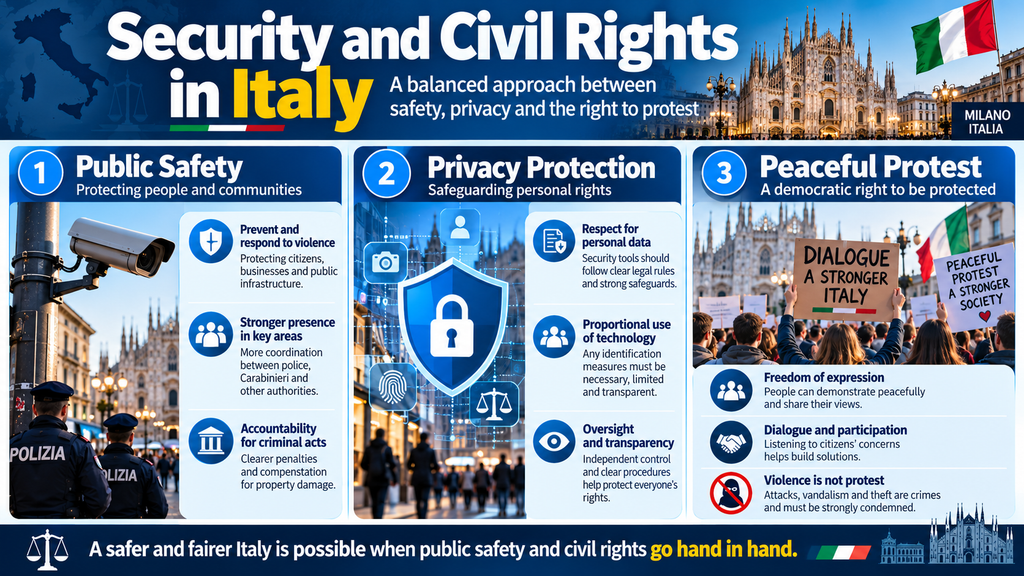
An important part of the government statement distinguishes peaceful demonstrators from people who commit violence. The speaker refers to farmers, road transport workers, industrial employees, and communities experiencing economic difficulties. These groups may organize demonstrations to seek better working conditions, government support, or changes in public policy. Their concerns can be legitimate even when authorities disagree with their demands. Democratic participation requires space for criticism, public debate, and organized civic action.
Peaceful protest can also help governments understand problems that might otherwise receive little attention. Workers may demonstrate over employment conditions, farmers may raise concerns about operating costs, and residents may oppose local decisions affecting their communities. None of these activities should be confused automatically with vandalism. The presence of isolated offenders at a large demonstration does not erase the rights of everyone else. Authorities and organizers both have responsibilities to reduce risks while protecting lawful participation.
The Difference Between Demonstration and Destruction
Imagine two gatherings taking place in the same city. During the first, hundreds of people march peacefully, carry banners, and speak with journalists. During the second, a small group deliberately damages parked vehicles and attacks other people. Although both events may occur in public spaces, the conduct involved is fundamentally different. A democratic legal system should respond to actual behavior rather than assuming that everyone expressing political dissatisfaction poses a security threat.
The distinction also matters for public trust. If peaceful participants fear collective punishment, they may lose confidence in institutions. If violent offenders face no meaningful consequences, residents and businesses may lose confidence in public protection. Fair enforcement must therefore avoid both extremes. Investigations should focus on evidence, and any restrictions should have a lawful basis. Public authorities should also communicate clearly so that ordinary residents understand which conduct is prohibited and which activities remain protected.
Dialogue as an Alternative to Confrontation
The transcript mentions a meeting between Transport Minister Matteo Salvini and representatives of the road transport sector. The government uses this example to argue that it can oppose violence while listening to people who protest peacefully. Dialogue does not guarantee that every demand will be accepted. It can, however, create opportunities to identify practical solutions, clarify misunderstandings, and reduce tension before disagreements escalate.
For example, transport workers concerned about rising operating costs may request meetings with officials, present financial evidence, and propose policy changes. Government representatives can explain existing programs, discuss limitations, and negotiate possible adjustments. Even when the parties remain divided, structured communication can make the disagreement more constructive. Public demonstrations and negotiations are not mutually exclusive. In many cases, both contribute to democratic participation and accountability.
How Violent Disorder Affects Small Businesses and Communities
Property destruction can create consequences far beyond the immediate repair bill. A damaged storefront may prevent a business from opening for several days. Employees may lose working hours, customers may shop elsewhere, and owners may face additional expenses for security and cleaning. For a small family business, even a temporary closure can create financial pressure. The government statement emphasizes these consequences to explain why it wants faster compensation and stronger accountability for destructive behavior.
Consider a neighborhood bakery that suffers broken windows during an incident. The owner must arrange emergency repairs, protect equipment, and determine whether the premises are safe for customers. If the bakery cannot open, it may lose daily sales while still paying rent, utilities, and wages. Insurance might cover some losses, but coverage depends on the policy and circumstances. The impact extends to suppliers, employees, and customers who rely on the business. These practical consequences deserve attention when discussing public disorder.
The Financial Burden of Repairs and Business Interruptions
Repair costs are only one part of the economic impact. Businesses may also need temporary barriers, replacement equipment, professional cleaning, and additional security services. In some cases, damaged stock must be discarded. Owners may spend hours dealing with insurers, police reports, contractors, and administrative paperwork. These activities take time away from ordinary operations and can be particularly difficult for businesses with limited staff.
For example, replacing a broken shop window might be relatively straightforward, but restoring a damaged entrance and replacing merchandise can take longer. The business may also experience reduced customer confidence after the incident. Reliable compensation procedures can help victims recover, but financial reimbursement cannot always eliminate the disruption. This is one reason preventive measures, rapid emergency response, and support for affected businesses remain important alongside criminal investigations.
What Business Owners Can Do After an Incident
The first priority after violence or property damage is personal safety. Business owners should avoid confronting dangerous individuals and contact emergency services when necessary. Once the location is safe, photographs, video recordings, witness details, and repair estimates may help document the damage. Owners should preserve original records and avoid publishing identifiable footage of suspected offenders without considering privacy and legal implications. An official police report may also be important for insurance and legal proceedings.
The next step is to contact the insurer and review the relevant policy. Some policies may cover vandalism, broken glass, theft, or business interruption, while others contain exclusions or specific reporting deadlines. Owners should keep receipts for emergency repairs and maintain a clear record of communications. If compensation is disputed or substantial losses are involved, professional legal advice may be appropriate. The government’s announced procedures should not be assumed to replace existing reporting, insurance, or evidentiary requirements.
What the Reported Arrest Figures Tell Us and What They Do Not
The government statement refers to approximately 330 people being detained or arrested after the incidents. It also makes claims about the backgrounds of some individuals. Such figures can attract considerable public attention, particularly when connected to debates about migration, crime, and public safety. However, arrests are not convictions, and demographic descriptions do not establish why a person allegedly committed an offense. Responsible reporting should avoid treating an entire population group as responsible for the actions attributed to particular individuals.
To evaluate the situation properly, readers would need verified information about the number of incidents, alleged offenses, evidence collected, charges filed, and subsequent judicial outcomes. It would also be necessary to understand how categories such as nationality, birthplace, and family background were defined. Without that context, a numerical claim can easily be misunderstood. The most useful principle is straightforward: criminal responsibility should be assessed individually, based on conduct and evidence, rather than assumptions about someone’s origin.
Why Arrests Are Not the Same as Convictions
An arrest or detention can occur during the investigative stage of a criminal case. It does not mean that a court has established guilt. Investigators may later gather additional evidence, prosecutors may change allegations, or courts may dismiss charges. Some cases may result in convictions, while others may not. The presumption of innocence remains an important safeguard because it prevents allegations from being presented as proven facts before the appropriate legal process is completed.
Imagine a person detained near a damaged building during a demonstration. Investigators might initially suspect involvement, but subsequent footage could show that the individual was trying to leave the area. Another person might be identified through reliable evidence as having deliberately caused damage. These situations require different legal responses. Accurate journalism should use terms such as “suspected,” “accused,” and “convicted” carefully, rather than treating them as interchangeable.
What Residents and Visitors Should Know During Demonstrations
Most people attending a peaceful demonstration do not intend to participate in disorder. Nevertheless, large public gatherings can affect transportation, traffic, and access to commercial areas. Residents and visitors can reduce inconvenience by checking official local information before traveling. Public transport operators, municipal authorities, and police services may publish notices about temporary closures or route changes. These practical updates are generally more useful than relying on dramatic videos shared without context.
Anyone who encounters an unsafe situation should prioritize leaving the area calmly when possible. Avoid moving toward violent confrontations to record footage, and follow lawful instructions from emergency personnel. If someone is injured or faces immediate danger, contact the appropriate emergency service. In Italy, 112 is the general emergency number. Visitors should also keep identification and important contact information accessible, especially when traveling through unfamiliar areas.
How to Participate in a Demonstration Responsibly
Before attending a public gathering, participants can review the organizer’s information and any applicable local requirements. It is helpful to understand the planned route, expected duration, and available transportation. People attending with friends or family can agree on a meeting point in case they become separated. Participants should avoid carrying dangerous objects and should not engage with individuals encouraging violence or property damage.
During the demonstration, remaining aware of the surroundings is important. If a peaceful gathering becomes unsafe, participants can move away from the disturbance rather than becoming involved. Recording public events may be lawful in many circumstances, but publishing images raises separate questions about privacy and context. Responsible participation means respecting other people, public infrastructure, and lawful public safety arrangements while exercising the right to express an opinion.
What Still Needs Official Verification
Although the transcript presents several measures as approved by Italy’s Council of Ministers, it does not provide a decree number, publication reference, or official legislative text. These details are essential because political announcements, approved decrees, parliamentary bills, and laws currently in force are not always identical. A proposal can change during the legislative process, and the final legal wording may contain conditions or exceptions absent from a simplified public explanation.
One especially important point concerns juvenile detention. Official Italian juvenile court information already describes precautionary measures, including custody in juvenile penal institutions under specified conditions. Therefore, the statement’s suggestion that pretrial detention was previously available only for adults should not be repeated as a general description of existing Italian law. The announced change may concern the scope or conditions of detention, but the transcript alone does not establish the precise amendment.
How Readers Can Verify the Legal Status
Readers should consult Italy’s official legal publication system, the Gazzetta Ufficiale, for published legislative texts. The Normattiva portal is useful for researching Italian legislation and its consolidated wording. The Italian Ministry of Justice provides information about the justice system, including juvenile procedures. These sources can help establish whether a particular measure has entered into force and whether subsequent amendments have changed it.
For example, before publishing a definitive claim that a specific offense carries a €20,000 fine, an editor should identify the relevant article of the decree and verify its exact wording. The same applies to parental liability, biometric identification, and changes affecting minors. If a provision is still being debated, it should be described as proposed rather than enacted. This distinction protects readers from misunderstanding their rights and obligations.
Frequently Asked Questions
1. What are Italy’s new anti-violence measures?
According to the supplied government statement, the announced measures address violent participation in demonstrations, property damage compensation, parental responsibility, juvenile justice, and additional security personnel in Milan. The statement also references biometric identification measures. The precise legal status of each announcement requires confirmation from official legislative publications.
2. Can someone face five years in prison for violence during a demonstration?
The statement describes a penalty of up to five years in prison for a newly announced offense involving violent participation in a group of at least five people. It also mentions a possible fine of up to €20,000. These figures should not be treated as independently verified sentencing provisions without the official decree text.
3. Are peaceful demonstrations still allowed in Italy?
Yes. Peaceful assembly is a protected democratic right, subject to applicable legal requirements. The government statement itself distinguishes peaceful protesters from individuals committing violence. Attending a demonstration does not automatically make someone responsible for criminal actions committed by others.
4. Can parents be forced to pay for damage caused by their children?
The government statement announces stronger financial responsibility for parents when minors cause property damage. However, the precise circumstances, legal defenses, and enforcement procedures depend on applicable legislation. Parents should not assume that every allegation against a child creates an automatic obligation to pay.
5. What happens when someone damages a shop during a protest?
A damaged business may report the incident, document losses, contact its insurer, and consider legal compensation procedures. The statement proposes faster recovery mechanisms for private property damage. Actual eligibility and enforcement depend on the applicable law and the evidence available.
6. Can a 14-year-old be held criminally responsible in Italy?
Italian criminal law allows responsibility for individuals aged 14 to 17 when the relevant legal requirements concerning capacity are met. Official Ministry of Justice guidance explains the importance of assessing a minor’s capacity to understand and control their actions. Any announced change to this framework must be verified against the final legislation.
7. Can an 11-year-old be sent to prison for participating in violence?
Italian juvenile justice guidance establishes that children under 14 are not criminally responsible. Certain protective or security measures may be available under specific legal conditions, but these are not equivalent to an ordinary criminal conviction. The response must reflect the child’s age and the applicable legal safeguards.
8. Is Italy deploying 500 additional soldiers to Milan?
The supplied statement announces plans to send 500 additional military personnel to Milan by the end of an unspecified year. It does not establish whether the deployment has occurred or provide an operational schedule. Readers should consult official government announcements for confirmation.
9. Is Italy using artificial intelligence to identify protesters?
The statement refers to biometric recognition and AI-assisted identification, but it does not identify a specific operational system or explain its legal safeguards. It would be inaccurate to assume that every protester is subject to facial recognition based solely on this transcript.
10. How can residents protect themselves during violent demonstrations?
Residents should monitor official local updates, avoid dangerous confrontations, and follow emergency instructions. Business owners should document damage once it is safe and contact their insurers. People attending peaceful demonstrations should remain aware of their surroundings and leave areas where serious violence develops.
A Safer Future Requires Both Accountability and Rights
Italy’s announced anti-violence measures reflect a serious debate about how governments should respond when demonstrations are accompanied by criminal acts. The statement emphasizes stronger penalties, financial responsibility, increased security resources, and changes affecting young offenders. These proposals raise important questions about prevention, proportionality, civil liberties, and the practical ability of institutions to enforce the law fairly. The damage suffered by businesses and communities deserves attention, but so do the rights of peaceful participants and the safeguards protecting people accused of offenses.
Ultimately, effective public safety policy should aim to prevent harm, support victims, and reduce repeated offending. Stronger sanctions may form part of that approach, but education, youth support, reliable investigations, and constructive public dialogue also matter. The most important next step is to verify the precise legislative provisions and evaluate their implementation through evidence rather than political claims alone. A society can reject violence while continuing to protect peaceful disagreement, individual rights, and equal treatment under the law.
⚠️ Disclaimer and Source Hygiene
This article is provided for general information and educational purposes. It is not legal advice and should not be used as a substitute for guidance from a qualified Italian legal professional. The principal source is a Romanian-language transcript of a government statement supplied for this article. Several reported measures, penalties, figures, and implementation dates have not been independently confirmed through the relevant decree. Additional background on Italian juvenile justice was checked against official Ministry of Justice materials. Readers should consult authoritative legal publications before making decisions based on any announced measure.
Sources and References
The primary source is the uploaded Romanian-language transcript, Italia – măsuri contra violenței. It provides the statements, announced figures, policy descriptions, and political arguments discussed in this article.
Additional authoritative background sources include the Italian Ministry of Justice – Juvenile Criminal Proceedings, which explains juvenile responsibility and procedural safeguards, and the Juvenile Court of Bari – Criminal Jurisdiction, which describes the jurisdiction and precautionary measures available in juvenile cases.
For the legal texts and subsequent amendments, consult the Gazzetta Ufficiale della Repubblica Italiana and Normattiva Italian Legislation Portal. These are verification resources, not confirmation that every announced provision described in the transcript is in force.
Secondary Sources and Testimonials
The article uses fictional everyday examples involving shop owners, teenagers, families, and peaceful demonstrators to make legal concepts easier to understand. These are explanatory scenarios, not eyewitness testimonials or verified incidents. No personal testimonies have been invented or attributed to real individuals.
