
⏲️ Estimated reading time: 30 min
Table of Contents
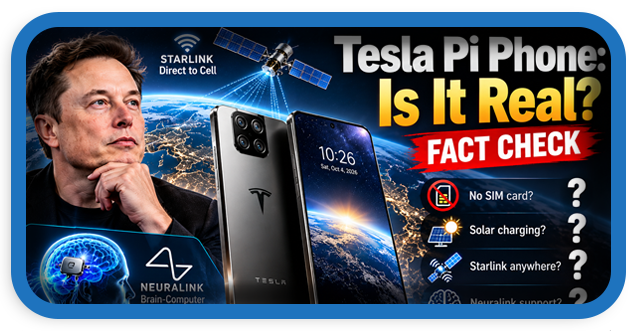
Viral posts claim Elon Musk has launched a $789 Tesla Pi Phone with Starlink connectivity, solar charging and Neuralink support. The specifications sound revolutionary, but what has actually been confirmed? We examine the claims, official information and technologies behind one of the internet’s most persistent smartphone rumors.
Last fact-checked: October 4, 2026
The idea sounds almost too perfectly designed for the internet. Elon Musk launches a smartphone. It connects directly to Starlink satellites, works far beyond normal cellular coverage, charges from sunlight and eventually communicates with Neuralink. Better still, viral posts claim the device costs around $789 and could challenge Apple and Samsung almost overnight.
That story has circulated under names including Tesla Pi Phone, Tesla Model Pi, Tesla Phone and simply Elon Musk Phone. Some versions are accompanied by polished product renders. Others show supposed launch presentations, specifications, prices and images of Musk holding a futuristic Tesla-branded device. When these elements appear together, the story can look surprisingly convincing.
The material that inspired this article makes the same dramatic claims. It describes a device called Tesla Pi that supposedly needs neither a SIM card nor Wi-Fi because it connects directly to Starlink satellites. It also claims integrated solar charging and an official price of roughly $789.
There is an even more futuristic claim. The circulating text says the phone would work with Neuralink and imagines people answering calls, controlling a car, unlocking doors or transferring money through thought.
There is just one major problem.
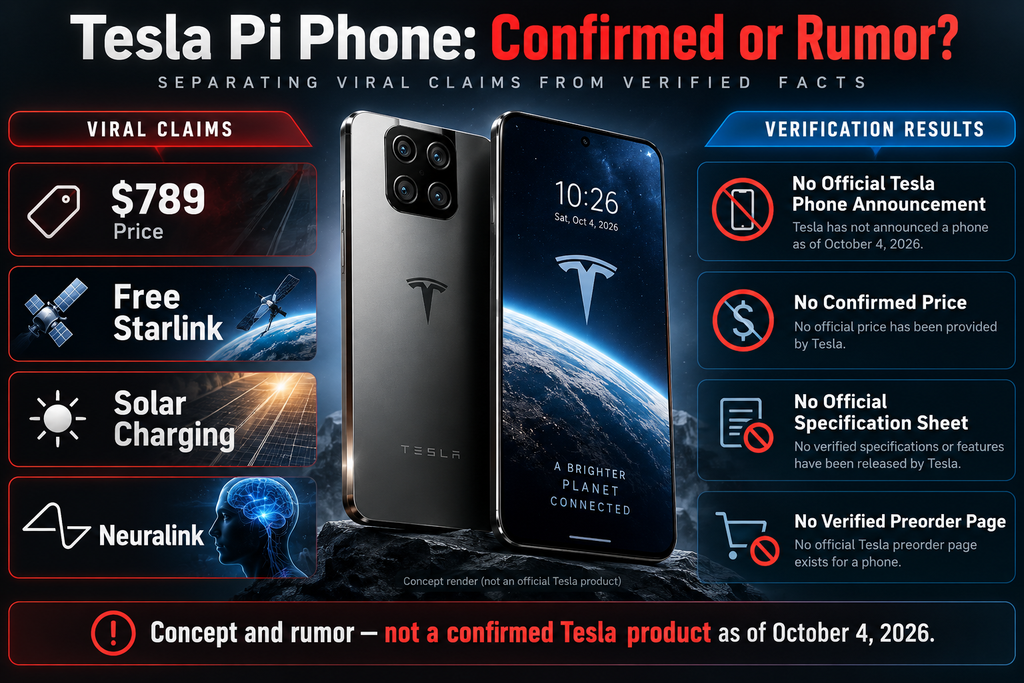
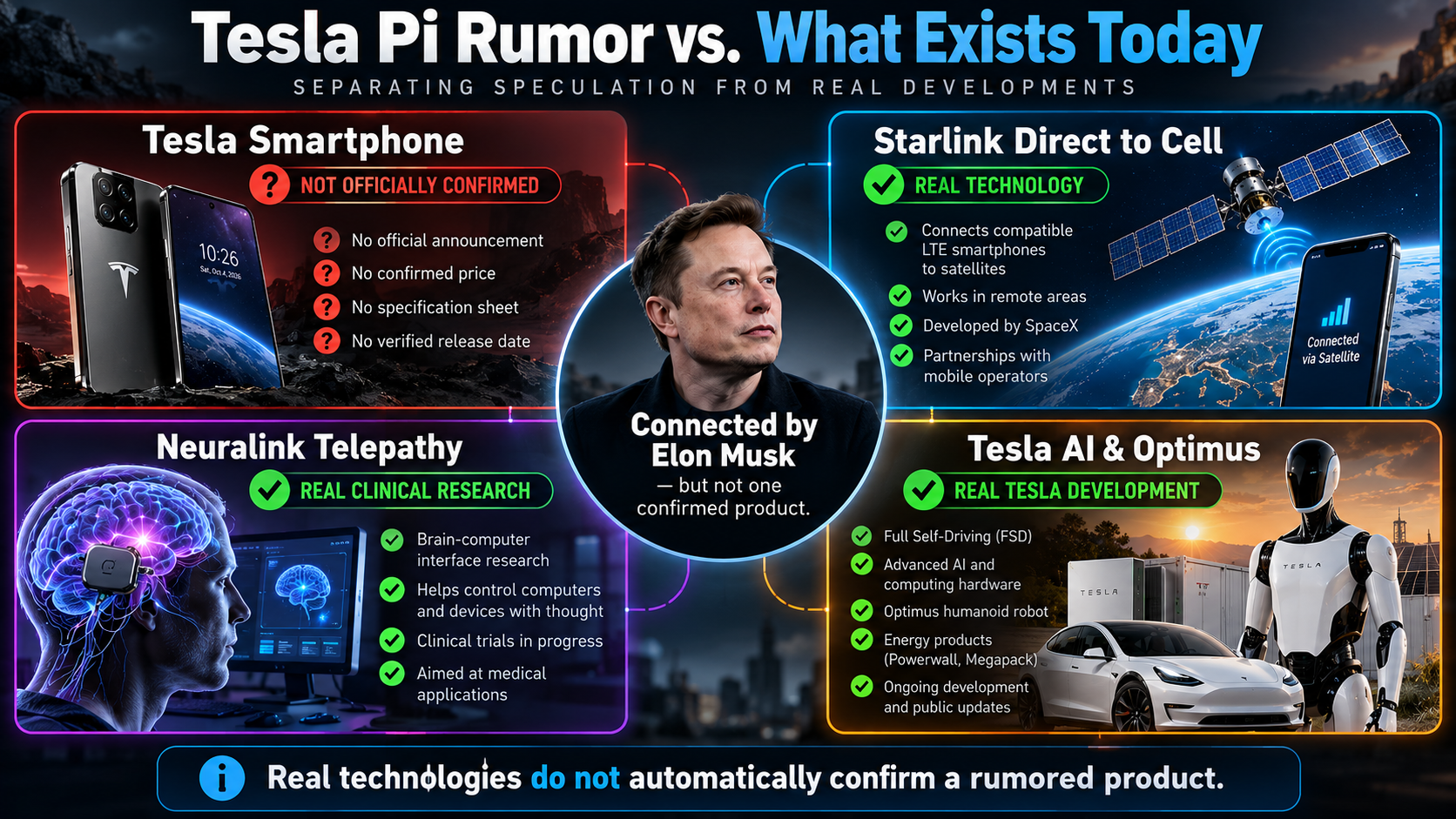
As of October 4, 2026, there is no verified official announcement establishing that Tesla has launched a smartphone called the Tesla Pi Phone or Model Pi. There is also no verified Tesla specification sheet, official $789 price or Tesla preorder page supporting the viral claims examined here.
That does not mean every technology mentioned in these stories is imaginary. Starlink really is connecting ordinary mobile phones to satellites. Neuralink really is developing brain-computer interfaces. Tesla really does build sophisticated batteries, software, artificial intelligence systems and vehicles.
Those genuine technologies are precisely what make the fictional combination so believable.
Is the Tesla Pi Phone Real in 2026?
The most important distinction is between a technology that could theoretically exist and a product that a company has actually announced. Those two ideas are repeatedly mixed together in Tesla Pi discussions.
Tesla’s official public material describes electric vehicles, energy products, charging infrastructure, artificial intelligence, autonomous technology and Optimus. Tesla’s own About page focuses on solar energy, batteries and electric vehicles, while its AI pages discuss autonomous vehicles, AI hardware and humanoid robotics.
A smartphone launch would normally leave a substantial trail. Consumers would expect an official product page, hardware specifications, supported countries, regulatory information, warranty conditions, software details, pricing and ordering information. A global communications product would also require relationships with network operators and regulators.
Those pieces of evidence are missing from the viral Tesla Pi story.
AFP previously investigated a remarkably similar claim involving a supposed $789 Tesla Pi Phone with free Starlink. Its October 2025 fact-check found no evidence that Tesla or Musk had released such a smartphone. AFP also found that Tesla’s website did not list a mobile device.
That matters because the $789 figure is not merely similar to the current rumor. It is essentially the same claim.
The sensible status in October 2026 is therefore not “Tesla Pi confirmed.” It is unverified Tesla smartphone rumor.
This distinction protects readers from another problem. Once an imaginary product becomes popular enough, websites begin repeating information from other websites. A speculative price becomes an “expected price.” The expected price is then quoted as a “reported price.” Eventually, another post calls it the “official price.”
Repetition does not transform speculation into confirmation.
What Would Count as Real Confirmation?
A genuine Tesla phone announcement should be relatively easy to verify. The strongest evidence would come directly from Tesla through an official product page, investor communication, verified corporate announcement or formal launch presentation.
Independent reporting would then provide additional confirmation. Major technology publications would have access to specifications, photographs, regulatory records or hands-on hardware. Network partners could explain connectivity. Retail availability and warranty terms would become visible.
A dramatic social-media video alone does not provide that standard of evidence.
Readers can apply the same test to future Tesla Pi claims. Instead of asking whether a render looks realistic, ask where the product can be found officially. Instead of trusting a screenshot containing a price, look for the corresponding Tesla ordering page.
That simple verification process can separate a genuine launch from an attractive concept in minutes.
Where Did the Tesla Pi Phone Story Come From?
The Tesla phone idea did not appear from nowhere. Elon Musk has publicly discussed the possibility of creating an alternative smartphone under certain circumstances. That real conversation provided fertile ground for years of speculation.
In 2022, Musk responded to a discussion about Apple and Google potentially restricting Twitter, now X, from their app stores. He said that if there were no other choice, he would make an alternative phone. That was a conditional statement rather than a product announcement.
The subject returned during Musk’s 2024 appearance on The Joe Rogan Experience. Asked about persistent videos claiming that Tesla was releasing a phone, Musk rejected the immediate premise. He explained that Tesla could potentially build one and has extensive software expertise, but said a phone was not something the company wanted to make unless circumstances forced it to do so.
That is dramatically different from announcing a Tesla Pi.
Nevertheless, the possibility is irresistible to concept designers and technology channels. Tesla already has an enormous technology ecosystem. SpaceX operates Starlink. Musk is involved with xAI and X. Neuralink is developing brain-computer interfaces. Tesla vehicles depend heavily on software and mobile applications.
Combine those businesses in an imaginary rectangle of glass and metal, and you have the perfect viral smartphone.
How a Concept Becomes an Internet “Product”
Imagine a designer creates an unofficial Tesla smartphone render. The image looks professional, so another account reposts it with the words “Tesla Model Pi concept.” A video creator then adds speculative features such as satellite internet and solar charging.
Another account removes the word “concept.”
Suddenly the same picture appears with a price.
Someone else creates an AI-generated image showing Elon Musk apparently holding the device. A headline says it has been “revealed.” Another video calls the specifications a “leak.” Within days, readers encounter ten different pages repeating roughly the same story.
The number of posts can create an illusion of independent confirmation even when those posts trace back to speculation.
AFP documented this pattern around Tesla phone misinformation, including manipulated or fabricated images presented as evidence of a smartphone launch.
This is why source quality matters more than the number of times a claim has been repeated.
The $789 Tesla Pi Phone Claim Explained
One of the most specific details in the viral story is also one of the easiest to remember: $789.
Specific numbers are psychologically powerful. “Tesla may release a phone someday” clearly sounds speculative. “Tesla launched its new phone for $789” sounds like information obtained from a product announcement.
Yet a precise number still requires a source.
The uploaded material describes approximately $789 as the official price. But no supporting Tesla product announcement is provided in that material.
The same $789 claim had already appeared online before this article was written. AFP examined social posts in 2025 claiming that a Tesla Pi Phone costing $789 had arrived with free Starlink. The fact-check found no corresponding Tesla smartphone release.
Consequently, readers should not treat $789 as a confirmed retail price.
Why the Price Sounds Plausible
A price around $789 has an interesting quality: it is neither absurdly cheap nor impossibly expensive.
Place a hypothetical Tesla phone at $99 and readers immediately become suspicious. Give it a $4,000 price and it becomes commercially unrealistic for the mainstream smartphone market. Put it around $789 and suddenly it sounds like a premium flagship positioned against major phones from Apple, Samsung and Google.
That plausibility is not evidence.
If Tesla ever announces a phone, the real price could theoretically fall above, below or around that figure. Until Tesla publishes pricing, any specific amount remains speculation.
Consumers should be particularly careful when a website uses an alleged Tesla Pi price to collect deposits, cryptocurrency payments or card details.
An official price is useful only when an official product exists behind it.
Can Starlink Really Connect Directly to a Smartphone?
This is where the Tesla Pi rumor becomes much more interesting, because the underlying technology is real.
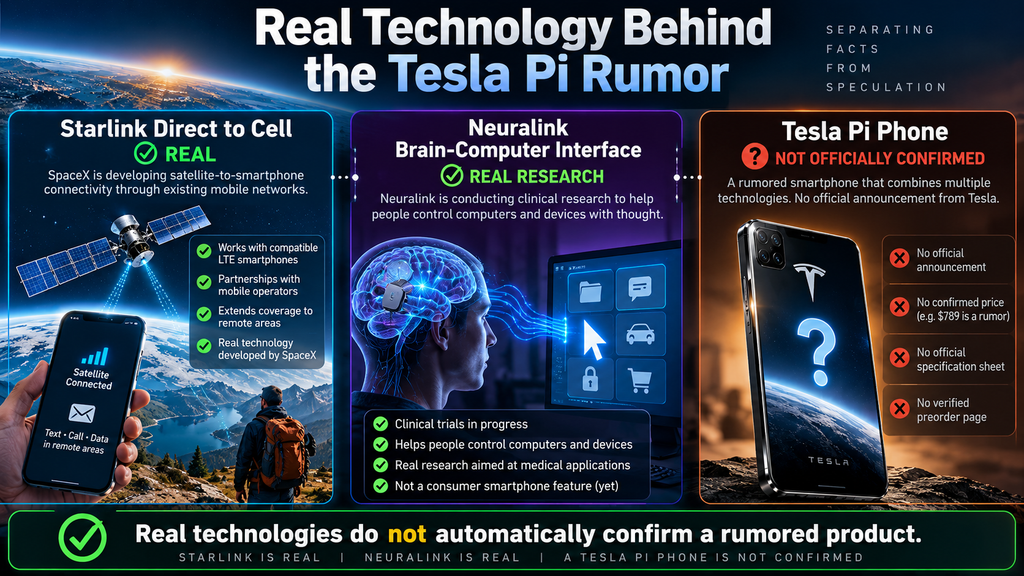
SpaceX has developed Starlink Direct to Cell, technology designed to connect compatible ordinary mobile phones to satellites in areas where terrestrial mobile towers are unavailable. Starlink describes the satellites as functioning somewhat like cellular towers in space.
Early Direct to Cell testing demonstrated communication with unmodified LTE phones. SpaceX reported successfully sending and receiving text messages using its satellites and T-Mobile spectrum in January 2024.
The significance is enormous.
Historically, satellite communication often required specialized equipment. Direct-to-device satellite systems are changing that model. Instead of carrying a dedicated satellite telephone, a consumer can potentially use an ordinary compatible smartphone when terrestrial coverage disappears.
That is a real technological development.
It still does not prove the existence of a Tesla Pi Phone.
Starlink Does Not Need a Tesla Phone to Reach Phones
One of the biggest misconceptions surrounding the rumor is that Tesla would need to manufacture special hardware before Starlink could communicate with smartphones.
Starlink’s approach demonstrates the opposite.
SpaceX has specifically designed Direct to Cell around existing mobile devices and partnerships with telecommunications operators. Its published material describes integration with standard LTE phones without requiring consumers to replace their devices with a Tesla-branded handset.
In other words, you do not need an imaginary Tesla Pi to understand why Musk-associated satellite technology could appear on a smartphone.
The smartphone may already be in your pocket.
Starlink has worked with mobile operators in different markets. Its published Direct to Cell material has identified partners including T-Mobile in the United States, Rogers in Canada, Optus in Australia, KDDI in Japan, One NZ in New Zealand and others. Availability and functionality depend on the country, network, device and regulatory environment.
That last point is particularly important.
Satellite-to-phone connectivity is not simply a magical replacement for every SIM, Wi-Fi router and cellular network on Earth.
Would a Tesla Phone Work Without a SIM or Wi-Fi?
The viral version of the Tesla Pi story says the device needs neither a SIM card nor Wi-Fi because it connects directly to Starlink.
This statement takes a genuine technological concept and stretches it considerably beyond what has been established for a Tesla product.
Starlink’s mobile technology operates through partnerships with telecommunications companies and licensed spectrum. SpaceX describes Starlink Mobile as integrating with mobile network operators in a way similar to a roaming partner.
That is very different from saying a hypothetical Tesla handset would simply bypass the global telecommunications industry.
A normal smartphone constantly chooses among different connection methods. At home, it may use Wi-Fi. Outside, it usually connects to terrestrial cellular towers. In an area without tower coverage, supported satellite connectivity can potentially provide an additional layer.
Satellite service therefore complements terrestrial networks rather than making every other form of connectivity irrelevant.
What “Works Anywhere” Really Means
The phrase “works anywhere in the world” should always make a careful reader stop and investigate.
Satellite systems have major geographical advantages, but availability can still depend on regulations, operator partnerships, supported frequencies, device compatibility, subscription conditions, satellite capacity and visibility of the sky.
Indoor environments create another obvious challenge. A satellite connection cannot automatically behave like a strong Wi-Fi access point sitting several meters away. Buildings, terrain and other physical obstacles matter.
The uploaded viral text claims the supposed phone could remain connected in the middle of the ocean, high in the mountains and even without electricity.
Parts of that vision resemble the goal of satellite connectivity: extending communication into places where cellular towers cannot reach.
But a real product claim would require much greater precision.
Does “connected” mean emergency messaging? SMS? Voice? Low-speed data? Broadband internet? Which countries? Which operators? What view of the sky is required? What happens indoors?
Until an official Tesla smartphone specification answers those questions, they should not be invented on Tesla’s behalf.
Could a Tesla Pi Phone Have Solar Charging?
Solar charging is another feature that has followed the Tesla Pi rumor for years.
At first glance, it seems like an obvious combination. Tesla is strongly associated with clean energy, batteries and solar products. A solar-powered Tesla phone therefore feels almost inevitable.
Engineering reality is more complicated.
A smartphone has limited surface area. A small photovoltaic surface exposed to ordinary sunlight cannot automatically provide the same convenient power delivery as plugging a modern smartphone into a high-output charger.
Solar energy could potentially supplement battery charging. Specialized products already demonstrate that small electronics can harvest sunlight. However, promising practical everyday solar independence would require engineering details about panel area, efficiency, temperature, charging speed, battery capacity and operating conditions.
No verified Tesla Pi specification provides those details because no verified Tesla Pi specification has been published.
“No More Chargers” Is a Much Bigger Claim
Suppose a hypothetical phone consumes several watt-hours during normal daily use. A small solar surface would need sufficient light for sufficient time to replace that energy.
Now put the device inside a pocket for most of the day.
Move indoors.
Add clouds.
Increase screen brightness, GPS activity, camera use, gaming or satellite communication.
The marketing phrase “solar charging” can quickly become much less impressive when translated into actual energy requirements.
This does not make solar-assisted smartphone charging impossible. It means we should distinguish between possible supplementary charging and a claim that a phone can achieve complete energy independence.
The uploaded text goes much further by describing integrated solar charging and saying goodbye to cables and electrical outlets.
That claim remains unsupported for a Tesla smartphone.
What About Tesla Pi and Neuralink?
Perhaps no feature makes the Tesla Pi story sound more futuristic than Neuralink.
The viral description imagines a phone connected to a Neuralink implant, allowing a person to answer calls, control a vehicle, unlock doors and transfer money using thought alone.
Here again, the story attaches speculation to real technology.
Neuralink is developing brain-computer interfaces. Its official clinical-trial information describes research into controlling computers and robotic devices through thought for people with serious neurological impairments.
Neuralink also describes its Telepathy project as aiming to let people with paralysis control computers, phones and robotic limbs through neural signals. In a January 2026 update, the company showed trial participants using its technology for computer interaction, gaming, artwork and assistive robotic control.
That is remarkable enough without adding an imaginary Tesla phone.
Controlling a Device Is Not Tesla Pi Integration
There is an important technical distinction.
If a brain-computer interface allows someone to control a cursor, select interface elements or send digital commands to a computer or smartphone, that does not mean the smartphone was specifically manufactured for Neuralink.
Consider a conventional accessibility device.
A person might control an iPhone or computer through an external accessibility interface. We would not therefore describe the iPhone as a dedicated product created for that medical system.
The same caution should apply here.
Neuralink’s real work on device control does not confirm a Tesla Pi-Neuralink partnership, special Tesla smartphone hardware or a consumer feature that allows anyone to make financial transactions by simply thinking.
Security would also become extremely important if neural interfaces eventually gained access to sensitive operations.
A payment system must distinguish intention from accidental input. Authentication, authorization, consent, fraud prevention and recovery mechanisms would all matter. “Think about transferring money” and “authorize an irreversible $10,000 transfer” cannot safely become equivalent concepts.
The fascinating question is therefore not whether today’s rumored Tesla Pi can read your thoughts.
It is how future computing platforms will securely interact with increasingly sophisticated assistive brain-computer interfaces.
Could Tesla Actually Build a Smartphone?
This is a different question from asking whether Tesla has already built one.
Could it?
Potentially, yes.
Tesla has significant expertise in software, electronics, batteries, power management, connectivity, artificial intelligence and hardware integration. Its vehicles are effectively sophisticated networked computers containing displays, processors, cameras, communications systems and continuously updated software.
Musk himself has acknowledged that Tesla would be in a relatively strong position to create an alternative smartphone platform. During the 2024 Rogan discussion, he pointed to Tesla’s software expertise while simultaneously emphasizing that creating a phone was not something the company wanted to do unless necessary.
Building a prototype would therefore not be unimaginable.
Building a competitive global smartphone business is another matter.
A Phone Is More Than Hardware
Imagine Tesla designed an excellent handset tomorrow.
It would still need an operating system strategy. Developers would need a reason to build applications for it. Consumers would expect banking applications, messaging, navigation, streaming, authentication, workplace software, password managers and countless regional services.
The company would need supply chains for displays, cameras, processors, memory, modems and dozens of smaller components. It would need manufacturing capacity, repair programs, warranties and replacement parts.
Then come telecommunications requirements.
Phones need frequency support, network certification, emergency calling, regulatory approval and relationships with carriers across different countries. A successful global smartphone platform also needs years of security updates.
Apple and Google did not create their mobile ecosystems overnight.
The hardware is only one part of the challenge.
Tesla Could Also Choose an Easier Route
If Musk eventually decides that greater control over mobile computing is strategically important, Tesla or another Musk-associated company would not necessarily need to build everything from scratch.
A device could theoretically use an existing Android foundation. A company could partner with an established manufacturer. Another possibility would be deeper integration of X, xAI services, Tesla vehicles and Starlink into existing smartphones rather than manufacturing a completely new handset.
These are scenarios, not reports of Tesla’s plans.
The important word is could.
“Tesla could build a phone” is reasonable analysis.
“Tesla has launched the Tesla Pi for $789” requires evidence that currently does not exist.
Would Tesla Pi Really Be an iPhone Killer?
Calling an unreleased product an “iPhone killer” is a classic technology headline.
The phrase has been applied to smartphones for years because it creates an instant contest. Readers already understand the benchmark. Apple represents one of the world’s most established smartphone ecosystems, so anything presented as a direct threat immediately sounds significant.
However, defeating a mature ecosystem involves much more than specifications.
A hypothetical Tesla phone could offer an extraordinary battery, innovative satellite functions and deep Tesla vehicle integration while still struggling to persuade people to abandon their existing apps, cloud storage, accessories, passwords, photo libraries and communication services.
Samsung and other Android manufacturers have spent years building equally sophisticated ecosystems.
A new competitor would need to convince consumers that switching is worth the inconvenience.
The Ecosystem Could Be Tesla’s Strongest Advantage
Tesla would nevertheless possess one unusual advantage if it ever entered the smartphone market: an existing community of customers already interacting with Tesla through mobile devices.
A Tesla-branded phone could theoretically integrate vehicle controls, charging information, home energy systems, navigation, AI services and other connected products.
Again, none of those ideas should be mistaken for confirmed Tesla Pi specifications.
They simply explain why the concept continues to attract attention.
The imagined Tesla phone is compelling because people can see how pieces of Musk’s technology businesses might fit together.
The rumor is effectively a product roadmap designed collectively by the internet.
Why Starlink Is the Most Believable Part of the Rumor
Of all the Tesla Pi claims, satellite connectivity has the strongest foundation in existing technology.
Starlink Direct to Cell has moved satellite-to-smartphone communication from science-fiction territory into real-world telecommunications. SpaceX says its technology allows compatible ordinary mobile phones to communicate with specially equipped satellites functioning as cellular infrastructure in space.
Starlink Mobile’s longer-term ambitions are even broader. SpaceX discusses future satellite systems designed to provide expanded cellular coverage and greater bandwidth in partnership with mobile network operators.
That future is significant regardless of whether Tesla ever manufactures a phone.
Imagine driving through a remote region where terrestrial towers disappear. Your existing smartphone loses its normal signal but gains satellite-supported connectivity through your operator.
For many users, that would deliver the most attractive part of the supposed Tesla Pi experience without requiring a Tesla phone.
Satellite Connectivity May Become Ordinary
Technology often stops feeling revolutionary once it becomes infrastructure.
GPS was once an extraordinary military technology. Today, people use satellite positioning to find a coffee shop without thinking about spacecraft.
Satellite-to-phone communication may follow a similar path.
At first, consumers notice a special satellite icon and deliberately use the service in emergencies. Later generations may simply move between terrestrial towers and satellites automatically.
When that happens, the question may no longer be, “Does my phone have Starlink?”
It may become, “Does my mobile operator provide satellite coverage?”
That distinction helps explain why today’s genuine Starlink development is more important than an unverified Tesla Pi render.
How to Verify the Next Viral Tesla Pi Announcement
The Tesla Pi story is an excellent example of how people can verify technology news before sharing it.
Start with the company supposedly releasing the product.
If a post says Tesla launched a phone, search Tesla’s official website and official company communications. A global smartphone launch would be an important commercial event, not a secret available only through a random social-media video.
Next, search for independent confirmation from established technology and news organizations. A genuine launch from a company as closely watched as Tesla would attract immediate international coverage.
Then inspect the details.
A real smartphone has a model designation, operating system, processor, display specifications, supported wireless bands, storage options, battery information, warranty conditions, supported countries and a release schedule.
Fake announcements often contain spectacular features but surprisingly little mundane information.
That imbalance is a warning sign.
Be Suspicious of Urgency
Another warning appears when a post immediately asks readers to purchase, reserve or register.
A scammer benefits when people act before checking.
The more revolutionary the supposed offer appears, the more important verification becomes.
Do not send cryptocurrency because a social-media account promises early Tesla Pi access. Do not enter payment-card information into a site simply because it uses Tesla logos. Do not install an APK claiming to be Tesla Pi software unless its authenticity can be independently established.
Also inspect the domain carefully.
A page can copy logos, photographs and colors within minutes. Professional appearance does not prove ownership.
When a real Tesla smartphone eventually appears-if one ever does the safest route will be an official Tesla channel or a clearly identified authorized partner.
Why AI Images Make Tesla Pi Rumors Harder to Spot
Older fake product stories often looked fake.
The typography was wrong. Shadows did not match. Logos were distorted. The supposed product looked like a rough Photoshop experiment.
Generative AI has changed that environment.
A creator can now produce an image of a futuristic smartphone, a convincing stage presentation, a retail box or even a person apparently holding an unreleased device. The image may look polished enough to pass a casual inspection.
That means visual quality is no longer reliable evidence.
AFP’s investigations into Tesla smartphone claims have previously identified fabricated or manipulated visuals associated with false launch stories.
The safest response is not to become an expert at spotting every AI artifact.
Instead, verify the event behind the image.
If an image supposedly shows Elon Musk launching a Tesla Pi Phone, ask where and when the launch occurred. Find the complete presentation. Check Tesla’s official channels. Search reputable reporting.
A genuine event produces evidence beyond one picture.
Concept Art Is Not the Problem
Concept designers are not automatically spreading misinformation.
Technology concept art can be creative, interesting and useful. Designers routinely imagine future iPhones, cars, computers and spacecraft.
The problem begins when the context disappears.
A picture labeled “What a Tesla smartphone could look like” is clearly speculative.
The same picture reposted with “Elon Musk just launched this phone for $789” becomes misinformation.
Publishers therefore have a responsibility to label concept images clearly.
For this article, any illustration of a Tesla Pi should be marked as a concept rather than presented as product photography.
What Tesla Is Actually Building
Separating rumor from reality does not make Tesla’s technology story boring.
Tesla continues to focus heavily on vehicles, autonomy, artificial intelligence, energy and robotics. Its official AI material discusses Full Self-Driving-related AI development, inference hardware and Optimus humanoid robotics.
The company’s 2026 public material has also discussed continued Optimus development and production ambitions.
Those are substantial engineering programs.
Tesla’s official Belgian website currently highlights vehicles, supervised Full Self-Driving, Powerwall and Megapack products rather than a smartphone.
This context matters because misinformation often distracts from genuine developments.
A fictional smartphone receives millions of views because it combines several futuristic ideas into one irresistible object. Meanwhile, real satellite-to-phone networks, brain-computer interfaces, humanoid robotics and autonomous transportation are progressing independently.
Reality may be less tidy than the viral story, but it is arguably more interesting.
What Neuralink Is Actually Building
Neuralink deserves similar separation from the Tesla Pi narrative.
Its work is currently centered on brain-computer interfaces and clinical research, particularly technologies intended to restore or improve independence for people with serious neurological conditions.
Neuralink’s clinical-trials page describes active research involving thought-based control of computers and robotic arms. It also describes work aimed at decoding communication from neural activity.
Its Telepathy project aims to translate neural activity associated with intended movement into digital commands. Neuralink says the goal includes allowing people with paralysis to control computers, phones and robotic limbs.
That is a real and important distinction from the consumer fantasy often attached to Tesla Pi.
The technology is not being presented by Neuralink as a magical mass-market smartphone accessory that lets everyone instantly control bank accounts, cars and doors.
Clinical brain-computer interfaces involve medical procedures, patient selection, research protocols, safety considerations and regulatory oversight.
Turning that work into a casual smartphone feature dramatically oversimplifies the science.
What a Real Tesla Phone Could Look Like
Speculation can still be useful when it is clearly labeled.
If Tesla eventually decided to manufacture a smartphone, several features would make strategic sense. Deep Tesla vehicle integration would be an obvious starting point. Strong integration with satellite-supported mobile connectivity could also become attractive as Starlink Mobile expands.
Artificial intelligence would almost certainly play a large role in any future Musk-associated computing platform.
Battery efficiency would matter. Security would matter even more. Tesla would also need a compelling software strategy because hardware alone would not create a successful third mobile ecosystem.
But there is no reason to assume every viral feature would appear.
Solar charging might prove impractical as a primary power source. Neuralink might remain an accessibility interface rather than a dedicated phone component. Direct satellite connectivity might work perfectly well through ordinary operator-supported smartphones.
The eventual device if it ever exists could look nothing like today’s Tesla Pi concepts.
The Name Might Not Even Be Tesla Pi
Even the product name is unconfirmed.
“Model Pi” fits neatly alongside names such as Model 3, Model S, Model X and Model Y, which probably helps explain its popularity.
But a catchy fan-created name is not a trademarked product announcement.
Tesla could choose a completely different name.
Another Musk company could theoretically launch a device instead.
Or no dedicated phone may appear at all.
That uncertainty should remain visible whenever publishers discuss the subject.
The safest terminology is rumored Tesla Pi Phone, unconfirmed Tesla smartphone or hypothetical Tesla phone unless Tesla itself changes the situation with an official announcement.
Frequently Asked Questions
Is the Tesla Pi Phone real?
There is no verified official Tesla launch of a smartphone called the Tesla Pi Phone or Model Pi as of October 4, 2026. Viral images, specifications and videos should therefore be treated as concepts or unverified claims unless they can be traced to an official Tesla announcement. AFP previously investigated similar launch claims and found them false.
Did Elon Musk launch the Tesla Pi Phone?
No verified evidence reviewed for this article shows Elon Musk launching a Tesla Pi smartphone. Musk has discussed the possibility of making an alternative phone under certain circumstances, but that is different from announcing a commercial product. In 2024, he said making a phone was not something Tesla wanted to do unless necessary.
Does the Tesla Pi Phone cost $789?
There is no verified official $789 Tesla Pi price. That figure has circulated in social-media claims and videos. AFP specifically examined a previous claim about a $789 Tesla Pi Phone with free Starlink and found no evidence that Tesla had launched the device.
Does Tesla Pi include free Starlink internet?
No official Tesla specification confirms free Starlink service for a Tesla Pi Phone. Starlink does have genuine Direct to Cell technology that can connect ordinary mobile devices through participating telecommunications networks. That real technology should not be confused with an unconfirmed Tesla smartphone or a promise of unlimited free satellite internet.
Can Starlink connect directly to normal smartphones?
Yes, this part is based on genuine technology. SpaceX has demonstrated Direct to Cell communication with ordinary LTE phones and is developing satellite-based mobile coverage in cooperation with telecommunications operators. Service capabilities and availability depend on the network, country, device and regulatory environment.
Does Tesla Pi have solar charging?
No verified Tesla Pi specification confirms integrated solar charging. Solar charging is technically possible for small electronics, but claims that a Tesla phone can operate indefinitely without conventional charging require evidence that has not been provided by Tesla.
Does Tesla Pi work with Neuralink?
No official Tesla or Neuralink announcement reviewed for this article establishes a special Tesla Pi-Neuralink integration. Neuralink is genuinely researching brain-computer interfaces capable of controlling computers, phones and robotic devices through neural signals, but that does not confirm a Tesla Pi product.
Can Neuralink really control a phone with thought?
Neuralink says its Telepathy technology aims to allow people with paralysis to control computers, phones and robotic limbs using neural activity. This work is part of brain-computer-interface development and clinical research. It should not be confused with the much broader consumer claims attached to viral Tesla Pi stories.
Could Tesla eventually manufacture a smartphone?
Yes, it is technically possible. Musk has acknowledged that Tesla has substantial software expertise and could potentially create an alternative phone. However, he has also said that making one is not something Tesla wants to do unless circumstances make it necessary. Possibility is not confirmation of development or launch.
Where should I check for a real Tesla Pi announcement?
Start with Tesla’s official website and verified corporate communications. Then look for confirmation from established independent technology and news organizations. A genuine global smartphone launch should provide pricing, specifications, supported regions, warranty information and ordering details rather than relying only on social-media videos or concept images.
The Real Future Is More Interesting Than the Rumor
The Tesla Pi Phone is a perfect modern technology story because almost every ingredient feels plausible.
Tesla understands batteries, electronics, software and artificial intelligence. SpaceX operates Starlink. Starlink is developing real satellite-to-smartphone connectivity. Neuralink is conducting real brain-computer-interface research. Elon Musk has even acknowledged that an alternative smartphone could theoretically be created if circumstances required one.
Put those facts together and the Tesla Pi practically writes itself.
But possibility is not a product announcement.
The viral text examined for this article goes much further, presenting Tesla Pi as an already launched device with Starlink connectivity, solar independence, a roughly $789 price and Neuralink compatibility. Those claims are not supported by a corresponding official Tesla smartphone announcement.
The more interesting story is what is actually happening.
Ordinary smartphones are beginning to communicate directly with satellites. Brain-computer interfaces are allowing trial participants to interact with computers through neural signals. Tesla is developing increasingly sophisticated AI, autonomous systems and humanoid robotics.
We do not need to turn those developments into a fictional smartphone to appreciate how significant they are.
If Tesla eventually launches a phone, the technology world will notice immediately. There will be specifications, prices, demonstrations, regulatory information and official purchasing channels.
Until then, Tesla Pi remains a fascinating vision of what a Musk-centered technology ecosystem could become not a smartphone consumers should assume they can buy today.
⚠️ Disclaimer and Source Hygiene
This article is provided for informational and educational purposes. Product availability, telecommunications services, clinical research programs and company plans can change. Readers should verify important purchasing, investment, medical or technology decisions through the relevant company, qualified professionals and authoritative regulatory sources.
Claims about the Tesla Pi Phone were separated from confirmed information throughout this article. Official Tesla, Starlink and Neuralink materials were prioritized for information about their respective technologies. Independent fact-checking was used to evaluate viral smartphone claims. Conceptual or hypothetical features are explicitly described as speculation rather than confirmed Tesla specifications.
Never send money, cryptocurrency, identification documents or payment information to a website claiming to sell an unreleased Tesla product without first verifying that the seller and product are legitimate.
🔔 For more tutorials like this, consider subscribing to our blog.
📩 Do you have questions or suggestions? Leave a comment or contact us!
🏷️ Tags: Tesla Pi Phone, Tesla Phone, Elon Musk Phone, Tesla Model Pi, Starlink Phone, Starlink Direct to Cell, Neuralink, Tesla Smartphone, Elon Musk Technology, Tesla Pi Rumors
📢 Hashtags: #TeslaPi, #TeslaPhone, #ElonMusk, #Starlink, #Neuralink, #Tesla, #Smartphone, #Technology, #FactCheck, #FutureTech
Sources and References
Tesla – Official company information: Tesla describes its current work around electric vehicles, energy, batteries, AI and related technologies. Its official materials provide useful context for separating publicly documented Tesla programs from speculative smartphone claims.
Starlink – Direct to Cell: SpaceX’s Starlink documentation explains how satellites equipped with Direct to Cell technology can communicate with ordinary LTE phones and operate alongside participating telecommunications providers.
Neuralink – Clinical Trials and Telepathy: Neuralink’s official material documents its research into brain-computer interfaces, including thought-based control of computers and robotic devices. Its Telepathy program also describes the goal of controlling computers, phones and robotic limbs using neural signals.
AFP Fact Check – Tesla smartphone claims: AFP investigated social-media claims alleging Tesla had launched a $789 smartphone with free Starlink. It found no evidence of an official Tesla smartphone release and documented fabricated or misleading imagery associated with the rumor.
AFP Fact Check: Social Media Posts Falsely Claim Tesla Released Smartphone
Secondary Sources and Testimonials
The original material supplied for this article illustrates how the Tesla Pi story is commonly presented online. It describes the supposed device as a revolutionary smartphone that connects directly to Starlink without conventional SIM or Wi-Fi connectivity.
The same material attributes solar charging and an approximately $789 official price to the device. Those details were treated as claims requiring independent verification rather than as established specifications.
Its Neuralink section goes further by imagining calls, vehicle control, door unlocking and financial transactions performed through thought. Neuralink’s actual research demonstrates why brain-computer interfaces attract such speculation, but its current official material does not establish these claims as Tesla Pi features.
The clearest lesson is simple: real Starlink and Neuralink breakthroughs make the Tesla Pi story believable, but believable is not the same thing as verified.
