

⏲️ Estimated reading time: 29 min
Table of Contents
One action can transform an ordinary person into a hero, memory can turn a hero into a legend, and time can transform that legend into myth. Yet the cycle does not end there. A powerful story can inspire another ordinary person to act and begin everything again.
“Through an Action, a Man becomes a Hero. Through Death, a Hero becomes a Legend. Through Time, a Legend becomes a Myth. Through hearing a Myth, a Man takes an Action.”
“Through an Action, a Man becomes a Hero. Through Death, a Hero becomes a Legend. Through Time, a Legend becomes a Myth. Through hearing a Myth, a Man takes an Action.”
Some words stay with us because they explain something complicated in an unexpectedly simple way. This quotation does exactly that. In four short stages, it describes a cycle that humanity has repeated for thousands of years: an ordinary person acts, that action becomes memorable, memory becomes a story, and the story eventually inspires another person to act. What begins with one human decision can therefore survive far beyond the person who originally made it.
The most interesting part is that the cycle does not begin with greatness. It begins with action. The person at the beginning is not introduced as a hero, legend, king, warrior, genius, or celebrity. He is simply a man. In a broader modern interpretation, we can understand “man” here as any ordinary human being. What changes that person is not a title but a decision followed by action.
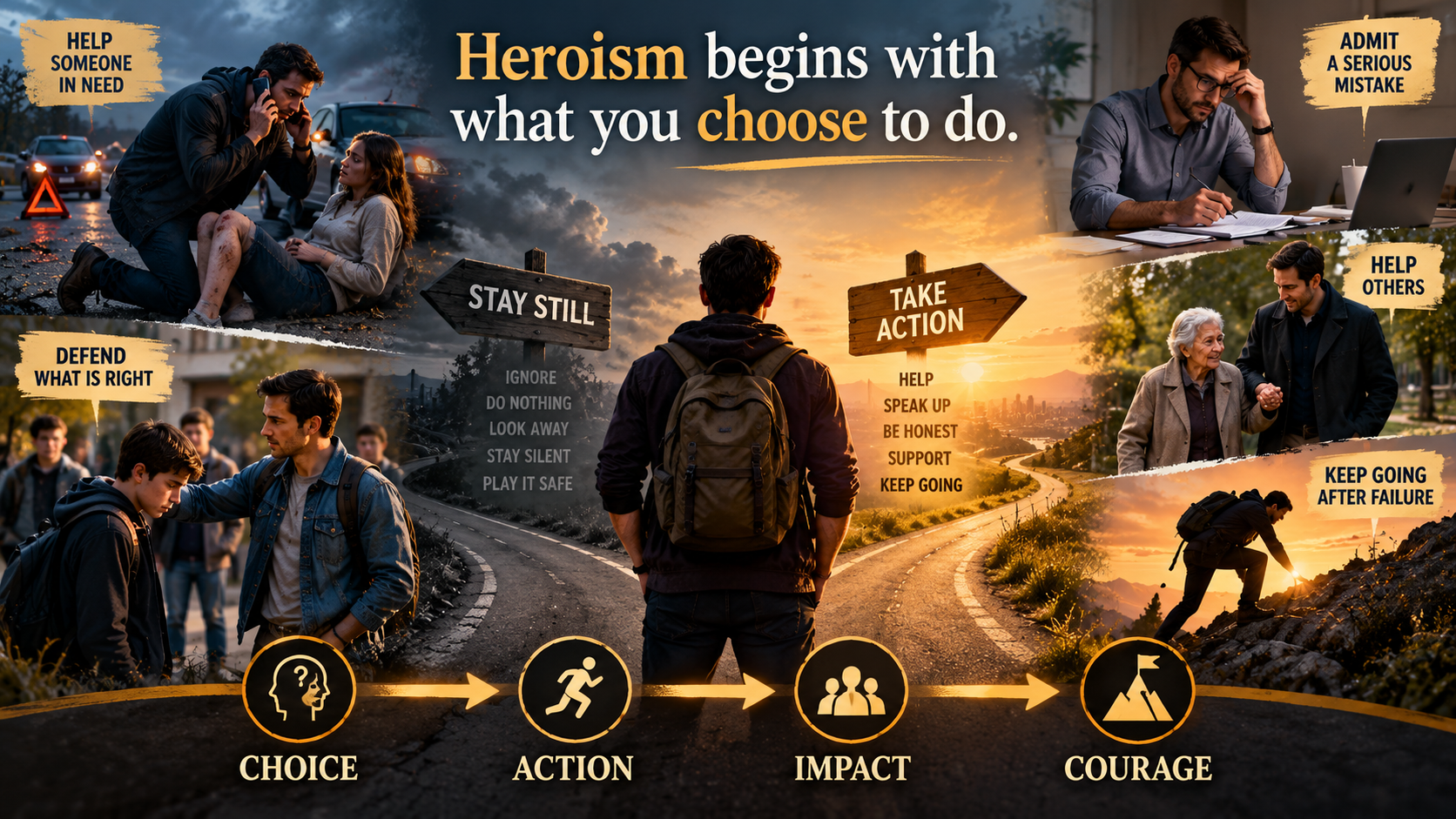
This distinction gives the quotation its real power. Most people will never become famous, and very few will appear in history books. Yet everyone eventually encounters moments when a decision matters. Sometimes those moments are dramatic. More often, they are quiet: helping someone, defending what is right, accepting responsibility, refusing to give up, protecting another person, admitting a mistake, or simply taking the first difficult step toward a better life.
The Eternal Cycle: Action, Hero, Legend, Myth and Action Again
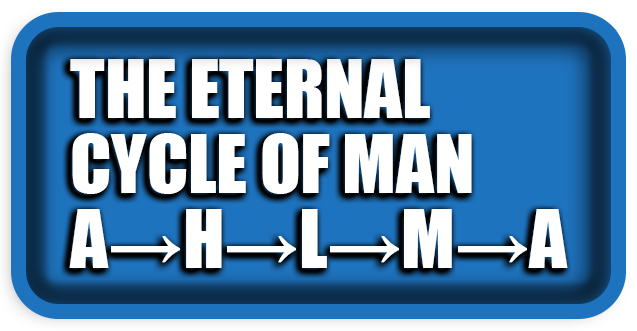
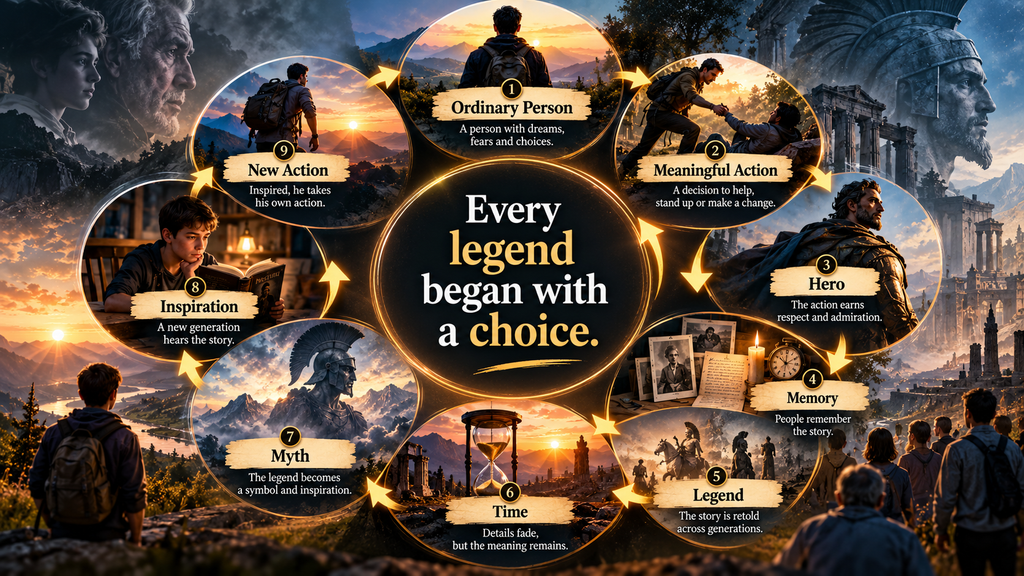
Read the quotation quickly and it appears to describe a straight journey: man, hero, legend, myth. However, the final sentence changes everything. The myth is heard by another person, and that person takes action. The ending therefore returns us to the beginning. Instead of a straight line, we have a circle: Person → Action → Hero → Memory → Legend → Time → Myth → Inspiration → Person → New Action.
This cycle explains one of the remarkable ways human experience travels across generations. We cannot personally meet people who lived hundreds or thousands of years ago, yet their stories can still influence our choices. We encounter them through books, family stories, historical records, monuments, films, traditions, biographies, and cultural memory. Their original actions may belong to another century, but the emotional questions surrounding those actions can remain familiar: Will I continue? Will I help? Will I speak? Will I risk failure? Will I defend someone? Will I stand by what I believe?
The cycle also reminds us that every famous story once had a moment when nobody knew the ending. We hear about the successful expedition after the destination has been reached. We read about the scientific discovery after the experiment worked. We celebrate the athlete after the record was broken. The person living through the original moment had none of that certainty. They had only a situation, a decision, and whatever courage they could find at that moment.
Through an Action, a Man Becomes a Hero
The first line contains the foundation of everything that follows: “Through an Action, a Man becomes a Hero.” Notice what the quotation does not say. A person does not become a hero through appearance, promises, wealth, popularity, intelligence, status, or simply wanting to do something good. The transformation occurs through action. An internal value becomes meaningful to other people when it produces something in the real world.
Almost everyone has good intentions. We think about calling someone who is struggling. We imagine defending somebody who is being treated unfairly. We promise ourselves that we will change a destructive habit, repair a damaged relationship, start a project, or help someone who needs us. Those thoughts may be sincere, but intention and action are different things. Courage becomes visible when someone acts despite discomfort, uncertainty, inconvenience, or fear.
This does not mean every action is heroic. Actions have consequences, and good intentions can sometimes produce bad results. Heroism therefore involves more than movement. It usually involves meaningful action directed toward protecting, helping, creating, defending, enduring, or accepting responsibility. Sometimes that action lasts only seconds. At other times, it requires years of patience and discipline.
Heroism Can Begin With Something Surprisingly Small
Imagine driving home late in the evening after a difficult day. Rain is falling heavily, visibility is poor, and you want nothing more than to reach home. Ahead, you notice a car that has left the road. Several vehicles continue driving. You could easily assume someone else has already called for help. Instead, you stop somewhere safe, activate your hazard lights, contact emergency services, describe the location accurately, and follow the operator’s instructions.
You do not enter a dangerous situation unnecessarily. You do not pretend to have medical skills you do not possess. You simply take the safest useful action available. Perhaps emergency services would eventually have been contacted anyway. Perhaps your call saves only a few minutes. Yet when someone is injured, those minutes can matter. To you, stopping might feel like basic human decency. To the person waiting inside that vehicle, seeing somebody stop may mean that they are no longer alone.
This example also reveals why heroism depends partly on perspective. Firefighters, paramedics, nurses, rescue workers, police officers, caregivers, and many other professionals often describe extraordinary events as simply doing their jobs. The people they helped may remember those same moments for the rest of their lives. A person does not always feel heroic while performing an action that another person will remember as heroic.
Courage Is Not the Same as Recklessness
There is an important warning hidden inside any discussion about heroism. Courage should never be confused with unnecessary danger. Running into a burning building without training or protective equipment may create another victim instead of helping anyone. Entering deep water without knowing how to perform a safe rescue can turn one emergency into two. Responsible action sometimes means calling trained professionals rather than attempting a dramatic intervention yourself.
Imagine seeing smoke coming from an apartment building. A reckless interpretation of heroism might tell you to rush inside. A responsible response begins by alerting emergency services, warning people who can safely be reached, providing accurate information, moving away from immediate hazards, and following professional instructions. Trained firefighters have equipment, communication systems, protective clothing, and procedures specifically designed for such environments.
The lesson matters because real heroism is not a performance. The objective is not to look brave. The objective is to produce the best reasonable outcome. Sometimes courage means moving forward, while in other situations it means recognizing your limitations. Good judgment does not reduce courage. Very often, it is part of courage.
Courage Often Begins Before Confidence Arrives
Many people imagine courage incorrectly. We sometimes assume courageous people feel little or no fear, while ordinary people experience uncertainty. If that were true, courage would belong only to a special category of fearless humans. Real life is more complicated. Courage often exists precisely because someone feels afraid, understands the difficulty, and still chooses a responsible course of action.
Consider an employee who discovers a serious mistake in a project. Nobody else appears to have noticed it. Reporting the problem could cause embarrassment, criticism, additional work, or even professional consequences. Hiding it seems easier. Instead, the employee collects the relevant information, goes to the manager, explains exactly what happened, accepts responsibility, and helps find a solution. Nothing about the scene looks traditionally heroic, yet the decision requires character.
The employee cannot control the manager’s reaction. What they can control is whether they act honestly. By reporting the mistake early, they may also prevent a much larger problem. This is an important form of everyday courage because it replaces the question “How can I protect myself?” with “What is the responsible thing to do now?” Heroism does not always involve saving another person from physical danger. Sometimes it means refusing to protect your reputation at the expense of truth.
The First Step Is Usually Smaller Than the Story
When we hear stories about remarkable achievements, we usually encounter them after the ending is known. A successful business becomes a story about entrepreneurship. A scientific breakthrough becomes a story about discovery. A championship becomes a story about determination. A rebuilt life becomes a story about resilience. Looking backward makes the path appear far more organized than it probably felt while somebody was walking through it.
Before the company existed, someone made the first call, learned the first skill, built the first imperfect version, or accepted the first rejection. Before the championship, an athlete completed thousands of training sessions that nobody celebrated. Before the book, a writer faced a blank page. Before a person rebuilt life after failure, there was probably one ordinary morning when getting up and trying again felt more difficult than anyone else could understand.
This matters because people frequently wait for a dramatic feeling before beginning. They want complete confidence, perfect conditions, guaranteed success, or certainty that their effort will matter. Those conditions rarely arrive together. Meaningful journeys often begin with a surprisingly unimpressive action: opening the document, making the appointment, submitting the application, attending the first class, saying “I was wrong,” asking for assistance, or trying one more time.
Example: Standing Beside Someone Who Is Alone
Imagine a student who notices another student being mocked repeatedly. Many classmates see what is happening. Some may privately dislike it, yet nobody wants to become involved because involvement carries social risk. One afternoon, a student decides to sit beside the isolated classmate, speak to them normally, refuse to participate in the humiliation, and report persistent bullying through the appropriate school channels.
From the outside, these actions may appear small. Nobody defeats an enemy. There is no dramatic soundtrack. The student simply chooses not to join the crowd and takes practical steps to help. For the person experiencing isolation, however, that intervention may carry enormous emotional weight. Sometimes knowing that one person sees what is happening can change the way an entire situation feels.
The example also shows that courage does not require confrontation for its own sake. The safest response to bullying, harassment, violence, or abuse depends on the situation. Seeking help from responsible adults, authorities, employers, schools, or appropriate professionals may be necessary. Courage should serve safety and dignity rather than ego.
A Hero Is Still a Human Being
One of the greatest mistakes we make with heroic stories is removing the humanity from the hero. After enough retelling, the person can appear fearless, endlessly disciplined, morally perfect, and completely certain about every decision. The real person was almost certainly more complicated. They became tired, experienced doubt, made mistakes, changed their mind, needed help, and probably had moments when giving up seemed easier.
Those characteristics do not necessarily weaken the story. They make meaningful actions easier to understand. If heroes are fundamentally different from everyone else, their example offers admiration but little practical guidance. If they are ordinary human beings who sometimes made extraordinary decisions, their stories become more relevant. We can recognize something of ourselves in them, including uncertainty, fear, imperfection, and the need to choose without knowing exactly what will happen next.
A courageous action also does not automatically make every other decision in a person’s life admirable. Human beings can demonstrate exceptional courage in one situation and poor judgment in another. Historical figures may leave valuable achievements while also having serious flaws. Recognizing complexity does not require us to erase meaningful accomplishments. Instead, it helps us separate useful lessons from the unrealistic idea that a hero must first become a perfect person.
Through Death, a Hero Becomes a Legend
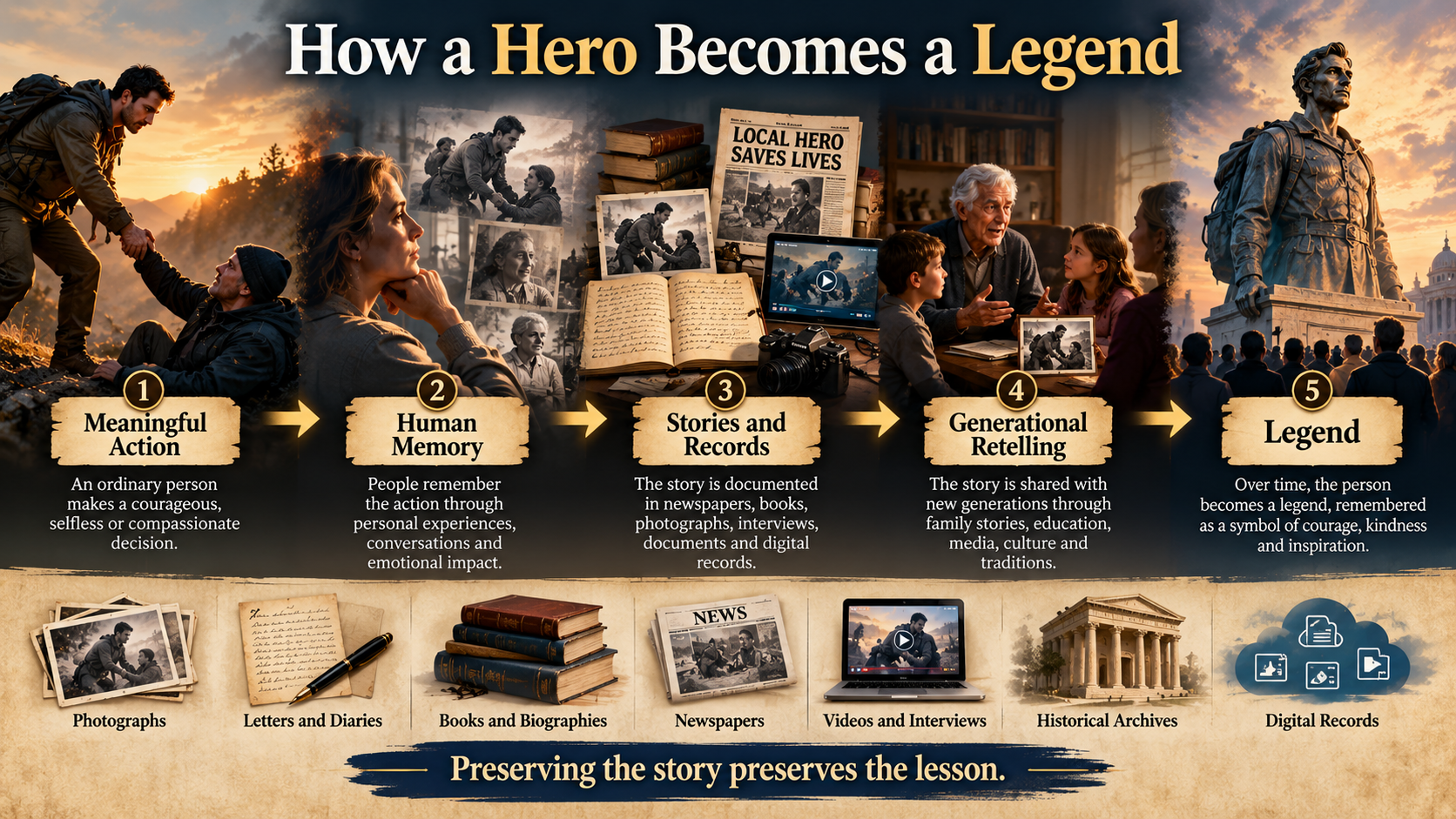
The second line changes the perspective: “Through Death, a Hero becomes a Legend.” This should not be interpreted as suggesting that death itself creates heroism or that a person needs to die for an action to matter. A healthier interpretation concerns memory. While someone is alive, we experience a complicated human being. After that person dies, future generations increasingly encounter memories, records, photographs, writings, achievements, testimonies, and stories instead.
Memory naturally selects. Imagine someone who spends thirty years serving a community. Thousands of breakfasts, commutes, ordinary conversations, frustrations, mistakes, quiet evenings, and uneventful workdays disappear from public memory. A smaller number of meaningful events survive. People remember the rescue, the sacrifice, the discovery, the kindness, the speech, the difficult decision, or the years of service.
As time passes, those remembered moments can begin representing the person as a whole. A child may know a grandparent through only ten family stories. A community may remember a local figure through one important event. A nation may remember a historical individual through several defining achievements. The full human life becomes compressed into a narrative, and that narrative can eventually become legend.
A Legend Is Built Through Memory and Retelling
A remarkable action can disappear if nobody preserves its story. Human memory travels through communication. Parents tell children about grandparents. Teachers introduce students to historical figures. Communities build memorials. Writers create biographies. Historians preserve documents. Journalists record testimony. Families protect photographs and letters. Modern technology adds videos, audio recordings, digital archives, interviews, and databases.
Every act of preservation creates a bridge between generations. Imagine a nurse who demonstrated extraordinary dedication during a local disaster many decades ago. The patients eventually die, colleagues retire, and the hospital changes. If nobody records what happened, direct memory slowly disappears. If someone documents the event carefully, however, a young nurse fifty years later may discover the story and recognize the same values in a completely different world.
Retelling also creates responsibility. Stories can become exaggerated, simplified, or distorted. Several people’s actions may eventually be attributed to one individual. Difficult details may disappear because the cleaner version is easier to remember. For that reason, we can respect the meaning of a legendary story while still distinguishing between documented history and later interpretation. A powerful story does not become less meaningful because we care about accuracy.
Through Time, a Legend Becomes a Myth
The third transformation is perhaps the most fascinating: “Through Time, a Legend becomes a Myth.” In everyday conversation, people sometimes use “myth” as another word for something false. That definition is too narrow for understanding this quotation. Across cultures, myths have also functioned as stories that communicate identity, values, warnings, ideals, explanations, and shared meaning.
Time changes stories because generations change. A person who was once remembered by living witnesses eventually becomes someone known only through records and retelling. Another century passes, and even the social world surrounding the original event may feel unfamiliar. Details disappear while symbols become stronger. A historical warrior can come to represent courage. A traveler can represent curiosity. A survivor can represent endurance. A reformer can become associated with justice.
At this stage, the story can become larger than the biography. People may use it to explain a principle rather than simply describe an individual. This is where critical thinking remains essential. Historical facts, legends, folklore, and mythology are not interchangeable categories. A story can contain a meaningful lesson without every element being historically verifiable.
Time Removes Details but Can Preserve Meaning
Imagine throwing a stone into still water. The stone disappears beneath the surface almost immediately, but the circles created by its impact continue moving outward. Eventually, the waves become weaker, yet they can travel far beyond the exact point where the stone entered.
Human actions can work in a similar way. The original person cannot remain forever. Even detailed memories eventually disappear with those who personally witnessed an event. What can continue outward is the effect of what happened: a story, an institution, a discovery, a tradition, a lesson, a warning, or an example.
This explains why some very old stories remain emotionally understandable even when their worlds are completely different from ours. Technology changes. Governments change. Languages evolve. Social customs disappear. Yet humans still recognize fear, loyalty, jealousy, love, ambition, sacrifice, grief, courage, betrayal, hope, and the desire to protect the people we care about. The setting may be ancient, while the emotional question remains surprisingly modern.
Why Some Stories Survive While Others Disappear
Not every story becomes legendary, and not every legend develops into myth. Stories tend to survive when later generations continue finding meaning in them. A tale about courage can remain relevant whenever people face fear. A story about perseverance can matter whenever somebody experiences failure. A warning about pride can remain recognizable whenever success creates arrogance.
Simplicity also helps stories survive. Human memory handles clear narrative structures particularly well. A person faces difficulty, makes a decision, experiences consequences, and leaves behind a lesson. Over time, complicated historical circumstances can therefore become compressed into memorable narrative patterns.
That compression creates both strength and danger. It makes stories easier to remember, but it can remove important context. Responsible storytelling therefore requires balance. We can preserve the emotional lesson while remaining honest about what we know, what is uncertain, and what later generations may have added.
Through Hearing a Myth, a Man Takes an Action
The fourth line completes the circle: “Through hearing a Myth, a Man takes an Action.” Without this final transformation, the quotation would simply describe how memory changes after death. Instead, it makes the story active again. The purpose of remembering is no longer merely to admire the past. The past influences somebody living in the present.
Imagine a child listening to a grandparent describe how a relative once helped neighbors during an extremely difficult period. Years later, that child becomes an adult and encounters someone who needs assistance. The adult may not consciously reproduce the original event, yet the family story has helped shape an idea of what a decent person does when another human being needs help.
Stories give us models of possible behavior. They show us choices and consequences before we personally encounter similar situations. A person reading about perseverance may continue after failure. Someone learning about moral courage may find the strength to speak when remaining silent would be easier. Another person may learn from a tragic story and decide not to repeat the same mistake.
Inspiration Matters Only When It Eventually Becomes Action
Inspirational stories can make us feel powerful emotions. We can finish a book feeling ready to transform our lives, watch a film and feel courageous for an evening, or save dozens of motivational quotations on our phones. Emotion alone, however, does not necessarily change anything.
The cycle in this quotation requires action.
Suppose someone reads the story of a person who completely rebuilt life after a major failure. The reader feels inspired and thinks, “I need to change my situation.” That thought is valuable, but it remains incomplete. The cycle begins moving only when inspiration becomes something concrete: researching a course, preparing a résumé, asking for professional guidance, creating a realistic budget, making an appointment, ending a destructive routine, or beginning a project.
The action does not need to be enormous. In fact, making it small can make it more realistic. “I will completely transform my life tomorrow” is emotionally powerful but difficult to execute. “Tomorrow at 9:00 I will spend thirty minutes updating my résumé” creates a specific behavior. Inspiration provides energy, but a defined action gives that energy somewhere to go.
Example: Turning an Old Story Into a New Decision
Imagine a young woman named Emma who wants to become an engineer. She struggles during her first year of university and begins believing she does not belong there. After several disappointing results, she seriously considers leaving.
During this period, she reads about scientists, engineers, inventors, and entrepreneurs whose paths included rejection, failed experiments, financial difficulties, and long periods without recognition. Instead of focusing only on their eventual success, she notices something more useful: they continued learning after failure.
Emma does not suddenly become confident. Her problems do not disappear. Instead, she takes one practical action. She speaks with a professor and asks where her understanding is weakest. Then she joins a study group, changes her study schedule, and gives herself another semester before making a final decision.
The old stories did not solve Emma’s problem. They changed what she did next. That is the cycle described by the quotation.
You Do Not Need an Audience to Do Something Meaningful
Modern life can create the impression that important actions require visibility. Achievements are photographed, recorded, posted, shared, counted, liked, and compared. As a result, it becomes easy to confuse recognition with value.
Yet many of the most important actions in human life happen without an audience.
A parent wakes repeatedly during the night to care for a sick child. A stranger returns a wallet containing money. A friend answers the telephone when someone desperately needs to talk. An adult cares patiently for an aging parent. An employee refuses to participate in something dishonest. Someone apologizes sincerely after realizing they caused harm.
None of these actions requires public applause to matter.
In fact, one useful test of character is asking what we would do if nobody ever discovered what we had done. Would we still help? Would we still return what was not ours? Would we still tell the truth? Would we still keep our promise?
A hero does not require an audience. An action requires a reason.
Your Greatest Action May Never Become a Legend
The quotation describes how a man can become a hero, a hero a legend, and a legend a myth. Yet most meaningful actions will never travel through every stage. That does not make them failures.
You may:
- help one person, and only that person remembers.
- teach your child something that changes how they treat other people.
- support a friend during a terrible year.
- create something useful for a small community.
- refuse to repeat a destructive pattern that has existed in your family for generations.
Nobody writes a book about it. No monument appears. Your name never enters a history lesson.
The action still mattered.
This is perhaps the most human interpretation of the quotation. Becoming famous should not be the objective. The person at the beginning cannot reliably control whether history remembers them. What they can influence is the decision immediately in front of them.
Legends belong to memory. Actions belong to the living.
The Cycle Also Contains a Warning
Stories can inspire courage, but stories can also be misunderstood. Romanticizing reckless sacrifice can encourage people to take unnecessary risks. Simplifying complicated historical figures can hide serious mistakes. Repeating legends without checking evidence can gradually transform uncertain details into supposed facts.
For this reason, inspiration should remain connected to judgment. Before copying someone’s action, we should ask whether the circumstances are actually comparable. A courageous decision in one situation may be dangerous or inappropriate in another. Professional medical, legal, financial, safety, or emergency situations often require qualified assistance rather than imitation of something we encountered in a story.
The healthiest use of heroic stories is therefore not “I must do exactly what this person did.” A better question is: “What principle can I learn from this story, and what responsible action fits my situation?” Courage can be copied as a value without copying every historical action literally.
The Hero, the Legend and the Myth Are All Connected by Storytelling
There is another character hidden inside the quotation: the storyteller. Without someone preserving the action, the transformation from hero to legend and legend to myth becomes much more difficult.
Human beings have always transmitted knowledge through stories. Long before digital archives, families and communities used oral storytelling to preserve experiences across generations. Writing allowed stories to travel farther. Printing multiplied their reach. Photography and audio preserved additional details. Film gave future generations moving images and voices. The internet now allows an ordinary event to travel around the world within minutes.
Technology changes, but the fundamental human process remains recognizable. Something happens. Someone remembers it. Someone tells somebody else.
That responsibility should encourage us to tell meaningful stories carefully. We should distinguish evidence from speculation, avoid turning complex people into perfect characters, and preserve context whenever possible. A story becomes more useful, not less useful, when readers understand both its inspirational meaning and its factual limitations.
What This Quote Can Teach Us About Everyday Life
The quotation may sound epic, but its most useful lesson belongs to ordinary days. Most of us are not deciding whether to lead an army, cross an unknown ocean, or save a city. We are deciding whether to make a difficult phone call, tell the truth, help someone, continue after failure, control our anger, learn something new, protect our family, or admit that we need assistance.
These small decisions accumulate. Character is rarely created by one enormous moment appearing from nowhere. The response we give during a major challenge often reflects habits developed during smaller challenges. Someone who practices honesty when the consequences are small may find honesty easier when the consequences become serious. A person who repeatedly helps others responsibly becomes more prepared to respond when help truly matters.
We cannot schedule the moment when courage will be required. We can, however, practice the qualities that make courageous action possible: empathy, responsibility, patience, discipline, honesty, preparation, and good judgment. When the important moment arrives, those habits give us something stronger than a motivational quotation. They give us experience choosing what matters.
How to Turn Inspiration Into Your Next Action
Start by identifying what specifically moved you. Do not stop at “This story inspired me.” Ask why. Was it the person’s courage, persistence, honesty, loyalty, creativity, sacrifice, discipline, or willingness to begin again? Naming the quality converts a vague emotional response into something you can examine.
Next, connect that quality to a real situation in your own life. If perseverance inspired you, identify something worthwhile that you abandoned too quickly. If honesty inspired you, consider a conversation you have been avoiding. If compassion moved you, think about someone who could genuinely benefit from appropriate help. The goal is not to recreate the hero’s circumstances. It is to translate the underlying value into your circumstances.
Finally, choose an action small enough to perform. Send the message. Make the appointment. Study for thirty minutes. Apply for the position. Apologize. Ask the question. Donate responsibly. Call the person. Begin the first page. Seek qualified help where necessary. One action will not automatically make anyone legendary, but that is not the point. The cycle has always started before anybody knew what the ending would become.
Frequently Asked Questions
What does “Through an Action, a Man becomes a Hero” mean?
It suggests that heroism is demonstrated through meaningful behavior rather than status or intention alone. A person becomes heroic in the eyes of others when an action demonstrates qualities such as courage, compassion, responsibility, perseverance, or selflessness. The action does not necessarily need to be dramatic. Helping someone during a difficult moment, defending another person responsibly, admitting a serious mistake, or continuing through hardship can all demonstrate courage.
Does someone need to risk their life to become a hero?
No. Heroism should not be equated with unnecessary physical danger. Many meaningful acts involve emotional courage, responsibility, honesty, caregiving, persistence, or helping others safely. In emergencies, contacting trained professionals and following their instructions may be far more responsible than attempting a dangerous rescue without proper training.
What does “Through Death, a Hero becomes a Legend” mean?
The phrase can be understood as describing the transition from a living person to remembered stories. After someone dies, later generations increasingly know that person through memories, records, achievements, photographs, documents, and stories. Over time, particular actions can become strongly associated with the individual, helping create a legendary reputation.
Does death automatically make someone a legend?
No. Death alone does not create heroism or a lasting legacy. Stories generally survive because people continue finding meaning in particular actions, achievements, ideas, or experiences and preserve them through storytelling, historical records, family memories, education, or cultural traditions.
Does “myth” mean that a legendary story is false?
Not necessarily. In everyday language, “myth” can mean a false belief, but mythology also refers to traditional stories carrying cultural, symbolic, or moral meaning. Historical fact, legend, folklore, and myth should still be distinguished carefully. A story may carry meaningful lessons even when some details cannot be historically verified.
Can an ordinary person become a hero?
Yes, because heroic actions are not limited to famous people. An ordinary person can behave courageously or compassionately during an important moment. Whether society eventually calls that person a hero is another question, but meaningful action itself does not require fame, wealth, status, or public recognition.
Why are stories so powerful in motivating people?
Stories provide concrete examples of choices, struggles, consequences, and possibilities. Instead of presenting only an abstract value such as courage, a story shows what courage might look like in a human situation. However, inspiration works best when people think critically about the story and adapt its underlying lesson responsibly to their own circumstances.
Can a hero also make mistakes?
Absolutely. Heroism in one situation does not make a person perfect in every area of life. Human beings can display extraordinary courage while still having weaknesses, making poor decisions, or holding flawed beliefs. Understanding that complexity allows us to appreciate meaningful actions without turning people into unrealistic symbols of perfection.
How can I turn an inspirational story into real action?
Identify the quality that inspired you, connect it with a genuine situation in your own life, and choose one practical action you can perform. Instead of promising to “change everything,” define something specific. Making a call, beginning a course, asking for help, apologizing, helping someone, or completing the first step of a project can turn inspiration into behavior.
Who originally wrote this quotation?
The quotation circulates widely online, sometimes with different attributions, but its authorship is uncertain. Unless reliable primary evidence establishes an original author, the responsible approach is to describe it as an author-unknown or widely circulated quotation rather than confidently attributing it to a famous historical figure.
Every Legend Once Stood Where You Stand
The beauty of this quotation lies in its circular structure. It begins with an ordinary person and eventually returns to another ordinary person. Between those two people may stand death, memory, generations, legends, myths, books, family stories, monuments, films, and centuries. Yet the cycle begins and ends in exactly the same place: a living human being deciding what to do next.
You do not need to become a legend. You do not need a monument, biography, audience, or thousands of people repeating your name. Most meaningful actions never become historical events. They matter because somebody was helped, something valuable was created, a mistake was corrected, a difficult truth was spoken, a promise was kept, or another person discovered that they were not alone.
Perhaps that is the deepest message hidden inside these four lines. We inherit stories from people who acted before us, and our actions become part of the world inherited by those who come after us. We cannot control whether time turns anything we do into legend or myth. We can control something much closer: the next meaningful action we choose to take.
⚠️ Disclaimer and Source Hygiene
This article is a philosophical and educational interpretation of a widely circulated quotation. It does not present heroism, legend, or myth as rigid scientific stages, nor does it suggest that dangerous or reckless behavior should be undertaken in pursuit of heroism. In emergencies, prioritize personal safety, contact appropriate emergency services, and follow instructions from trained professionals.
Historical, psychological, and cultural concepts should be considered within their proper context. Inspirational stories can provide valuable lessons, but they should not replace professional medical, legal, psychological, financial, or safety advice when such expertise is required. Where historical stories are used as inspiration, readers should distinguish documented evidence from folklore, later interpretation, and unverified attribution.
🔔 For more tutorials like this, consider subscribing to our blog.
📩 Do you have questions or suggestions? Leave a comment or contact us!
🏷️ Tags: ahlma, action, hero, legend, myth, heroism, courage, legends, mythology, inspirational stories, personal growth, human courage, meaningful action, life lessons
📢 Hashtags: #AHLMA #Action, #Hero, #Legend, #Myth, #Courage, #Mythology, #Inspiration, #PersonalGrowth, #LifeLessons, #Humanity, #MeaningfulAction
Sources and References
For readers who want to explore the ideas behind this article further, useful authoritative starting points include academic and reference works dealing with mythology, folklore, oral tradition, collective memory, hero narratives, courage, and human storytelling. The Encyclopaedia Britannica provides background material on myth and its cultural functions, while academic publications in folklore, anthropology, psychology, history, and literary studies examine how narratives survive and change across generations.
When researching historical heroes or legendary figures, primary documents, established historical archives, museum collections, academic publications, and reputable biographies should take priority over anonymous quotation websites and social-media posts. This is particularly important with the quotation that inspired this article because different websites circulate different author attributions without consistently providing primary evidence.
Secondary Sources and Testimonials
Personal testimonies, family stories, oral histories, interviews, documentaries, memoirs, community archives, and traditional narratives can provide valuable insight into how people remember courageous actions. These sources can preserve experiences that formal historical records sometimes overlook, especially the actions of ordinary people who never became internationally famous.
However, testimony and tradition should be interpreted carefully when used to establish historical facts. Human memory can change over time, and stories often evolve as they pass between generations. Their cultural and emotional value can remain significant even when individual details require independent verification. The strongest approach respects both sides: preserve the human story while remaining honest about what can and cannot be documented.
