

⏲️ Estimated reading time: 30 min
Table of Contents
Oceania’s Fortnite duos pushed through another intense FNCS Division 1 Practice session on September 14, sharing landing plans, qualification updates, elimination-heavy games, and late-session pressure. The weekly competition continues to show why OCE remains one of Fortnite’s most aggressive and unpredictable competitive regions.
Last updated: September 14, 2026
Competitive Fortnite returned to Oceania on September 14 with another high-pressure FNCS Division 1 Practice session. Established duos and ambitious challengers entered the three-hour Battle Royale window looking for much more than another set of practice games.
Every rotation, elimination, contested landing, and placement mattered. For many players, these sessions represent an opportunity to test strategies against serious competition before the stakes become even higher.
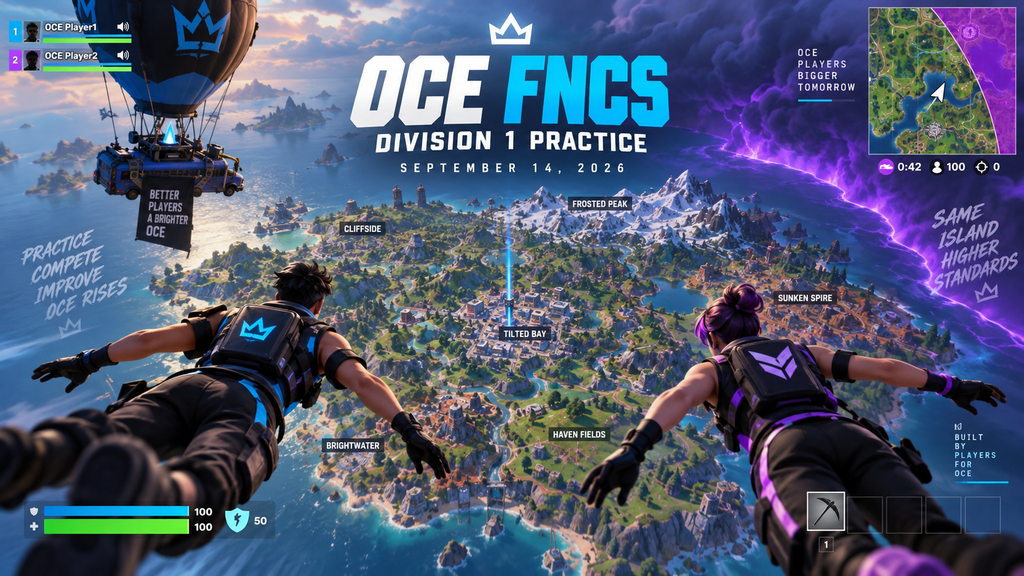
Epic Games scheduled the OCE FNCS Division 1 Practice for September 14 from 8:00 AM to 11:00 AM. The official event is played as Battle Royale Duos, with qualification connected directly to performance inside the Division 1 practice system.
The atmosphere around the session reflected that competitive importance. Players discussed qualification positions, landing spots, map zones, strong games, final drops, and the constant challenge of turning aggressive fights into consistent leaderboard points.
OCE FNCS Division 1 Practice Returned on September 14
The September 14 session formed part of the ongoing FNCS Division 1 Practice schedule. Epic Games lists the wider Division 1 Practice competition across several weeks, with regional sessions giving qualified players repeated opportunities to compete in serious tournament conditions.
For Oceania, the September 14 session ran from 8:00 AM until 11:00 AM. It was a Duos Battle Royale event, placing communication and coordinated decision-making at the center of every match.
That format creates a very different challenge from ordinary Fortnite matches.
A duo cannot rely only on mechanical skill. Both players need to understand their landing route, nearby opponents, available loot, storm movement, rotation timing, material economy, positioning, and each other’s intentions.
One bad decision can remove both players from a match.
A strong decision can turn an uncomfortable position into a valuable late-game opportunity.
That tension is what makes Division 1 practice particularly useful. The lobby contains players who understand competitive Fortnite at a high level, so obvious mistakes are punished quickly.
Teams therefore enter these sessions with detailed plans rather than simply dropping wherever they feel comfortable.
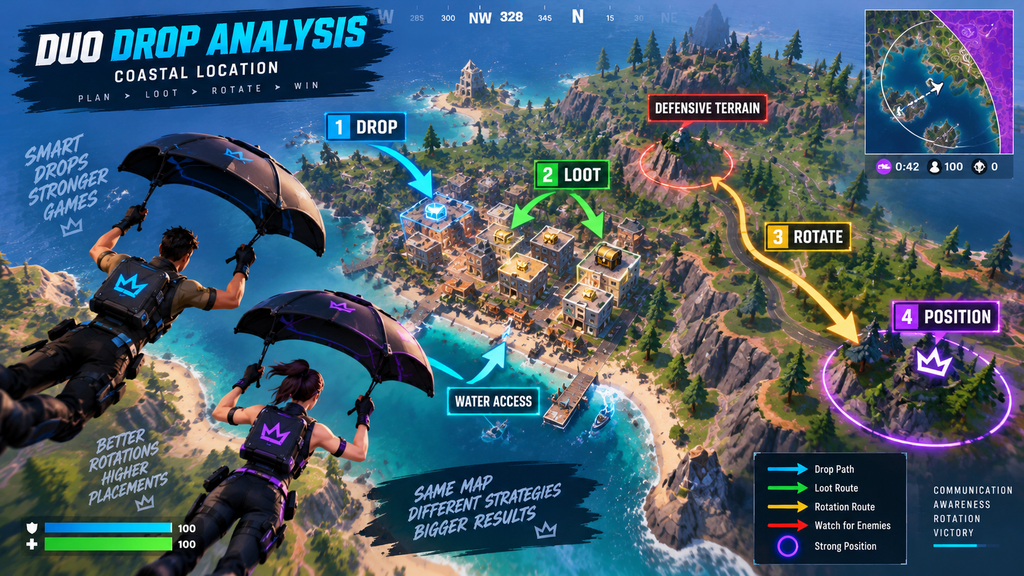
Some players publicly discuss their intended landing areas before or during competition. References to locations such as the left side of a preferred drop or marked zones near water and structures provide a glimpse into how carefully teams prepare their early game.
A landing spot is not simply somewhere to collect weapons.
At this level, it becomes the first stage of an entire match strategy.
Why Division 1 Practice Matters More Than Ordinary Scrims
Calling these matches “practice” can make them sound casual.
They are anything but casual.
The Division 1 environment exists to put competitive players into meaningful games where their performance has consequences. According to Epic Games, access to the FNCS Division 1 Practice Cup comes through previous qualification or advancement through the divisional structure.
Performance also determines who progresses.
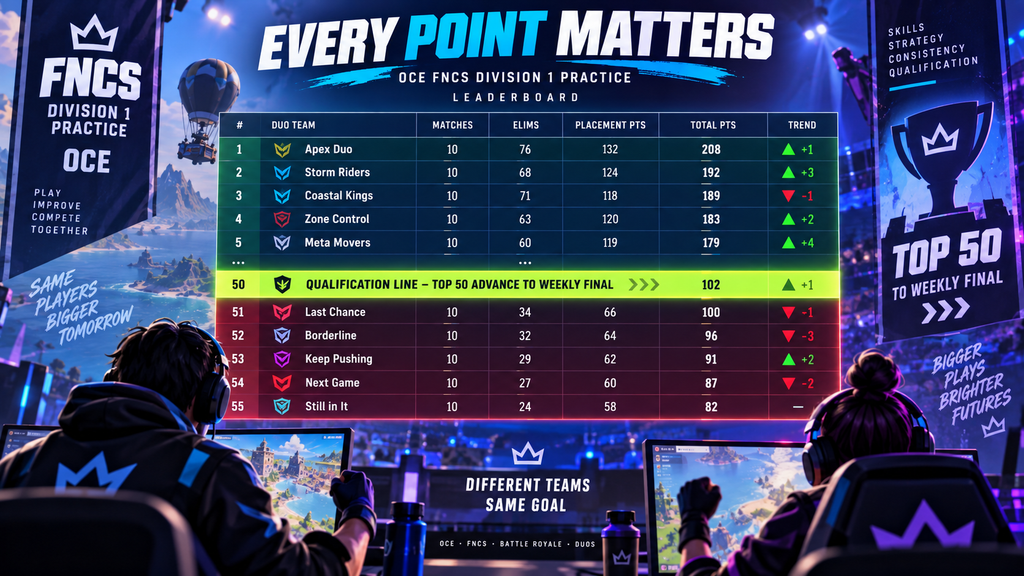
The top 50 teams from the corresponding Division 1 Practice session in each region qualify for the Weekly Final.
That changes everything.
Instead of entering a private scrim where the result disappears after the final game, players have a concrete reason to protect their points.
They still need to experiment. However, experimentation must happen inside a competitive environment.
A duo might test a different rotation.
Another team could adjust its landing split.
Some players may decide to fight more aggressively during the opening matches and then become conservative once they approach a qualification threshold.
Others do exactly the opposite.
They begin carefully, build a solid point total, and then increase their aggression when they know they need a larger final game.
This combination of practice and consequence makes Division 1 valuable.
Players receive tournament-quality repetitions while also experiencing the emotional pressure of a leaderboard.
That pressure cannot easily be recreated in Creative mode.
- You can practice aim.
- You can practice building.
- You can practice edits.
- You can rehearse individual fights hundreds of times.
However, it is much harder to recreate the feeling of entering a final match while knowing that one poor rotation could cost a qualification position.
Division 1 practice provides exactly that environment.
Qualification Pressure Changes Every Decision
Competitive Fortnite becomes especially interesting around the qualification line.
A team sitting comfortably near the top of the leaderboard can approach its next match differently from a duo hovering around the cutoff.
The leading team may prioritize survival.
Another duo might need eliminations.
A third team may need both.
This produces an evolving strategic puzzle.
Players cannot simply decide before the tournament that they will use one strategy for every match.
They need to read the leaderboard and adapt.
Suppose a duo has accumulated a strong total after several games. It might avoid unnecessary early fights during the final matches.
There is little reason to risk an entire tournament run for a small number of elimination points if qualification already looks likely.
The opposite situation creates much more aggression.
A duo outside the projected qualification range may have little to lose.
Suddenly, a contested drop becomes acceptable.
An aggressive mid-game push becomes attractive.
A dangerous refresh attempt might be necessary.
This is one reason final games can become so entertaining.
Players who appear cautious earlier in the session can completely change their approach once the mathematical reality of qualification becomes clear.
OCE Duos Continue to Favor Confident Fighting
Oceania has long produced competitive Fortnite players willing to take fights.
The September 14 discussion around the Division 1 grind again highlighted the importance of elimination-heavy performances.
High-elimination games can transform a leaderboard position very quickly.
A duo that combines a strong placement with a large number of eliminations can make a dramatic jump in only one match.
That possibility encourages confidence.
However, aggression at Division 1 level is not the same as blindly chasing opponents.
Good competitive aggression usually starts with information.
Where is the opposing duo?
How much damage has already been dealt?
Does the team have enough resources to finish the fight?
Is another duo close enough to third-party?
Where is the next storm circle?
How much time remains before a rotation becomes necessary?
Strong players process these questions extremely quickly.
To a casual viewer, the resulting attack may look spontaneous.
In reality, it often comes from several pieces of information collected within seconds.
That is why high-elimination performances attract attention.
They demonstrate mechanical ability, but they also show that the duo repeatedly identified situations where aggression could produce value.
Aspect and Mace Remain Names to Watch in OCE
Aspect and Mace have already demonstrated how explosive an OCE duo can become during Division 1 competition.
Official Fortnite results from an earlier OCE Division 1 Practice round on August 25 listed TRKF Aspect and Maceszn at the top with 638 points across 10 matches. The pair recorded two Victory Royales and an extraordinary 157 eliminations during that session.
Those numbers help explain why competitive viewers pay attention when the duo begins producing another aggressive run.
Their earlier performance averaged 15.7 eliminations per match.
That does not mean every session will follow the same pattern. Fortnite tournaments are highly variable. Drops change, opponents adapt, storm circles create different situations, and even elite teams can have difficult games.
Still, proven elimination potential matters.
When players with that history begin building momentum, other teams in the lobby must respect them.
The psychological effect can also influence fights.
Knowing that a nearby duo has repeatedly produced huge elimination totals may encourage opponents to rotate earlier or avoid unnecessary engagement.
At the same time, confident teams may deliberately challenge them.
Competitive reputations create their own layer of strategy.
Near-40 Elimination Games Show How Quickly Momentum Can Change
Few things transform a competitive Fortnite session faster than a massive elimination game.
A duo can spend several matches struggling to build momentum and then suddenly produce an enormous performance.
That single game changes everything.
The point total jumps.
Confidence improves.
The qualification picture becomes clearer.
Other players notice the result.
Most importantly, the duo gains more strategic freedom for the remaining matches.
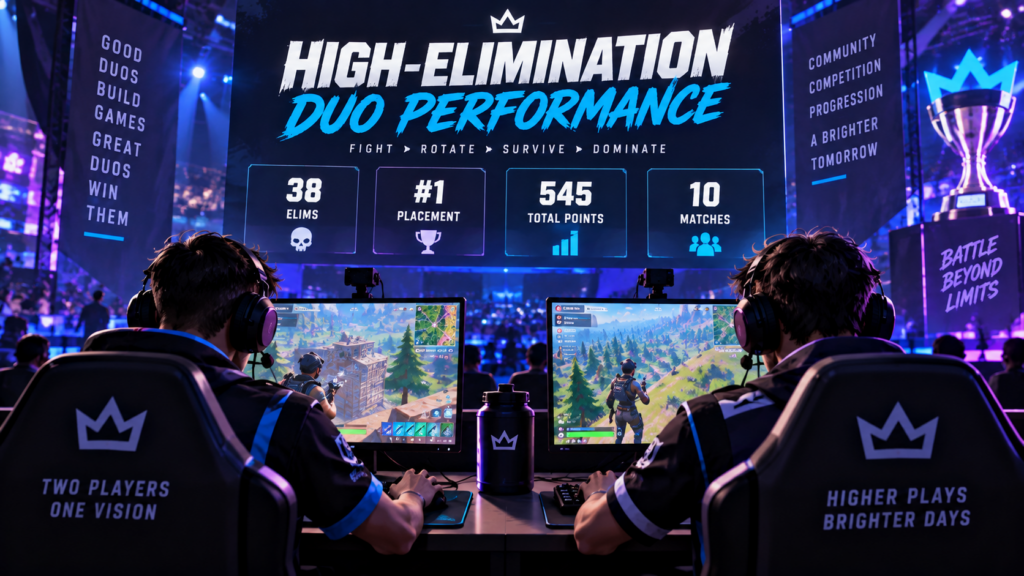
Reports and player discussion around the September 14 grind highlighted near-40-elimination performances. Numbers at that level naturally attract attention because they represent much more than ordinary consistency.
They represent a lobby-changing game.
However, one huge match does not automatically guarantee the best tournament result.
Consistency still matters.
A duo that produces one extraordinary game but repeatedly gets eliminated early can lose ground to teams that consistently survive deep into each match.
That balance between explosive potential and repeatable performance defines much of competitive Fortnite.
The ideal session contains both.
A team wants enough eliminations to separate itself from conservative opponents, but it also needs enough placements to prevent bad games from destroying its total.
That sounds simple.
Executing it against Division 1 opponents is much harder.
Placement Points Still Separate Good Teams From Great Teams
Eliminations receive attention because they are exciting.
Placement often wins tournaments.
Late-game Fortnite requires a completely different skill set from early-game fighting.
The available space becomes smaller.
Teams become compressed.
Resources disappear.
Players must identify layers, elevation, safe routes, possible refresh opportunities, and enemy positions while the storm continues moving.
One mistake can end a match instantly.
Duos that repeatedly reach these situations develop a major advantage.
They become familiar with chaos.
Instead of panicking when several teams occupy the same small area, experienced players recognize patterns.
They know when to move.
They know when to wait.
They understand when taking height is realistic and when attempting it would simply waste resources.
Most importantly, they communicate.
A strong duo rarely plays the final moments as two independent players.
One may lead the rotation.
The other protects the side.
One tracks materials.
The other identifies opponents.
Those roles can switch within seconds.
The teams capable of maintaining that coordination while under pressure are usually the teams that convert good sessions into excellent ones.
Landing Spots Can Decide a Tournament Before Mid-Game
Every competitive Fortnite match begins with a decision that can affect everything afterward.
Where do you land?
For established duos, the answer is rarely random.
Teams practice specific drops repeatedly because familiarity creates efficiency.
They learn where items appear.
They understand the quickest loot routes.
They know which structures provide protection.
They identify nearby mobility.
They memorize terrain.
They also learn how opposing teams behave when the location becomes contested.
A few seconds saved during the opening stage can matter later.
Reaching a weapon first can decide a fight.
Finding additional shields can change whether a team challenges another duo.
Leaving a location 20 seconds earlier may create a safer rotation.
This is why landing-spot discussions matter during FNCS practice.
When players mention the left side of a location or mark particular zones near water and structures, they reveal how precise competitive preparation has become.
The location itself is only the beginning.
Teams are effectively planning a chain of decisions.
Drop.
Loot.
Fight or disengage.
Collect resources.
Identify storm.
Choose rotation.
Secure position.
Prepare for the next zone.
A mistake at the first stage can make every later stage harder.
Contested Drops Create a Different Kind of Pressure
Landing alone is one thing.
Landing beside another Division 1 duo is something else.
A contested drop introduces immediate uncertainty.
Even if both teams know the location perfectly, small differences can determine the result.
One player may reach a weapon first.
Someone may receive better shields.
A chest may provide exactly the item needed to win the opening fight.
One player could land slightly too far from their teammate.
Suddenly, a planned two-versus-two becomes two isolated one-versus-one fights.
Professional and high-level competitive players therefore spend enormous amounts of time refining their drops.
They do not simply aim toward a building.
They study the approach.
They understand how their glider reaches the terrain.
They know which side gives them the best chance of arriving first.
Practice sessions provide opportunities to test those details against real opponents.
If a duo repeatedly loses the same contested location, something needs to change before a major event.
Perhaps the drop is inefficient.
Maybe the loot split leaves the players too far apart.
Possibly the opposing duo simply understands the location better.
Division 1 practice exposes those weaknesses.
That makes losing useful, provided the players learn from it.
Map Knowledge Becomes a Competitive Weapon
Mechanical skill receives most of the attention in Fortnite clips.
Map knowledge receives less attention, yet it can be equally important.
Knowing the environment allows players to make faster decisions.
A team that understands terrain can rotate without constantly checking every possible route.
Players know where they can find cover.
They understand which hills create dangerous sightlines.
They recognize locations where another team is likely to wait.
Water, structures, elevation, mobility routes, and natural cover all affect the decision.
This becomes particularly important when the storm forces an unusual rotation.
A duo cannot always follow its preferred route.
Sometimes the safest path is blocked.
Another team may control the obvious position.
A vehicle or mobility option may disappear.
The zone may pull in the opposite direction.
Strong teams improvise because their knowledge extends beyond one rehearsed route.
That flexibility is difficult to measure on a leaderboard.
Yet it often explains why the same players consistently survive difficult games.
Communication Is the Hidden Skill Behind Successful Duos
Two mechanically talented Fortnite players do not automatically create a great duo.
Communication connects everything.
During a competitive match, players exchange information constantly.
Damage.
Position.
Resources.
Weapons.
Movement.
Enemies.
Storm timing.
Possible rotations.
A good call needs to be short and understandable.
There is rarely enough time for a long discussion.
If one player says “rotate,” the other needs to understand where, when, and why.
That shared understanding develops through repetition.
Division 1 practice provides exactly those repetitions.
The more games a duo plays together, the more communication becomes automatic.
Eventually, one word can communicate an entire plan.
That efficiency becomes especially valuable during moving zones.
Sound becomes chaotic.
Multiple opponents may be firing.
Structures appear everywhere.
The storm is moving.
Both players may be low on resources.
Clear communication prevents two individuals from making two different decisions.
When both players move as one unit, the duo becomes significantly harder to eliminate.
Why Final Drops Feel Different
The final game of a competitive session has a unique atmosphere.
There is no future match available to repair a mistake.
The leaderboard is already taking shape.
Players know approximately what they need.
For teams near qualification, the final drop may feel more stressful than any previous match.
A comfortable team wants to avoid disaster.
A struggling team needs something special.
That creates conflicting strategies inside the same lobby.
Some duos become extremely careful.
Others become extremely aggressive.
The result can be unpredictable.
A team desperate for points might contest a location it normally avoids.
Another duo may change its drop to escape unnecessary risk.
Players who need eliminations may attack earlier.
Teams already sitting above the projected line may prioritize placement.
The final lobby therefore becomes a fascinating mixture of objectives.
Everyone is playing Fortnite.
Not everyone is playing the same strategic game.
The Top 50 Qualification Line Creates Constant Movement
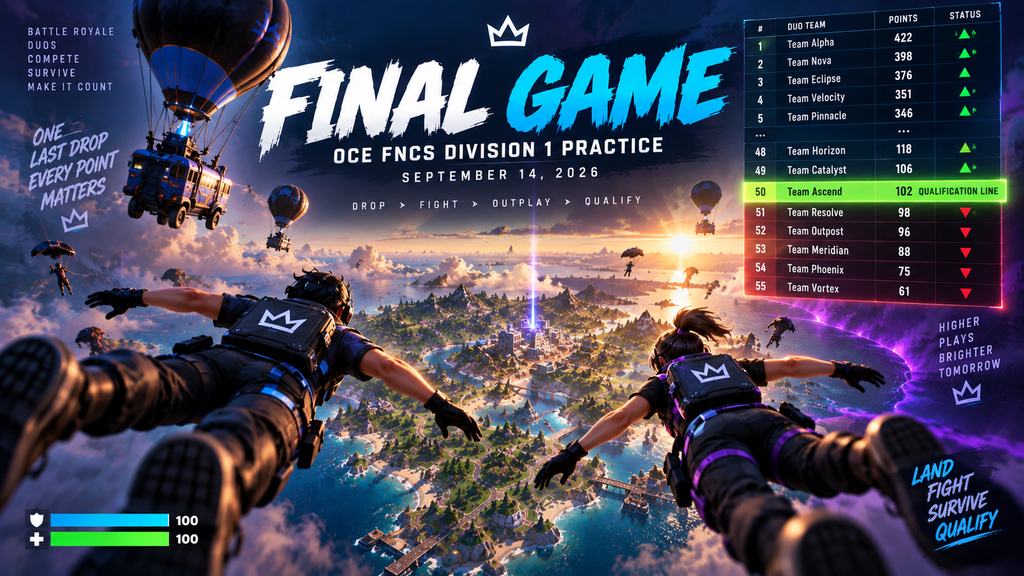
Epic Games states that the top 50 teams in each region qualify from the corresponding Division 1 Practice session to the Weekly Final.
Fifty places may initially sound generous.
In a competitive lobby, it can feel incredibly small.
The difference between qualification and elimination can come down to a handful of points.
That creates constant leaderboard movement.
A duo may appear safe after one match and fall several positions while waiting for the next game.
Another team can jump dramatically after a Victory Royale.
Large elimination performances create even bigger movements.
Players therefore need to understand that their visible position is temporary until the session ends.
The leaderboard is not static.
Other teams are still playing.
Matches finish at different times.
Points continue arriving.
A duo sitting in 45th place cannot simply assume it has qualified.
Likewise, a team in 60th should not assume the session is over.
One excellent match can change the picture.
This uncertainty is one of the strongest sources of competitive tension.
Previous OCE Sessions Show the Region’s Scoring Potential
Recent Division 1 results demonstrate how competitive OCE can become.
In the August 25 OCE session, Aspect and Maceszn produced 638 points with two Victory Royales and 157 eliminations across 10 matches.
Other duos also produced enormous totals.
The second-place team finished with 620 points and 129 eliminations, while several additional teams approached or exceeded the 480-point range.
Those numbers show how demanding the top of an OCE leaderboard can become.
A respectable performance may not be enough to challenge for first place.
Teams need combinations of eliminations, placements, and wins.
Another OCE Division 1 session tracked by competitive ranking services showed Aspect and Mace leading with 574 points, followed closely by other duos above 550.
The exact totals vary from session to session, but the broader lesson remains consistent.
OCE’s best-performing teams can accumulate points extremely quickly.
That creates pressure throughout the leaderboard.
When the leaders start producing huge games, everyone else must decide whether to increase their aggression or continue trusting a more consistent approach.
Weekly Finals Reward More Than One Hot Game
Qualifying for a Weekly Final represents another challenge.
The opening practice session can reward explosive scoring over a longer window.
A final compresses the competition.
Players who advance are surrounded by other teams that successfully survived the qualification stage.
Easy fights become less common.
Mistakes become more expensive.
The September 12 OCE Weekly Final provides a useful example of how different the environment can become.
Official results showed hwk masezx and JOGO spookÿ winning that final with 302 points across six matches.
They did not record a Victory Royale.
Instead, their overall performance was enough to finish first.
PWR Alex8x and their teammate followed with 298 points and two Victory Royales.
That contrast demonstrates something important.
Victory Royales matter.
They are not the only route to success.
Consistency across a limited number of matches can beat a team with more wins.
That lesson carries directly into practice.
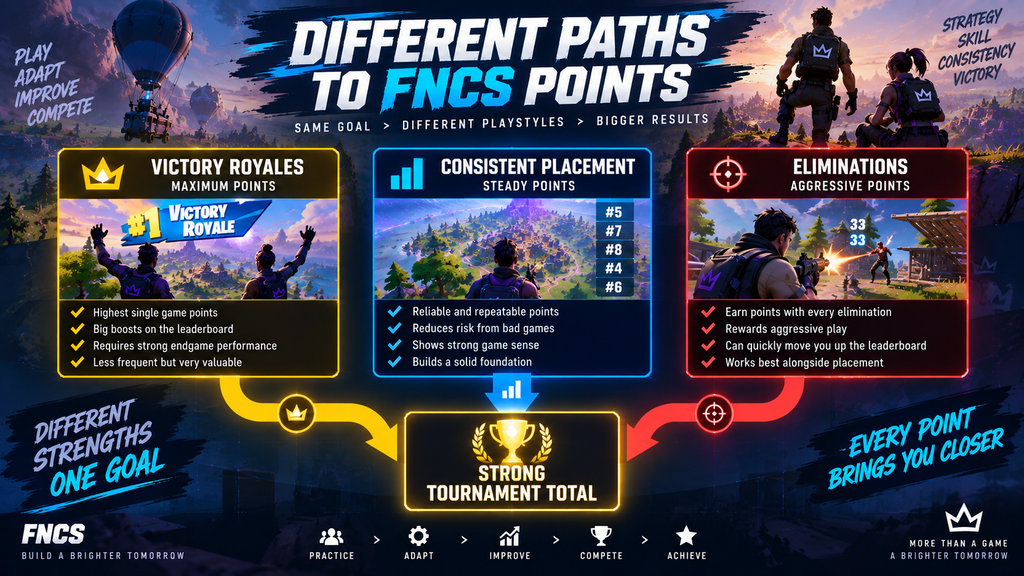
Duos need several ways to score.
If their entire strategy depends on winning matches, one unfortunate zone can destroy the plan.
If they can collect points through eliminations and repeated strong placements, they become much more resilient.
Strong Eliminations Need Smart Placement to Produce Results
A 30- or 40-elimination performance looks spectacular.
It also creates an important strategic question.
Can the duo repeat enough of that success?
Tournament scoring rewards totals, not clips.
A team could produce the most memorable game of the day and still finish below a quieter duo that reaches the late game repeatedly.
The best teams combine both styles.
They identify opportunities for eliminations without sacrificing their entire tournament.
This often means changing pace during a match.
The early game might be controlled.
Mid-game could become aggressive when a favorable fight appears.
Late game becomes focused on survival, positioning, and refreshes.
Then aggression returns when eliminations become necessary.
Elite Fortnite is not permanently aggressive or permanently defensive.
It is adaptive.
Players change their behavior according to information.
That ability separates skilled fighters from complete tournament players.
Resource Management Becomes Critical in High-Elimination Games
Every fight costs something.
- Ammunition.
- Healing.
- Mobility.
- Materials.
- Time.
- Position.
Sometimes the biggest cost is not immediately visible.
A duo may win three consecutive fights but finish the sequence with almost no resources.
Another team arrives.
The successful fighters suddenly become vulnerable.
Competitive players therefore need to evaluate whether an elimination is worth pursuing.
Finishing an opponent can provide valuable resources.
Chasing that opponent for too long can create the opposite result.
The storm may arrive.
Another team may take the desired position.
The duo may waste mobility.
This is why elimination numbers alone cannot describe how well a team played.
Context matters.
An elimination that provides a crucial refresh during the final zone may be far more valuable than an unnecessary mid-game fight.
Good teams understand the difference.
Storm Rotations Test Preparation and Improvisation
No amount of preparation can completely control Fortnite’s storm.
That randomness forces players to adapt.
A favorable zone allows a duo to preserve resources.
An unfavorable zone may require immediate movement.
Long rotations create exposure.
Players may need to cross open areas.
Opponents can hold positions along the route.
Mobility becomes more valuable.
Timing becomes critical.
Rotating too early can surrender a strong position.
Rotating too late can leave the team trapped.
There is rarely one universally correct answer.
The decision depends on the lobby.
That is another reason practice matters.
Players encounter more scenarios.
Over time, those situations become familiar.
A difficult storm pull stops feeling completely new because the duo has already experienced something similar.
Experience does not remove uncertainty.
It makes uncertainty easier to manage.
OCE Competition Has Its Own Identity
Oceania may have a smaller competitive player pool than some of Fortnite’s largest regions, but the region has developed a recognizable competitive identity.
OCE players often demonstrate strong mechanical confidence.
The region can produce fast-paced games and aggressive elimination totals.
At the same time, top players understand that international success requires more than regional dominance.
Strategies that work comfortably in one environment may need adjustment elsewhere.
Different regions have different tendencies.
Some lobbies contest locations more aggressively.
Others preserve more players into late game.
Rotation patterns can change.
The speed of fights can change.
Even the psychological expectations around specific landing locations can be different.
Regional practice therefore provides the foundation.
The strongest players then need to translate those skills into broader competition.
That process is part of what makes the FNCS ecosystem interesting.
Division 1 Creates a Weekly Competitive Routine
One overlooked benefit of the divisional system is repetition.
Serious improvement rarely comes from one tournament.
Players need a routine.
Prepare.
Compete.
Review.
Adjust.
Compete again.
Division 1 Practice encourages that cycle.
After each session, a duo can identify what went wrong.
Were too many games lost at spawn?
Did rotations begin too late?
Were fights taking too long?
Did one player repeatedly become isolated?
Were materials running out during moving zones?
Was communication unclear?
These questions turn tournament results into useful information.
A poor session can therefore have long-term value.
It exposes weaknesses before a more important event.
A great session also needs review.
Winning does not mean every decision was correct.
Sometimes a team survives a mistake because the opponent fails to punish it.
Against stronger competition, the same mistake may end the match.
Professional improvement requires players to separate the result from the quality of the decision.
That mindset is essential.
What Players Can Learn From Their September 14 Games
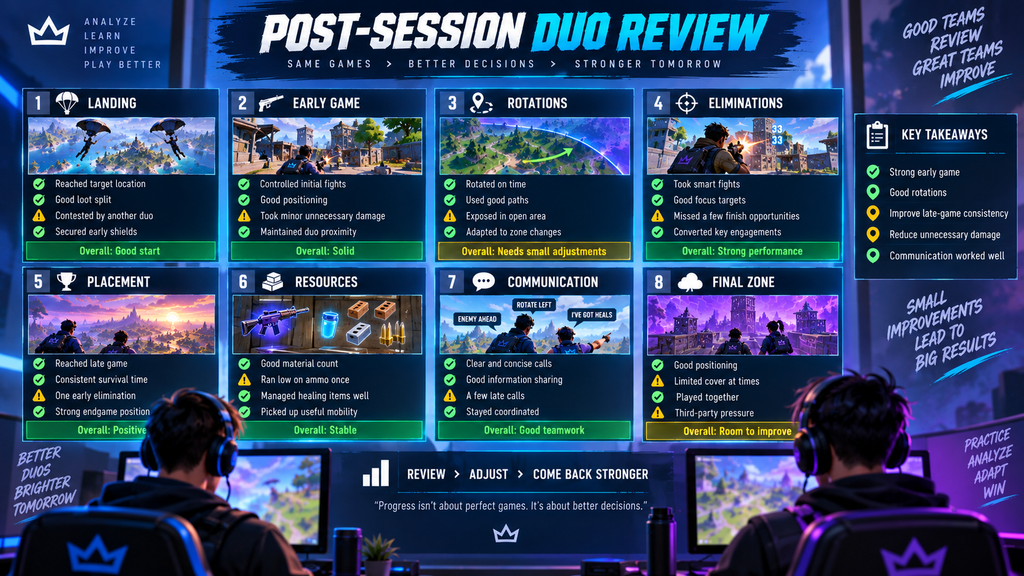
The September 14 session gives OCE duos another collection of matches to analyze.
Landing consistency should be the first area of review.
If the duo repeatedly started matches with poor loot or split positioning, the drop plan may need adjustment.
Next comes early fighting.
Teams should examine whether their eliminations came from controlled advantages or risky improvisation.
Mid-game deserves separate attention.
Many tournament runs disappear during rotations rather than direct mechanical fights.
A team might repeatedly move through dangerous terrain.
Another may rotate too late.
Some duos waste mobility early and have nothing available when the storm becomes difficult.
Late game offers another category.
Did both players survive together?
Were resources shared efficiently?
Did communication remain clear?
Were refreshes planned or desperate?
The answers help players identify patterns.
One mistake means little.
The same mistake across five matches becomes a problem.
Why Practice Results Should Not Be Overinterpreted
Strong practice performances are encouraging.
They are not guarantees.
Competitive Fortnite changes quickly.
A duo can dominate one session and struggle in the next.
Opponents adapt.
Landing spots become contested.
Game updates can alter the meta.
Items change.
Strategies spread.
Players also experience normal variation in performance.
The important question is not whether a team wins every practice session.
The better question is whether the team is improving the skills required to perform when the biggest event arrives.
Practice results provide evidence.
They do not provide certainty.
That distinction is particularly important when discussing young esports competitors.
One leaderboard should not define a player’s ability.
Long-term consistency matters more.
FNCS Practice Builds Toward Bigger Competitive Goals
Division 1 sessions exist within a much larger competitive journey.
Players are not grinding these lobbies simply to collect screenshots of high scores.
They want preparation.
They want qualification.
They want experience against strong opponents.
Ultimately, many want opportunities to compete on Fortnite’s biggest stages.
That long-term objective changes how practice should be evaluated.
A contested drop that goes badly today may provide valuable information for a future major.
A failed rotation can reveal a map weakness.
A communication breakdown can show exactly what the duo needs to improve.
Even a disappointing final can become useful.
The competitive season rewards teams that learn quickly.
Players who repeat the same mistake receive the same result.
Players who identify problems and adapt become increasingly difficult to beat.
Other Regions Add Another Layer to the September 14 Grind
OCE was not operating in isolation.
Epic Games scheduled Division 1 Practice sessions across multiple competitive regions.
The European Division 1 Practice window for September 14 was scheduled from 5:00 PM to 8:00 PM.
Other regions followed their respective schedules.
That creates an interesting rhythm for competitive Fortnite viewers.
Strategies become visible throughout the day.
Players can watch how different regions approach similar tournament situations.
One region may favor aggressive early contests.
Another may produce crowded endgames.
Individual players can introduce strategies that later appear elsewhere.
Competitive Fortnite constantly evolves through this exchange.
Even when players are opponents, they learn from each other.
The Difference Between Grinding and Practicing Intentionally
Competitive players often describe long sessions as a grind.
The word makes sense.
Improvement requires many hours.
However, simply playing more games does not automatically produce better results.
Intentional practice is different.
A duo enters each session with goals.
Perhaps the objective is improving an awkward landing split.
Maybe the players want cleaner mid-game communication.
Another session might focus on preserving mobility for late zones.
These goals provide something measurable.
Afterward, the duo can evaluate whether the change worked.
Without that process, players can repeat the same habits for hundreds of matches.
Quantity matters.
Quality of repetition matters more.
Division 1 gives teams an ideal testing environment because opponents are capable of exposing mistakes.
A strategy that works against weaker players may fail immediately against high-level competition.
That failure is useful information.
Mechanical Skill Still Matters When Plans Collapse
Competitive strategy sounds organized when described outside the game.
Actual matches are messy.
Plans fail.
An opponent appears unexpectedly.
A teammate takes heavy damage.
The storm shifts.
Mobility disappears.
A third team attacks.
At that moment, mechanical skill becomes the emergency system.
Strong aim can rescue a bad position.
Fast building can create enough time to heal.
Clean edits can turn defense into an elimination.
Movement can help a player escape.
This is why top competitors continue grinding mechanical practice even when their tournament knowledge is excellent.
Strategy creates favorable situations.
Mechanics help players survive unfavorable ones.
The best competitors need both.
Duo Chemistry Can Be More Valuable Than Individual Reputation
Competitive Fortnite constantly produces talented individual players.
Finding the correct teammate is another challenge entirely.
Two excellent players can struggle together if their styles conflict.
One may want to attack immediately.
The other prefers patience.
One communicates constantly.
The other expects more independent decision-making.
Neither approach is automatically wrong.
The problem appears when expectations differ.
Successful duos develop a shared identity.
They understand when to fight.
They agree on rotation priorities.
They know who makes certain calls.
They trust each other.
That trust reduces hesitation.
During a tournament, half a second can matter.
A player who doubts the teammate’s call may move too late.
A player who trusts the call commits immediately.
Practice builds that trust.
Competitive Fortnite Is Often a Game of Small Advantages
Huge elimination games dominate social media.
Many tournament victories come from smaller advantages accumulated repeatedly.
A slightly better drop.
Ten additional seconds to loot.
One extra healing item.
A safer rotation.
A stronger position.
A few additional materials.
Better communication during one fight.
None of these moments looks spectacular alone.
Together, they change tournaments.
This is an important lesson for anyone watching FNCS Division 1.
The leaderboard shows the final total.
It does not show every small decision that created it.
That hidden layer is where much of professional Fortnite actually happens.
What Makes the September 14 OCE Session Worth Following
The September 14 session matters because it captures several elements of competitive Fortnite at once.
There is qualification pressure.
There are established duos.
There are ambitious challengers.
Landing spots matter.
Eliminations matter.
Placement matters.
Adaptation matters.
The format also gives viewers an opportunity to see teams outside the biggest championship broadcasts.
Practice events can reveal emerging partnerships before they become widely recognized.
They can show which players are finding form.
They can expose new landing conflicts.
They can highlight teams capable of enormous elimination totals.
Most importantly, they show the work behind major tournament performances.
The championship is the visible destination.
Sessions like Division 1 Practice are part of the road that gets players there.
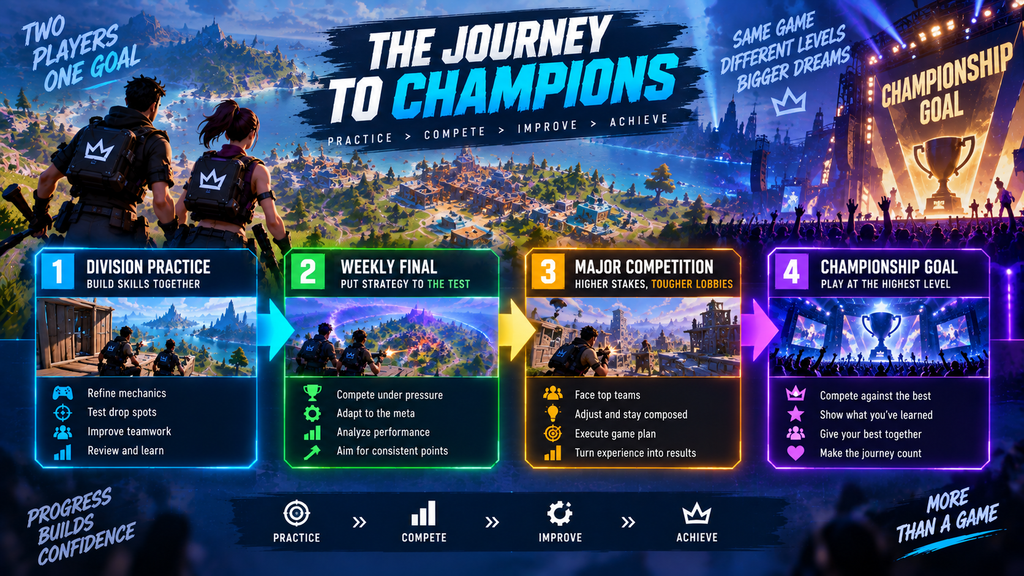
Frequently Asked Questions
What was the OCE FNCS Division 1 Practice on September 14?
It was an official Fortnite competitive Battle Royale Duos practice session for Division 1 players in the Oceania region. Epic Games scheduled the session for September 14, 2026.
What time did the OCE Division 1 Practice session run?
Epic Games listed the OCE session from 8:00 AM until 11:00 AM on September 14, 2026.
Was the September 14 FNCS Practice played as Duos?
Yes. The official Fortnite competitive schedule identifies FNCS Division 1 Practice as a Battle Royale Duos competition.
How do teams qualify for the Weekly Final?
According to Epic Games, the top 50 teams in each region from the corresponding FNCS Division 1 Practice session qualify for the Weekly Final.
Why are landing spots so important in FNCS?
A reliable landing spot affects loot, early-game survival, resources and rotation timing. High-level duos repeatedly practice their drops because small early advantages can influence the entire match.
Are eliminations more important than placement?
Both matter. High-elimination games can create large point gains, while consistent placements reduce the damage caused by weaker matches. Successful tournament teams usually need a balance.
Have Aspect and Mace performed well in OCE Division 1?
Yes. In an official August 25 OCE Division 1 Practice session, TRKF Aspect and Maceszn finished first with 638 points, two Victory Royales and 157 eliminations across 10 matches.
Does winning more Victory Royales guarantee first place?
No. Overall points determine the leaderboard. For example, an OCE Weekly Final on September 12 was won by a duo that recorded no Victory Royales but accumulated enough points through its overall performance.
Why are Division 1 Practice sessions valuable?
They allow strong competitive players to test tournament strategies under meaningful pressure. Teams can evaluate landing plans, rotations, communication, fighting decisions and late-game performance.
When is the next OCE Weekly Final?
The competitive schedule lists the next OCE Division 1 Practice Weekly Final for September 19, 2026. Players should always check the official Fortnite Competitive schedule because tournament dates and details can change.
OCE’s Grind Is About More Than One Leaderboard
September 14 provided another reminder that competitive Fortnite improvement happens long before the biggest championship stage appears on screen.
OCE duos entered Division 1 Practice with landing plans, qualification goals and strategies developed through countless previous games. Some chased eliminations. Others relied on consistency. The strongest performances attempted to combine both.
Large elimination games naturally attracted attention. So did the movement around qualification positions and the pressure surrounding final drops.
Yet the real value of the session goes deeper than individual scores.
Every match gives players information.
A failed landing reveals a weakness.
A successful rotation confirms a strategy.
A huge elimination game proves what a duo can accomplish when everything connects.
A disappointing result provides a reason to review and improve.
That cycle is competitive Fortnite.
Practice creates experience. Experience improves decisions. Better decisions create consistency. Consistency gives teams a stronger chance when the major opportunities arrive.
For OCE’s leading duos, the September 14 Division 1 grind was another step in that process.
And with the Weekly Final approaching, every lesson learned now could matter later.
⚠️ Disclaimer and Source Hygiene
This article is intended for informational and esports news coverage. Tournament schedules, player names, leaderboard positions, qualification rules and competitive formats can change as Epic Games updates events or player information.
Official Fortnite Competitive pages were used as the primary reference for confirmed event scheduling, format, qualification information and historical leaderboard results. Community competitive tracking services were used only as secondary references where additional historical context was useful.
Player comments, reported landing locations, elimination claims and live-session observations can originate from rapidly changing community discussions. Such details should be treated as snapshots of the competitive conversation unless they are confirmed by official final results.
Fortnite, Fortnite Championship Series, FNCS, Epic Games and related names are trademarks or properties of their respective owners. This website is not affiliated with or endorsed by Epic Games.
🔔 For more tutorials like this, consider subscribing to our blog.
📩 Do you have questions or suggestions? Leave a comment or contact us!
🏷️ Tags: Fortnite, FNCS, FNCS Division 1, OCE Fortnite, Fortnite Duos, Fortnite Competitive, FNCS Practice, Oceania Fortnite, Fortnite Esports, Battle Royale
📢 Hashtags: #Fortnite, #FNCS, #FortniteCompetitive, #OCEFortnite, #FortniteDuos, #FortniteEsports, #FNCSDivision1, #BattleRoyale, #CompetitiveFortnite, #OCE
Sources and References
Epic Games – Fortnite Competitive: FNCS Division 1 Practice
Primary source for the official competition format, Division 1 qualification structure, regional schedule and leaderboard information.
Official Fortnite Competitive FNCS Division 1 Practice
Epic Games – Fortnite Competitive OCE Schedule
Primary source confirming the September 14, 2026 OCE FNCS Division 1 Practice session from 8:00 AM to 11:00 AM and its Battle Royale Duos format.
Official Fortnite Competitive OCE Schedule
Epic Games – OCE Division 1 Historical Results
Official leaderboard information shows that TRKF Aspect and Maceszn won the August 25 OCE Division 1 Practice session with 638 points, two Victory Royales and 157 eliminations across 10 matches.
Official OCE FNCS Division 1 Results
Epic Games – OCE Weekly Final Results
Official results for the September 12 OCE Weekly Final provide context for placement consistency, Victory Royales and the different ways duos can build winning point totals.
Official OCE FNCS Weekly Final Results
Secondary Sources and Testimonials
Fortnite Tracker – OCE FNCS Division 1 Practice
Secondary competitive tracking reference confirming the OCE event sequence, including the September 14 opening session and September 19 final. It also summarizes the qualification format and scoring information.
Fortnite Tracker OCE Division 1 Practice
FN Comp Rankings – OCE Division 1
Secondary performance-tracking source useful for comparing previous OCE sessions, team scores and broader competitive trends.
FN Comp Rankings OCE Division 1
