


⏲️ Estimated reading time: 9 min
Table of Contents
Have you ever stood up for a moment and returned to find your dog sitting exactly where you were? It feels personal, almost intentional. However, the truth is very different. This behavior is not about dominance or control. It is rooted in comfort, attachment, instinct, and the deep emotional bond your dog feels toward you.
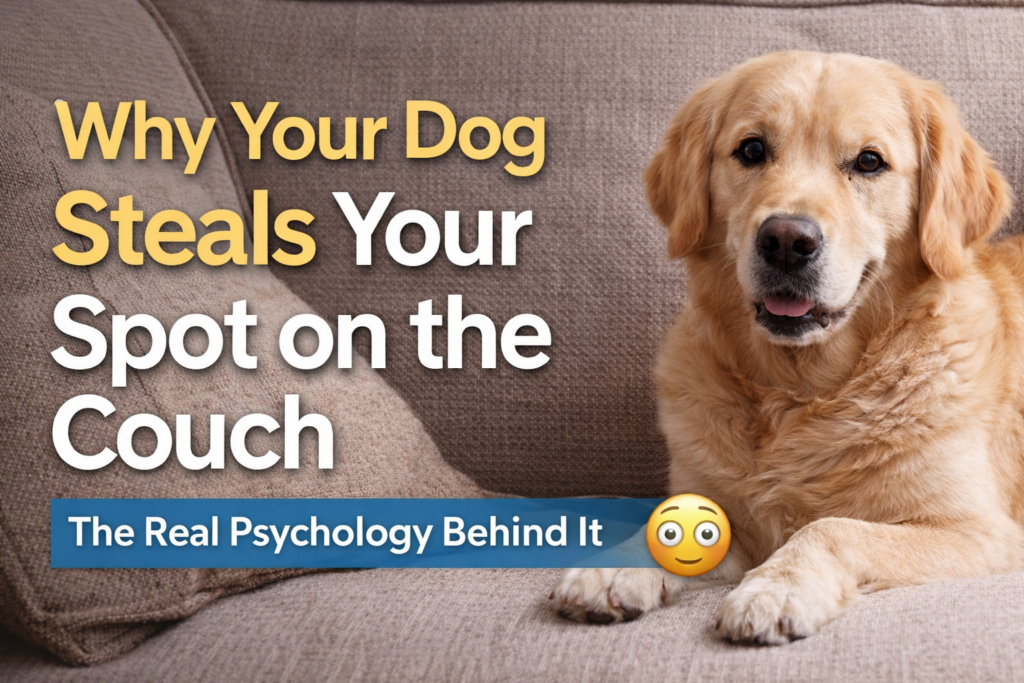
Why Your Dog Steals Your Spot on the Couch – The Real Psychology Behind It. It Feels Personal, But It Isn’t
Most dog owners have experienced this small but curious moment. You stand up from the couch to grab something, and when you return, your dog has taken your exact spot. Not just any place on the couch, but the very cushion you were warming seconds ago. At first glance, it seems deliberate. It feels like your dog waited for the opportunity. Some owners even joke that their dog is trying to “claim the throne.” Yet this interpretation reflects human psychology far more than canine psychology.
Dogs do not operate with the same social motivations that humans do. They are not plotting to challenge you or assert control. Instead, their behavior is guided by instinct, sensory perception, and emotional bonding. Once you understand how dogs experience the world, this seemingly mischievous act becomes something far more touching and logical.
Warmth: The Simplest Explanation
The most immediate and practical reason your dog steals your spot is warmth. When you sit somewhere, your body heat transfers into the cushion. The moment you stand up, that spot becomes the warmest place in the room. Dogs are naturally drawn to warmth because it represents comfort and energy conservation. In the wild, conserving heat meant survival. Even though your dog lives in a modern home, their instincts remain largely unchanged.
Your recently vacated seat offers a soft surface combined with fresh warmth. From a purely biological standpoint, it is the optimal resting area available. There is no deeper strategy involved. Your dog simply chooses the most comfortable option presented at that moment.
Scent and Emotional Security
Beyond warmth, scent plays an even more powerful role. Dogs perceive the world primarily through smell. Your seat on the couch carries your unique scent, which includes pheromones and subtle chemical signals that your dog associates with safety. To you, it is just a couch cushion. To your dog, it is a concentrated source of reassurance.
When your dog curls up in your spot, they are surrounding themselves with the scent of their trusted human. This creates a calming effect. Even if you have only stepped away briefly, your scent remains strong. For dogs that are highly bonded to their owners, being close to that scent reduces stress and increases feelings of stability. It is not about replacing you. It is about staying connected to you.
Attachment and Pack Instinct
Dogs are social animals with strong pack instincts. In natural pack structures, members rest and sleep close together. Physical proximity reinforces social bonds and enhances group security. In your home, you are your dog’s primary social figure. You are their pack leader in the sense of guidance and security, not dominance hierarchy.
When your dog chooses your seat, they are choosing closeness. Even if you are not physically present, the scent and warmth of your body create a symbolic presence. This behavior reflects attachment rather than authority. It shows that your dog feels safest where you have been. The act is less about territory and more about connection.
Human Projection and Misinterpretation
It is important to acknowledge how easily humans project meaning onto animal behavior. When a person takes our seat, we interpret it as a social gesture. We may see it as playful teasing, competition, or even subtle disrespect. Our brains are wired to interpret actions through social hierarchies. However, dogs do not apply those same rules.
When your dog looks at you after taking your seat, you may perceive a guilty or mischievous expression. In reality, dogs are highly sensitive to human facial expressions and tone. They respond to your reaction, not to an internal sense of wrongdoing. What you interpret as guilt is often simply anticipation of your response.
Understanding this difference allows you to shift your perspective. Instead of viewing the behavior as defiance, you can recognize it as instinct-driven comfort seeking.
Reinforcement Through Attention
Behavioral psychology also explains why this habit continues. If your dog takes your seat and you respond by laughing, petting them, or speaking in an animated tone, you are providing attention. Even mild interaction can reinforce behavior. Dogs learn quickly which actions lead to engagement.
If seat-stealing has ever resulted in cuddling or playful exchange, your dog may associate the act with positive outcomes. This does not mean they planned it with strategy. It simply means the behavior has been rewarded in some way. Reinforced behaviors naturally repeat.
Is It Ever About Dominance?
Older dog training theories often focused heavily on dominance hierarchies. Modern canine behavioral science has largely moved away from this simplistic view. In most household situations, dogs are not trying to dominate their owners. True dominance-related issues would include aggression over resources, growling when asked to move, or defensive posture when approached.
If your dog calmly sits in your spot and moves when gently redirected, there is no dominance issue at play. The behavior remains rooted in comfort and bonding. Dominance myths can create unnecessary tension between owners and pets. A more accurate understanding promotes healthier relationships.
Why Some Dogs Do It More Than Others
Certain dogs may be more prone to this behavior. Breeds known for strong attachment tendencies often seek closeness more intensely. Smaller or short-haired breeds may crave warmth more than others. Dogs with mild separation sensitivity may gravitate toward areas with strong scent cues.
Personality also plays a role. Some dogs simply prefer soft, elevated surfaces. If your couch is the central gathering place of the home, it becomes associated with social interaction and emotional warmth. Your seat, being the most used, becomes the most appealing.
When It Might Signal Anxiety
In most cases, this behavior is harmless and affectionate. However, context matters. If seat-stealing accompanies destructive behavior, excessive whining, or extreme clinginess, it may signal underlying anxiety. Dogs experiencing separation stress often seek areas that strongly carry their owner’s scent.
If you notice broader signs of distress, consulting a veterinarian or certified behavior specialist is wise. Addressing anxiety early prevents escalation and strengthens your dog’s emotional stability.
Should You Correct It?
Whether you correct the behavior depends entirely on your boundaries. If you do not mind sharing space, there is no harm in allowing it. If you prefer that your dog use their own bed, training can gently redirect the habit. Teaching a “place” command and rewarding them for using their designated area is effective.
Avoid harsh correction. Remember that the motivation behind the behavior is comfort and attachment. Punishment can create confusion or insecurity. Calm redirection combined with positive reinforcement works far better.
What This Behavior Truly Means
At its core, this small act reveals something meaningful. Your dog finds your presence comforting. Your scent provides emotional safety. Your warmth represents security. When they sit in your spot, they are not challenging you. They are choosing closeness.
In a world where dogs rely entirely on their human companions for structure and reassurance, selecting your seat is a subtle sign of trust. It reflects attachment, not rivalry.
Frequently Asked Questions
Why does my dog immediately take my seat when I stand up?
Because the cushion is warm and carries your scent, making it the most comfortable and reassuring place available at that moment.
Is my dog trying to dominate me by sitting in my spot?
No. Modern canine psychology shows that typical seat-stealing behavior is linked to comfort and attachment, not dominance.
Why does my dog look guilty when I return?
Dogs react to your facial expressions and tone of voice. What appears as guilt is usually anticipation of your response.
Should I push my dog off the couch?
Calm redirection is better than force. Teaching a designated resting place creates clarity without stress.
Why does my dog prefer my spot over my partner’s?
Your scent, emotional bond, or body heat may simply feel more comforting to them.
Does this behavior mean my dog loves me?
It suggests attachment and emotional connection, which are strong indicators of affection.
Can I train my dog to stop taking my seat?
Yes. Consistent redirection and rewarding alternative resting spots can change the habit.
Is it harmful if I let my dog sit in my spot?
In most cases, it is harmless as long as the behavior does not involve aggression or anxiety-related symptoms.
A Gentle Perspective Shift
You may also be interested in: Belgian Workers Find $10 Million in Hidden Gold
Instead of seeing the act as a tiny rebellion, consider it a compliment. Your dog chooses your spot because it feels safest there. The warmth and scent you leave behind become a temporary comfort zone. What feels like theft is often an expression of trust.
When you look at it through the lens of canine psychology, the moment changes. It is no longer a battle for territory. It becomes a reflection of attachment and instinctive comfort seeking. And in many ways, it is one of the quiet ways your dog says, “You are my safe place.”
⚠️ Disclaimer and Source Hygiene
This article is for informational purposes only and does not replace professional veterinary advice. Interpretations are based on established canine behavioral research and expert insights. If your dog shows signs of anxiety, aggression, or distress, consult a licensed veterinarian or certified animal behavior specialist.
🔔 For more tutorials like this, consider subscribing to our blog.
📩 Do you have questions or suggestions? Leave a comment or contact us!
🏷️ Tags: dog psychology, dog behavior, pet attachment, canine instincts, couch behavior, separation anxiety dogs, dog training tips, pet bonding, understanding dogs, animal psychology
📢 Hashtags: #DogPsychology, #DogBehavior, #PetLove, #DogOwnerLife, #CanineInstincts, #PetTips, #DogTraining, #AnimalBehavior, #DogsOfInstagram, #PetBonding
