


⏲️ Estimated reading time: 12 min
Table of Contents
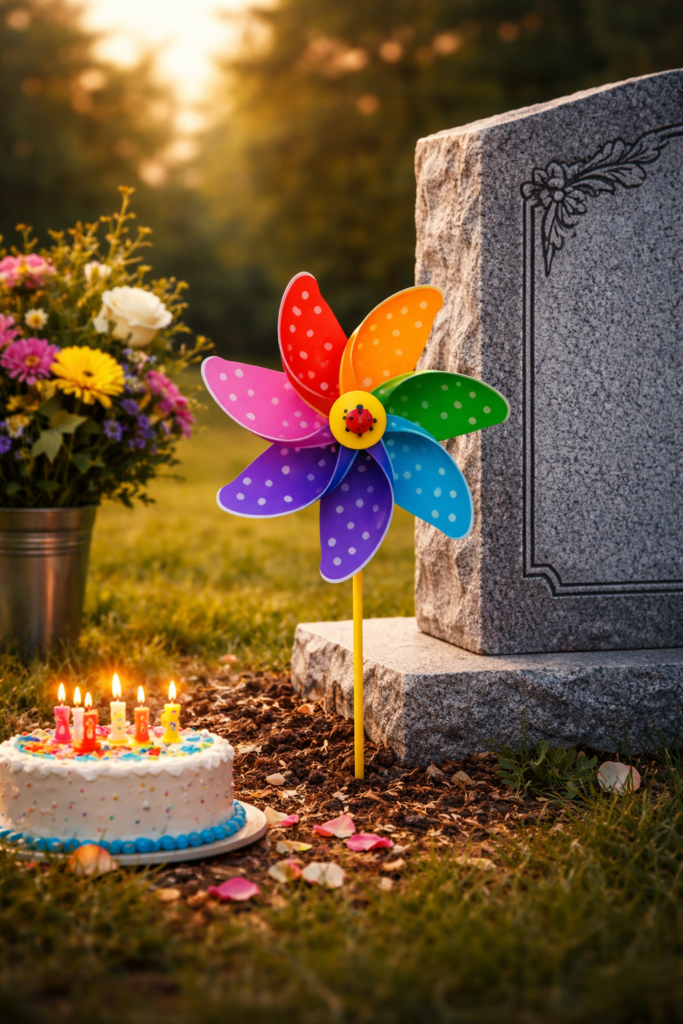
A mother goes to her son’s grave on his birthday. She brings a cake, sings softly, and wipes the dust away. In complete silence, a small pinwheel begins to spin on its own. For her, that simple movement becomes a message.
See also: Klaus-Michael Kühne Dies at 89, Leaving a Global Logistics
A story that begins with a cake and silence
There are pains that never truly “heal” in the classic sense. They change shape. Sometimes they soften. Other times they return without warning, like a memory slipping under the door uninvited. The pain of a mother who loses her child is often described as the deepest of all. Not because it matters more than other losses, but because it strikes directly at the instinct to protect, to hold close, to watch the future grow.
In this story, a mother goes to her son’s grave on his birthday. She does not go to make a public gesture. She does not go for photos or explanations. She goes because that is what her heart tells her to do. On a day when she once placed candles on a cake at home, she now places a cake beside a cold headstone.
Still, she tries to keep the ritual alive.
She brings a cake. She sings to him. She wipes the dust from around the grave. And then, in a silence that feels complete, something simple yet deeply unsettling happens: a small pinwheel beside the grave begins to spin on its own.
To an outside observer, it could be coincidence. A faint air current. A vibration. But for her, the moment carries a different weight. In a single second, a bridge forms between “what might be possible” and “what I feel.”
Why grief rituals matter so deeply
Grief is not only tears. It is routine. It is silence. It is objects left untouched in a house where someone no longer lives. It is buying two portions of food without realizing it. It is stopping in the middle of a song because your breath suddenly disappears.
Rituals appear because they bring a sense of order to an experience that feels chaotic. They may include:
- visiting the grave on specific dates;
- bringing a cake on a birthday;
- placing the same flower every time;
- repeating a prayer;
- leaving letters by the headstone;
- cleaning the place as an act of ongoing care.
These gestures do not bring the loved one back. But they stabilize the person who remains. They say, “I can still do something. I can still love actively. I still have a place where I can meet you.”
That is exactly what the mother does. The cake, the song, the cleaning are not tradition alone. They are ways of maintaining a bond with someone who, while no longer physically present, remains alive emotionally and psychologically.
Complete silence and the moment reality seems to shift
Some moments have an unusual clarity. Fewer sounds. Sharper colors. Stronger smells. In a cemetery, silence can feel so deep that any movement becomes an event. The mother notices there is no wind. Everything is still.
Then the key moment happens: the pinwheel starts to spin.
In everyday life, a pinwheel is insignificant. A decorative object. A cheerful detail in a sad place. That is exactly why it becomes so powerful. Something small and ordinary suddenly becomes the center of her world.
In grief, the mind searches for signs. It searches for any proof that love did not end with life.
In that moment, the mother does not think about physics. She does not pull out her phone to measure airflow. She does not analyze. She feels.
Her reaction: surprise, then dialogue
When the pinwheel starts spinning, the mother is shocked. She tells it to stop and it stops immediately.
This is where the story moves from “phenomenon” to “conversation.” In her mind, the object is no longer just an object. It becomes a response.
She begins to cry. These tears are not only sadness. They are release. They are shock. They are recognition: “If this is happening now, maybe I am not alone.”
She touches the cold headstone and says she misses him. She asks for a sign: “If you miss me too, please make the pinwheel spin again.” And it starts spinning fast, even though there is still no wind.
From that point on, she repeats the request, as if engaged in an ongoing conversation. Each time the pinwheel spins, she feels warmth, as though her son is speaking in a quiet language of his own.
The need for signs: psychology and the soul
Many people ask, “Is it healthy to look for signs?” The honest answer is: it depends.
From a psychological perspective, grief often triggers three core needs:
- the mind seeks meaning to survive the absurd;
- the heart seeks continuity so love does not feel abruptly cut off;
- the body seeks regulation to function day by day.
Signs can act as emotional bandages for these needs. They do not prove anything scientifically, but they can provide comfort.
From a spiritual perspective, signs appear across cultures: a sudden breeze, a bird approaching closely, an unexplained light, a song playing at the exact moment of remembrance, an object falling at the mention of a name. Whether interpreted literally or symbolically, they become bridges between the visible and the invisible.
In this story, the pinwheel becomes that bridge.
The pinwheel as a living symbol
A pinwheel spins because of wind. Wind is invisible, but its effects are visible. The metaphor is powerful: love is invisible, but its impact is felt. The son is not visible, yet his presence seems to move something.
For the mother, the pinwheel becomes a language. And every language develops rules:
- spinning means “yes”;
- stopping means “not now”;
- spinning faster feels stronger.
Even if rational explanations exist, emotional meaning takes root. And those roots help her stand.
When comfort becomes painful
The story shows an important inner shift. At first, the mother asks for the sign. Then she receives it and cries. But eventually, the sign becomes overwhelming.
She says, “God, I miss you. Now stop it. Stop it.”
This detail is profoundly human. Sometimes what you long for becomes too intense. Feeling that the loved one is close can deepen the pain, not ease it. Presence reminds you of absence. And absence burns.
In grief, people often experience this contradiction:
- “I want to feel that you are with me.”
- “I cannot bear feeling that you are with me, because I cannot hold you.”
Her back-and-forth between asking and stopping is not weakness. It is the heart trying to adapt to the impossible.
“Are you with me?”: the endless question
The question “Are you with me?” is not limited to stories. It appears in bedrooms late at night, in quiet kitchens, in moments when people stare at the ceiling unable to sleep.
The mother asks:
- “My love, are you with me?”
- “If you are with me wherever I go, make it spin.”
Here, she seeks more than confirmation at the grave. She wants assurance that the bond is not confined to that place. She does not want her son trapped in the ground. She wants him present in her life.
This marks an important stage in grief: moving from the grave as the only meeting place to the inner world as the meeting place. Many eventually feel that their loved one lives in habits, values, expressions, and memories.
How grief changes the way we see the world
Before loss, the world feels stable. After loss, it feels fragile. Time fractures. Certain dates become heavy knots; others blur.
Her son’s birthday becomes such a knot. She crosses it with cake, song, cleaning, and hope.
Grief also changes how people perceive coincidence. Those untouched by loss may see coincidence as random. Those who grieve may feel it as communication.
The grieving person is not trying to win a debate. They are trying to breathe.
Possible interpretations of the moment
The spinning pinwheel can be understood in multiple ways, all of which can coexist.
Emotional interpretation
The mother receives comfort. Even if the cause is natural, the emotional effect is real. She feels answered.
Symbolic interpretation
The pinwheel becomes a symbol of their connection. Symbols do not need proof. They need meaning.
Spiritual interpretation
She experiences the moment as a sign from her son or a divine response. She prays and speaks to God.
Rational interpretation
There may have been subtle airflow, vibration, or pressure change. Yet this does not erase the emotional truth of the experience.
These interpretations do not have to compete. What matters is whether the experience helps or harms the soul.
When seeking signs becomes a trap
There is also a real risk. If a person becomes dependent on signs, life can freeze. The mother repeats the request again and again.
This repetition has two sides:
- it shows love and longing;
- it may also reveal desperation and a need for control.
A gentle question can help: “Does this sign help me move forward, or does it keep me stuck?” Not to judge, but to protect oneself.
Healthy grief allows signs to remain as warm memories while life continues, even with pain.
What it really means to continue after loss
Continuing does not mean:
- forgetting;
- stopping the tears;
- never speaking their name;
- pretending nothing happened.
Continuing means:
- accepting that love remains, but its form changes;
- allowing pain without letting it destroy identity;
- building a new balance, even if imperfect;
- accepting help.
The mother takes a small step. She speaks. She cries. She asks. She feels answered.
Creating personal healing rituals
If you have lost someone, you can create your own rituals not to imitate this story, but to honor your bond.
A meaningful annual moment
Choose an important date. Light a candle. Bake something. Visit a special place.
A symbolic object
A photo, a bracelet, a stone, a letter. Not to live in the past, but to maintain connection.
Written dialogue
Write letters. Say what you feel. Keep them or tear them up. The process matters more than the object.
Turning grief into care
Some people donate, volunteer, or support others. Love continues through action.
Why this story resonates with so many
This story is not really about a spinning pinwheel. It is about:
- longing that never disappears;
- love searching for expression;
- silence becoming language;
- hope appearing in a tiny detail.
Many people have experienced similar moments in different forms: a familiar scent, a song playing at the exact right moment, a vivid dream, sudden peace.
Not every experience can be proven. But every experience can be respected.
What a pinwheel teaches us about love
True love does not end with death. It moves into:
- memory;
- habit;
- gesture;
- value;
- speech;
- the way pain is carried.
The pinwheel spins. The mother cries. The mother asks. The pinwheel responds again. In that loop, something essential appears: love wants to keep moving.
How to speak to someone who is grieving
If someone near you has lost a loved one:
- presence matters more than words.
What helps
- “I’m here.”
- “Tell me about them.”
- “Can I help with something specific?”
- “I’m sorry. You’re not alone.”
What can hurt
- “Time heals everything.”
- “God wanted it this way.”
- “Be strong.”
- “At least you still have…”
The mother does not need explanations. She needs permission to feel.
When professional help is important
Grief has many forms. Professional support may help if:
- daily functioning becomes impossible;
- guilt is overwhelming;
- panic attacks appear;
- isolation deepens;
- thoughts of not wanting to live arise.
Seeking help does not mean loving less. It means choosing survival.
Frequently Asked Questions
Is it normal to feel that I receive signs from someone who passed away?
Yes. Many people experience this in grief. If it helps you function and does not trap you, it can be part of healing.
Should I look for rational explanations?
You can, if it brings peace. Sometimes understanding does not change emotional meaning.
What if rituals make me cry more?
Crying is not failure. If relief follows, the ritual may still be helpful.
How long does grief last?
There is no universal timeline. Love remains; intensity changes.
Is visiting the grave often unhealthy?
Only if it prevents you from living. Otherwise, it can be supportive.
How can I help a parent who lost a child?
Be present, listen, and help practically. Do not rush their pain.
Is it wrong to feel joy again?
No. Joy does not erase love.
Can rituals be non-religious?
Yes. They only need meaning for you.
What remains after the pinwheel story
This story does not demand belief in one explanation. It invites compassion for how a human being survives longing.
A mother came with a cake. She sang. She cleaned dust. She spoke to cold stone as if it were warm skin. And a pinwheel spun, answering without words.
From that small “yes,” she received something immense: the feeling that love did not end.
⚠️ DISCLAIMER
This article is intended for informational and inspirational purposes only. It does not constitute medical, psychological, legal, or spiritual advice. Grief and emotional responses vary from person to person. For personalized guidance, please consult a qualified psychologist, therapist, medical professional, or spiritual advisor. The content is based on narrative interpretation and general research from reputable sources.
🔔 For more tutorials like this, consider subscribing to our blog.
📩 Do you have questions or suggestions? Leave a comment or contact us!
🏷️ Tags: grief and loss, losing a child, mother and son, signs after death, grief rituals, emotional healing, coping with loss, psychology of grief, love beyond death, bereavement support
📢 Hashtags: #grief, #loss, #bereavement, #motherlove, #healing, #emotionalhealing, #griefjourney, #lovebeyonddeath, #mentalhealth, #copingwithloss
