

⏲️ Estimated reading time: 9 min
Table of Contents
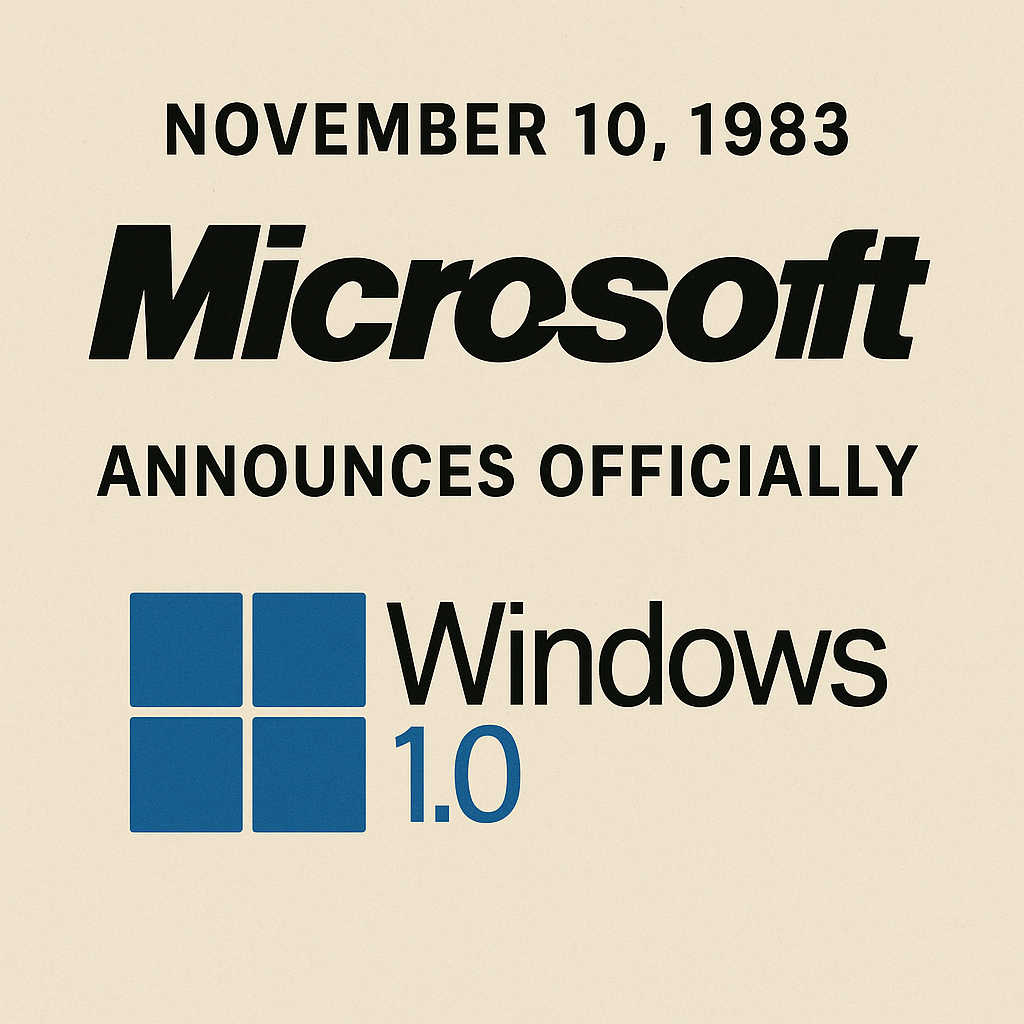
Microsoft Announces Windows 1.0 (1983). On November 10, 1983, Microsoft forever changed the world of computing by officially announcing Windows 1.0 the first graphical interface for MS-DOS. It marked the beginning of a digital revolution that redefined how people interact with computers.
Happy Birthday Windows you are 42 years old
A Day That Changed Everything: November 10, 1983
You may also be interested in: Why You Should Photograph Your Hotel Room Before Checkout
In the early 1980s, personal computers were starting to gain popularity. IBM had already launched its PC, and other companies were racing to build compatible systems. But the user experience was still primitive. To operate a computer, you had to type commands manually. There was no mouse, no graphical interface, and no visual feedback.
Microsoft founded by two ambitious young men, Bill Gates and Paul Allen wanted to change that reality.
On November 10, 1983, at the Plaza Hotel in New York, Bill Gates took the stage to announce something revolutionary: Microsoft Windows 1.0.
For the first time, he presented a system that allowed users to interact with their computers through graphical windows and a mouse, not just text commands. The crowd was stunned.
It was the birth of a new computing era the age of visual interfaces.
What Windows 1.0 Really Was
Windows 1.0 wasn’t a full operating system by itself. Instead, it was a graphical layer that ran on top of MS-DOS.
Users would boot up their PC using DOS and then launch Windows. Once running, they could use a mouse to open and switch between multiple applications.
Some of the first programs included:
- Calculator
- Calendar
- NotePad (a primitive version of today’s Notepad)
- Paint (then called Paintbrush)
- Reversi, a simple logic game
- Clock, a digital time display
- MS-DOS Executive, an early file management interface
For the first time, these programs could coexist on the same screen. The idea of multitasking even in a limited form was groundbreaking.
A New Way to Interact With Technology
Before Windows, computing meant memorizing commands like dir, copy, or del.
Windows 1.0 introduced something entirely new: a graphical user interface (GUI) that used icons, menus, and a mouse pointer.
For millions of people, it made computers suddenly understandable.
Microsoft’s slogan for Windows 1.0 captured this spirit perfectly:
“Introducing Microsoft Windows. See your computer differently.”
And indeed, the world did start to see computers differently. Windows promised to make technology friendly, visual, and accessible.
The Competition in the 1980s
When Microsoft revealed Windows, several companies were already experimenting with GUIs. Apple had just launched Lisa (1983) and was preparing Macintosh (1984). Digital Research was working on GEM, while Xerox PARC had already pioneered much of the graphical technology behind the scenes.
But Microsoft had one advantage no one else could match its partnership with IBM.
Because MS-DOS powered nearly every IBM PC, Windows could reach an enormous user base without requiring a brand-new computer.
Even though Windows 1.0 wasn’t an immediate commercial hit, it established the foundation for Microsoft’s dominance.
The Announcement and Early Reactions
The November 1983 event drew huge media attention. Reporters were intrigued but also skeptical.
Many wondered whether regular people really needed a mouse or if it would just confuse them. Others pointed out that most PCs were too slow to handle complex graphics.
Microsoft spent two full years refining the product before its official launch in November 1985.
The final release required an IBM-compatible computer with:
- Intel 8088 processor or better
- 256 KB of RAM
- Two floppy drives or a hard disk
- Optional mouse
At the launch, Bill Gates declared:
“Windows gives users the ability to see what they are doing. It brings the power of graphical computing to everyone.”
That vision became prophetic.
The Interface: The Birth of the GUI Revolution
Windows 1.0 looked nothing like the sleek systems of today. The design was extremely simple flat gray backgrounds, boxy icons, and fixed window positions.
Unlike modern systems, windows couldn’t overlap; they appeared side-by-side only. Microsoft had made this choice partly to avoid legal disputes with Apple over interface design.
Despite its limitations, Windows 1.0 introduced key graphical concepts that remain central today:
- Windows for organizing applications
- Drop-down menus for quick access
- Dialog boxes for settings
- The mouse as a core input device
For the first time, users could literally see what they were doing on screen.
Paint and Reversi: The Fun Side of Early Computing
Two of the most memorable apps bundled with Windows 1.0 were Paint and Reversi.
Paint allowed users to draw lines and shapes using a mouse a magical experience in the 1980s.
Reversi, on the other hand, was more than just a game. It served as a demonstration of multitasking and mouse control, showing that Windows could manage complex graphical operations.
These small programs played a huge role in winning people’s curiosity and affection.
From Windows 1.0 to Global Dominance
The journey didn’t stop in 1983. Each new version brought improvements:
- Windows 2.0 (1987) introduced overlapping windows and keyboard shortcuts.
- Windows 3.0 (1990) became the first true commercial success.
- Windows 95 (1995) revolutionized computing with the Start button and taskbar.
- Later came Windows 98, XP, 7, 10, and 11 each building on the foundation laid in 1983.
That first step the announcement of Windows 1.0 ignited a chain of innovations that shaped decades of computing history.
The Cultural and Economic Impact of Windows 1.0
Windows wasn’t just software; it was a catalyst for the digital age.
It democratized computing, enabling schools, homes, and businesses to embrace technology.
By making PCs accessible to ordinary users, Microsoft accelerated the personal computer revolution and built a trillion-dollar empire.
Windows 1.0 paved the way for:
- The rise of Microsoft Office (Word, Excel, PowerPoint)
- Software compatibility across devices
- PC gaming as a new form of entertainment
- The expansion of the Internet era
Every click, every drag-and-drop action, every desktop interface today owes something to that first Windows.
Bill Gates’ Vision for the Future
Bill Gates understood something profound: the future of technology wasn’t hardware it was software.
In a 1984 interview, he said:
“We’re entering an age where software will define the experience. Hardware is just the stage.”
That belief guided Microsoft for decades. While other companies competed over physical machines, Microsoft built an ecosystem one where Windows became the universal language of computers.
The Rivalry With Apple
Apple didn’t take Windows’ arrival lightly. Steve Jobs famously accused Microsoft of copying the Macintosh interface.
The dispute escalated into a high-profile lawsuit in 1988, which Apple eventually lost in 1993.
But by then, Windows had already captured the global market.
The rivalry between Apple and Microsoft became one of the most legendary battles in tech history pushing both companies to innovate faster than ever.
The Technology Behind Windows 1.0
Under the hood, Windows 1.0 was a marvel of efficiency.
Given the limited hardware of the time, Microsoft engineered an innovative system using cooperative multitasking applications voluntarily gave up CPU time to one another.
The system introduced standardized drivers for keyboards, displays, and mice, setting a precedent for hardware compatibility that endures today.
Although Windows 1.0 ran slowly by modern standards, its architecture laid the foundation for future versions.
Marketing Windows 1.0: A Bit of 80s Charm
Microsoft’s marketing campaign for Windows 1.0 is now iconic.
One of the most famous ads featured a young Steve Ballmer, enthusiastically shouting:
“How much do YOU think this advanced operating environment is worth? Don’t answer!”
The over-the-top energy captured the excitement of a new era.
The ads promised a revolutionary experience at an “unbelievably low price” a mix of comedy and genuine ambition that made Windows unforgettable.
Windows 1.0’s Legacy
Looking back, November 10, 1983 wasn’t just another product announcement.
It was the beginning of personal computing as we know it.
Windows transformed computers from tools for specialists into tools for everyone students, doctors, artists, and business owners alike.
Without Windows, the world of digital productivity, creativity, and connectivity might look entirely different.
Fun Facts About Windows 1.0
- Windows 1.0 required only 256 KB of RAM to run.
- It shipped on five floppy disks (5.25-inch).
- There was no Start button that came twelve years later in Windows 95.
- The early logo featured blue lines on a black background, not color.
- Microsoft continued to provide support for Windows 1.0 until 2001 nearly 18 years!
Why the 1983 Announcement Still Matters Today
In 2025, as we use Windows 11 or explore AI-powered systems, it’s incredible to realize how it all started with a simple dream to make technology friendly.
Windows 1.0 wasn’t perfect, but it bridged the gap between humans and machines.
It taught the world that software could be visual, intuitive, and even enjoyable.
That’s why November 10, 1983, remains one of the most important dates in tech history.
From the First Window to the Digital World
When Microsoft introduced Windows 1.0, it wasn’t just launching software it was opening a window to the future.
That day redefined what computers could be.
It made technology approachable, human, and creative.
From 1983 to today’s connected world, the DNA of that first Windows lives on in every click, every icon, and every digital experience we take for granted.
Frequently Asked Questions (FAQ)
1. When was Windows 1.0 officially announced?
Microsoft officially announced Windows 1.0 on November 10, 1983, in New York.
2. When was Windows 1.0 actually released to the public?
It was released in November 1985, two years after the initial announcement.
3. What were the system requirements for Windows 1.0?
An IBM-compatible PC with 256 KB RAM, dual floppy drives, and optionally a mouse.
4. Why is Windows 1.0 considered historic?
Because it introduced a graphical user interface and mouse control to PC users, changing how people interacted with computers forever.
5. Can Windows 1.0 still be used today?
Yes, through emulation tools like DOSBox, but only for educational or nostalgic purposes.
🔔 For more tutorials like this, consider subscribing to our blog.
📩 Do you have questions or suggestions? Leave a comment or contact us!
🏷️ Tags: Microsoft, Windows history, Bill Gates, 1983 technology, computer history, GUI evolution, software revolution, digital era, tech innovation, PC history
📢 Hashtags: #Microsoft #Windows #BillGates #TechHistory #Innovation #1983 #GUI #DigitalRevolution #Computing #WindowsHistory
