


⏲️ Estimated reading time: 11 min
Table of Contents
Martin Luther King Jr. – The Dreamer Who Changed the World. Discover the inspiring life of Martin Luther King Jr., the pastor, activist, and Nobel laureate who transformed America through nonviolence, equality, and his timeless dream of justice for all. Explore his journey from Atlanta to immortality.
The Early Life of Martin Luther King Jr.
Martin Luther King Jr. was born on January 15, 1929, in Atlanta, Georgia. Originally named Michael Luther King Jr., he later changed his name to honor the Protestant reformer Martin Luther. His family was deeply rooted in the church. His grandfather began serving as pastor of the Ebenezer Baptist Church in Atlanta in 1914, a legacy continued by his father, Martin Luther King Sr., and later by King himself.
Growing up in the segregated South, young Martin experienced racial injustice firsthand. Yet, his parents instilled in him a strong sense of self-worth and faith. His father would often remind him, “You are as good as anyone.” Those words stayed with him forever.
He attended segregated public schools and proved to be an exceptional student, graduating high school at just 15 years old. He went on to study at Morehouse College, the same institution his father and grandfather attended. In 1948, he earned his Bachelor of Arts degree, already showing interest in theology and social justice.
Education and Spiritual Formation
Martin Luther King Jr. continued his education at Crozer Theological Seminary in Pennsylvania. There, he was elected president of his predominantly white senior class a testament to his charisma and intellect. King immersed himself in theology, philosophy, and ethics, earning his Bachelor of Divinity degree in 1951.
While at Crozer, King was introduced to the ideas of Mahatma Gandhi, whose philosophy of nonviolence would later shape his entire approach to civil rights. He realized that spiritual power could be stronger than physical force that love could disarm hate.
In 1953, King enrolled at Boston University, where he pursued his doctoral studies. Two years later, he completed his Ph.D. in Systematic Theology, a significant academic achievement for any scholar and even more remarkable for a young Black minister in the 1950s.
During his time in Boston, he met Coretta Scott, a gifted musician and activist. They married in 1953 and built a family that would become a symbol of dignity and faith. Together, they raised four children Yolanda, Martin III, Dexter, and Bernice.
The Montgomery Bus Boycott – A Turning Point
In 1954, King became pastor of Dexter Avenue Baptist Church in Montgomery, Alabama. The following year, a seamstress named Rosa Parks refused to give up her bus seat to a white passenger, sparking a community uprising.
King, then just 26 years old, was chosen to lead the Montgomery Bus Boycott, a nonviolent protest against racial segregation on public transportation.
For 382 days, the African American community walked instead of riding buses. They endured harassment, arrests, and violence, but they stood united. King’s home was bombed, and he faced repeated threats. Yet, his response remained peaceful “We must meet hate with love,” he said.
Finally, in December 1956, the U.S. Supreme Court ruled that segregation on public buses was unconstitutional. The boycott ended in victory. King had emerged as a national leader, and the civil rights movement gained unstoppable momentum.
Founding the Southern Christian Leadership Conference (SCLC)
In 1957, King and other ministers formed the Southern Christian Leadership Conference (SCLC). The organization’s mission was to harness the moral authority of Black churches to advance civil rights through nonviolent protest.
King’s leadership style blended Christian faith with Gandhian nonviolence, emphasizing the power of peaceful resistance. His words inspired thousands:
“The ultimate measure of a man is not where he stands in moments of comfort and convenience,
but where he stands at times of challenge and controversy.”
Over the next decade, King led campaigns across the American South, organizing marches, boycotts, and sit-ins against segregation. He faced arrests more than 20 times and endured beatings, yet his resolve never wavered.
His strategy was clear: nonviolence was not weakness. It was a courageous act of faith and discipline a way to shame injustice by exposing its cruelty to the world.
The Birmingham Campaign and “Letter from a Birmingham Jail”
In 1963, King launched one of his most influential protests in Birmingham, Alabama then considered one of the most racially divided cities in America. The demonstrations faced brutal opposition: police dogs, fire hoses, and mass arrests. King himself was jailed for his activism.
During his imprisonment, he wrote his famous “Letter from a Birmingham Jail.”
In this masterpiece, King addressed white clergymen who urged him to “wait” for change. His reply was timeless:
“Injustice anywhere is a threat to justice everywhere.”
The letter became a manifesto for the civil rights movement a passionate defense of moral action in the face of injustice.
The Birmingham campaign not only drew national attention but also forced political leaders to confront the harsh reality of segregation. The images of peaceful protesters attacked by police shocked the conscience of America.
The March on Washington and “I Have a Dream”
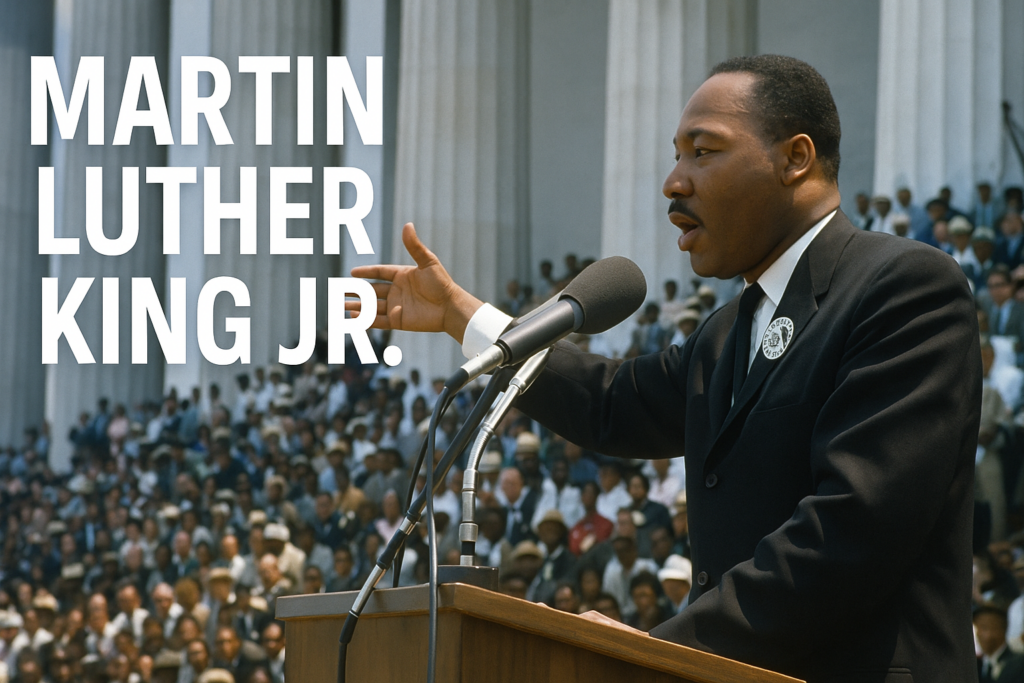
On August 28, 1963, more than 250,000 people gathered in Washington, D.C. for the March on Washington for Jobs and Freedom one of the largest political rallies in American history.
Standing at the Lincoln Memorial, King delivered his immortal “I Have a Dream” speech. His voice echoed across the nation:
“I have a dream that my four little children will one day live in a nation
where they will not be judged by the color of their skin but by the content of their character.”
His dream became a universal vision of equality not just for Black Americans, but for all humanity. That moment defined his legacy forever.
Time Magazine later named him “Man of the Year” (1963), and he became the face of moral courage in a divided America.
The Nobel Peace Prize
In 1964, at just 35 years old, Martin Luther King Jr. became the youngest person ever to receive the Nobel Peace Prize.
When he accepted the honor in Oslo, Norway, King humbly declared that he would donate the $54,123 prize money to further the civil rights cause.
In his acceptance speech, he said:
“I accept this award on behalf of a movement which is moving with determination and a majestic scorn for risk and danger
to establish a reign of freedom and a rule of justice.”
His words reminded the world that nonviolence could change nations and that peace was not passive, but powerful.
See also: The Eternal, Cycle Of Man (AHLMA)
Confronting New Challenges
After the passage of the Civil Rights Act of 1964 and the Voting Rights Act of 1965, King turned his attention to poverty and economic inequality.
He led the Chicago Freedom Movement to fight housing discrimination and launched the Poor People’s Campaign to demand economic justice for all races.
However, his stance against the Vietnam War and his criticism of U.S. foreign policy made him a controversial figure. Some former allies distanced themselves, yet King stood firm.
“A time comes when silence is betrayal,” he said, denouncing violence at home and abroad.
King believed true peace was not just the absence of war but the presence of justice. His message was global one of compassion, unity, and human dignity.
The Final Days in Memphis
In April 1968, King traveled to Memphis, Tennessee, to support striking sanitation workers demanding fair wages and respect. On April 3, he delivered his haunting final speech, “I’ve Been to the Mountaintop.”
In it, he spoke of death as though sensing it was near:
“I’ve looked over. And I’ve seen the Promised Land.
I may not get there with you. But I want you to know tonight,
that we, as a people, will get to the Promised Land.”
The next evening, April 4, 1968, while standing on the balcony of the Lorraine Motel, King was assassinated.
He was only 39 years old.
The world mourned. America wept. But his dream lived on.
The Legacy That Never Fades
Martin Luther King Jr. left behind more than speeches he left a spiritual blueprint for justice. His movement reshaped American democracy, proving that faith and courage could conquer fear and hate.
His teachings continue to inspire global movements for equality from South Africa’s anti-apartheid struggle to modern human rights campaigns.
Each year, Martin Luther King Jr. Day, celebrated every third Monday in January, honors his memory and message of hope.
King once said:
“Darkness cannot drive out darkness; only light can do that.
Hate cannot drive out hate; only love can do that.”
Those words remain a moral compass for humanity.
Martin Luther King Jr.’s Books and Writings
King was not only a leader but also a prolific writer. His books captured the depth of his faith and his strategic vision for nonviolent change.
Here are his most important works:
- “Stride Toward Freedom” (1958): The story of the Montgomery Bus Boycott and the power of collective action.
- “The Measure of a Man” (1959): Two sermons on the meaning of dignity and moral worth.
- “Strength to Love” (1963): A powerful collection of sermons combining theology and activism.
- “Why We Can’t Wait” (1963): Reflections on the urgency of the civil rights struggle.
- “Where Do We Go from Here: Chaos or Community?” (1967): King’s vision for America’s moral and social direction.
- “The Trumpet of Conscience” (1968): His final published work, addressing peace, poverty, and protest.
These writings remain essential for understanding King’s spiritual philosophy and his unwavering belief in love as a transformative force.
Honors and Influence
During his lifetime, King received five honorary degrees and was recognized by leaders across the world. His influence transcended race, nationality, and religion.
He inspired millions to act with compassion and courage. His words still move hearts, from classrooms to parliaments, from churches to protests.
In 1986, the United States established Martin Luther King Jr. Day as a federal holiday a national recognition of his eternal dream.
Today, monuments, streets, and schools across the globe bear his name. The Martin Luther King Jr. Memorial in Washington, D.C., stands as a symbol of his enduring impact.
Lessons from Martin Luther King Jr.
- Nonviolence is strength. Real power lies in self-discipline, not aggression.
- Faith can move nations. King’s Christianity was not theoretical it was transformative.
- Silence helps the oppressor. Speak truth, even when it costs you.
- Dreams inspire change. Every movement begins with a vision.
- Love conquers hate. Only love can heal the divisions of humanity.
Frequently Asked Questions (FAQ)
1. Why did Martin Luther King Jr. win the Nobel Peace Prize?
He received the Nobel Peace Prize in 1964 for his nonviolent struggle against racial segregation and injustice in the United States.
2. What was his most famous speech?
His “I Have a Dream” speech, delivered at the March on Washington in 1963, is considered one of the greatest speeches in history.
3. What did he believe about nonviolence?
King believed nonviolence was the most powerful weapon against oppression rooted in love, not hate.
4. How did Martin Luther King Jr. die?
He was assassinated on April 4, 1968, in Memphis, Tennessee, while supporting striking sanitation workers.
5. What is Martin Luther King Jr.’s legacy today?
His vision of equality and justice continues to inspire human rights movements worldwide and remains central to America’s conscience.
The Eternal Dream Lives On
Martin Luther King Jr. did not live to see the full fruits of his labor, but his message outlived him. His voice still calls us to rise above division, to believe in love, and to fight injustice with peace.
Every time a child of any color dreams freely, every time a citizen votes without fear, and every time a nation chooses compassion over cruelty his dream breathes again.
⚠️ DISCLAIMER
This post is an informational tribute to the life and legacy of Dr. Martin Luther King Jr. It is intended for educational and inspirational purposes. While every effort has been made to ensure historical accuracy, readers are encouraged to consult primary sources and historical texts for scholarly research. The views expressed reflect the historical context of Dr. King’s work and are not an endorsement of any contemporary political positions.
🔔 For more tutorials like this, consider subscribing to our blog.
📩 Do you have questions or suggestions? Leave a comment or contact us!
🏷️ Tags: Martin Luther King Jr., civil rights, I Have a Dream, American history, Nobel Peace Prize, nonviolence, Coretta Scott King, SCLC, equality, social justice
📢 Hashtags: #MartinLutherKingJr #CivilRights #IHavaADream #Equality #Peace #Justice #Nonviolence #AmericanHistory #Inspiration #HumanRights
