


⏲️ Estimated reading time: 8 min
Table of Contents
Pelé – The King of Football Who Changed the World. Born on October 23, 1940, Edson Arantes do Nascimento, known as Pelé, became one of the greatest footballers in history. His talent, passion, and humility transformed football forever and inspired millions across generations.
From a Poor Boy to a Global Legend
Edson Arantes do Nascimento, better known as Pelé, was born on October 23, 1940, in Três Corações, Minas Gerais, Brazil. His story is not only about talent it’s about perseverance, faith, and love for the game.
Pelé grew up in poverty. His father, João Ramos do Nascimento, nicknamed Dondinho, had been a footballer himself, but his career was cut short by injury. From his father, Pelé inherited the dream of football. The family struggled financially, and young Edson often played barefoot in the dusty streets, kicking makeshift balls made from rolled-up socks or grapefruits.
Despite humble beginnings, he dreamed big: to become the best football player in the world.
Early Beginnings and Professional Debut
Pelé’s extraordinary skill quickly caught local coaches’ eyes. At just 15 years old, he joined Santos FC, the team that would forever be linked with his name. His mentor, Waldemar de Brito, famously told the club’s director:
“This boy will be the greatest football player in the world.”
It didn’t take long for those words to come true. In his first full season, Pelé scored 36 goals in 29 matches. He was only sixteen, yet already a national sensation.
The 1958 World Cup – A Star Is Born
The turning point came in 1958, during the FIFA World Cup in Sweden. Only 17 years old, Pelé stunned the world. He scored a hat-trick against France in the semifinal and two unforgettable goals in the final against Sweden. Brazil lifted its first World Cup trophy, and a legend was born.
As the final whistle blew, Pelé collapsed into his teammates’ arms, crying tears of joy. That photo of a boy who conquered the world became one of the most iconic images in sports history.
The Golden Era with Santos FC
The 1960s marked the golden era of Pelé and Santos FC. The team dominated Brazilian and international football, winning multiple national titles, Copa Libertadores, and the Intercontinental Cup against Europe’s best clubs.
Pelé’s record was astonishing: over 1000 career goals a feat few have ever come close to. He wasn’t just a player; he was “O Rei” – The King.
Santos became a global attraction. Whenever the club toured abroad, entire stadiums sold out. Governments invited them to play simply so that Pelé would appear on their soil. His presence meant art, joy, and revenue all at once.
World Cup Triumphs in 1962 and 1970
In 1962, Pelé once again led Brazil to the World Cup in Chile. Though an injury forced him out early, the team still triumphed proving how much his influence had elevated Brazil’s entire squad.
After a frustrating tournament in 1966, Pelé returned stronger than ever for Mexico 1970. That Brazilian side, with Jairzinho, Rivelino, Tostão, and Carlos Alberto, is widely considered the greatest national team of all time.
The 4–1 victory over Italy in the final sealed Pelé’s immortality. The final goal finished by Carlos Alberto after Pelé’s visionary pass is often called the most beautiful team goal in World Cup history.
Pelé remains the only player in history to win three FIFA World Cups (1958, 1962, 1970) a record still unmatched.
The Playing Style – Grace, Power, and Genius
Pelé embodied everything beautiful about football. He combined South American flair with tactical intelligence and physical strength.
He could shoot with both feet, head the ball powerfully, and score from anywhere. Even in an era without player protection, Pelé faced brutal tackles but always got up smiling.
He played with a rare balance of elegance and aggression, making every move look effortless yet deadly.
A Cultural and Social Icon
Pelé wasn’t just a footballer he became a symbol of unity and hope.
In a world divided by politics, race, and poverty, Pelé represented joy, equality, and excellence. His rise from the slums to global superstardom made him a hero to millions who dared to dream.
He was welcomed by popes, kings, and presidents. To many, Pelé was the face of Brazil a joyful, creative, and resilient nation.
Through him, football evolved from a game into a universal language of happiness.
Life After Retirement
Pelé retired from professional football in 1977 after a short stint in the United States with the New York Cosmos, where he helped popularize the sport in North America.
After hanging up his boots, he became a global ambassador for football and peace.
You may also be interested in: Perez Hilton Treated After Disturbing Livestream Incident
He worked with the United Nations and UNESCO, advocating for children’s rights, education, and anti-poverty programs. He even served as Brazil’s Minister of Sports, promoting transparency and reform within Brazilian football.
Honors and Global Recognition
Pelé’s list of honors is as extraordinary as his talent.
- FIFA Player of the Century (2000) – shared with Diego Maradona.
- Olympic Gold Order, UN Peace Medal, and countless humanitarian awards.
- Included in every Hall of Fame list ever created for football.
In FIFA’s official “Player of the Century” poll, experts and associations chose Pelé, while the public voted for Maradona. This healthy rivalry defined two eras of greatness, though even Maradona later admitted:
“Pelé will always be the King.”
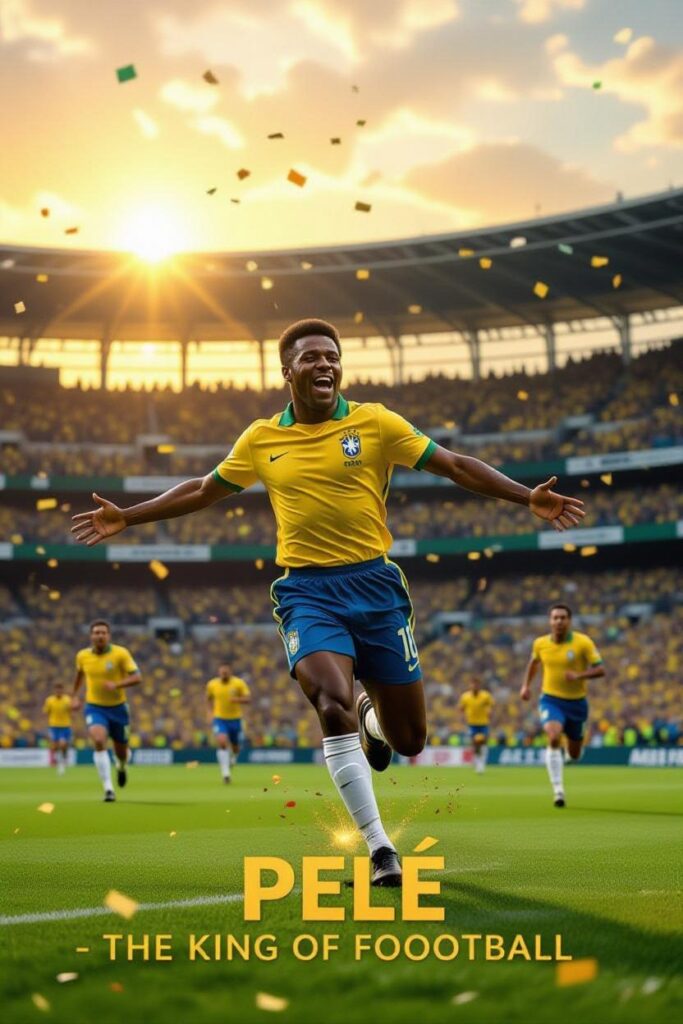
Pelé and Brazil – An Eternal Bond
For Brazil, Pelé is not merely a footballer; he’s part of the nation’s soul.
Every goal he scored brought light during dark times. Every victory united the people. He proved that greatness can emerge from anywhere that dreams born in poverty can reach the stars.
Every October 23, Brazilians celebrate not just his birthday, but the birth of modern football itself.
Legacy Beyond the Pitch
Pelé passed away on December 29, 2022, aged 82. But his spirit lives in every child who kicks a ball with joy.
Stadiums around the world went silent in his honor. Brazil declared three days of national mourning, and billions shared tributes online.
Pelé was more than an athlete he was an ambassador of joy, humanity, and hope.
Lessons from Pelé’s Life
- Work beats talent. Discipline shapes destiny.
- Keep smiling. Positivity can turn pain into strength.
- Be humble. Never forget your roots.
- Inspire others. Greatness means lifting others as you rise.
- Play with love. Passion makes success meaningful.
Unforgettable Moments in His Career
- First goal for Santos FC at age 16.
- Hat-trick in the 1958 World Cup semifinal.
- Two goals in the 1958 final.
- His visionary assist in the 1970 World Cup final.
- The 1000th goal, scored at Maracanã in 1969.
- Farewell match with New York Cosmos in 1977, before 75,000 fans.
Each moment carved another chapter in the history of the world’s game.
Pelé in Popular Culture
Pelé starred in films like Escape to Victory (1981) alongside Sylvester Stallone and Michael Caine.
He was also the subject of the biographical movie Pelé: Birth of a Legend, showing his journey from the streets of Brazil to global fame.
To this day, the Pelé brand represents not only football greatness but human inspiration.
How Pelé Inspired Future Generations
From Ronaldinho to Neymar, from Ronaldo to Messi every player who dazzles with skill owes a debt to Pelé.
He showed the world that football could be art, that joy could be as important as trophies. His influence shaped modern football’s creativity, charisma, and respect for the game.
Pelé – The Eternal King of Football
The title “The King of Football” isn’t media hype it’s truth.
Pelé transformed sport into poetry, competition into communion.
Every time a child scores a goal and celebrates with open arms, somewhere above, the King smiles.
Frequently Asked Questions about Pelé
Who was Pelé?
Pelé was a Brazilian footballer, considered by many the greatest player of all time, born on October 23, 1940.
How many goals did Pelé score in his career?
Over 1,280 goals in recognized matches.
How many World Cups did Pelé win?
Three – in 1958, 1962, and 1970.
Which clubs did he play for?
He played for Santos FC, New York Cosmos, and the Brazilian national team.
When did Pelé die?
On December 29, 2022, at the age of 82.
A Legend That Never Dies
Pelé wasn’t just a player he was an idea, a movement, a source of light.
Generations grew up copying his moves, dreaming of his goals, and learning from his humility.
As long as football exists, Pelé’s spirit will run with every ball kicked across the planet.
🔔 For more tutorials like this, consider subscribing to our blog.
📩 Do you have questions or suggestions? Leave a comment or contact us!
🏷️ Tags: Pelé, Brazil football legend, Santos FC, FIFA World Cup, football history, Brazilian soccer, Pelé biography, World Cup 1970, greatest footballers, sports icons
📢 Hashtags: #Pele, #FootballLegend, #Brazil, #SantosFC, #WorldCup, #SoccerKing, #FootballHistory, #PeleLegacy, #SportsIcons, #PeleBirthday
