


⏲️ Estimated reading time: 8 min
Table of Contents
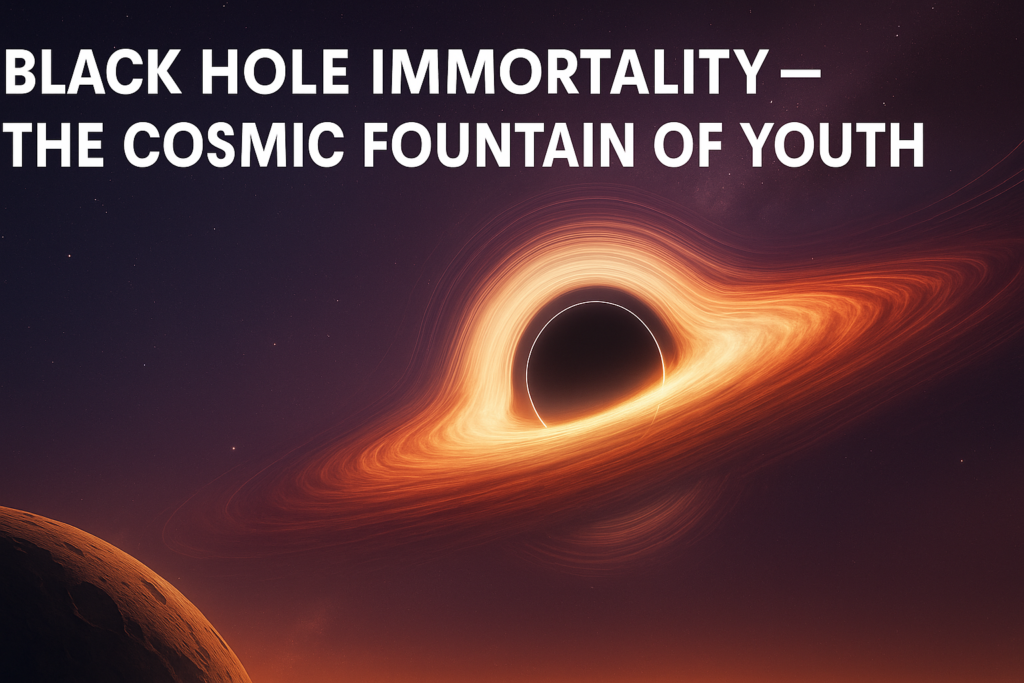
Black Hole Immortality – The Cosmic Fountain of Youth. Could time dilation near a black hole grant you cosmic immortality? Discover how Einstein’s theory of relativity turns black holes into nature’s ultimate time machines, and why surviving such a journey might not be the eternal paradise you imagine.
Section I: Time Dilation Near a Black Hole – Einstein’s Real-Life Time Machine
The concept of time dilation has fascinated scientists, philosophers, and filmmakers for decades. It’s not just a theoretical curiosity it’s a measurable, observable reality predicted by Einstein’s general theory of relativity. The closer you get to a massive gravitational source, the more time itself bends, slows, and stretches.
Understanding Time Dilation
At its simplest, time dilation is the phenomenon where time runs differently for observers in different gravitational potentials or at different velocities. It manifests in two key forms:
- Special Relativistic Time Dilation – When objects move close to the speed of light, their time slows relative to stationary observers.
- Gravitational Time Dilation – When you’re in a strong gravitational field (for example, near a black hole), time for you passes slower compared to someone farther away.
These effects aren’t science fiction. They’re woven into the very structure of space and time. Einstein’s revolutionary idea that space and time are part of the same four-dimensional continuum spacetime means that gravity isn’t a force in the traditional sense, but rather the curvature of spacetime itself.
The Interstellar Example: Miller’s Planet
In Christopher Nolan’s Interstellar, the scene on Miller’s Planet, orbiting dangerously close to the supermassive black hole Gargantua, is perhaps the most vivid depiction of gravitational time dilation in popular culture. The crew spends a few hours on the planet, yet decades pass on Earth. Cooper’s chilling line “One hour here is seven years on Earth” captures both the brilliance and tragedy of this cosmic effect.
This cinematic moment wasn’t merely fantasy. The film’s scientific consultant, Kip Thorne, a Nobel Prize–winning physicist, ensured that the depiction followed the math of general relativity as closely as possible. The numbers check out: near the event horizon of a black hole with Gargantua’s estimated mass, an extreme gravitational time differential is entirely plausible.
How It Works: Bending Time Itself
To visualize it, imagine spacetime as a flexible rubber sheet. A massive object like a star or planet makes a small dip in the sheet that’s gravity. A black hole, however, makes a deep, almost bottomless pit. As you get closer to that pit’s edge the event horizon spacetime stretches so much that time, from your perspective, slows nearly to a halt.
For an outside observer, you would appear frozen in time, your movements slowing infinitely as you approach the event horizon. But for you, time would feel perfectly normal. This paradox is the heart of relativity both realities coexist, each valid from its own frame of reference.
The Proof in Modern Science
Time dilation isn’t just theoretical we measure it daily.
- CERN experiments accelerate particles like muons close to the speed of light. Normally, these particles live just 2.2 microseconds, but when traveling at near-light speed, they survive for hundreds of times longer.
- GPS satellites orbit Earth at altitudes where gravity is weaker. Their onboard atomic clocks tick slightly faster than those on the ground. Engineers must correct for this relativistic discrepancy, or GPS systems would drift several kilometers each day.
- NIST atomic clocks (U.S. National Institute of Standards and Technology) have measured gravitational time dilation over mere millimeters of height proving that even a small elevation changes the rate of time’s passage.
From subatomic particles to your smartphone, relativity defines reality. And yet, it’s near a black hole that this phenomenon becomes almost divine a literal stretching of time so intense it borders on immortality.
Section II: Black Hole Immortality – The Cosmic Fountain of Youth
Let’s imagine the impossible: you’ve reached the edge of a supermassive black hole like Gargantua. Its gravity is so immense that time for you nearly stops relative to the rest of the universe. From your perspective, hours pass. But for the cosmos, eons flow by.
Could You Become Immortal?
In a sense, yes. You would experience time at an infinitesimally slow rate compared to the universe outside. If you could hover just above the event horizon indefinitely (without falling in), you’d essentially see the universe accelerate toward its heat death while you remain nearly unchanged. Stars would form and die, galaxies would collide, and the universe would fade into darkness all while you barely age.
This is the theoretical cosmic fountain of youth: immortality not through biology, but through physics.
The Impossible Orbit
However, surviving there is another story. The gravitational pull would tear apart any spacecraft or human through a process called spaghettification, where tidal forces stretch your body atom by atom. Even light struggles to escape. So unless you had godlike technology capable of manipulating gravity, this immortality would remain unreachable.
See also: When Motherhood Feels Lonely in a Relationship
Even if you could orbit just outside the event horizon, the time dilation gradient is so steep that a few meters’ difference could mean decades’ discrepancy in time flow. The slightest miscalculation could send you plunging into eternal darkness.
Psychological Immortality: The Loneliness of Infinite Time
Even assuming you survive, immortality near a black hole may not be bliss. Imagine watching the universe end every friend, every civilization, every star gone. Time outside would race by like a timelapse of cosmic extinction. You’d be timeless, but utterly alone. In the final analysis, this “immortality” is both a scientific marvel and a philosophical nightmare.
Would such existence still count as living? Or is immortality without meaning just another form of death?
Pros and Cons of Black Hole Immortality
| Pros | Cons |
|---|---|
| Experience near-immortality due to extreme time dilation | The gravitational forces would destroy any normal matter |
| Observe the future of the universe unfold | Eternal isolation from all known life |
| Push physics to its ultimate frontier | Impossible to maintain orbit near the event horizon |
| Offers unmatched insight into relativity | “Immortality” is purely relative not true eternal life |
Case Studies and Scientific Parallels
1. The Muon Experiment at CERN
Muons, subatomic cousins of electrons, live for about 2 microseconds at rest. When accelerated close to light speed, their lifespan extends thousands of times longer a miniature version of black hole time dilation. This experiment beautifully validates Einstein’s theory and shows how motion alone can manipulate time.
2. GPS Satellites as Everyday Proof
The GPS constellation experiences both types of time dilation special (due to orbital velocity) and gravitational (due to altitude). Engineers must constantly correct their atomic clocks to maintain accuracy. Without Einstein’s equations, your GPS would be off by over 10 kilometers per day.
3. The Twin Paradox
Imagine twins: one travels near a black hole while the other stays on Earth. When the traveler returns, the Earth-bound twin has aged decades, while the traveler has barely changed. It’s one of relativity’s strangest yet experimentally supported predictions. This paradox inspired Interstellar’s emotional time-loss storyline.
Comparative Table: Earth vs Miller’s Planet
| Environment | Gravity Strength | Time Dilation Ratio (Approx.) | 1 Hour Equals… |
|---|---|---|---|
| Earth | 1 g | 1:1 | 1 hour |
| International Space Station | 0.9 g | 1.00000003:1 | 1 hour + 0.1 milliseconds |
| GPS Satellite Orbit | 0.25 g | 1.000000045:1 | 1 hour + 0.16 milliseconds |
| Miller’s Planet (near Gargantua) | ~10,000,000 g | 1:61,320 | 1 hour = 7 Earth years |
(Values simplified for conceptual comparison)
Philosophy and Paradox: What Is Time Without Meaning?
Even if one could achieve near-immortality near a black hole, what would it mean to live when everything else ceases to exist? Would consciousness itself change under such distortions of time?
In a universe where entropy always wins, immortality might be a curse to outlast the meaning of existence. Yet it also represents humankind’s unending curiosity: our drive to touch the impossible, to understand the very limits of reality.
Some theorists speculate that in the far future, intelligent beings could harness black holes as time vaults, storing information or even consciousness in regions of slowed time to preserve it for billions of years. Whether that’s salvation or isolation is up for debate.
Key Takeaways
- Time dilation is a proven phenomenon of Einstein’s relativity time flows slower near massive bodies like black holes.
- Black hole immortality is theoretically possible, but practically impossible due to extreme tidal forces and energy requirements.
- Movies like Interstellar are remarkably accurate in their portrayal of these physics concepts.
- Immortality through time dilation raises deep philosophical and emotional questions about loneliness, meaning, and the passage of time.
- Einstein’s equations continue to define both our scientific understanding and existential imagination of the cosmos.
🔔 For more tutorials like this, consider subscribing to our blog.
📩 Do you have questions or suggestions? Leave a comment or contact us!
🏷️ Tags: Black Hole Immortality, Time Dilation, Einstein, Interstellar, Gargantua, Space-Time, Relativity, Astrophysics, Cosmic Phenomena, Physics Explained
📢 Hashtags: #BlackHoleImmortality, #TimeDilation, #Einstein, #Relativity, #Interstellar, #Astrophysics, #SpaceTime, #BlackHoles, #ScienceExplained, #CosmicWonder
Beyond the Event Horizon – Our Eternal Curiosity
Humanity has always dreamed of eternal life in myths, religions, and now physics. Whether or not we ever reach the edge of a black hole, the search for understanding time itself is our truest path to immortality.
We may never drink from the cosmic fountain of youth, but by daring to explore it, we ensure our stories and our curiosity live forever.
