


⏲️ Estimated reading time: 6 min
Table of Contents
German Unity Day – National Holiday in Germany, History & Traditions. German Unity Day is celebrated annually on October 3rd. Learn about the historical significance of reunification in 1990, national traditions, public events, cultural programs across the Länder, and practical travel tips for experiencing Germany’s only official national holiday.
Germany’s National Holiday
You may also be interested in: Klaus-Michael Kühne Dies at 89, Leaving a Global Logistics
H1: German Unity Day – Germany’s National Holiday
On October 3rd, Germany officially celebrates its reunification, which took place in 1990 with the integration of the German Democratic Republic (GDR) into the Federal Republic of Germany (FRG). German Unity Day (Tag der Deutschen Einheit) is the only national public holiday recognized at the federal level. It is a day of reflection on freedom, democracy, solidarity, and responsibility. Each year, the main events are hosted in the capital of the federal state that holds the Bundesrat presidency, while Berlin remains a permanent hub for commemorations.
Why October 3rd and not another date?
While November 9, 1989 marks the fall of the Berlin Wall, October 3, 1990 represents the legal date of reunification. This makes German Unity Day not just a day of emotional remembrance, but an institutional confirmation of a functioning federal democracy and the rule of law. It is a day when Germany emphasizes not only its past but its commitment to building a shared future.
The Meaning of “Unity”
The word “unity” does not refer only to dismantling a border, but also to social, cultural, and economic cohesion. After 1990, Germany invested massively in infrastructure, education, and industrial redevelopment in the East, while promoting solidarity across regions.
German Unity Day therefore stands for:
- Remembering the peaceful protests in Leipzig, Dresden, and Berlin.
- Reaffirming commitment to human rights and democratic freedoms.
- Reflecting on persistent regional differences and solutions.
- Celebrating Germany’s diversity within a united Europe.
How German Unity Day is Celebrated
The celebration combines state ceremonies with public festivals:
- Ecumenical Service: Usually opens the day, underlining reconciliation and shared values.
- State Ceremony (Staatsakt): Attended by the Federal President, Chancellor, and leaders of the Bundestag and Bundesrat.
- Citizen’s Festival (Bürgerfest): A large outdoor celebration in the host city, featuring concerts, cultural performances, exhibitions, food stalls, and interactive programs for children.
While Berlin organizes symbolic events every year, the hosting city changes annually, based on the Bundesrat presidency. This ensures that all regions actively participate in commemorating unity.
Key Historical Background
The peaceful revolution of 1989, marked by the Monday Demonstrations in Leipzig, triggered political change across East Germany. This led to the fall of the Berlin Wall and, later, to the Treaty of Unification, which made the Basic Law (Grundgesetz) applicable to all of Germany.
Thus, German Unity Day is not just a national holiday – it is a constitutional celebration of modern Germany.
Traditions and Civic Symbols
While there is no single nationwide ritual, common elements include:
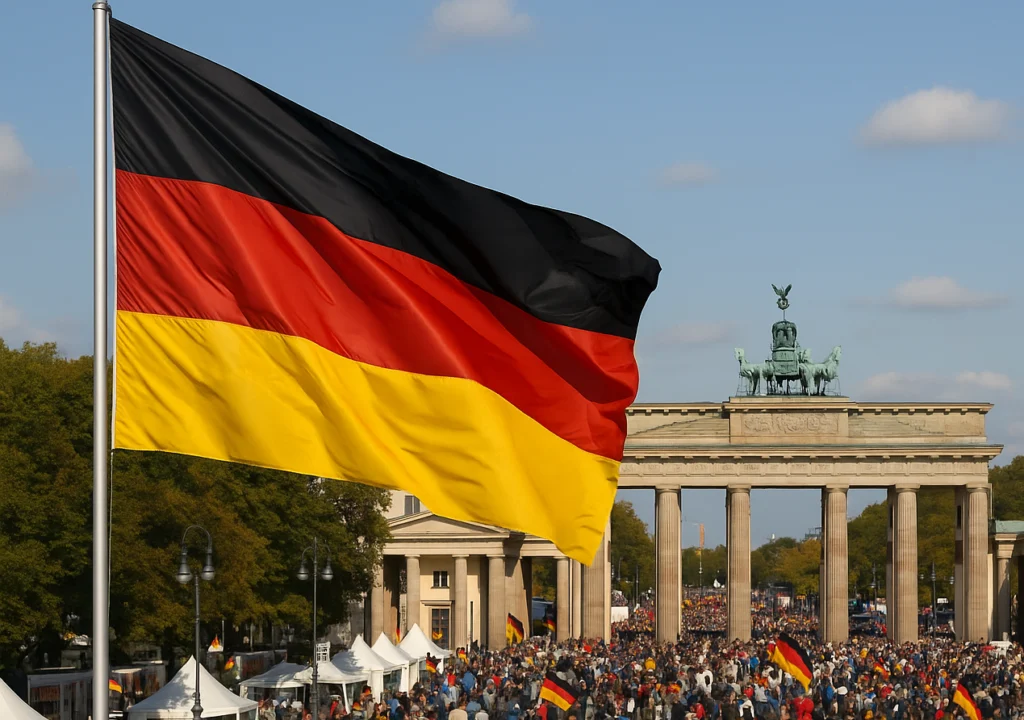
- Raising the national flag and lighting buildings in black, red, and gold.
- Open house events at federal institutions such as the Bundestag.
- Concerts and fireworks in some cities.
- Historical exhibitions about the Cold War and reunification.
- Public debates and educational workshops.
Regional & Local Relevance
Each state (Land) showcases its cultural identity during the Citizen’s Festival:
- Bavaria brings traditional food, music, and costumes.
- Northern states highlight maritime culture.
- Saxony and Thuringia focus on the legacy of peaceful protests.
- Baden-Württemberg emphasizes innovation and technology.
This diversity strengthens the message that unity is built on regional richness, not uniformity.
Travel Guide for Tourists and Expats
Visiting Germany on October 3rd provides a unique experience:
- Berlin: Visit the Brandenburg Gate, East Side Gallery, or the Berlin Wall Memorial.
- Leipzig: Explore the St. Nicholas Church and exhibitions on the Monday Demonstrations.
- Dresden: Join river festivals and art installations along the Elbe.
- Hamburg & Munich: Expect music stages, gastronomy, and vibrant local events.
Practical tips:
- Public transport is the best choice on this busy day.
- Many museums and memorials organize special exhibitions.
- Families will find kid-friendly workshops and interactive democracy games.
Case Studies / Examples
Berlin – Unity in the Public Space
Berlin embodies the memory of division and the hope of unity. Around October 3rd, the Brandenburg Gate transforms into a stage for music, lights, and civic gatherings. Walking along the remains of the Wall is an open-air lesson in history and democracy.
Leipzig – Courage of the Monday Demonstrations
Leipzig celebrates its role as the birthplace of the peaceful protests of 1989. Exhibitions and lectures recall how civic courage transformed the future of a divided nation.
Bonn – The Former Capital’s Role
Bonn, the capital of West Germany until 1990, hosts commemorations that bridge past and present, underlining the continuity of democratic values.
Pros & Cons of Modern Celebrations
Pros:
- Strengthens democratic memory.
- Brings citizens closer to institutions.
- Promotes regional diversity.
- Boosts tourism and cultural exchange.
Cons:
- Regional inequalities are still visible.
- Overcrowding in festival areas.
- Risk of over-politicization.
- High organizational costs.
Quick Timeline of Key Events
| Year | Event | Significance |
|---|---|---|
| 1989 | Fall of the Berlin Wall (Nov 9) | Opened the path to reunification |
| 1990 | German Reunification (Oct 3) | GDR officially joined the FRG |
| 1991–1999 | Institutional integration | Infrastructure and political reforms |
| 2000–2010 | Economic growth | Expansion of industry and innovation |
| 2011–present | New challenges | Energy transition, digitalization, migration |
FAQs – Quick Answers
- Is October 3rd a public holiday? Yes, nationwide.
- Is Berlin always central to the events? Yes, but the main host city rotates.
- Do all states participate? Yes, each has its own programs.
- Are fireworks common? Sometimes locally, not a national rule.
- What is the best way to experience it? Attend a Citizen’s Festival, visit memorials, or join guided tours.
Key Takeaways
- October 3rd marks Germany’s official reunification in 1990.
- The holiday mixes state ceremonies with public festivals.
- Berlin and the rotating host city are the celebration centers.
- It highlights democratic values, freedom, and diversity.
- Ideal for tourists to explore history and modern Germany in action.
🔔 For more tutorials like this, consider subscribing to our blog.
📩 Do you have questions or suggestions? Leave a comment or contact us!
🏷️ Tags: German Unity Day, National Holiday Germany, October 3rd Germany, Berlin celebrations, German reunification, Bundesrat events, German history, German tourism, Berlin travel guide, peaceful revolution 1989
📢 Hashtags: #GermanUnityDay, #Germany, #October3, #Berlin, #Reunification, #NationalHoliday, #Bundesrat, #GermanHistory, #Europe, #TravelGermany
Final Note – Experiencing October 3rd in Germany
German Unity Day is more than a legal holiday – it is a living civic lesson. Whether you walk along the Berlin Wall, attend a concert in Leipzig, or enjoy Bavarian traditions in Munich, the day reminds us that unity is not given once for all. It is built daily, through dialogue, memory, and shared responsibility.
