


⏲️ Estimated reading time: 10 min
Table of Contents
Arresting Gear: The $140M System That Stops Fighter Jets. Discover the arresting gear used on aircraft carriers a powerful cable-and-hydraulic system that can stop a 50,000 lb fighter jet in seconds. Learn how it works, why people say “$140 million,” program costs, and the real engineering behind those dramatic landings.
A dramatic stop in seconds
You’ve seen the clip: a jet thunders down an aircraft carrier deck, hooks a cable, and seems to vanish to a dead stop in the blink of an eye. It looks like physics on fast-forward. In reality, it’s an engineered system designed to absorb enormous energy in a very short distance. Popular posts call it a “$140 million system.” That number makes for a clickable line but what does it actually mean? This article explains the technology, the numbers, and the program-level costs behind arresting gear so you get the full, accurate picture. (Wikipedia)
What is arresting gear?
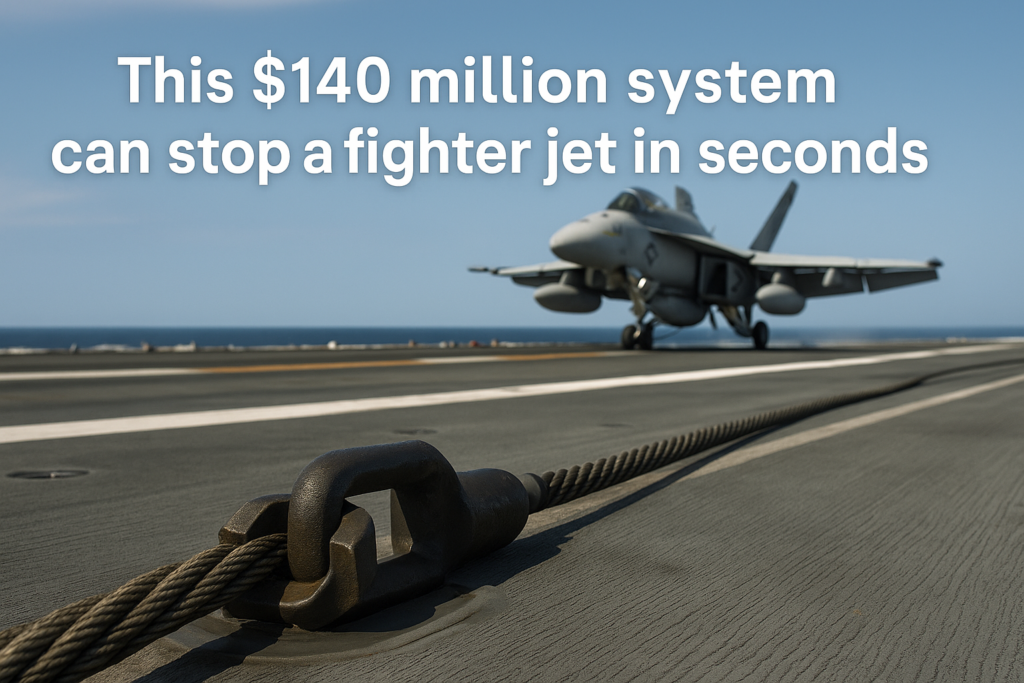
Arresting gear (or arrestor gear) is the system that brings fixed-wing aircraft to a halt during short deck landings. On U.S. Navy carriers and other CATOBAR-equipped ships, a tailhook on the aircraft catches one of several steel deck wires. That wire called a deck pendant or arresting cable transfers the plane’s forward motion into the ship’s arresting engine, which converts that kinetic energy into hydraulic or electric energy that is then dissipated. The process happens in just a few seconds and across only a few hundred feet. (Wikipedia)
Why can it stop a jet so fast? (The basic physics)
Stopping a 50,000-pound aircraft moving at roughly 150–160 knots (≈170–185 mph / 270–300 km/h) requires removing a huge amount of kinetic energy very quickly. Arresting gear does this by:
- Capturing the aircraft’s tailhook with a strong steel cable (pendant). (Wikipedia)
- Routing that cable through sheaves and purchase cables to an arresting engine below deck. (Wikipedia)
- Using hydraulic/pneumatic systems (or, in some modern designs, electromagnetic systems) to convert the cable pull into heat or controlled fluid motion a rapid, managed energy sink that prevents destructive shock to the airframe. (Wikipedia)
Because the energy is managed over a controlled “runout” distance, the system can reliably stop very heavy aircraft in about two seconds and in a few hundred feet. That short runout and tiny time window are what make carrier landings so dramatic. (HowStuffWorks)
Key components the arresting system anatomy
- Deck Pendants (arresting cables): The visible steel wires across the landing area. They’re built to be extremely strong and replaceable. On U.S. carriers, crews often replace a cable after a fixed number of arrested landings. (Wikipedia)
- Purchase Cables / Tapes: These run from each pendant into the ship where the energy-absorbing engines sit. (Wikipedia)
- Sheaves and Routing Hardware: Pulleys and routing gear that steer the cable path and reduce shock loads on other components. (Wikipedia)
- Arresting Engine (energy absorber): The “brain and muscle” of the system. Traditional engines are hydro-pneumatic; newer designs may use motor-generator systems, turbines, or electromagnetic absorbers. This is where the kinetic energy converts to hydraulic or electrical energy and is safely dissipated. (Wikipedia)
- Control valves & Constant Runout Valves (CROV): These provide predictable stopping distances regardless of aircraft weight by adjusting fluid flow or damping characteristics. (Wikipedia)
How fast and how far? Typical performance numbers
Practical, tested figures appear across engineering summaries and public domain sources:
- A typical arresting system can recover a 54,000 lb aircraft at 130 knots and bring it to a stop in roughly 2 seconds and ~315 feet (≈96 m) of deck. That’s an example often cited for Nimitz-class carrier systems. (Wikipedia)
These are headline numbers, but the system’s actual settings are adjusted by operators for each aircraft’s weight and condition to ensure safe, controlled deceleration. (Wikipedia)
The $140 million figure what people are talking about
You’ll see many reels and short posts that say, “This $140 million system can stop a fighter jet in seconds.” That headline mixes two different levels of cost:
- Component / per-system cost: A single arresting engine or set of deck pendants rarely costs tens of millions by themselves. The basic mechanical arresting cable and engine are expensive, but not usually $140 million on their own. (Wikipedia)
- Program or ship integration cost: When you look at advanced systems like the U.S. Navy’s Advanced Arresting Gear (AAG) program, program-level costs (R&D, testing, integration, shipboard installation, facilities, fixes over years) balloon into the hundreds of millions. Government audits and oversight reports show the AAG program incurred huge RDT&E overruns measured in hundreds of millions during development which likely explains high-dollar claims tied to the system. In other words: program costs + integration + testing + failure fixes = headline-making sums. (dodig.mil)
Short version: the viral “$140 million” line is a simplified headline. It’s meant to evoke the expensive, high-tech nature of carrier systems. But if you dig into procurement reports and oversight documents, you’ll find program costs and overruns explain the big numbers not a single cable that costs $140M. (dodig.mil)
The Advanced Arresting Gear (AAG) modernizing the old
The U.S. Navy moved to replace older hydraulic systems on Ford-class carriers with the AAG. The idea: use more controlled, safer energy-absorption methods (including electric motor-driven systems and sophisticated control electronics) to handle heavier, newer aircraft like the F-35C and future platforms. In practice, AAG development faced software and hardware challenges and significant cost growth. The program’s development and retrofit efforts generated oversight reports that document multi-hundred-million-dollar cost increases. That real program-level spending feeds the social posts claiming astronomical sticker prices. (dodig.mil)
Why the Navy changed course (and why AAG mattered)
Older hydro-pneumatic arresting engines are proven. But heavier, more varied air wings and demands for reduced maintenance and improved safety motivated the move toward more advanced systems. AAG promised:
- Smoother energy absorption across different aircraft weights,
- Lower maintenance and manpower needs, and
- Better integration with modern flight ops.
However, cutting-edge systems bring testing challenges. As oversight reports show, immature tech plus Navy integration demands drove cost and schedule growth. That’s a classic pattern in big defense modernization efforts. (dodig.mil)
Maintenance realities it’s not a “set and forget” cable
Carrier arresting cables take enormous punishment. On U.S. carriers, cranes and deck crews replace cross-deck pendants frequently; one common routine is replacing a cable after a defined number of arrested landings (e.g., around every 125 arrested landings on some classes). That continuous maintenance is part of the lifecycle cost picture: the hardware and manpower required to keep the system safe and reliable add up over decades of service. Viral $140M claims usually don’t clarify that lifecycle angle. (Wikipedia)
Read also: Lightning Strike Kills Footballer During Thailand Cup Match
Arresting gear beyond carriers land use and EMAS
Arresting systems aren’t only naval. Land-based tactical runways, short-field airports, and emergency strips also use cable/tape or engineered materials arrestor systems (EMAS). EMAS uses crushable concrete blocks in overruns to stop civilian aircraft that overrun runways. Land-based cable systems use similar physics but different scale, designs, and often less-costly equipment. (Skybrary)
Safety, training, and margins it’s a team effort
A successful arrestment requires:
- A well-maintained system,
- A pilot hitting the correct approach, and
- A flight deck crew coordinating settings and weight inputs.
If the hook misses the cable (“bolter”), the pilot must power up and go around. If multiple systems fail, the carrier has emergency barricades or other last-resort measures. The technology is critical, but human factors, procedures, and redundancy make it work consistently. (Wikipedia)
Common viral claims and the truth behind them
- Claim: “The cable alone costs $140 million.” Reality: No. A single cable or even a set of cables does not cost that much. The large price tags come from program development, R&D, integration across an entire class of ships, or cumulative lifecycle costs. (dodig.mil)
- Claim: “It stops jets instantly.” Reality: It stops jets in a couple of seconds across a controlled runout. That’s unbelievably fast by everyday standards, but it’s engineered and calculated, not magical. (HowStuffWorks)
- Claim: “This is new tech.” Reality: Arresting technology dates back to the early 20th century; what’s new is the scale, control electronics, and advanced energy-absorption designs being tested today. (Wikipedia)
Real-world example numbers that help
A widely cited engineering performance: stopping a 54,000 lb aircraft at 130 knots in 2 seconds and ~315 feet. Think about that: in the time you count “one-one-thousand, two-one-thousand,” a ton-scale machine goes from nearly 150 mph to zero without a catastrophic structural failure. That’s the product of careful engineering, controlled energy absorption, and rigorous testing. (Wikipedia)
Why the system matters beyond “cool videos”
Arresting gear is a safety enabler. It makes carrier air operations possible and limits the enormous risks of short-deck landings. It also enables rapid sortie generation aircraft can land, be refueled, and launch again quickly. On a strategic level, reliable arresting gear is vital for projecting airpower from sea. The technology’s cost and complexity reflect that strategic value. (Wikipedia)
Future trends where this tech could go
- Electromagnetic systems: Researchers and engineers explore electromagnetic absorption and motor-generator setups to smooth arrestments and reduce maintenance. (Wikipedia)
- Better predictive maintenance: Sensors, condition monitoring, and digital twins could reduce lifecycle costs and improve safety margins. (Government Accountability Office)
- Smaller-scale arresting options: For expeditionary or austere runways, lighter, faster-to-deploy tapes and nets will evolve for tactical flexibility. (Skybrary)
Frequently Asked Questions (FAQ) quick answers
Q: What exactly catches the plane?
A: A tailhook on the aircraft catches a deck pendant (steel cable) stretched across the landing area. (Wikipedia)
Q: How fast can the system stop an aircraft?
A: Typical stops take about 2 seconds and a few hundred feet for heavy fighter/strike aircraft. Exact numbers depend on weight and speed. (HowStuffWorks)
Q: Does the cable break the plane?
A: No. The system is designed to absorb and control the energy so the aircraft and pilot survive intact under normal arrests. It’s tuned for predictable deceleration. (Wikipedia)
Q: Why do viral posts say $140 million?
A: That number likely conflates program-level development, integration, or lifecycle costs with the physical arresting gear itself. Oversight reports show AAG program costs grew into the hundreds of millions during development. (dodig.mil)
Q: Can civilian airports use arresting systems?
A: Yes. Tactical or joint-use runways sometimes use cable arresters or EMAS bed systems to safely stop aircraft that cannot stop on the remaining runway. (Skybrary)
🔔 For more tutorials like this, consider subscribing to our blog.
📩 Do you have questions or suggestions? Leave a comment or contact us!
🏷️ Tags: arresting gear, aircraft carrier, tailhook, Advanced Arresting Gear, AAG, naval aviation, carrier landing, arresting cable, aviation safety, aircraft arrestor
📢 Hashtags: #ArrestingGear, #AircraftCarrier, #NavalAviation, #Tailhook, #AAG, #AviationSafety, #HowItWorks, #MilitaryTech, #CarrierLanding, #Aerospace
Behind the Cable
Arresting gear is engineering theatre. The wire you see on deck is the tip of a complex machine that manages enormous energy and keeps pilots alive. The “$140 million” headline captures attention. The truth is more layered: decades of engineering, R&D, integration, maintenance, and oversight make those short, dramatic stops possible. If you liked this explainer, I can break down the Advanced Arresting Gear timeline, show procurement documents, or make an illustrated breakdown of the arresting engine tell me which you want next.
Sources / further reading:
- Arresting gear general overview and operation. (Wikipedia)
- How aircraft carriers’ arresting gear works HowStuffWorks. (HowStuffWorks)
- DOD Inspector General Advanced Arresting Gear program cost and schedule assessment. (dodig.mil)
- GAO reporting on carrier production and technology integration. (Government Accountability Office)
- EMAS and runway arresting systems (technical PDF). (Skybrary)
