


⏲️ Estimated reading time: 17 min
Table of Contents
Earth’s core is extremely hot, yet the deep ocean stays near freezing. This guide explains the real reason in plain English: how heat moves through rock, why the ocean forms stable layers, how polar water sinks, and where geothermal heat actually shows up.
Why the Deep Ocean Stays Cold on a Hot Earth
The text you shared points to a “paradox” that feels almost unfair. If the inside of Earth is blazing hot, why is the deepest ocean still close to ice-cold? Your intuition makes sense. You imagine heat rising, spreading, and eventually warming everything above it.
The surprise comes from how the real world moves heat. The Earth does not heat the ocean like a stove heats a pot. The ocean is not a single mixed bowl of water. Instead, it is a layered system, fed by cold polar water, with slow heat coming from below and huge heat coming from above.
This post turns your text into a complete, human explanation. You will see the hidden “mechanics” that connect geology, physics, and oceanography. By the end, the paradox disappears, and the ocean starts to feel logical again.
Temperature Versus Heat Flow
Many explanations fail because they confuse two different ideas:
- Temperature is “how hot something is.”
- Heat flow is “how much energy moves from one place to another.”
A place can be extremely hot and still deliver only a modest amount of heat to the surface if:
- the distance is huge,
- the material blocks heat,
- the transfer mechanism is slow,
- the surface has stronger competing influences.
Earth’s interior has a very high temperature, but the heat must travel through thousands of kilometers of rock. That trip is slow.
A Simple Analogy That Works
Imagine a candle burning in a cold stadium at night.
- The candle flame is very hot.
- The stadium is still cold.
The flame’s heat is real, but the total energy is small compared to the stadium’s size and the cold air around it.
Now scale up the stadium to planet size, replace the flame with Earth’s inner heat, and replace the cold air with an ocean system that constantly renews cold water at depth. The result looks surprising, but it is not mysterious.
Earth Is Not a Thin Crust Over a Global Lava Lake
A common mental picture says: “You walk on a thin shell, and below is a huge ocean of lava.” That picture is dramatic, but it is not accurate.
Earth has layers with different states and behaviors:
- The crust is solid rock.
- The mantle is mostly solid but can flow very slowly over long times.
- The outer core is liquid metal.
- The inner core is solid metal, kept solid by enormous pressure.
Magma exists, but it is not everywhere. It forms in certain places where conditions allow melting, often near plate boundaries or hot spots.
This matters because it changes what you expect from heat transfer. If the planet were one giant lava lake under a thin lid, the seafloor would look very different.
Why Temperature Increases When You Go Down Into the Ground
You can feel the “truth” of Earth’s heat in mines, deep tunnels, and geothermal regions.
This comes from the geothermal gradient, which is the general rise in temperature with depth in the crust.
The rise is gradual. It does not jump from cool to inferno in a short distance. The exact rate varies, but the key idea stays the same: deeper rock tends to be warmer because it is closer to the internal heat sources and because rock stores heat very well.
Why “Deeper in the Ocean” Does Not Follow the Same Pattern
Here is the turning point:
- In rock, going deeper moves you closer to the planet’s heat reservoir.
- In the ocean, going deeper moves you into a pool of cold water created by Earth’s climate system.
Depth in the ocean is not like depth in the crust. The ocean has its own rules because it is a moving fluid with layers and global circulation.
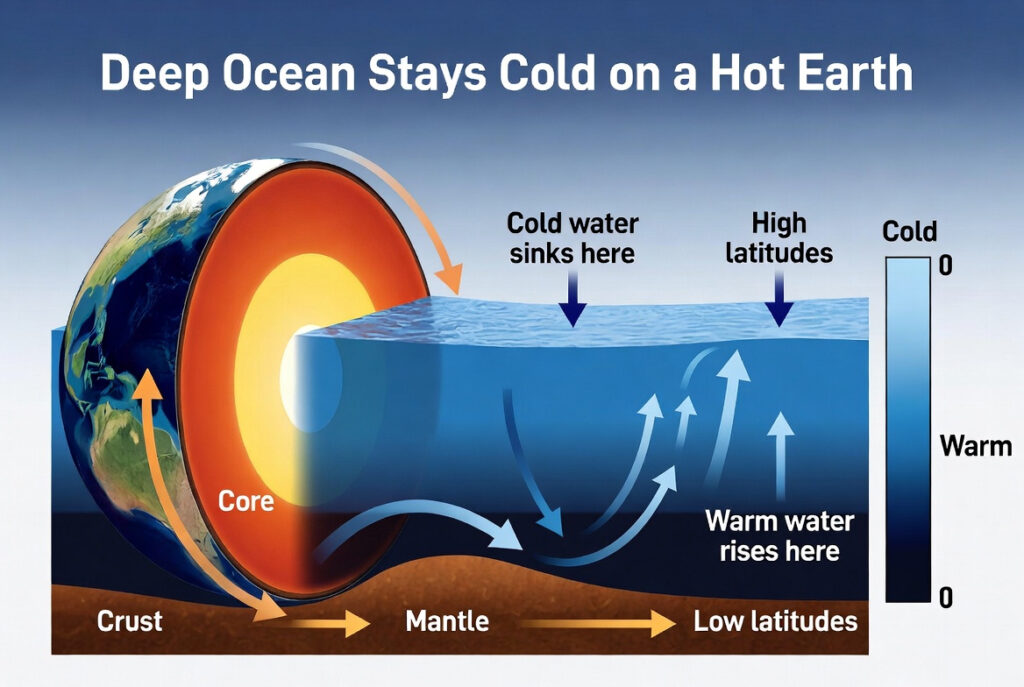
The Ocean Is Heated Mostly From Above, Not Below
For ocean water, the dominant heat source is the Sun.
Sunlight warms the surface layer directly. The atmosphere also exchanges heat with the ocean surface through wind, evaporation, condensation, and radiation.
Geothermal heat enters the ocean from the seafloor, but on average, it is much smaller than the heat the ocean receives from above.
This one fact alone already reduces the paradox. The deep ocean is not sitting on a “high-powered heater” compared to what the Sun does at the surface.
The Ocean Is Not One Big Mixed Bath
It feels natural to assume water always mixes. You pour milk into coffee and it blends fast. So people assume the ocean is like that.
The ocean does mix, but not equally in all directions.
- Horizontal movement can be fast and huge.
- Vertical mixing is often limited.
Why does that matter? Because warm surface water does not easily sink to replace cold deep water. The ocean forms layers that resist mixing.
Density Controls Who Sits Where
Water density depends mainly on:
- temperature,
- salinity.
Cold water is usually denser than warm water. Saltier water is usually denser than fresher water.
So the ocean tends to arrange itself like this:
- warmer, lighter water stays near the top,
- colder, heavier water settles lower.
Once that layering forms, it becomes stable, like oil sitting on top of vinegar. You can shake it, but it separates again.
The Thermocline Is the Ocean’s “Thermal Wall”
In many parts of the ocean, temperature drops quickly over a certain depth range. This region is called the thermocline.
Above it, surface water can warm strongly and change with seasons.
Below it, water stays cold and changes slowly.
The thermocline acts like a barrier. It limits how much heat from the surface can travel downward.
The Deep Ocean Is Supplied by Polar Water
Now we reach the hidden engine that your text was missing.
The deep ocean is cold largely because it is filled by water that becomes dense at high latitudes, then sinks.
This happens especially in regions such as:
- around Antarctica,
- the North Atlantic.
In winter, surface water there becomes very cold. Sea ice formation can also leave the remaining water saltier. Cold plus salty means denser water.
Dense water sinks, sliding under other layers, and spreads through the deep ocean basins.
This process helps create the deep ocean water masses that stay near freezing.
The Global Conveyor Belt Effect
Oceanographers often describe a global pattern called thermohaline circulation, driven by temperature and salinity differences.
It does not move like a neat belt you can point at on a single day. It is a network of slow, massive movements.
Still, the outcome is clear:
- cold dense water sinks in key regions,
- it spreads at depth,
- it eventually upwells elsewhere,
- surface waters return poleward.
This circulation keeps deep waters cold because the source water is cold.
Darkness Does Not Create Cold, But It Removes a Heat Source
Your text points out that sunlight does not reach the abyss. That is correct and important.
Darkness does not “freeze” water as a force. It simply means the deep ocean does not receive direct solar heating.
If heat cannot easily mix down from the surface, and if cold water sinks from the poles, the deep ocean stays cold even for very long periods.
Why Pressure Does Not Turn the Deep Ocean Into Ice
People often assume that high pressure forces water to freeze. Reality is more subtle.
Pressure does change physical properties, including freezing behavior, but it does not automatically turn deep seawater into ice.
Seawater also contains salt, which lowers the freezing point. So seawater can stay liquid slightly below 0°C.
That is why much of the deep ocean sits near freezing temperatures while remaining liquid.
Where the Earth’s Inner Heat Actually Shows Up in the Ocean
Geothermal heat is real. You can see it clearly in specific seafloor settings.
Mid-Ocean Ridges and New Crust
Along mid-ocean ridges, tectonic plates pull apart. Hot material rises, and new oceanic crust forms.
These areas have higher heat flow than the average seafloor. The heat is not spread evenly across the ocean floor. It is concentrated in certain places.
Hydrothermal Vents and “Smokers”
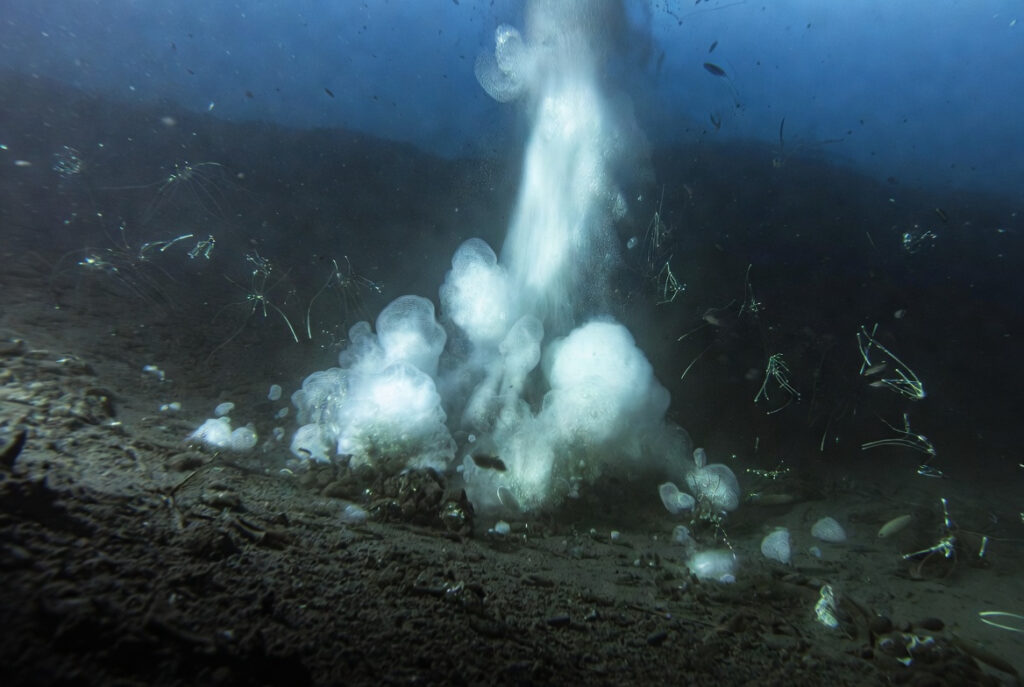
Hydrothermal vents are one of the most dramatic examples.
Seawater seeps into cracks in the seafloor, heats up near hot rock, picks up minerals, and rises back out.
Some vents release very hot fluid locally, even though the surrounding deep seawater remains close to freezing.
This creates a strange scene:
- near the vent, the water can be extremely hot,
- a short distance away, the water is still very cold.
Why These Hot Spots Do Not Warm the Entire Deep Ocean
This is a scale problem.
Hydrothermal vents are intense, but they are scattered. Their heat gets diluted quickly by the massive volume of cold deep water.
It is similar to lighting a bonfire on a frozen lake. The fire is hot, but the lake does not melt into warm water everywhere.
The Seafloor Is Not a Uniform Heater
The seafloor’s heat flow varies because of:
- crust age,
- plate boundaries,
- volcanic activity,
- sediment thickness,
- hydrothermal circulation.
Old seafloor tends to be cooler than young seafloor.
So even the heat from below is not consistent. That makes it even harder for the deep ocean to become warm overall.
Heat Transfer Through Rock Is Slow
Even if you picture the mantle as “hot,” the question becomes: how fast does heat move through that thick material?
Heat moves through rock mainly by:
- conduction,
- convection in the mantle over geologic time.
Conduction in rock is not fast enough to flood the ocean with heat on human timescales. It is steady but limited.
Mantle convection does move heat, but it is slow, like honey flowing across a table. It shapes continents over millions of years, not weeks or years.
Heat Flow at the Surface Is Small Compared to Solar Input
This is one of the most important “scale facts.”
The Sun delivers a huge amount of energy to Earth’s surface every day. The internal heat of Earth is significant for geology, plate tectonics, and volcanism, but the average heat flow at the surface is much smaller than the solar energy input.
That is why climate and ocean temperatures are dominated by solar-driven processes.
Why Deep Ocean Temperature Stays Near 0–4°C
Many deep ocean regions hover in a narrow temperature range, often close to freezing.
This range makes sense once you combine four points:
- polar regions create very cold surface water,
- cold water is dense and sinks,
- deep water is renewed through circulation,
- surface heat does not mix down easily.
So deep ocean temperature is not “trying to match Earth’s core.” It is responding to the ocean’s own circulation system.
Why Warm Surface Water Does Not Sink Easily
Warm water is lighter. That is the simplest reason.
But there are extra details that strengthen the barrier.
Surface Water Often Becomes Fresher
Rainfall, river input, and melting ice can make surface water less salty in some regions.
Less salty water is lighter. That keeps it floating, which further prevents sinking.
Wind Mixes the Top Layer, Not the Whole Ocean
Wind-driven waves can mix the upper ocean. Storms can deepen that mixed layer.
Still, the mixing usually stops far above the deep ocean. The deeper you go, the more stable the layering becomes in many regions.
The Ocean Has Slow “Turnover” at Depth
Deep ocean water can take centuries to millennia to fully circulate.
That slow turnover helps explain why deep temperatures change slowly.
Even when the surface warms or cools in a short time, the deep ocean does not immediately follow. It reacts slowly because it is protected by stratification and slow circulation pathways.
Why “The Ocean Should Warm Eventually” Feels Right but Fails
Many people say: “Even if it is slow, shouldn’t the deep ocean warm after millions of years?”
This is a fair thought. The catch is that deep waters are not sitting in isolation. They are constantly renewed with cold dense water from high latitudes, and they are constantly losing and gaining heat through slow but ongoing circulation.
So the deep ocean is not just “waiting to warm.” It is part of a moving, balanced system.
The Deep Ocean Is Cold, but It Is Not Static
Even cold deep water moves.
It flows along seafloor contours, through basins, around ridges, and up into other layers.
It also interacts with sediments and seafloor rock, exchanging heat and chemicals. That exchange is real, but it does not overpower the cold supply and stratification.
The Part That Often Gets Skipped in Simple Explanations
Your text complains, in spirit, that “the story feels incomplete.”
That feeling often comes from how science is taught in pieces.
- Geology classes emphasize Earth’s hot interior.
- Oceanography emphasizes surface heating and deep circulation.
- Physics explains heat transfer, but often without real-world systems.
Once you connect the pieces, the picture becomes complete.
A Clear Step-by-Step Answer to the “Paradox”
Here is the clean chain of logic in one flow:
- Earth’s interior is hot.
- Heat moves upward through thick rock slowly.
- The average geothermal heat reaching the seafloor is modest.
- The ocean is heated mainly from the top by the Sun.
- Warm surface water stays on top because it is lighter.
- Cold, dense water forms in polar regions and sinks.
- That sinking water fills deep ocean basins.
- Stable layering blocks large-scale downward heat mixing.
- Local seafloor hot spots exist, but they do not dominate the whole ocean.
When you accept all nine steps, the paradox disappears.
Real-World Places Where You Can “See” the Explanation
Hydrothermal Vent Fields
These sites show that geothermal heat does enter the ocean, but in concentrated areas. You can find hot water and cold water side by side.
Polar Regions and Deep Water Formation
If you follow the cold water to its source, you find regions where surface conditions create dense water that sinks.
That sinking action is the “cold pipeline” that feeds the abyss.
Ocean Basins With Very Stable Deep Layers
Many basins show deep temperature stability. That stability makes sense only when stratification is part of your mental model.
Common Myths That Make the Paradox Worse
Myth: The Mantle Is a Giant Liquid Ocean.
Reality: the mantle is mostly solid and flows slowly over geologic time.
Myth: Heat From the Core Must Make the Seafloor Hot
Reality: heat flow is limited by thick rock layers and by the scale of the ocean.
Myth: Pressure Makes Water Freeze
Reality: seawater stays liquid near freezing because salinity lowers the freezing point and pressure effects do not create instant ice.
Myth: Deep Water Is Cold Because It Is Dark
Reality: darkness prevents solar heating, but circulation and layering maintain the cold.
The “Human” Way to Picture It
If you want a mental image that sticks, use this:
- The Sun is the ocean’s main heater.
- The poles are the ocean’s main refrigerator.
- The deep ocean is the cold storage room.
- The thermocline is the insulated door.
- Geothermal heat is a small floor heater with a few hot vents.
With that picture, you stop expecting the abyss to be warm.
Why This Matters Beyond Curiosity
This question is not only philosophical. It matters for real-world understanding.
Climate and Heat Storage
The ocean stores a huge amount of heat. Most climate-driven heat first affects the surface and upper layers, then gradually spreads deeper.
Knowing how slow deep mixing can be helps explain why climate changes can have long delays and long-lasting effects.
Deep-Sea Life and Ecosystems
Deep-sea ecosystems depend on cold conditions, high pressure, and limited energy.
Hydrothermal vents create special ecosystems that do not rely on sunlight. They rely on chemistry. That is a direct link between Earth’s internal heat and ocean life.
Geology and Natural Hazards
Seafloor heat is tied to plate tectonics, which drives earthquakes, volcanic activity, and tsunamis.
Understanding where heat concentrates helps scientists map tectonic activity and crust creation zones.
Practical Summary for Readers Who Want the Quick Answer
The Deep Ocean Stays Cold Because
- The ocean is heated mainly from above by the Sun.
- Cold dense water forms at the poles and sinks to the bottom.
- The ocean forms stable layers that block heat from mixing downward.
- Geothermal heat enters from below, but the average is modest and often localized.
The Earth Can Be Hot Inside While the Ocean Is Cold Below Because
- temperature and heat flow are different,
- transfer through rock is slow,
- ocean circulation actively maintains cold water at depth.
Frequently Asked Questions
Is Earth’s core really that hot?
Yes, Earth’s interior is extremely hot, but that does not mean the surface receives a huge heat flow from it.
Why doesn’t geothermal heat warm the ocean more?
Because the average geothermal heat flow into the ocean is small compared to solar heating, and because deep ocean water is constantly renewed with cold polar water.
Why is deep water formed near the poles?
Because polar surface water becomes cold and often saltier, which increases density and causes it to sink.
Does the ocean mix from top to bottom?
Not efficiently. Vertical mixing is limited because layering is stable, with lighter water above denser water.
Are there warm areas on the seafloor?
Yes. Mid-ocean ridges, volcanic zones, and hydrothermal vents can be hot locally.
Does pressure make deep ocean water freeze?
No. Seawater remains liquid near freezing because salinity lowers the freezing point, and pressure does not automatically force freezing.
Why is it so cold if the deep ocean is close to Earth’s crust?
Because “close” here is still separated by layers and because the deep ocean is fed by cold water formation and protected by stratification.
Can deep ocean temperatures change?
Yes, but often slowly. Deep ocean circulation can take centuries, so deep temperatures respond gradually.
Is the deep ocean always near 0°C everywhere?
Not everywhere. It varies by basin and water mass history, but it is generally cold and stable compared to surface waters.
What is the simplest way to explain the paradox?
The Sun heats the surface, polar regions send cold water to the bottom, and the ocean’s layers keep that cold water in place while geothermal heat remains modest and localized.
The Big Takeaway That Makes Everything Click
If you remember one idea, remember this:
Earth’s internal heat shapes geology. The Sun and ocean circulation shape ocean temperatures.
The deep ocean is cold not because Earth is not hot, but because the ocean has a powerful system that creates and preserves cold water at depth.
Once you accept the ocean as a layered, circulating machine, the paradox turns into a neat piece of planetary logic.
You may also be interested in: Andrew and Tristan Tate Arrested in the U.S. Following UK
⚠️ Disclaimer and Source Hygiene
This article is for educational purposes only. It does not replace advice from qualified professionals such as geologists, oceanographers, or science educators. The explanations are based on established scientific principles and widely accepted research from authoritative institutions and textbooks, plus the text you provided.
🔔 For more tutorials like this, consider subscribing to our blog.
📩 Do you have questions or suggestions? Leave a comment or contact us!
🏷️ Tags: deep ocean temperature, earth core heat, thermohaline circulation, ocean stratification, geothermal heat, hydrothermal vents, mid-ocean ridge, heat transfer, oceanography basics, geology explained
📢 Hashtags: #OceanScience #DeepSea #Geology #Oceanography #ThermohalineCirculation #HydrothermalVents #EarthCore #ScienceExplained #ClimateScience #PlanetEarth
📚 Sources
Authoritative reference types used for research
- Introductory oceanography textbooks covering thermohaline circulation, stratification, and deep-water formation
- Geology and Earth science textbooks explaining Earth’s internal structure, geothermal gradient, and heat flow
- Educational materials and public research pages from recognized scientific institutions such as NOAA, NASA, USGS, and major university oceanography departments
