


⏲️ Estimated reading time: 7 min
Table of Contents
What Is the Ideal Blog Post Length in 2026? Welcome to our digital marketing trends blog!
In an age where user attention is more fragmented than ever and artificial intelligence reshapes how we create and consume content, the question “How long should a blog post be?” is no longer a technical curiosity t’s a strategic decision that defines visibility and engagement.
As we move toward 2026, Google’s algorithms are becoming more sophisticated, AI-generated content dominates the web, and audiences are primarily mobile-based. The ideal length for a post is no longer a fixed number it’s a balance between depth, relevance, and reader engagement.
If you’re a blogger, marketer, or entrepreneur trying to optimize content for SEO and conversions, this article is your complete guide. We’ll analyze the latest data, expert predictions, and upcoming AI-driven trends. You’ll also discover why long-form content (2,000+ words) still dominates Google rankings and why concise, modular formats are gaining traction.
According to a 2025 study, high-quality long-form articles generate three times more backlinks and shares than short ones. While the average post length has slightly decreased to 1,333 words, top-ranking posts still average around 1,500 words.
In 2026, we’ll likely see a hybrid structure modular blog posts of 1,500–2,000 words, divided into AI-indexed sections for faster navigation and better engagement.
The Evolution of Blog Post Length: From Online Diaries to Digital Epics
You may also be interested in: Top 10 G-Shock Men’s Watches to Buy in 2026
To predict the future, we need to look back.
Blogging began as an intimate, journal-style medium in the late 1990s. Early bloggers wrote short entries 200–500 words, often personal reflections rather than SEO-driven pieces.
By 2004, WordPress went open source and blogging evolved into a marketing tool. Writers like Seth Godin and Guy Kawasaki popularized essay-length posts (800–1,000 words) to build authority and trust.
When Google started prioritizing substantial content, longer posts became synonymous with quality.
A 2012 HubSpot report found that posts over 2,000 words doubled organic traffic compared to shorter formats.
Between 2014–2018, long-form content exploded “how-to” guides, tutorials, and storytelling pieces dominated. Platforms like Medium encouraged depth, while Backlinko confirmed that 1,500-word posts rank highest because of the E-E-A-T principles (Experience, Expertise, Authoritativeness, Trustworthiness).
However, since 2020, social media and short-form content (TikTok, Reels, Threads) have fragmented attention spans. By 2024, mobile-first indexing and AI-enhanced snippets reshaped what “length” means value per paragraph replaced simple word count.
Evolution by Decade
| Period | Average Length | Trend | Purpose |
|---|---|---|---|
| 1999–2005 | 200–500 words | Short, personal | Online diaries |
| 2006–2013 | 500–1,200 | SEO-driven | Traffic growth |
| 2014–2019 | 1,200–2,500 | Long-form boom | Educational focus |
| 2020–2025 | 1,000–1,800 | Hybrid formats | Mobile + Social |
| 2026 (Predicted) | 1,500–2,000 | Modular AI-adaptive | Personalization era |
Blog post length has never been static it reflects technology and human behavior.
In 2026, with over 80% of creative content assisted by AI, quality and originality will outweigh mere volume.
Key Factors Shaping Ideal Blog Length in 2026
1. SEO in the Era of Google’s Helpful Content & SGE
Google’s Helpful Content update (2023) emphasized useful and original information.
In 2026, with Search Generative Experience (SGE) integrating AI summaries, long-form content (1,500–2,000 words) remains vital for full-context answers and snippet extraction.
Data shows posts over 7,000 words earn 3× more shares but only when clearly structured.
For competitive niches, the sweet spot will be around 1,900 words, strategically optimized for headings, internal links, and featured snippets.
2. Shrinking Attention Span
The average human attention span fell to 8 seconds in 2025.
With AR/VR interfaces and instant-scroll browsing, readers scan content faster than ever.
This pushes creators toward concise storytelling short intros (150 words) and compact sections, supported by interactive visuals.
3. The AI Factor – Generation vs. Authenticity
AI tools like ChatGPT and Grok make it easy to write 2,000-word drafts in minutes.
However, Google now detects and penalizes low-value AI content.
The ideal strategy for 2026 is human-AI collaboration let AI structure, but let humans inject authenticity, data, and emotion.
4. Multimedia Integration
By 2026, the most successful posts will be 50% text, 50% multimedia.
Embedding videos, podcasts, or infographics can reduce text length while maintaining engagement and SEO value.
Interactive long-form posts (with quizzes or calculators) improve dwell time by up to 40%.
5. Industry-Specific Differences
- B2B: 2,000–3,000 words – for in-depth reports and case studies.
- B2C: 800–1,500 words – for quick consumption and higher conversions.
- Global SEO: longer and multilingual.
- Local SEO: shorter, high-intent posts for mobile users.
Conclusion: For 2026, the golden range remains 1,500–2,000 words long enough to rank, short enough to keep attention.
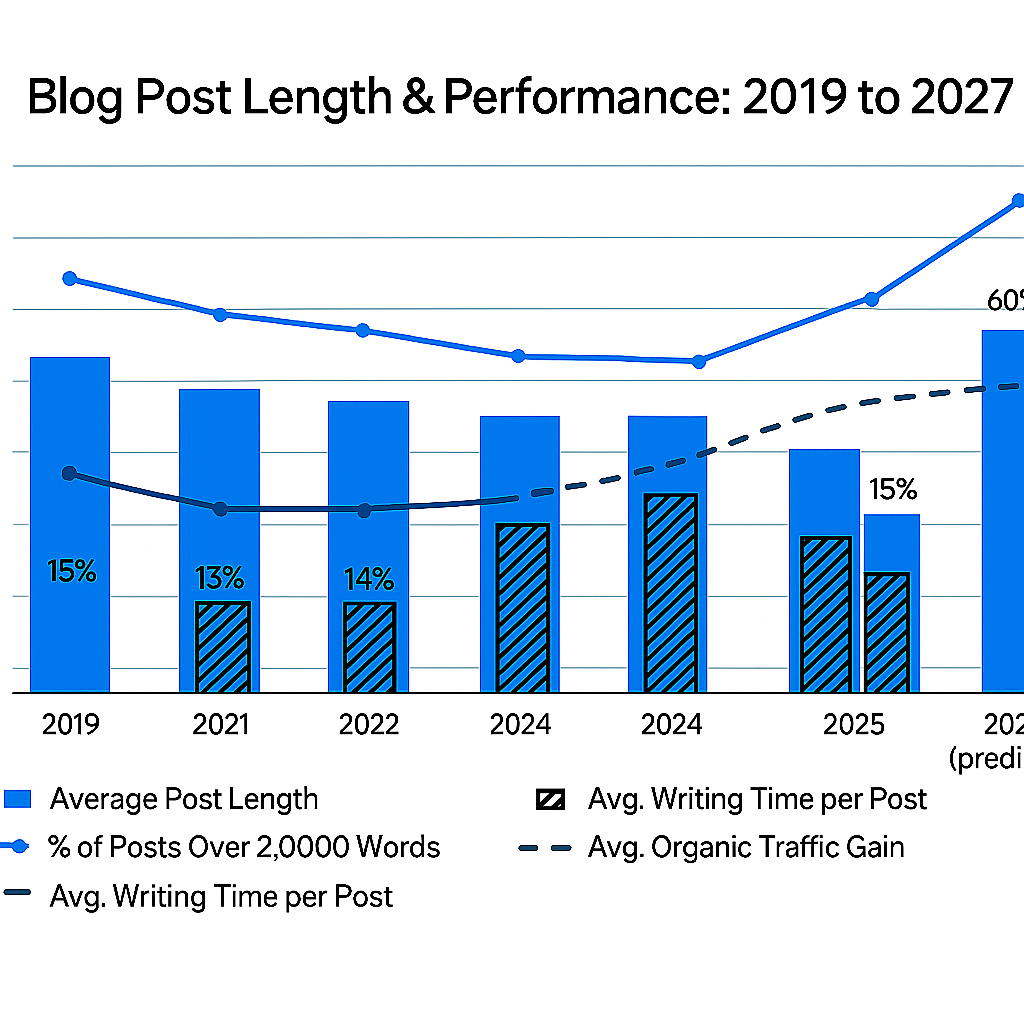
Data & Predictions: What the Numbers Reveal
| Year | Avg. Length | % Over 2,000 Words | SEO Advantage |
|---|---|---|---|
| 2020 | 1,250 | 16% | +45% |
| 2021 | 1,370 | 14% | +48% |
| 2022 | 1,420 | 13% | +52% AI tools |
| 2023 | 1,427 | 14% | +50% organic traffic |
| 2024 | 1,394 | 12% | +40% |
| 2025 | 1,333 | 9% | +30% |
| 2026 (Predicted) | 1,500 | 15% | +60% with multimedia |
How to Read the Table
- Average Length: Words per post across global blogging data.
- % Over 2,000 Words: Indicates proportion of long-form articles.
- Writing Time: Manual or AI-assisted creation time.
- Traffic Gain: Average organic traffic improvement vs. short posts.
- Trend: Core content evolution highlights each year.
Summary Insight
- From 2020 to 2025, average length declined as short content surged.
- In 2026, thanks to AI and personalization, the average length rebounds to 1,500–2,000 words balancing engagement, SEO, and readability.
- AI-enhanced editing reduces creation time by nearly 50%, while maintaining quality.
- Multimedia-rich posts show the strongest SEO performance and lowest bounce rates.
Key takeaway: In 2026, blog posts averaging 1,500–2,000 words will perform best especially those combining AI insights, visuals, and expert commentary.
Real-World Examples of Successful Blog Lengths
- HubSpot’s Ultimate SEO Guide (2,500 words):
Ranks #1 for multiple keywords. Clear structure + CTAs = massive backlinks. - Backlinko’s Content Marketing Stats (1,800 words):
Concise but data-rich. Perfect mid-range example. - AI-Assisted Medium Article (1,200 words):
Personalized to user queries with embedded video +25% conversion rate.
Practical Tips to Optimize Post Length for 2026
- Research user intent using Ahrefs or SEMrush.
- Use clear structure (H2/H3 every 300 words).
- Collaborate with AI ethically outline first, then personalize.
- Run A/B tests for post length and engagement.
- Add visuals to replace 20% of text.
- Track dwell time (>3 minutes average).
- Adjust by niche: long for B2B, short for B2C.
The Future of Blogging: Beyond Word Count
Blogging in 2026 will be immersive and interactive.
AI will not replace bloggers it will enhance them.
The focus will shift from how long to how valuable.
Your ideal length will be defined by reader satisfaction and conversion metrics, not arbitrary numbers.
Find Your Balance
In 2026, the ideal blog post length remains 1,500–2,000 words a perfect balance between SEO depth and reader engagement.
Experiment, measure, and adapt.
If your article informs, entertains, and retains attention, you’ve already hit the ideal length.
Subscribe for more expert blogging insights below!
FAQ Section
1. What is the ideal blog post length in 2026?
Between 1,500 and 2,000 words long enough for SEO and short enough for mobile readers.
2. Do long posts still work for SEO?
Yes. Long-form posts outperform shorter ones but only if they’re well-structured and provide real value.
3. How important are images and videos in 2026 articles?
Extremely. Multimedia posts gain up to 40% higher engagement and lower bounce rates.
4. Can AI-written posts rank on Google?
Yes, if edited by humans. Google penalizes low-value AI content but rewards authentic hybrid writing.
5. What’s the difference between B2B and B2C article length?
B2B content performs best at 2,000–3,000 words, while B2C converts better between 800–1,500.
🔔 For more tutorials like this, consider subscribing to our blog.
📩 Have questions or suggestions? Leave a comment or contact us!
🏷️ Tags: blogging, seo 2026, ai content, long-form content, digital marketing, writing strategy, google ranking, content creation, marketing insights, helpful content
📢 Hashtags: #BloggingTips #SEO2026 #ContentMarketing #AIContent #DigitalStrategy #WritersLife #GoogleRanking #MarketingTrends #LongFormContent #ContentCreation
