


⏲️ Estimated reading time: 14 min
Table of Contents
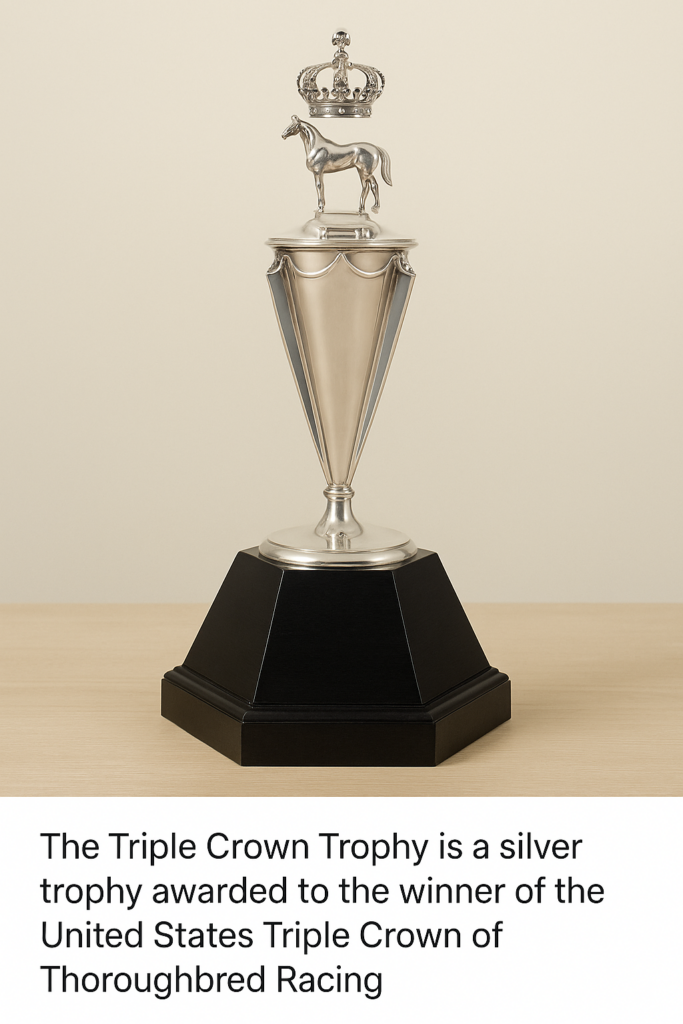
The Triple Crown Trophy is the silver prize awarded to the connections of a horse that wins the Kentucky Derby, Preakness Stakes, and Belmont Stakes in the same year. Discover its history, symbolism, ceremony, and the legends who earned it.
What Is the Triple Crown Trophy?
The Triple Crown Trophy is a silver award presented to the connections of any Thoroughbred who captures the United States Triple Crown. The Triple Crown means sweeping three elite races in a single season: the Kentucky Derby, the Preakness Stakes, and the Belmont Stakes. The trophy honors a feat achieved by very few horses. It symbolizes stamina, speed, and consistency across different tracks, distances, and dates.
The award goes to the team behind the champion. That means the owner receives the trophy, while the trainer, jockey, and breeder are also celebrated with their own honors and keepsakes. The trophy marks a once-in-a-generation achievement. Fans consider it the pinnacle of North American flat racing.
A Short History of the Triple Crown and Its Prize
The three races existed long before people used the phrase “Triple Crown.” Writers and race officials gradually linked them through the early twentieth century. Once the idea took hold, the industry sought a single emblem that captured the sweep.
A dedicated national trophy emerged so the racing world could honor the rare champion. Before that, winners mostly received individual race trophies and public acclaim. The Triple Crown Trophy unified the three victories under one symbol. It helped the sport tell a single, powerful story: a horse conquers spring, conquers three states, and conquers the imagination.
Over time, the trophy became a ceremonial centerpiece. It appears on television, in museum exhibits, and at racetrack celebrations. When a contender wins the first two legs, the trophy often travels to the Belmont Stakes under tight security. The public gets a glimpse of the goal that riders, trainers, and owners chase all year.
Why Silver? Material, Meaning, and Craft
Silver is traditional in racing awards. It reflects light brilliantly under track spotlights, cameras, and daylight. It also polishes to a mirror finish that reads beautifully on television. Silversmiths can work it into sharp lines and organic curves. That flexibility suits a trophy that must feel both classic and modern.
Symbolically, silver signals prestige without distraction. Gold can overpower details and color. Silver shows every engraved line. It lets the form and craftsmanship speak. The material also ties the trophy to a century of racing cups, plates, and bowls made for champions around the world.
Design Language and Symbolism
The Triple Crown Trophy’s design communicates unity and balance. The three races form a triangle. Many visual interpretations echo that geometry. A triangular base suggests the three legs. Rising above it is a single central form. That form represents the completed crown speed, stamina, and heart brought together.
Engravers inscribe the horse’s name and the year of victory. Some versions include race names or stylized motifs from Churchill Downs, Pimlico, and Belmont Park. Every line carries meaning. The base grounds the story in three spring dates. The apex celebrates one unbroken arc of excellence.
How the Trophy Is Made: From Concept to Presentation
Silversmiths follow a precise process. First come drawings. Designers plan the proportions so the eye flows upward. Then artisans create a mockup. That model tests weight and stability. The team checks how the trophy looks on a podium and in a champion’s hands.
Next they shape the silver. Depending on the maker, parts are raised, spun, or cast. Sections come together through soldering. Surfaces are planished and filed smooth. Craftspeople polish the metal through multiple grits to reach a liquid shine. Engravers finish with names and dates. The final inspection checks symmetry, seams, and legibility.
A lined presentation case protects the trophy. The case fits the exact footprint. Teams transport it with gloves. At the track, officials set it on a stable riser, away from strong heat or bright direct sun. The aim is simple: when cameras roll, the trophy should glow.
Who Receives the Trophy and What Happens Next
The owner of the Triple Crown winner receives the official Triple Crown Trophy. The racing team trainer, jockey, and breeder often receive commemorative pieces. Racetracks present their own hardware after each leg as well. That means a Triple Crown sweep produces a small constellation of awards for the connections.
The primary trophy becomes part of the owner’s collection. Many donate or loan it to museums for public display. Racing halls of fame, sports museums, and local cultural centers exhibit these trophies with bridles, silks, and shoes from the horse’s career. Exhibits bring fans face-to-face with the gleam and scale of the achievement.
Ceremony at the Belmont Stakes
If a horse wins the Derby and Preakness, the Belmont Stakes becomes a coronation stage. Security is tight. The trophy appears during the broadcast. Presenters rehearse the choreography. Photographers plan angles long before the bell rings.
After the race, the winning team enters the presentation area. Confetti, flowers, and the race blanket frame the moment. When officials deliver the Triple Crown Trophy, the crowd often reaches its loudest pitch. The champion’s name is announced to the world. Media capture every second. The trophy lifts, flashes in the lights, and enters history.
Why the Triple Crown Is So Hard to Win
Winning the Triple Crown requires much more than a fast horse. It demands three distinct skill sets. The Kentucky Derby challenges a large field and a chaotic run. The Preakness often favors tactical alacrity two weeks later. The Belmont asks for stamina at a longer distance and the ability to handle a sweeping, sandy track.
Timing matters. A horse must stay sound through a demanding schedule. Travel between states adds stress. Strategy evolves with every start. A gate break can decide everything. Jockeys must know when to wait and when to move. Trainers must read their horse’s recovery day by day.
Because the path is so tough, the trophy carries special weight. Few sports ask champions to compress so much into such a short season. The Triple Crown Trophy proves that a remarkable athlete did exactly that.
The Roll of Honor: Legends Who Claimed the Crown
The Triple Crown roll includes early pioneers and modern icons. The first recognized sweepers completed the three-race mission in the 1910s and 1930s. The war years produced iron horses who stamped the idea into culture. Mid-century champions showcased speed that still stuns fans. The 1970s delivered a trio whose names remain household words. Then came a long drought, broken in the twenty-first century by two dazzling performers.
This lineage gives the trophy a living halo. Each new champion joins a very small circle. Broadcasters replay past triumphs at every Belmont. Viewers see patterns: explosive Derby moves, Preakness elation, and the long Belmont stretch where legends either wilt or widen. The trophy binds those moments across decades.
The Trophy’s Role in Modern Media
In the digital era, images rule. The trophy must read at a glance on phones and podiums. Photographers love the way silver mirrors surroundings. The finish creates dramatic highlights. Editors can crop tight and still keep the silhouette readable.
Social platforms elevate the trophy into a meme of excellence. When a contender sweeps the first two legs, the trophy becomes a countdown symbol. Every post and clip points toward Belmont. Fans share stills of the trophy beside the contender’s name. Anticipation builds. The silver form becomes the sport’s most recognizable springtime icon.
Security, Insurance, and Care
The trophy is valuable as an art object and a cultural artifact. Owners treat it with museum-level care. Many insure it for transport. Reputable couriers handle trips to events. Soft cloths and gloves are standard protocol. Owners avoid abrasive polishes. They rely on gentle, silver-safe solutions and microfiber towels.
Display conditions matter. Avoid harsh sunlight that can heat metal and fade silk displays nearby. Stable humidity helps prevent tarnish. When not on show, the trophy rests in its padded case. Good stewardship preserves both monetary and historic worth.
Replicas, Exhibitions, and Public Access
Fans can see Triple Crown trophies at special exhibits. Museums cooperate with owners to loan pieces. Some connections commission replicas for public display. Others exhibit the original for limited runs. Curators build narratives around the trophy with film, audio, and interactive kiosks. Visitors learn training routines, pedigree facts, and the split-second decisions that defined each leg.
These programs invite new audiences. Children press against glass displays. Alumni relive the Belmont roar. Docents explain how one season can define a century. The trophy sits at the center, sparkling like a lighthouse.
Economic Impact and Brand Value
A Triple Crown season boosts the sport’s economy. Tracks see attendance spikes. Broadcast ratings jump. Wagering volume rises during Derby week and sustains through Preakness and Belmont. Merchandising thrives. Hats, commemorative posters, and framed photos sell briskly. The trophy’s image anchors campaign visuals. It appears on banners, souvenir programs, and victory parades.
For owners and farms, the value extends into breeding. A stallion with a Triple Crown on his résumé commands attention. The trophy functions like a trademark of excellence. It signals durability, class, and big-race temperament.
The Human Stories Behind the Silver
The trophy immortalizes a horse, but it also honors people. Grooms walk the shedrow at dawn. Exercise riders feel every stride before the public arrives. Hotwalkers cool out the star in quiet circles. Veterinarians guide recovery between races. Farriers manage hoof health in delicate windows. The team’s discipline takes the horse to the gate three times ready.
Owners often speak about family journeys. Some saved for years to breed or buy a prospect. Others built stables across generations. The trophy compresses these paths into one gleaming moment. Tears on the podium are common. They reflect sacrifices no camera ever fully captures.
Comparisons to Other Great Sports Trophies
Every sport has an emblem. Basketball crowns a champion after months of playoffs. Hockey’s famous cup travels to hometown barbecues. Soccer’s world prize visits continents. The Triple Crown Trophy stands apart because it honors a three-part victory by a single athlete an equine athlete who cannot repeat the feat the next week or month. The window is small, the pressure high, and the narrative unrepeatable within a season.
The trophy’s aura comes from scarcity. Many seasons end without a sweep. When the stars align, the achievement feels almost mythical. The silver object becomes the visible proof that the myth was real.
Myths, Misconceptions, and Clarifications
Some fans assume the trophy belongs to the jockey. In reality, the primary award goes to the owner, with distinct honors for the jockey, trainer, and breeder. Others think the trophy is awarded after each leg. It is only bestowed when a horse wins all three races in the same year.
Another misconception is that all three races are similar tests. They differ in distance, track characteristics, and spacing. A horse must adapt to each challenge. That adaptability is part of what the trophy celebrates.
Changing Times, Enduring Symbol
Racing evolves. Safety standards, training philosophies, and track surfaces adapt. Broadcast styles change with technology. Yet the trophy’s meaning holds. It recognizes a champion who mastered the sport’s most complete test in a compressed calendar. It ties today’s fans to their grandparents’ memories.
As long as spring thunders with hooves in Kentucky, Maryland, and New York, the Triple Crown Trophy will matter. It remains the sport’s most magnetic object, bright with tradition and charged with hope.
How Owners Display the Trophy at Home or Office
Display choices blend design and security. Many owners mount the trophy within a glass cabinet. LED lights provide even illumination without heat. Dark matte backdrops reduce glare and enhance contrast. Custom plinths echo the triangular theme. A brass plaque identifies horse, year, and connections for visitors.
Some owners create a “victory wall.” Framed silks, finish photos, and the trophy share a single axis. The narrative starts with a Derby frame, steps through Preakness, and ends with Belmont glory. The trophy anchors that visual journey. It draws guests forward before they read a single caption.
The Trophy in Education and Outreach
Youth programs use the trophy’s story to teach resilience. In workshops, students learn how to set multi-step goals. They build timelines that mirror the three-race path. Coaches emphasize daily routines and rest. Veterinarians discuss equine health and fairness. The trophy becomes a classroom object lesson in discipline, teamwork, and kindness to animals.
Museums design interactive stations where kids “train” a season on a touch screen. They manage rest days, weather, and travel. A successful run ends with a virtual podium. The real trophy gleams nearby, making the simulation feel alive.
The Role of the Trophy in Philanthropy
Owners frequently lend the trophy for charity events. Galas auction photo sessions with the award. Fans donate to get a picture beside it. These efforts raise funds for aftercare organizations, equine hospitals, and community programs. The trophy’s magnetism becomes a force for good beyond the racetrack.
A Fan’s Guide: Seeing the Trophy in Person
If you want to see a Triple Crown Trophy, watch for museum announcements and special track events. Big race weeks sometimes feature public viewings. Arrive early. Lines form fast. Photography rules vary. Respect staff instructions and no-touch policies. A moment with the trophy feels brief, but the memory lasts. You will notice the crisp edges, the depth of the engravings, and the surprising weight suggested by its stance.
The Trophy’s Lasting Message
At heart, the Triple Crown Trophy tells a simple truth. Greatness requires alignment. A horse must be healthy, focused, and brave. People must be prepared, patient, and wise. Weather must cooperate. Breaks must go your way. When it happens, the trophy shows what is possible when talent meets timing.
The silver rises like a promise. It says there will always be another spring and another dream. It says effort is beautiful, even when it falls short. It says the journey teaches us as much as the destination.
Frequently Asked Questions (Text)
Who receives the Triple Crown Trophy?
The owner receives the official Triple Crown Trophy. The trainer, jockey, and breeder also receive recognition and commemorative awards.
What is the Triple Crown in the United States?
It is the Kentucky Derby, Preakness Stakes, and Belmont Stakes, won in the same year by one horse.
Is the trophy always made of silver?
Yes, the Triple Crown Trophy is crafted in silver to reflect tradition, clarity, and premium craftsmanship.
Is there a presentation at Belmont Park?
Yes. If a horse wins the Derby and Preakness, a Triple Crown ceremony takes place after the Belmont Stakes.
Do replicas exist?
Some connections commission replicas for exhibition or display while the original is kept secure.
Can the public see Triple Crown trophies?
Yes. Museums, halls of fame, and special racetrack events often exhibit them.
Why is the Triple Crown hard to win?
Different distances, surfaces, timing, travel, and recovery make the three races a unique and demanding sequence.
Does the jockey keep the main trophy?
No. The primary trophy goes to the owner. Jockeys, trainers, and breeders receive separate honors.
What happens if a horse wins two legs but loses Belmont?
No Triple Crown is awarded. The team still receives individual race trophies and significant acclaim.
How is the trophy cared for?
Use gloves, microfiber cloths, and silver-safe cleaners. Store in a padded case and avoid harsh light and humidity swings.
Conclusion Crown of Spring, Proof of Greatness
The Triple Crown Trophy glows because it stands for an entire journey. It represents three tests, one year, and the narrowest window in sports. The silver does not make the champion; the champion makes the silver matter. Each time a horse lines up at Churchill Downs, a dream begins. Each time a rider turns for home at Pimlico, the dream grows brighter. And each time a field enters Belmont’s sweeping stretch, the trophy waits quiet, shining, and ready to meet the next legend.
🔔 For more tutorials like this, consider subscribing to our blog.
📩 Do you have questions or suggestions? Leave a comment or contact us!
🏷️ Tags: Triple Crown Trophy, United States horse racing, Kentucky Derby, Preakness Stakes, Belmont Stakes, Thoroughbred racing, sports trophies, silver trophy, racing history, equine champions
📢 Hashtags: #TripleCrownTrophy, #HorseRacing, #KentuckyDerby, #Preakness, #BelmontStakes, #Thoroughbred, #SportsHistory, #RacingLegends, #SilverTrophy, #USSports
You may also be interested in: The Young Hero Who Sacrificed Everything for Love: The Story
