


⏲️ Estimated reading time: 6 min
Table of Contents
The Giant Bobbit Worm is one of the ocean’s most mysterious and efficient predators. Buried beneath the sand, it strikes with astonishing speed. This in-depth article explains what it really is, how it hunts, where it lives, and which viral myths are true or exaggerated.
Giant Bobbit Worm – The Ocean’s Hidden Predator With a Lightning Strike
Fear Is Born From What We Cannot See
Humans instinctively fear what they cannot observe.
The ocean is full of such creatures.
One of them became famous online under the name Giant Bobbit Worm.
Viral videos portray it as a sea monster.
Headlines promise “monster bites” and “instant kills.”
The real story is far more fascinating than internet horror.
The Bobbit worm is not a monster.
It is a product of millions of years of precise evolution.
What Is the Giant Bobbit Worm
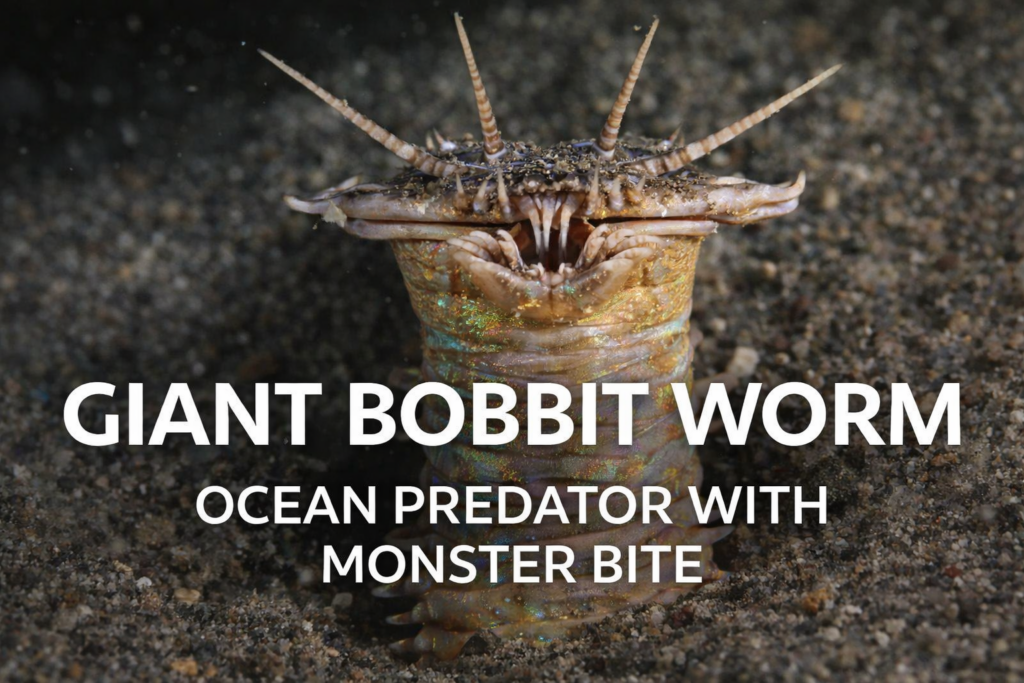
The Giant Bobbit Worm is the common name for Eunice aphroditois.
It belongs to the group of marine segmented worms called polychaetes.
These worms are not rare.
They are simply extremely well hidden.
Biological Classification
- Kingdom: Animalia
- Phylum: Annelida
- Class: Polychaeta
- Family: Eunicidae
- Species: Eunice aphroditois
Where the Name “Bobbit Worm” Comes From
The term “Bobbit worm” is not scientific.
It originates from popular culture.
The name is linked to a widely known story from the 1990s.
Although controversial, the association stuck.
Marine biologists do not use this name officially.
However, the internet made it impossible to ignore.
What the Bobbit Worm Really Looks Like
Impressive Size
In ideal conditions, individuals can reach:
- Over 1 meter (3 feet) in length
- Rare reports mention even larger specimens
Most of its body remains hidden at all times.
Only a small portion is ever visible.
Segmented and Flexible Body
The worm has a long, segmented body.
Each segment is equipped with tiny bristles.
These bristles help with:
- Anchoring in sand
- Rapid movement
- Passive defense
Colors and Iridescence
Under light, the body may appear metallic.
Observed colors include:
- Dark brown
- Green
- Purple
- Black with iridescent tones
This effect gives it an “alien” appearance.
The Head and Jaws – A Perfect Weapon
Retractable Mandibles
The Bobbit worm possesses powerful jaws.
When resting, the mandibles are retracted.
During an attack:
- They extend instantly
- Grip the prey
- Pull it underground
Bite Strength
The jaws are capable of:
- Cutting soft tissue
- Crushing small shells
- Holding fast-moving fish
Everything happens in a fraction of a second.
Where Bobbit Worms Live
Natural Habitat
They prefer:
- Warm tropical waters
- Sandy seabeds
- Coral reef environments
They are found in:
- The Indian Ocean
- The Pacific Ocean
- Tropical and subtropical seas
Depth Range
Most commonly:
- Shallow coastal waters
- Near reef systems
- Beneath layers of sand
Seeing one fully exposed is extremely rare.
Hunting Strategy – The Art of Ambush
The Bobbit worm does not chase prey.
It waits.
Ambush Position
- Entire body buried
- Only antennae exposed
- Sometimes the jaw tips
This position makes it nearly invisible.
Detecting Prey
The antennae detect:
- Vibrations
- Water movement
- Chemical signals
This sensory system is extremely precise.
The Lightning Strike
The attack lasts:
- Less than a second
The prey has no time to escape.
The jaws:
- Shoot upward
- Grab the victim
- Pull it beneath the sand
This efficiency made the species famous.
What Does the Bobbit Worm Eat?
Primary Diet
- Small fish
- Crustaceans
- Mollusks
- Other marine worms
It is an opportunistic predator.
Does It Eat Fish Alive?
Yes.
Like most marine predators.
The phrase “eats fish alive” is dramatic but misleading.
Predation in nature rarely involves instant death.
The Ecological Role of the Bobbit Worm
The Bobbit worm is not a villain.
It is an essential regulator.
Ecological Benefits
- Controls populations of small fish
- Removes weak or sick individuals
- Maintains reef balance
Without predators like this, ecosystems collapse.
Why It Is So Rarely Seen
Perfect Camouflage
- Sand-colored body
- Fully buried posture
- Minimal movement
Nocturnal Behavior
Most active:
- At night
- During dusk
- In low-light conditions
Even experienced divers rarely see one.
Bobbit Worms and Aquariums
How They End Up in Tanks
They may arrive via:
- Live rock
- Coral shipments
- Imported sand
Some remain undetected for years.
Signs of Their Presence
- Fish disappearing
- Unexplained remains
- Strange sand disturbances
Removing one is extremely difficult.
Are Bobbit Worms Dangerous to Humans?
Realistic Risk
For humans:
- Risk is extremely low
- Documented attacks are virtually nonexistent
They do not hunt people.
Safety Advice
- Do not touch marine animals
- Avoid digging in sand blindly
- Respect natural habitats
Popular Myths About the Bobbit Worm
“It Is a Sea Monster”
False.
It is a highly specialized animal.
“It Can Kill Humans”
No evidence supports this claim.
“Cutting It Creates More Worms”
Exaggerated.
While regeneration exists, this is not reproduction.
Why the Internet Turns It Into Horror
Clickbait Culture
Shocking titles:
- Drive views
- Increase engagement
- Distort scientific reality
Fear Sells
Hidden predators trigger:
- Anxiety
- Fascination
- Curiosity
Education changes fear into understanding.
Bobbit Worm as a Marine Biology Lesson
This species is ideal for:
- Education
- Scientific outreach
- Nature documentaries
It demonstrates how evolution shapes survival.
Writing AdSense-Friendly Content About “Scary” Animals
- Avoid graphic violence
- Use scientific explanations
- Focus on ecology
- Correct misinformation
This approach performs best long-term.
Why This Topic Works on WordPress
- High global interest
- Evergreen search traffic
- Strong engagement
- Discover-friendly
Ideal for informational blogs.
Frequently Asked Questions
What is a Bobbit Worm?
A marine polychaete worm that hunts by ambush while buried in sand.
How big can it get?
Over one meter in length in optimal conditions.
Is it dangerous to humans?
No. Encounters are extremely rare.
Why does it strike so fast?
It is an evolutionary adaptation for ambush hunting.
Where does it live?
Warm tropical waters near reefs.
Can it be kept in an aquarium?
It is strongly discouraged.
Why is it popular online?
Its appearance and hunting method are visually striking.
Is it rare?
No, just very difficult to observe.
A Final Perspective on Fear
The Bobbit worm frightens us because it is hidden.
Because it strikes suddenly.
Because we do not understand it.
Knowledge replaces fear with respect.
The ocean is not a place of monsters.
It is a place of perfect adaptation.
You may also be interested in: Top 5 Oldest People Ever Recorded in the World
⚠️ DISCLAIMER
This article is intended for educational purposes only. Information is based on marine biology research and observational data. For academic or professional use, consult peer-reviewed scientific sources and marine biology literature.
🔔 For more tutorials like this, consider subscribing to our blog.
📩 Do you have questions or suggestions? Leave a comment or contact us!
🏷️ Tags: bobbit worm, eunice aphroditois, marine worms, ocean predators, marine biology, reef life, sea creatures, ambush predators, underwater wildlife, ocean facts
📢 Hashtags: #bobbitworm, #marinebiology, #oceanlife, #wildlifefacts, #deepsea, #reefcreatures, #natureeducation, #oceanpredators, #sealife, #sciencecontent
