


⏲️ Estimated reading time: 12 min
Table of Contents
The Kardashev Scale: Imagining a Type III Civilization That Burns Galaxies. We may think humanity is advanced, but on the Kardashev scale, we’re barely starting. Imagine a civilization so powerful it controls entire galaxies, moves stars, bends space-time, and shapes the cosmos itself the ultimate peak of intelligence and energy mastery.
Understanding Humanity’s Place in the Cosmic Hierarchy
You may also be interested in: Paris Knife Attack Leaves Three Women Injured: Investigation
When we look around, it’s easy to think humanity is advanced.
We’ve created smartphones, rockets, artificial intelligence, and quantum computers.
Yet on a universal scale, we’re still infants.
Our greatest scientific achievements barely scratch the surface of what’s possible.
That’s where the Kardashev Scale comes in a framework that measures a civilization’s technological advancement based on how much energy it can harness and use.
Developed in 1964 by Russian astrophysicist Nikolai Kardashev, this scale doesn’t just measure intelligence.
It measures power not political or military, but raw, cosmic power.
The kind that determines how far a civilization has gone in mastering the universe itself.
Kardashev proposed three main levels:
- Type I A civilization that can use all available energy from its home planet.
- Type II One that can harness all the energy of its star.
- Type III A civilization that controls the energy of its entire galaxy.
Each step represents an unimaginable leap.
To move from one type to the next isn’t like upgrading your phone it’s like evolving into a new form of existence altogether.
The Humble Beginnings of a Type 0 Civilization
Before we dream of galactic empires, let’s face the truth:
Earth isn’t even Type I yet.
We still burn fossil fuels to survive.
We still struggle with renewable energy adoption.
Our global infrastructure leaks inefficiency everywhere.
According to theoretical astrophysicist Carl Sagan’s extended formula, humanity currently sits at about 0.73 on the Kardashev Scale.
That means we use less than one-tenth of the energy potential of our planet.
Think about that.
We’re toddlers playing with matches while the cosmic adults command stars.
Transitioning to Type I would require capturing and managing every ounce of energy from wind, sunlight, oceans, and geothermal sources.
That includes weather control, total planetary stability, and zero energy waste.
It’s an enormous challenge and we’re centuries away from achieving it.
But once a species masters its home planet, it begins to look up to the stars.
Type I Civilization: Masters of a Planet
Let’s imagine Earth a few thousand years in the future.
Humanity has become a Type I civilization.
We can harvest energy from the entire surface of our planet.
Cities glow with sustainable power.
Every drop of sunlight, wave, and breeze is stored and distributed with perfect efficiency.
Natural disasters like hurricanes and earthquakes? Controlled.
Famine and energy poverty? Eliminated.
Climate change? A relic of the past.
Communication is instant across the globe.
Languages, borders, and divisions have faded into cultural history.
A Type I world is united not by force, but by technology and shared progress.
But such control also demands wisdom.
If a civilization reaches this stage without destroying itself, it shows maturity an understanding that true power lies not in domination, but in balance.
When the planet is finally stable and sustainable, curiosity pushes life beyond its home toward its star.
Type II Civilization: Harnessing a Star
If mastering a planet is godlike, then mastering a star is divine.
A Type II civilization doesn’t just observe the sun; it captures its full output.
To do that, scientists theorize a megastructure called a Dyson Sphere a massive shell or swarm of satellites surrounding a star, absorbing every photon of its radiant energy.
Imagine a swarm of solar collectors orbiting the Sun, each one transmitting energy to planetary stations through laser or microwave beams.
Such a civilization would never run out of power.
They could terraform planets, melt icy moons, and ignite artificial suns.
Entire worlds could become habitats, orbiting within a carefully engineered solar system.
But even that may not be their limit.
Type II beings might manipulate their star’s life cycle extending its lifespan or triggering controlled solar flares for energy.
Their technology would operate at scales we can barely describe.
If you could travel to a system like this, it might look like a living machine light refracting through an enormous web of satellites, like a cosmic cathedral shimmering across space.
At that point, the civilization no longer fears extinction.
They’ve transcended planetary threats, cosmic radiation, and even asteroid impacts.
But their curiosity doesn’t stop there it expands to the galactic horizon.
Type III Civilization: Lords of the Galaxy
Now comes the Type III civilization the gods of the cosmos.
They don’t just control stars; they control entire galaxies.
Every system, every black hole, every cosmic phenomenon becomes part of their energy grid.
They wield trillions of times the power of our Sun.
If Type I civilizations play with planetary weather, and Type II civilizations shape solar systems, then Type III civilizations sculpt reality itself.
They could move stars the way we move chess pieces.
They could create planets out of dust clouds.
They could collapse suns to form black holes for energy extraction.
They might even bend space-time, creating stable wormholes to travel between galaxies.
To them, the universe isn’t a place to explore it’s a medium to design.
They might have long transcended biological form, existing instead as vast networks of intelligence data clouds spread across light-years, pulsing in harmony with the energy of quasars and supernovae.
Their communication might not use light or sound but gravity waves, quantum entanglement, or even dark matter modulation.
To our eyes, such a civilization would be invisible.
Not because they’re hiding, but because their technology blends perfectly with nature.
We’d look at it and see nothing unusual perhaps just “natural” cosmic phenomena.
That’s the frightening beauty of it:
The universe might already contain Type III civilizations, but we’re too primitive to recognize them.
Would a Type III Civilization Look Like God?
Here’s a thought:
If a Type III civilization can create stars, design planets, and bend time what separates them from the concept of a deity?
To a primitive species like ours, their technology would appear as miracles.
They could make suns appear or vanish.
They could resurrect extinct ecosystems.
They could simulate entire universes within their computational realms.
If we ever encountered them, it wouldn’t be like meeting aliens.
It would be like meeting creation itself.
Philosophically, it challenges everything we believe about reality.
Are gods just civilizations so ancient and advanced that they’ve reached the limits of physics?
Is our universe, as some scientists speculate, the creation of a Type III or Type IV civilization experimenting with cosmic-scale computing?
Perhaps the Big Bang wasn’t an explosion at all maybe it was the boot sequence of a universal simulation.
Detecting the Undetectable
If such civilizations exist, why haven’t we seen them?
This question known as the Fermi Paradox asks why we haven’t observed any signs of advanced life despite the high probability of its existence.
One theory is that Type III civilizations camouflage themselves naturally.
Their energy signatures are indistinguishable from normal cosmic radiation.
They’ve reached a point where energy use is perfectly efficient no waste heat, no noise, no emissions.
Another idea is that they exist in different layers of reality, operating through quantum fields we can’t perceive.
Or maybe and this is humbling they simply don’t care to communicate.
To them, our galaxy might be a wild, untamed zone, much like a rainforest to us.
We might be microbes in their cosmic Petri dish.
There’s also a darker theory: civilizations rarely survive long enough to reach Type III status.
The technological and moral challenges at each stage might cause self-destruction.
That’s why the stars are silent because most civilizations burn out before they can light the cosmos.
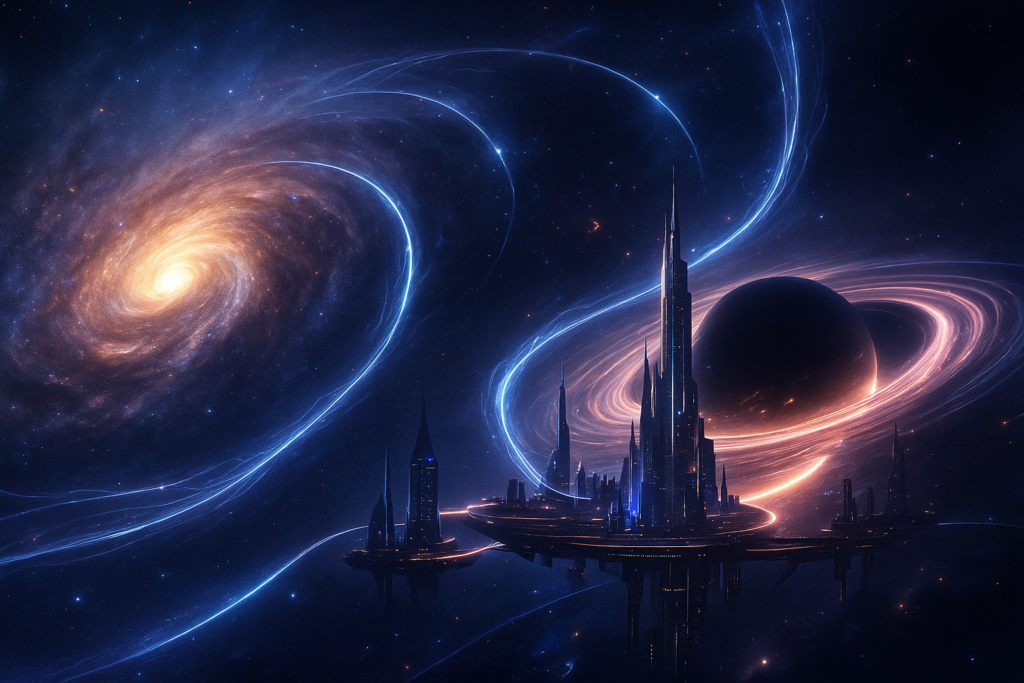
What Would a Type III Civilization Build?
Speculation is where imagination meets science.
If we imagine what such beings could build, the possibilities are beyond comprehension.
Some potential creations include:
- Galaxy-Wide Energy Webs:
Vast networks channeling power from every star to a central hub. - Black Hole Reactors:
Systems that feed matter into black holes to extract Hawking radiation for energy. - Stellar Transportation Systems:
Mechanisms that move stars to optimize galactic balance or prevent collisions. - Artificial Universes:
Simulations so detailed they contain conscious beings like us living unaware inside them. - Cosmic Libraries:
Archives encoded in the spin of particles, storing the collective knowledge of trillions of years.
Each of these achievements would redefine the word “civilization.”
They wouldn’t just inhabit the galaxy; they would become one with it.
Could Humanity Ever Reach Type III?
Theoretically, yes.
Practically, it’s a monumental challenge.
First, we must survive long enough to reach Type I.
That means stabilizing Earth, mastering renewable energy, and ensuring we don’t destroy ourselves with technology or warfare.
Next, we must learn to live among the stars.
Terraforming Mars, building Dyson Swarms, and expanding to nearby systems could move us toward Type II status.
That alone may take thousands of years.
To reach Type III, humanity would need to spread across the entire Milky Way colonizing billions of systems and merging consciousness with artificial intelligence.
It’s not impossible.
It’s just a matter of time and wisdom.
But maybe there’s another path.
Maybe intelligence doesn’t need to spread physically.
Perhaps it can evolve into a digital form that expands faster than light, using quantum computation to replicate itself across the universe instantly.
That could be our gateway to a higher type not through expansion, but through transformation.
The Philosophical Implications of Type III
The Kardashev Scale isn’t just about energy.
It’s about meaning.
Every leap up the scale requires not just science, but ethics, unity, and consciousness.
A species that reaches Type III must understand its role in the cosmic story.
Would such beings still care about art, love, or emotion?
Or would they transcend those concepts entirely, existing as pure logic?
Perhaps they would preserve the essence of all civilizations they’ve encountered a kind of eternal museum of souls.
In that sense, reaching Type III isn’t just a technological goal.
It’s a spiritual evolution.
It means understanding the universe not as a place to conquer, but as a canvas to harmonize with.
Maybe the universe itself is evolving through us toward that final state.
Type IV and Beyond: Theoretical Gods of Reality
While Kardashev only defined three types, later thinkers expanded the idea.
- Type IV civilizations would control the energy of an entire universe.
- Type V might manipulate multiple universes the multiverse itself.
- Some even suggest a Type Ω (Omega) civilization beings that have merged with the fabric of existence, becoming indistinguishable from reality itself.
At that point, “civilization” isn’t the right word anymore.
It’s more like a cosmic consciousness intelligence woven into the equations of space and time.
If such entities exist, they wouldn’t just observe reality they would be reality.
And perhaps, deep down, our own curiosity and creativity are fragments of that same infinite intelligence, reaching out through us, trying to know itself.
Lessons for Humanity from the Kardashev Scale
The Kardashev Scale isn’t just a fun theoretical tool.
It’s a mirror.
It shows us where we are and what we could become.
It reminds us of three essential truths:
- Energy is power, but wisdom is survival.
Without moral and ecological balance, technology destroys rather than uplifts. - Curiosity is the path forward.
Every great discovery begins with the question, “What if?” - Unity is essential.
No species reaches Type III through division.
It takes cooperation, empathy, and shared purpose.
Our challenge today is simple yet monumental:
Harness our planet’s energy responsibly.
Build sustainable systems.
And expand our awareness not just outward, but inward.
Maybe one day, when another civilization looks up into the night sky, they’ll see our galaxy glowing a silent beacon of intelligence, peace, and harmony.
And they’ll say:
“There that’s a Type III civilization. The ones who learned how to sculpt the stars.”
FAQ – Type III Civilizations and the Kardashev Scale
Q1: What is the Kardashev Scale?
It’s a theoretical framework that classifies civilizations based on their energy consumption: Type I (planetary), Type II (stellar), and Type III (galactic).
Q2: Where is humanity on the Kardashev Scale?
We’re currently around 0.73, meaning we harness less than 1/10 of Earth’s total energy potential.
Q3: What would a Type III civilization look like?
They’d control the energy of entire galaxies, likely existing as non-biological intelligence vast networks beyond our comprehension.
Q4: Could Type III civilizations already exist?
Possibly. They might be invisible to us because their technology appears as natural cosmic phenomena.
Q5: Can humans ever become a Type III civilization?
Theoretically yes, but it would take thousands or millions of years of progress, cooperation, and survival.
Beyond the Stars, Beyond Ourselves
The Kardashev Scale isn’t a competition it’s a journey.
Each level represents not just progress, but evolution in consciousness.
From burning fossil fuels to sculpting galaxies, every stage demands responsibility, imagination, and courage.
We may still be toddlers in the cosmic nursery, but one day if we survive our mistakes we might light up the stars ourselves.
When that happens, the universe will not just be something we live in.
It will be something we understand, shape, and love.
🔔 For more tutorials like this, consider subscribing to our blog.
📩 Do you have questions or suggestions? Leave a comment or contact us!
🏷️ Tags: Kardashev scale, Type III civilization, advanced civilizations, cosmic energy, Dyson sphere, Fermi paradox, humanity’s future, space exploration, astrophysics, galaxy technology
📢 Hashtags: #KardashevScale, #TypeIII, #Civilization, #CosmicEnergy, #SpaceExploration, #Astrophysics, #HumanFuture, #DysonSphere, #FermiParadox, #GalacticIntelligence
