


⏲️ Estimated reading time: 8 min
Table of Contents
The pistol shrimp is one of the most extraordinary creatures on Earth. With a claw that snaps so fast it creates a bubble hotter than the Sun’s surface, this tiny marine animal has stunned scientists for decades. Discover how it hunts, survives, communicates, and shapes underwater ecosystems.
The Astonishing World of the Pistol Shrimp
See also: Top 10 G-Shock Men’s Watches to Buy in 2026
The oceans hide many mysteries, but few animals are as surprising, powerful, and scientifically fascinating as the pistol shrimp. Known also as the snapping shrimp, this small crustacean has become famous for its unbelievable hunting strategy: it uses sound, pressure, and physics to kill or stun prey instantly.
At first glance, the pistol shrimp looks like many other small shrimp species colorful, compact, and quick. However, one claw is far larger than the other, and this asymmetrical design hides one of the most extraordinary biological weapons ever recorded in nature.
In this extended WordPress post, we explore everything that makes the pistol shrimp special:
how it lives, hunts, snaps, communicates, breeds, evolves, and interacts with other species.
We also break down the physics behind the snap, the cavitation bubble, and the extreme temperatures created for only a fraction of a second.
Prepare for a deep dive into one of nature’s smallest but loudest hunters.
The Unique Anatomy That Powers the Snap
The pistol shrimp’s entire biology is built around one thing: its snapping claw. While most shrimp use both claws equally, the pistol shrimp has one oversized claw shaped like a gun hammer.
This claw has two major components:
- A movable “hammer” (dactyl)
- A fixed “barrel” (propus)
When the shrimp pulls the hammer back and releases it, the claw slams shut with incredible speed. This closing motion doesn’t just create a loud sound it launches a jet of water so fast that it forms a physics phenomenon known as cavitation.
Why One Claw Is Huge
The enlarged claw can be nearly half the animal’s body length. Evolution favored shrimp that could snap louder and harder, allowing them to hunt more effectively and defend themselves.
If the claw is ever lost in a fight, the pistol shrimp has an incredible trick:
the small claw transforms into a large claw, and the lost claw grows back as the smaller one.
Nature has designed a perfect biological weapon that regenerates.
How the Pistol Shrimp Creates a Bubble Hotter Than the Sun
When the claw snaps, water moves at speeds up to 100 km/h (62 mph). This motion is so rapid that it creates a small pocket of low pressure. That pocket instantly collapses into itself, forming a cavitation bubble.
This bubble momentarily reaches temperatures up to 4,700°C (8,500°F) hotter than the Sun’s surface but only for billionths of a second.
The Shockwave
When the bubble collapses, it creates a shockwave powerful enough to:
- stun fish
- kill small prey
- break shells
- scare off predators
- generate light (sonoluminescence)
This shockwave produces the famous snap that gives the pistol shrimp its name.
The sound can reach 218 decibels, louder than a real gunshot and among the loudest sounds in the ocean.
How the Pistol Shrimp Hunts
The pistol shrimp is not a passive scavenger it is a true predator.
Step-by-Step Hunting Process
- The shrimp hides inside a burrow or coral structure.
- It detects movement using sensitive antennae that read vibrations.
- It approaches the prey quietly.
- It positions its claw like a gun.
- It snaps the claw, releasing the cavitation bubble.
- The shockwave stuns or kills the prey instantly.
- The shrimp drags the prey into its burrow to eat.
What the Pistol Shrimp Eats
Its diet includes:
- small fish
- crabs
- worms
- small shrimp
- plankton
- anything stunned by the cavitation shockwave
Although small, the pistol shrimp behaves like a top-level ambush predator in its micro-habitat.
The Pistol Shrimp’s Underwater Engineering
Pistol shrimp are expert architects. They build complex tunnel systems in sand or rubble. These burrows include:
- multiple escape exits
- airflow tunnels
- feeding chambers
- egg-protection areas
They dig using both their legs and their smaller claw. Once complete, the pistol shrimp spends most of its life inside the burrow, snapping at prey that gets too close.
A Fascinating Partnership: The Shrimp and the Goby Fish
One of the most extraordinary aspects of pistol shrimp behavior is its relationship with gobies.
This partnership is a perfect example of mutualism each species benefits the other.
What the Shrimp Provides
- Digging and maintaining the safe burrow
- Housing for both itself and the goby
What the Goby Provides
- Excellent vision
- Warning signals for approaching predators
The shrimp has poor eyesight, so it keeps one antenna touching the goby.
If danger approaches, the goby flicks its tail, warning the shrimp to hide instantly.
This cooperation has allowed both species to thrive in areas full of predators.
How the Pistol Shrimp Communicates
While many animals use sound to communicate, pistol shrimp use their snaps for multiple purposes:
- Hunting
- Defending territory
- Warning others
- Attracting mates
- Establishing dominance
In regions where many pistol shrimp live, their snapping creates an underwater “static noise” so strong that submarines detect it on sonar.
Entire coral reefs sometimes sound like frying bacon because of thousands of pistol shrimp snapping at once.
Species of Pistol Shrimp
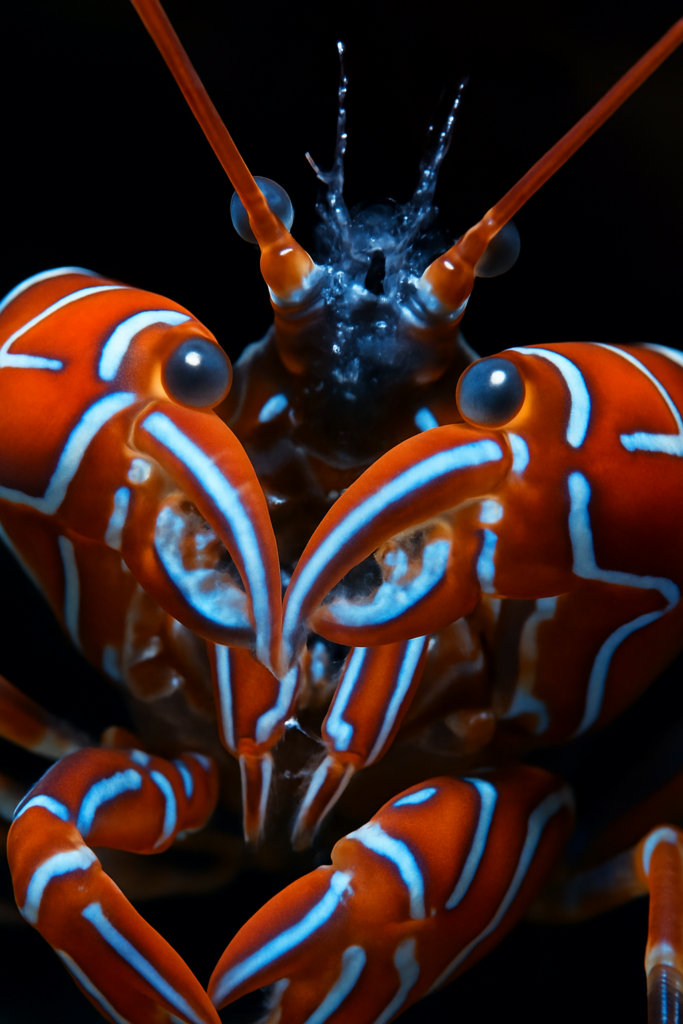
There are more than 600 species of snapping shrimp, each with unique colors and patterns. Some are plain brown, while others, like the one in your image, display bright orange, white, and blue patterns.
Well-known species include:
- Alpheus heterochaelis
- Synalpheus regalis
- Alpheus randalli
- Alpheus soror
Some species live in colonies inside sponges and act like underwater “armies.”
Social Behavior and Colony Life
Certain pistol shrimp species live in highly structured colonies, similar to bees or ants. They divide tasks into:
- workers
- defenders
- breeders
The defenders have the largest claws and protect the colony using their powerful snaps.
Scientists have recorded organized battles where colonies snap aggressively at invading groups.
Reproduction and Life Cycle
Pistol shrimp follow a typical crustacean reproductive cycle, but with some interesting behaviors.
Mating
Males court females by:
- snapping
- vibrating their bodies
- offering food
Females carry eggs under their abdomen and regularly clean and oxygenate them.
Larval Stage
Baby pistol shrimp hatch as tiny larvae floating in the water column. After several molts, they settle on the seafloor and begin burrow building.
Lifespan
Most pistol shrimp live between 3 and 6 years depending on water conditions.
Scientific Importance
Scientists study pistol shrimp not only for biology but also for physics.
Key Research Areas
- Cavitation physics
- Sonoluminescence
- Underwater acoustics
- Micro-fluid dynamics
- Regenerative biology
- Marine communication networks
Their snapping abilities help engineers design better underwater equipment and more efficient fluid dynamic systems.
Threats and Conservation
Although not endangered, pistol shrimp face environmental challenges:
- coral reef destruction
- polluted waters
- rising ocean temperatures
- invasive species
- increased sedimentation
Protecting coastal ecosystems naturally protects pistol shrimp populations.
Why the Pistol Shrimp Went Viral
This creature frequently appears in documentaries and viral videos because:
- It’s incredibly powerful for its size
- It uses physics as a weapon
- It produces light underwater
- It has a claw hotter than the Sun
- It forms adorable partnerships with goby fish
- It creates natural underwater “gunshots”
The shrimp in your image, with orange and white stripes, is one of the most visually striking species.
Frequently Asked Questions
What is a pistol shrimp?
A small marine shrimp known for producing powerful snaps that generate shockwaves strong enough to stun or kill prey.
How loud is the pistol shrimp snap?
Up to 218 decibels one of the loudest sounds produced by any animal.
Can pistol shrimp hurt humans?
No. Their snap is dangerous only to small marine animals.
Why does the claw get so hot?
The rapid collapse of the cavitation bubble temporarily creates extreme heat and light.
Do pistol shrimp live alone?
Some do, while others form colonies or live with goby fish partners.
Disclaimer and Source Hygiene
This post is written for educational purposes using reliable scientific sources, marine biology research, and documented observations. No copyrighted materials were copied. All explanations are original, neutral, and informational.
🔔 For more tutorials like this, consider subscribing to our blog.
📩 Do you have questions or suggestions? Leave a comment or contact us!
🏷️ Tags: pistol shrimp, snapping shrimp, marine biology, ocean creatures, underwater physics, cavitation bubble, goby fish partnership, sea predators, ocean science, wildlife facts
📢 Hashtags: #pistolshrimp, #snappingshrimp, #marinebiology, #oceanlife, #sealife, #underwaterworld, #wildlifeeducation, #sciencefacts, #oceancreatures, #naturepower
A Final Look at Nature’s Tiny Superweapon
The pistol shrimp proves that size is irrelevant in nature when evolution provides the right tools. Through physics, pressure, and biological innovation, this small creature dominates its environment, creates underwater shockwaves, and demonstrates one of the most extraordinary survival systems in the animal kingdom.
