

⏲️ Estimated reading time: 9 min
Table of Contents
King Leopold’s Congo Atrocities: The Photo That Changed History
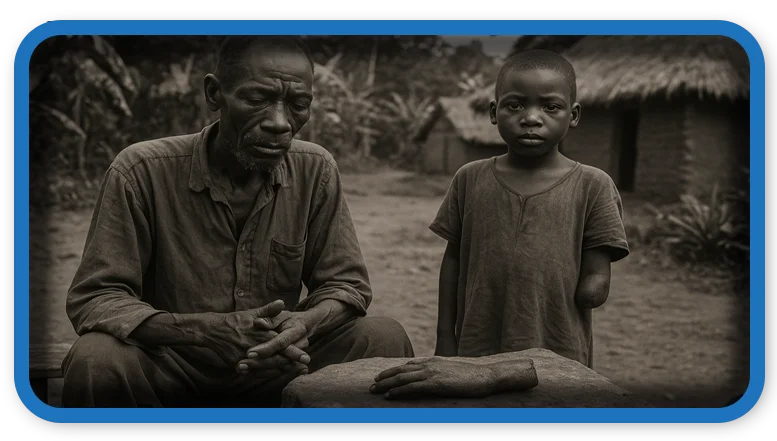
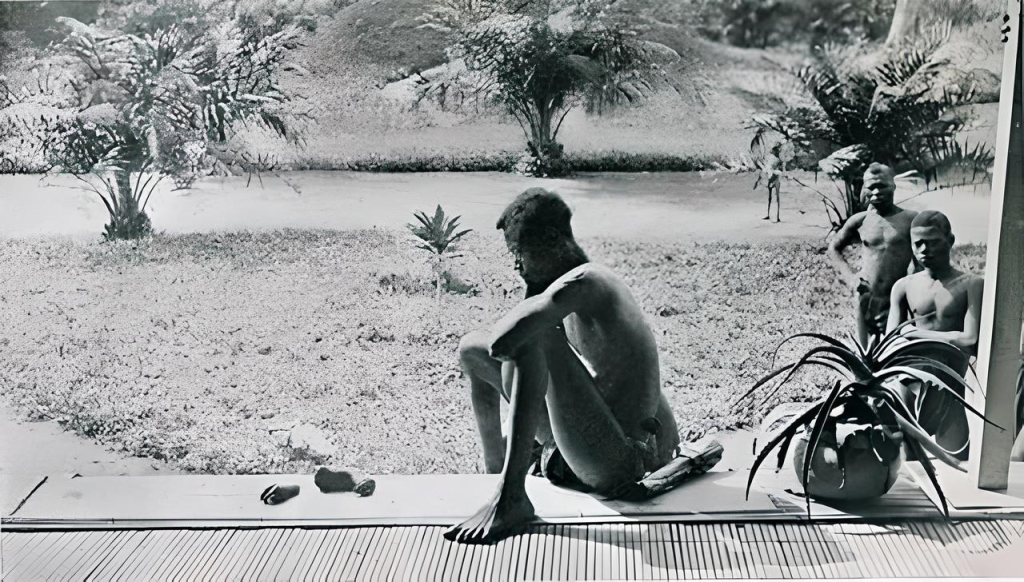
In 1904, a heartbreaking photograph captured by missionary Alice Seeley Harris exposed the brutal reality of King Leopold II’s Congo Free State. The image, showing a father mourning over his daughter’s severed hand and foot, sparked global outrage and helped dismantle one of the most violent colonial regimes in history.
The Photo That Exposed a Hidden Empire of Violence
A World Confronted by a Single Image
In the early 1900s, few Europeans understood what was happening deep in Central Africa. Reports circulated, but they were usually dismissed as exaggerations, misunderstandings, or even anti-Belgian propaganda. It wasn’t until 1904 that the truth became impossible to ignore.
Alice Seeley Harris, a British missionary armed with a simple Kodak camera, captured one of the most haunting images in the history of photojournalism: a Congolese father named Nsala, sitting alone on a verandah, staring in frozen grief at the severed hand and foot of his five-year-old daughter, Boali.
The photograph became a turning point in global consciousness. It shattered the illusion of benevolent European colonialism and exposed a system built on forced labor, brutality, and terror. This one image revealed the horrifying reality behind King Leopold II’s personal rule of the Congo Free State a regime responsible for what many historians describe as one of the largest genocides in modern history.
Understanding King Leopold’s Congo Free State
A Personal Empire Masquerading as Humanitarianism
To understand what the photo represented, we must understand the man behind the atrocities: King Leopold II of Belgium.
Leopold was not content to rule a small European nation. Obsessed with wealth and international prestige, he wanted a colony not for Belgium, but for himself. Through elaborate manipulation, false humanitarian language, and political maneuvering, he convinced the great powers of Europe at the Berlin Conference of 1885 to allow him private ownership of a territory 80 times the size of Belgium.
He called it the Congo Free State, claiming he would bring civilization, commerce, and Christianity. In reality, he created a vast forced-labor system designed to extract rubber and ivory on a scale never seen before.
The Rubber Boom and the Machinery of Exploitation
The late 19th century saw global demand for rubber skyrocket due to bicycles, automobiles, telegraph cables, and industrial expansion. Congo’s forests provided a natural source of wild rubber vines and Leopold saw an opportunity to enrich himself.
He imposed impossible rubber quotas on local villages. Every able-bodied man was forced into the forest to collect rubber for weeks at a time. Those who resisted, failed to gather enough, or attempted escape faced brutal punishments.
How the System of Terror Operated
The Force Publique: Leopold’s Private Army
To enforce these quotas, Leopold created the Force Publique, a militarized force commanded by Belgian officers but largely composed of conscripted Africans.
This military machine had one purpose: terrorize the population into compliance.
It did so through:
- hostage-taking (often women and children),
- village burnings,
- executions,
- public torture,
- and widespread mutilation.
Why Hands Were Severed The Logic of Colonial Violence
Severed hands became iconic symbols of Leopold’s Congo. But many people misunderstand why the practice developed.
There were three main reasons:
1. Proof of Bullets Used “Correctly”
Leopold’s officials monitored bullets obsessively. Each bullet fired by a soldier had to be “accounted for.”
To prove a bullet had killed someone and wasn’t used for hunting, soldiers were required to return with a severed human hand. This grotesque bureaucracy encouraged widespread mutilation even of living victims.
2. Punishment for Rubber Shortages
Failing to meet rubber quotas could result in violent collective punishments. Hands were cut off as a warning to others.
3. Psychological Warfare
Hands functioned as symbols of power and terror. The act transformed communities into populations ruled by fear, not law.
This horrifying practice became so widespread that even some Belgian officials quietly protested. But Leopold refused to change a profitable system.
The Photograph That Sparked Global Outrage
Alice Seeley Harris: A Pioneer of Human Rights Photography
Alice Seeley Harris was not a journalist by trade. She arrived in the Congo as a missionary with her husband John, intending to teach, support communities, and preach. Instead, she found herself witnessing scenes of unimaginable cruelty.
Using her Kodak camera, she began documenting:
- mutilated survivors,
- destroyed villages,
- chained hostages,
- and the haunting consequences of quota enforcement.
Her image of Nsala became the defining symbol of the Congo Free State atrocities.
The Story of Nsala and His Daughter Boali
Nsala had returned from rubber collection when he discovered that Force Publique soldiers had raided his village. His wife and daughter were held hostage because the village hadn’t met its quota. In retaliation, soldiers murdered little Boali, cut off her hand and foot, and delivered them to her father in a basket.
Alice photographed him at the exact moment he sat, powerless, staring at the remains of his beloved child.
The image traveled the world, transforming distant rumors into undeniable truth.
See also: How to Fix Received Discarded Packets in Windows 11
How the World Responded
From Local Witness to Global Campaign
When the photograph reached Europe and the United States, it ignited mass outrage. It was displayed:
- in churches,
- at public rallies,
- in newspapers,
- in political meetings,
- and through lantern-slide lectures attended by thousands.
Refusing to let the world look away, activists launched what became the first major international human rights movement.
The Congo Reform Association
Led by British activist E.D. Morel and Irish diplomat Roger Casement, the Congo Reform Association (CRA) used the photos to expose Leopold’s crimes. Their work included:
- books,
- pamphlets,
- parliamentary debates,
- rallies,
- international petitions,
- and ongoing photo exhibitions.
Alice Seeley Harris toured extensively, showing her photographs to horrified audiences who demanded political action.
The Collapse of Leopold’s Personal Rule
Under immense global pressure, Belgium forced Leopold to cede the Congo Free State to the Belgian government in 1908.
Although Belgian colonialism remained harsh and highly exploitative, it ended Leopold’s direct reign and its extreme systemic brutality.
The Human Cost: A Lost Generation
How Many Died?
Although exact numbers are impossible to determine, most historians estimate 8 to 10 million Congolese died due to forced labor, starvation, disease, and violence during Leopold’s 23-year rule.
This makes it one of the deadliest colonial enterprises in history.
Cultural and Social Devastation
Beyond deaths, entire communities were:
- displaced,
- destroyed,
- traumatized,
- or forced into cultural collapse.
Traditional political structures weakened or disappeared. Languages, practices, and oral histories were lost.
The psychological wounds of this period shaped generations.
Why This History Still Matters
A Warning from the Past
The severed hand photograph is not merely a historical artifact it is a warning. It demonstrates what can happen when:
- absolute power goes unchecked,
- profit becomes a justification for dehumanization,
- and colonialism masks itself as philanthropy.
The Power of Photography in Human Rights Advocacy
Alice Seeley Harris proved that images can change the world.
Her work pioneered:
- documentary photography,
- investigative journalism,
- visual activism,
- and the idea of moral witness.
Today’s human rights movements from Darfur to Aleppo follow the path she helped carve.
Frequently Asked Questions
1. Who was Nsala, the man in the famous photo?
Nsala was a Congolese villager whose daughter, Boali, was killed by Force Publique soldiers after the village failed to meet rubber quotas. Her severed hand and foot were presented to him as punishment.
2. Why did soldiers cut off hands in the Congo Free State?
The practice served as proof that bullets were used “properly,” as punishment for rubber shortages, and as a tool of psychological terror.
3. How many people died under King Leopold’s rule?
Historians estimate 8–10 million deaths from forced labor, starvation, disease, and violence.
4. Who exposed the atrocities?
Missionaries like Alice Seeley Harris, activists such as E.D. Morel, and officials like Roger Casement played central roles in exposing the crimes.
5. Did Belgium apologize for the Congo Free State?
As of today, Belgium has acknowledged colonial abuses but has not issued a full formal apology for the atrocities under Leopold II.
6. Was Belgian rule after 1908 better?
While less openly brutal than Leopold’s private regime, Belgian colonial rule remained exploitative and racially hierarchical.
7. Why is the severed hand photo so important?
Because it forced the world to confront undeniable evidence of atrocity, helping dismantle Leopold’s brutal system.
8. Why is this history sometimes ignored?
Many European education systems downplay colonial violence. Only recently have these events received broader academic and public attention.
Echoes of Memory: A Final Reflection
The story of King Leopold’s Congo is a dark chapter, but one that must be remembered with clarity and honesty. The image of Nsala mourning his child stands as a symbol not only of suffering but also of resistance a cry that reached across oceans and changed the course of history.
By studying this photograph and the atrocities behind it, we carry forward the voices of those who suffered and ensure that their pain is not erased. The past becomes meaningful only when it teaches us to build a more just future.
Disclaimer and Source Hygiene
This article is based on historical research, academic publications, archival photographs, and documented testimonies. It should not replace specialized historical consultation. For academic or professional use, refer to primary sources and peer-reviewed research.
🔔 For more tutorials like this, consider subscribing to our blog.
📩 Do you have questions or suggestions? Leave a comment or contact us!
🏷️ Tags: King Leopold II, Congo Free State, colonial atrocities, African history, Alice Seeley Harris, rubber trade, human rights violations, Force Publique, genocide history, photojournalism
📢 Hashtags: #CongoHistory, #KingLeopold, #ColonialAtrocities, #HumanRights, #AfricaHistory, #Photojournalism, #HistoricalTruth, #NeverForget, #DocumentaryPhotography, #WorldHistory
